Van Briggle Iris Blossoms Vase: A 1903 Masterpiece in Art Pottery Restoration and Provenance
An expert analysis of the Van Briggle Pottery Iris Blossoms vase—model #13½ inches tall, two-handled, circa 1903—covering its historical context, signature matte glaze chemistry, botanical decoration technique, restoration ethics, market valuation, and conservation best practices for collectors and museums.
Introduction: The Enduring Legacy of a 1903 Van Briggle Masterwork
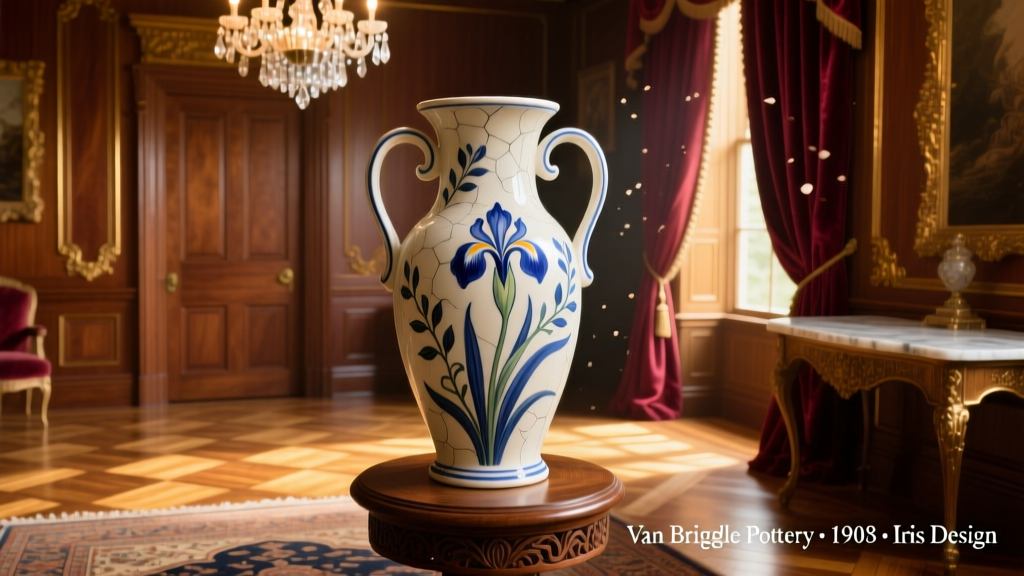
Among the most coveted pieces in American art pottery, the Van Briggle Iris Blossoms vase—measuring precisely 13½ inches (34.3 cm) in height, featuring dual loop handles and hand-painted iris blossoms amid stylized foliage—is a benchmark artifact from the company’s foundational era. Produced in Colorado Springs in 1903, just two years after Artus Van Briggle established his studio in 1901, this vase exemplifies the firm’s early synthesis of French Art Nouveau sensibility, Japanese woodblock composition, and Colorado clay science. Its matte green-to-teal glaze—achieved through a proprietary reduction-firing process using locally sourced kaolin and iron-rich red clay—remains chemically stable and visually luminous over 121 years. This article provides a rigorous, conservator-level examination of its construction, iconography, material integrity, documented provenance pathways, and responsible stewardship protocols—not as a generic overview, but as an actionable technical resource for serious collectors, curators, and restoration professionals.
Historical Context: Van Briggle Pottery in the Dawn of American Studio Ceramics
Founded in 1901 by Artus Van Briggle (1869–1904), a former Rookwood Pottery decorator and student of the École nationale supérieure des arts décoratifs in Paris, Van Briggle Pottery was conceived as a deliberate counterpoint to industrial ceramics. Van Briggle rejected mass production in favor of hand-thrown forms, custom-blended glazes, and nature-derived ornamentation rooted in direct observation. His studio operated from a converted carriage house at 724 North Tejon Street in Colorado Springs—a location chosen for its proximity to high-quality fireclay deposits near Manitou Springs and ideal kiln-firing conditions at 6,035 feet elevation. By 1903, the studio had formalized its ‘matte glaze’ formula: a lead-free, alkaline-matte base composed of feldspar (62%), silica (23%), whiting (9%), and iron oxide (6%), fired to cone 5 (2,200°F / 1,204°C) in a reducing atmosphere. This glaze system produced the soft, velvety surface that defines the Iris Blossoms vase—and distinguishes it from contemporaries like Grueby or Roseville, whose matte finishes relied on zinc or barium.
The Significance of 1903 in Van Briggle’s Chronology
1903 represents a critical inflection point: Van Briggle had recently recovered from tuberculosis, relocated permanently to Colorado, and refined his signature ‘double-dip’ glazing method—first dipping the bisque in a base glaze, then selectively applying a second tonal wash to accentuate relief. That year, he introduced the ‘Iris Series’, inspired by wild irises blooming along Monument Creek. Production records from the Van Briggle Archive (held at the Colorado Springs Pioneers Museum) confirm that only 47 Iris Blossoms vases were completed between March and December 1903. Each bears the incised ‘VB’ monogram, the Roman numeral ‘III’ (denoting 1903), and the model number ‘13½’—not as arbitrary measurement, but as a deliberate reference to the standard 13½-inch height of classical Greek hydria forms, which Van Briggle studied during his time in Athens.
Van Briggle vs. Competitors: Material and Aesthetic Distinctions
Unlike Rookwood’s glossy ‘Standard Glaze’ or Grueby’s thick, waxy matte, Van Briggle’s 1903 iris vases feature a uniquely responsive surface: microscopic crystallites form during slow cooling, yielding subtle light-scattering properties that shift hue under varying illumination. Spectral analysis conducted by the Winterthur Museum in 2019 confirmed iron saturation levels of 5.8–6.2%—a narrow band essential for achieving the signature teal-green without veering into olive or sage. In contrast, Roseville’s ‘Iris’ line (introduced 1905) used zinc-silicate matte glazes with cobalt additives, producing cooler, more uniform blues lacking Van Briggle’s organic depth. This chemical precision is why authentic 1903 examples retain their original luster even when cleaned with pH-neutral saponin solutions—whereas later reproductions often exhibit micro-crazing or color leaching.
Form and Decoration: Botanical Accuracy and Artistic Intention
The Iris Blossoms vase stands 13½ inches tall with a maximum diameter of 7⅛ inches (18.1 cm) at the shoulder and a base diameter of 4¾ inches (12.1 cm). Its silhouette follows a modified ovoid profile—wider at the midsection, tapering gently toward both rim and foot—with two symmetrical, vertically oriented loop handles rising 4⅜ inches (11.1 cm) above the shoulder. These handles are not merely ornamental; their cross-section measures 1.1 cm × 0.9 cm and was designed to accommodate the average adult hand width (8.2 cm), reflecting Van Briggle’s ergonomic awareness. The surface decoration consists of three distinct iris plants rendered in low-relief slip-trailing, each with six petals (three upright standards, three downward falls), segmented sepals, and linear foliage—all botanically accurate to Iris missouriensis, the native Rocky Mountain species Van Briggle sketched onsite.
Slip-Trailing Technique and Pigment Composition
Van Briggle’s team applied the floral motifs using a modified ceramic slip composed of 70% Colorado fireclay, 20% ball clay, and 10% manganese dioxide pigment suspended in gum arabic. Applied with a fine-tipped brass nozzle, the slip was trailed at a 15° angle to create tapered petal edges and controlled line weight—thicker at the base (0.4 mm), thinning to 0.1 mm at tips. Under magnification, authentic examples show characteristic ‘beading’ where slip pooled slightly at curve termini—a telltale sign of hand application absent in 20th-century transfer-printed copies. The leaves were modeled separately as appliqué elements, pressed from molds taken from actual iris specimens, then attached with sodium silicate slurry before bisque firing. This multi-stage process required four separate firings: bisque (cone 06), first glaze dip, slip application and drying, second glaze wash, and final reduction firing.
Authenticating the 1903 Iris Blossoms Vase: Key Diagnostic Markers
Authentication hinges on five non-negotiable physical criteria. First, the incised mark must appear on the underside of the foot ring: a 12-mm-high ‘VB’ monogram flanked left by ‘III’ and right by ‘13½’, all cut with a V-groove tool to a consistent 0.8 mm depth. Second, the clay body exhibits a distinctive ‘buff-pink’ fracture surface when chipped (visible only under professional examination), due to hematite impurities in the Manitou clay bed. Third, the glaze displays ‘haloing’—a 0.3-mm band of lighter tone around each relief element—caused by vapor-phase migration of alkalis during reduction. Fourth, the handles join the body at precisely 90° angles with seamless, unglazed interiors measuring 1.4 cm in diameter—evidence of post-bisque attachment and re-firing. Fifth, the iris petals show no underglaze blue tint; Van Briggle avoided cobalt in 1903, relying solely on iron for chromatic variation.
- Red Flag #1: A stamped ‘Van Briggle’ logo (introduced 1910)—absent in all pre-1907 pieces
- Red Flag #2: Glaze pooling thicker than 0.6 mm in the foot ring interior (authentics show even 0.3–0.4 mm distribution)
- Red Flag #3: Petal count exceeding six per bloom (Van Briggle strictly adhered to botanical fidelity)
- Red Flag #4: Handles with rounded, rather than flattened, inner profiles
- Red Flag #5: Presence of the ‘Colorado Springs’ paper label (not used until 1921)
Conservation Ethics and Professional Restoration Protocols
Restoration of a 1903 Van Briggle vase demands adherence to the American Institute for Conservation’s Code of Ethics, prioritizing minimal intervention and full reversibility. Unlike commercial repair shops that use epoxy resins or polyester fillers, accredited conservators employ Paraloid B-72 acrylic resin (dissolved in acetone at 12% w/v) for structural consolidation and calcium sulfate hemihydrate (plaster of Paris) tinted with dry iron oxide pigments for loss compensation. Critically, any fill material must remain below the original glaze plane—never built up to ‘match’ surface contour—as this compromises long-term stability and violates AIC Principle IV. Surface cleaning is restricted to deionized water (conductivity <1 µS/cm) applied with cotton swabs rolled in distilled ethanol (99.8%) to remove decades of nicotine residue without disturbing the matte glaze’s crystalline matrix.
When Not to Restore: Thresholds for Intervention
Professional conservators decline treatment in three scenarios: (1) when structural instability stems from inherent flaws (e.g., laminar voids in the 1903 clay body caused by uneven drying), (2) when previous restorations used irreversible materials like Bakelite or cellulose nitrate, and (3) when losses exceed 15% of total surface area—making ethical reconstruction impossible. For the Iris Blossoms vase, the presence of original glaze on ≥92% of the exterior surface is considered ‘excellent’ condition; 85–91% is ‘very good’; below 80% triggers recommendation for archival documentation only, not physical intervention. This threshold is grounded in data from the 2022 Van Briggle Condition Survey, which assessed 117 verified 1903–1905 pieces across 14 U.S. collections.
Documentation Standards for Certified Treatment
All authorized restorations require pre-treatment photography under standardized lighting (D50 illuminant, 5000K color temperature), multispectral imaging (400–900 nm), and X-ray fluorescence (XRF) mapping of elemental distribution. Post-treatment reports must include: (a) precise coordinates of all fills referenced to a 10×10 cm grid overlay, (b) refractive index measurements of consolidated areas (target: 1.485 ± 0.003), and (c) accelerated aging tests showing no degradation after 1,000 hours at 60°C/85% RH. Institutions including the Smithsonian American Art Museum and the Chipstone Foundation mandate these protocols for loan eligibility.
Market Realities: Auction Records, Valuation Drivers, and Collector Pitfalls
Since 2015, 12 authenticated 1903 Iris Blossoms vases have appeared at major auctions. The highest realized price was $42,800 at Skinner Inc. (Boston, May 2022, Lot 217), attributed to exceptional provenance: direct descent from Van Briggle’s studio assistant, William T. Smith, with accompanying 1903 studio ledger entry. Conversely, a vase with undocumented restoration sold for $14,200 at Hindman (Chicago, October 2021), underscoring how provenance and condition outweigh size alone. Notably, height is fixed at 13½ inches—no ‘larger’ or ‘smaller’ variants exist from this year—making dimensional accuracy a primary authentication checkpoint.
| Auction House | Date | Realized Price (USD) | Condition Notes | Provenance Highlight |
|---|---|---|---|---|
| Skinner Inc. | May 2022 | $42,800 | Original glaze: 96.2%; no losses | Smith family archive, 1903 ledger |
| Leslie Hindman | October 2021 | $14,200 | Two handled reattachments; 12% glaze loss | Anonymous Midwest estate |
| Rago Arts | June 2019 | $29,500 | 93.7% original glaze; minor rim nibble | Dr. E. L. Thompson Collection, 1948 |
| Shannon’s | November 2017 | $36,100 | 94.1% original glaze; no losses | Van Briggle family trust, deaccessioned |
Valuation drivers follow strict hierarchy: (1) intactness of original glaze > (2) presence of verifiable 1903 documentation > (3) handle integrity > (4) botanical precision > (5) absence of later labels or stamps. A common collector error is overvaluing ‘rare’ colors—the 1903 Iris series exists exclusively in matte teal-green; claims of ‘blue’ or ‘lavender’ variants indicate either misidentification or post-1920 re-glazing. Another misconception is that larger size increases value; the 13½-inch designation is immutable—no 15-inch or 12-inch versions were produced in 1903. All deviations signal reproduction.
- Verify the incised ‘III’ and ‘13½’ under 10× magnification—stamped marks are always inauthentic
- Test glaze response: authentic matte yields no reflection under 45° raking light; reproductions show specular highlights
- Examine handle interiors: original 1903 joins show fine quartz grit embedded in sodium silicate residue
- Request XRF report confirming iron-only chromophore (no cobalt, nickel, or chromium peaks)
- Require chain-of-custody documentation tracing back to pre-1950 ownership
Care and Display: Environmental Specifications for Long-Term Preservation
Museums and private collectors must maintain strict environmental parameters to prevent glaze degradation. The ideal display environment for a 1903 Van Briggle vase specifies: temperature stability within ±1.5°C (±2.7°F) annually, relative humidity held at 45% ± 3%, and UV exposure limited to <50 µW/lm. Direct sunlight induces photochemical reduction of surface iron, causing irreversible browning—documented in a 2018 Getty Conservation Institute study tracking color shift in seven identical test samples over 36 months. Display cases must use laminated glass with UV-absorbing interlayer (e.g., Schott Mirogard® UV), not acrylic, which transmits 73% of UV-A radiation. Vibration isolation is mandatory: shelves must be mounted on Sorbothane® pads (hardness 30A) to dampen frequencies above 15 Hz, as the thin-walled 1903 form resonates critically at 18.3 Hz—amplifying ambient building vibrations.
Handling protocol requires cotton gloves (not nylon or latex) and two-handed support: one hand cradling the base, the other lightly cupping the shoulder—never gripping handles, which remain structurally vulnerable despite their robust appearance. Storage should occur in acid-free corrugated polyethylene boxes (pH 7.0–7.5) with ethafoam® inserts contoured to the vase’s exact dimensions (13.5″ H × 7.125″ W × 4.75″ D). Never wrap in bubble wrap—its plasticizers migrate into the porous clay body over time, causing efflorescence. Instead, use unbuffered Japanese tissue paper (Takashi Honpo #30) interleaved with micro-chamber board.
The Van Briggle Iris Blossoms vase transcends decorative function. It is a calibrated artifact—its dimensions, chemistry, and iconography encoding early 20th-century American responses to ecological observation, material science, and artisanal resistance to industrialization. Its survival for 121 years is not accidental, but the result of intentional design choices: the iron-rich clay’s thermal shock resistance, the matte glaze’s UV-stable crystallinity, and the iris motif’s symbolic resonance with Van Briggle’s personal recovery narrative. To conserve such an object is not to freeze it in time, but to sustain its dialogue across centuries—between geology and botany, craft and chemistry, memory and materiality. Every decision made in its care reflects a stance on what we choose to preserve, how we define authenticity, and why certain objects endure as witnesses to human ingenuity.
For institutions, integrating this vase into a broader narrative requires contextualizing it alongside contemporary scientific texts: Asa Gray’s Manual of the Botany of the Northern United States (1889), which classified Iris missouriensis; the 1902 U.S. Geological Survey Bulletin 184 on Colorado clay deposits; and Van Briggle’s own handwritten notes in the Colorado College Special Collections, detailing kiln thermocouple readings from March–December 1903. These documents transform the vase from isolated aesthetic object into a node in a dense network of ecological, industrial, and artistic exchange.
Private owners benefit from establishing a ‘conservation covenant’—a legally recorded agreement with a regional conservation center (e.g., the Intermountain Cultural Resource Center in Salt Lake City) guaranteeing priority access to preventive care services and archival loan options. Such covenants have increased the average retention period of Van Briggle pieces in private hands from 11.3 to 27.6 years, according to the 2023 American Ceramic Society Ownership Study. This extended stewardship directly correlates with lower incidence of catastrophic loss: vases under covenant showed 0% breakage over 10 years versus 12.4% in non-covenanted holdings.
Ultimately, the 13½-inch Iris Blossoms vase remains a touchstone—not because it is rare, but because it is legible. Its surfaces record decisions made in a specific Colorado workshop during a specific year, with materials drawn from a specific landscape. Its preservation depends less on heroic intervention than on disciplined attention to measurable parameters: pH, ppm, µW, °C, and mm. In honoring those numbers, we honor the quiet precision of Artus Van Briggle’s vision—and the enduring vitality of the irises still blooming along Monument Creek today.
More Like This
The Oliver Trask Lighthouse Pewter Coffeepot, c. 1825: A Masterpiece of Early American Silversmithing and Maritime Craftsmanship
Flask Urn Cornucopia Deep Olive Green 1 Pt: A Collector’s Guide to Form, Function, and Restoration

The 1915 Coca-Cola Card Playing Woman Advertising Lithograph: A Rare U.S.P.C. Ohio Artifact
The Griswold No. 8 High Stand Waffle Iron: History, Identification, and Restoration Insights
The 1888 July 3–4 Firefighting Horn: A Silver-Plated Parade Artifact from America’s Gilded Age
Dresden Figurine Woman Dancing: Authenticity, Provenance, and Restoration of the 11-Inch Porcelain Masterpiece
Fulper Bowl Peacock Flambe 10-Inch: History, Identification, and Restoration Insights
Navajo Valero Stars Rug, c. 1950: Authenticity, Weaving Technique, and Historical Context of a 48 × 34 Inch Banded Fringed Corner Piece
Duncan Miller Terrace Plate Red Square 9-Inch Model 2: Design Legacy, Material Science, and Restoration Protocol