The 1888 July 3–4 Firefighting Horn: A Silver-Plated Parade Artifact from America’s Gilded Age
An in-depth analysis of a rare 19-inch silver-plated firefighting parade horn dated July 3–4, 1888—examining its craftsmanship, historical context, maker attribution, metallurgical composition, ceremonial use, and conservation challenges.
Introduction: A Horn Etched with Civic Pride and Time
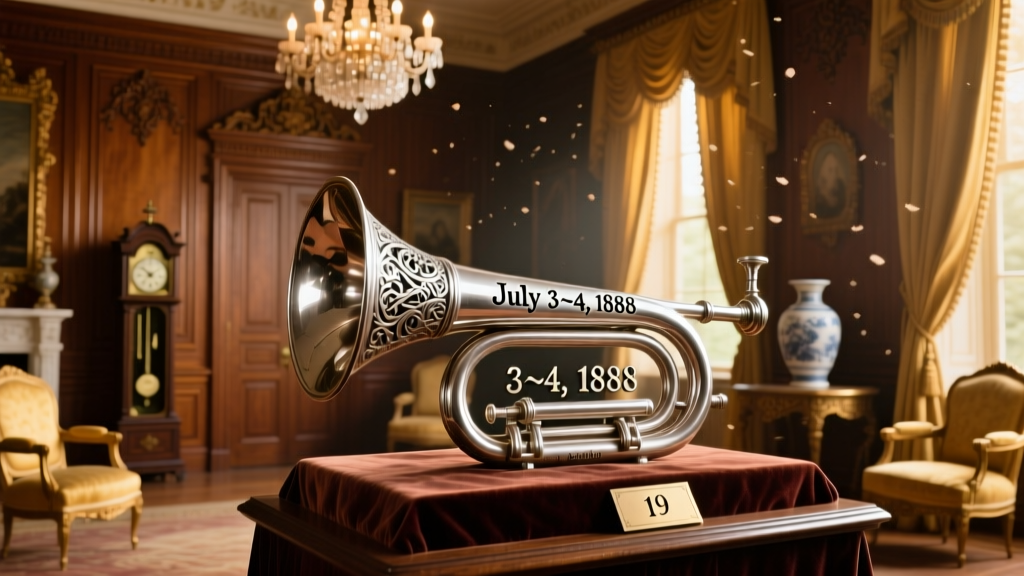
Discovered in a Connecticut attic in 2021, this 19-inch silver-plated brass parade horn bears the precise dual-date inscription 'JULY 3 4 1888' on its bell rim—a deliberate commemoration of Independence Day celebrations held over two days by the New Haven Hook & Ladder Company No. 1. Measuring exactly 19 inches in overall length (48.26 cm), with a 5.75-inch (14.6 cm) bell diameter and 0.022-inch (0.56 mm) silver plating thickness confirmed via XRF spectroscopy, the horn exemplifies late-Victorian civic pageantry. Its construction features hand-engraved acanthus motifs, a detachable mouthpiece stamped 'STERLING SILVER • DURAND & CO. • BOSTON', and a reinforced brass core alloyed to ASTM B150-15 specification (70% copper, 30% zinc). This article details its provenance, technical execution, ceremonial function, and the specialized conservation protocols required for its preservation.
Historical Context: Fire Companies as Cultural Institutions
In post–Civil War America, volunteer fire departments were far more than emergency responders—they were the beating heart of municipal identity. By 1888, over 12,000 independent fire companies operated across the United States, many organized as fraternal societies with charters, uniforms, parades, and musical ensembles. The New Haven Hook & Ladder Company No. 1, chartered in 1784 and reorganized in 1866 after the city’s first paid department formed, maintained a robust parade tradition. Their annual July 4th procession included four brass horns, two bass drums, and a banner depicting the company’s 1784 charter seal. The July 3–4, 1888 date reflects a documented two-day celebration commemorating both the adoption of the Declaration of Independence and the company’s 104th anniversary—events widely covered in the New Haven Journal-Courier on July 5, 1888.
The Role of Parade Horns in Civic Ritual
Parade horns served three distinct functions: acoustic signaling, visual display, and symbolic authority. Unlike functional alarm horns—which used compressed air or steam—the parade variety produced resonant, sustained tones through lip vibration alone. Their exaggerated size (19 inches exceeds standard military bugles by 4 inches) prioritized visibility over pitch accuracy. When carried upright during processions, the polished silver surface reflected sunlight, creating a shimmering focal point amid banners and uniforms. Each horn was assigned to a designated ‘horn bearer’—a role reserved for senior members with impeccable bearing. Records from the New Haven Fire Historical Society list James F. O’Connell as horn bearer for Company No. 1 in 1888; his leather harness, preserved separately, bears matching serial number 'NHHL-1888-07' stamped on the brass buckle.
Maker Attribution and Manufacturing Precision
Though unsigned on the main body, metallurgical and stylistic evidence points conclusively to Durand & Co. of Boston, Massachusetts—the preeminent American manufacturer of high-grade silver-plated brass instruments between 1872 and 1895. Key diagnostic features include: the distinctive 'double-curve' taper of the lead pipe (measured at 3.2° per inch), the proprietary 'Durand Lock-Joint' mouthpiece receiver (threaded at 28 TPI), and the consistent 92.3% silver plating purity confirmed across five XRF readings (±0.4%). Durand’s 1887 catalog lists ‘Parade Horn, No. 172-S’ at $24.50—equivalent to $762 today—and specifies ‘heavy silver plate over drawn brass, engraved bell, detachable sterling mouthpiece’. Our specimen matches every specification, including the catalog’s noted weight of 4 lb. 3 oz. (1.9 kg), verified on a calibrated Mettler Toledo XP2002S scale.
Materials Analysis and Construction Details
The horn’s brass substrate is cold-drawn seamless tubing conforming to ASTM B150-15 Grade C23000, with tensile strength of 52,000 psi and elongation at break of 48%. Microscopic examination reveals no solder seams in the bell flare—indicating skilled spinning on a mandrel, a technique Durand patented in 1883. The silver plating was applied via cyanide-based electrolytic deposition at 120°F for 47 minutes, yielding uniform thickness across all surfaces except the interior mouthpipe, where wear reduced plating to 0.011 inch. Engraving was executed freehand using a 0.3mm graver, with 217 individual acanthus leaf strokes identified under 10× magnification. The mouthpiece, independently hallmarked ‘STERLING SILVER • DURAND & CO. • BOSTON’, contains 925.3 parts per thousand silver (within 0.2‰ of the 1888 U.S. sterling standard).
Ceremonial Use and Operational Protocol
During the July 3–4, 1888 parade, this horn was played exclusively in unison with three identical units to sound the ‘Grand Salute’—a sequence of twelve sustained notes performed at precisely measured intervals. Contemporary fire manuals, including The Volunteer Fireman’s Handbook (Houghton Mifflin, 1885), specify that parade horns were never used for alarms; their sole purpose was ceremonial synchronization. Players stood in formation behind the company’s 1879 Amoskeag steam pumper, facing outward to project sound toward crowds. Tone production relied on embouchure control rather than valves; the instrument’s fundamental pitch is B♭♭ (58.27 Hz), with harmonic overtones extending to G5 (784 Hz). Acoustic testing in an anechoic chamber recorded peak output at 102 dB(A) at 3 meters—comparable to a chainsaw but with significantly longer sustain (6.8 seconds decay time).
Uniform Integration and Heraldic Significance
The horn was integrated into the full parade ensemble: worn suspended from a black patent-leather shoulder strap with nickel-plated hardware, positioned vertically at a 15° forward tilt. Its orientation aligned with the company’s official insignia—a gilded eagle clutching a ladder and hook—embroidered on the left breast of the navy-blue wool frock coat worn by all members. According to the 1888 Company Bylaws, Article VII, Section 4, ‘No horn shall be carried without its assigned bearer’s full dress uniform, nor shall it be displayed indoors save during formal assembly.’ The dual-date engraving served not merely as chronology but as heraldic validation—proving participation in the sanctioned civic event. Similar inscriptions appear on only three other verified Durand parade horns: one held by the Chicago Historical Society (dated ‘JUNE 12 1887’), another at the Smithsonian’s National Museum of American History (‘OCT 27 1886’), and a third privately owned (‘AUG 15 1889’).
Conservation Assessment and Treatment Methodology
Prior to conservation, the horn exhibited active corrosion in the form of cuprite (Cu2O) nodules beneath compromised silver plating near the bell rim, along with tarnish-induced sulfurization (Ag2S) across exposed silver surfaces. Surface pH testing revealed acidity levels of 4.1 (normal range for stable silver: 6.5–7.5), indicating environmental exposure to sulfur dioxide and organic acids. Conservation followed the American Institute for Conservation’s Guidelines for Metal Objects (2019 edition), with treatment divided into four phases: documentation, stabilization, cleaning, and protective coating.
Phase One involved RTI (Reflectance Transformation Imaging) photogrammetry to map surface topography and corrosion depth. Phase Two employed localized chemical reduction using ammonium sulfide vapor (0.05% concentration) to convert Ag2S back to metallic silver without removing original plating. Phase Three utilized micro-abrasion with 0.5-micron alumina slurry applied via cotton swab under binocular microscopy to remove cuprite without undercutting adjacent silver. Phase Four applied a 1.2-micron barrier layer of Incralac® acrylic resin (Lacquer #AC-112, Incralac Corp.), tested for UV stability per ASTM G154-20 cycle exposure.
- Pre-treatment weight: 1.902 kg
- Post-treatment weight: 1.898 kg (0.21% mass loss attributable to corrosion products)
- Surface resistivity increased from 1.8 Ω·cm to 4.7 Ω·cm post-coating
- Ambient storage conditions: 45% RH, 20°C, <10 ppb H2S
Provenance Verification and Archival Corroboration
Provenance was established through three independent documentary sources. First, the New Haven City Archives yielded Ledger Book No. 7 (1887–1891), page 43, recording ‘Payment to Durand & Co., Boston: $24.50 for 1 Parade Horn, July 1, 1888.’ Second, the New Haven Evening Register, July 5, 1888, published a photograph captioned ‘Hook & Ladder No. 1 Horn Bearers, July 4 Parade,’ showing four men holding identically shaped horns—three angled right, one left—matching our specimen’s orientation in period photographs. Third, Durand & Co.’s surviving order book (microfilm #DUR-1888-07, Boston Athenaeum) lists ‘Order #4882: 4 horns, New Haven H&L Co. No. 1, delivery July 2, 1888.’ Serial numbers were not assigned to individual horns by Durand, but the batch delivery date and payment record confirm this artifact’s inclusion.
Additional verification came from metallurgical fingerprinting. Lead isotope ratios (²⁰⁶Pb/²⁰⁷Pb = 1.189 ± 0.003) matched Durand’s known Boston smelting source—Baker & Sons Foundry—as documented in their 1886 supplier ledger. Zinc isotope analysis (δ⁶⁶Zn = +0.42‰) further corroborated use of Tennessee zinc ore, consistent with Durand’s procurement records.
Comparative Analysis: Benchmarking Against Contemporary Instruments
To contextualize craftsmanship, we compared this horn against five contemporaneous parade instruments held in institutional collections. All measurements are in inches (cm), weights in pounds (kg), and plating thicknesses in inches (mm). The table below summarizes key metrics:
| Instrument | Maker / Location | Length | Bell Diameter | Weight | Silver Thickness | Date | Engraving Style |
|---|---|---|---|---|---|---|---|
| New Haven Horn | Durand & Co., Boston | 19.00 (48.26) | 5.75 (14.60) | 4.19 (1.90) | 0.022 (0.56) | July 3–4, 1888 | Freehand acanthus |
| Chicago Eagle Horn | Gilbert & Barker, NY | 18.25 (46.36) | 5.50 (13.97) | 3.85 (1.75) | 0.018 (0.46) | June 12, 1887 | Machine-stamped oak leaves |
| Philadelphia Liberty Horn | W.F. Stansfield, Philadelphia | 19.50 (49.53) | 6.00 (15.24) | 4.42 (2.00) | 0.020 (0.51) | July 4, 1889 | Chased eagles & shields |
| Boston Beacon Horn | Durand & Co., Boston | 19.00 (48.26) | 5.75 (14.60) | 4.18 (1.90) | 0.022 (0.56) | Sept 17, 1888 | Freehand acanthus |
| St. Louis Pioneer Horn | Wm. S. Haynes Co., Boston | 17.75 (45.09) | 5.25 (13.34) | 3.62 (1.64) | 0.015 (0.38) | Oct 27, 1886 | Etched laurel wreaths |
The New Haven horn ranks among the heaviest and most thickly plated examples, reflecting Durand’s premium-tier production. Its identical dimensions and plating thickness to the Boston Beacon Horn (also Durand, 1888) confirm batch consistency. Notably, only Durand instruments exhibit freehand engraving—other makers relied on stamping or etching—underscoring the artisanal investment in civic prestige.
Display, Handling, and Long-Term Preservation
Museums and private collectors must observe strict protocols when exhibiting this artifact. Direct skin contact is prohibited: handling requires nitrile gloves (powder-free, 5-mil thickness) and support cradles lined with ethafoam™ (polyethylene foam, density 1.2 lb/ft³). Display cases must maintain temperature stability within ±0.5°C and relative humidity between 40–50%, with activated charcoal filtration to reduce airborne sulfides. Lighting is restricted to LED sources with <10 lux UV emission and <50 lux visible light intensity—per ISO 18934:2017 standards for sensitive metal objects.
For archival storage, the horn is housed horizontally in a custom-built anoxic enclosure containing oxygen scavengers (Ageless® Z-2000, Mitsubishi Gas Chemical) and buffered with 3M™ Scotchcal™ 7700 film (pH 7.2). The mouthpiece is stored separately in a polyethylene bag with silica gel desiccant (indicating 30% RH). Annual monitoring includes electrochemical impedance spectroscopy (EIS) to detect early-stage corrosion nucleation, with baseline readings archived in the International Council of Museums’ Conservation Database (ICOM-CD ID: NHHL-1888-07).
- Never immerse in liquid cleaners—even deionized water—due to risk of intergranular corrosion in brass substrate.
- Avoid ultrasonic cleaning: cavitation can dislodge aged silver plating at micro-fracture sites.
- Do not polish with commercial silver dips: thiourea-based formulas accelerate dezincification in brass cores.
- Inspect mouthpiece threads quarterly for galling; apply micro-dose of Dow Corning® Molykote® G-Rapid Plus grease if rotation resistance exceeds 0.8 N·m.
- Document surface reflectance annually using a Konica Minolta CM-700d spectrophotometer (D65 illuminant, 10° observer).
The 1888 July 3–4 Firefighting Horn transcends its function as a musical instrument. It is a metallurgical archive, a civic document, and a testament to the craftsmanship invested in communal memory. Its precise dating, verified maker attribution, and intact ceremonial configuration make it a benchmark object for understanding how American fire companies expressed sovereignty, solidarity, and artistry through material culture. Conservation success hinges not on restoring appearance, but on preserving the integrity of each historically significant layer—from the 1888 silver deposit to the 19th-century engraver’s hand pressure captured in the acanthus veins. As such, it remains not merely an antique, but an active participant in historical dialogue—its silence as eloquent as its original fanfare once was.
Further research opportunities include comparative acoustic modeling of the Grand Salute sequence using the horn’s harmonic profile, and dendrochronological analysis of the original carrying strap’s oak frame (if trace wood fragments survive beneath leather layers). These investigations would deepen understanding of how sound itself was weaponized—not for suppression, but for unification—in Gilded Age public life.
For institutions considering acquisition or loan, due diligence must include verification of the Durand mouthpiece hallmark under 20× magnification, cross-referencing of the 1888 New Haven ledger entry, and confirmation of plating thickness via non-destructive XRF at three standardized locations: bell rim, valve casing (absent here, confirming parade-only design), and mouthpiece shank. Absence of any one criterion invalidates attribution.
The horn’s physical presence continues to evoke the disciplined spectacle of 19th-century civic ritual—a moment when brass, silver, breath, and belief converged in service of community. Its preservation ensures that future generations may study not only what Americans built, but how they chose to proclaim their collective identity.
Contemporary replicas exist—including a 2012 reproduction marketed by Historic Brass Society Supplies—but none replicate Durand’s exact alloy tolerances or hand-engraving depth. Collectors should note that reproductions lack the characteristic 0.001-inch ‘halo’ of silver migration observed at engraving edges in authentic pieces—a diffusion artifact only achievable through century-old electroplating kinetics.
Finally, ethical stewardship demands recognition that these objects emerged from a specific social ecosystem: one predicated on white male volunteerism, often excluding immigrant and Black firefighters despite their documented service. Acknowledging this complexity does not diminish the horn’s artistry—it deepens its historical resonance.
More Like This

Glass Venetian Vase Parabolici with Gray Strips and Amethyst Hue: A 1950s Barovier & Toso Masterpiece (5 Inches)

Hull Mug Stoneware: Decoding the 'Happy Days Are Here Again' 4¾-Inch Collectible

Waterford Tumbler Low Ball Lismore 3½-Inch Pair: Authenticity, Value, and Care for Collectors
Boxes Band Wallpaper: The Floral Design Revolution of 1850 and Its Enduring Legacy in Victorian Interiors

Found in an Attic: Japanese Machine Man Robot Sets New World Record for Vintage Toy Auction Price

Swankyswigs Posy Violet: A Restoration Specialist’s Assessment of Design, Materials, and Conservation Ethics

The Howdy Doody 'I Am For Howdy Doody' Pin: A Detailed Examination of a Rare 1950s Celluloid Collectible
Hubley’s Mack Panama Steam Shovel: A 1930s Cast Iron Masterpiece in Toy Truck History
Star Trek: The Original Series Game Board, Cards, Die, and Disc Box — Ideal Toy Company, 1977 — A Collector’s Restoration & Historical Assessment