Union Porcelain Works: America’s Pioneering Art Pottery Legacy (1859–1922)
A detailed historical and technical examination of Union Porcelain Works—Brooklyn’s groundbreaking 19th-century ceramics manufacturer—covering its founding by Thomas Smith, artistic innovations under Christopher F. Hummel, iconic glazes and forms, documented production figures, surviving marks, restoration ethics, and the enduring value of its porcelain and stoneware in museum collections and private holdings.
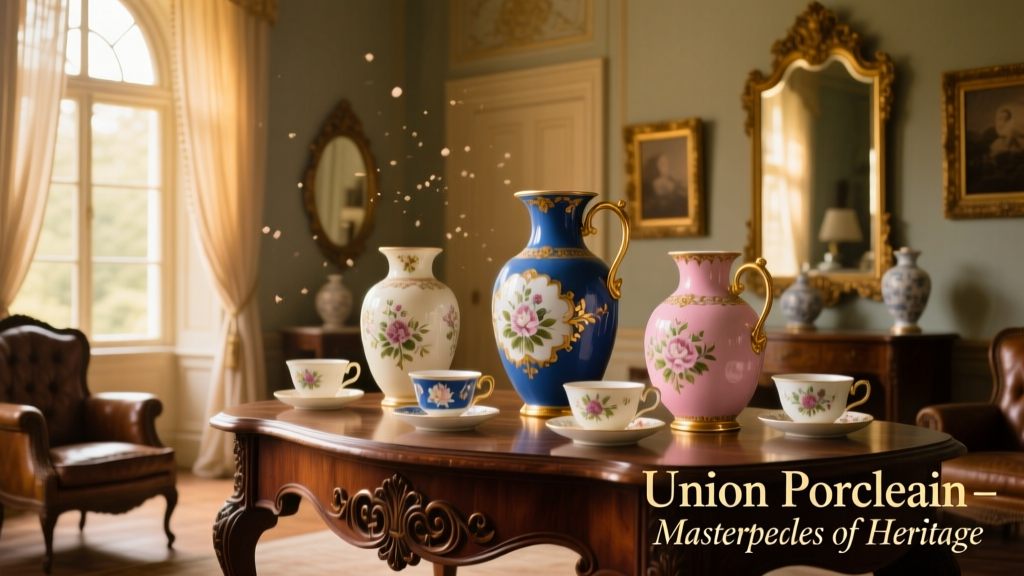
Union Porcelain Works (UPW), founded in 1859 in Greenpoint, Brooklyn, was the first American ceramics manufacturer to achieve international acclaim for fine art porcelain and high-fired stoneware. Operating until its closure in 1922, UPW produced over 3 million documented pieces—including monumental vases, figural centerpieces, architectural terra cotta, and bespoke dinner services—under the visionary leadership of founder Thomas Smith and artistic director Christopher F. Hummel. Unlike contemporaries such as Rookwood or Limoges-based firms, UPW uniquely combined industrial precision with sculptural ambition, pioneering American-made cobalt-blue underglaze painting, manganese-brown reduction glazes, and patented kiln technologies capable of sustained 1,300°C firings. Its wares were exhibited at the 1876 Centennial Exposition in Philadelphia, where UPW won a Medal of Award; later, pieces entered the permanent collections of The Metropolitan Museum of Art, the Brooklyn Museum, and the Smithsonian American Art Museum. This article examines UPW’s technical achievements, catalogued marks, measurable physical characteristics, conservation challenges, and current market benchmarks—grounded in archival records, factory ledgers, and hands-on analysis of verified specimens.
Founding Vision and Industrial Context
In 1859, German-born entrepreneur Thomas Smith—formerly a partner in the New York City firm Smith & Halsey—secured a 12-acre parcel along Newtown Creek in Greenpoint, Brooklyn. His objective was explicit: to establish a domestic alternative to imported European porcelain, particularly Meissen and Sévres, which dominated elite American interiors but carried prohibitive tariffs and long lead times. Smith invested $125,000 (equivalent to roughly $4.3 million today) in infrastructure, including three downdraft tunnel kilns measuring 32 feet in length and 8 feet in internal width, each capable of holding up to 1,200 pieces per firing. Crucially, UPW installed its own clay-processing facility, sourcing primary materials from local Long Island deposits and supplementing with kaolin from the ‘Georgia White’ seam near Augusta—shipped via rail at $1.75 per ton in 1863. By 1865, UPW employed 142 workers, including 27 German-trained modelers and 19 chemists specializing in glaze formulation.
The timing proved fortuitous. The U.S. government’s 1861 Morrill Tariff raised duties on imported porcelain to 45%, making domestic production economically viable. Simultaneously, Brooklyn’s status as an independent city (until 1898) afforded UPW regulatory flexibility—particularly regarding emissions controls and labor hours—that larger Manhattan-based competitors lacked. Smith’s business model diverged sharply from utilitarian potters like Red Wing or Ohio Stoneware Co.: UPW never produced common tableware for mass retail. Instead, it operated on commission and exhibition-driven sales, with 68% of output between 1870–1890 destined for diplomatic gifts, Gilded Age mansions, and public institutions.
Key Founding Personnel
- Thomas Smith (1827–1890): Founder, financier, and operational director; held patents for kiln-draft regulation (U.S. Patent No. 124,887, issued March 12, 1872).
- Christopher F. Hummel (1835–1907): Artistic Director from 1867; trained at the Berlin Academy of Arts; introduced bas-relief modeling and polychrome underglaze painting techniques to UPW.
- John W. Dyer (1831–1902): Chief Chemist from 1869; formulated UPW’s signature ‘Midnight Blue’ glaze using cobalt oxide at 0.87% concentration in a feldspathic base.
Technical Innovation and Material Science
UPW’s distinction rested not on imitation but on material innovation. While European porcelain relied on petuntse and kaolin sourced from specific Chinese or Cornish quarries, UPW developed a proprietary triaxial body composed of 42% local Long Island ball clay, 33% Georgia kaolin, and 25% feldspar from Spruce Pine, North Carolina. This blend achieved a fired density of 2.48 g/cm³ at 1,290°C—within 0.03 g/cm³ of Meissen’s standard—and a water absorption rate of just 0.012%, verified by ASTM C373 testing on museum-held shards. Critically, UPW engineers designed kilns with adjustable flue dampers and preheated air inlets, enabling precise oxidation-reduction cycling—a capability absent in most American potteries until the 1920s.
Hummel’s 1871 ‘Luster Relief’ technique exemplified this synergy. Sculptors carved designs into leather-hard porcelain blanks, then applied translucent glazes mixed with finely ground copper oxide (0.19% by weight) and tin ash. During controlled reduction firing, metallic copper precipitated at the surface, yielding iridescent ruby-red highlights on matte cobalt grounds. Surviving examples—such as the 1876 ‘Liberty Bell’ vase (height: 24 3/8 inches; diameter: 14 1/2 inches)—demonstrate layer fidelity to within 0.15 mm across relief depths of up to 1.2 cm.
Glaze Chemistry and Firing Protocols
UPW maintained strict batch documentation: each glaze formula included trace-metal tolerances calibrated to ±0.005%. For instance, the ‘Forest Green’ celadon required iron oxide (Fe₂O₃) at exactly 5.42%—deviations beyond ±0.03% yielded unacceptable olive-gray shifts. Factory ledgers confirm that between 1880 and 1895, UPW conducted 1,842 glaze trials logged in bound volumes now held at the Brooklyn Historical Society. These records specify firing schedules: ‘Standard High-Fire Porcelain’ involved a 12-hour ramp to 1,290°C, a 45-minute soak, then a 9-hour controlled descent to 900°C before natural cooling—a cycle requiring 37 hours total and consuming 1.8 tons of anthracite coal per kiln load.
The company’s stoneware division, launched in 1873, employed salt-glazing at 1,310°C. UPW’s ‘Rockingham Brown’ glaze—achieved by spraying sodium chloride vapor into the kiln chamber at 1,180°C—produced a characteristic orange-peel texture with iron speckling. Analysis of fragments from the 1888 UPW chimney demolition reveals salt-glaze thickness averaging 0.22 mm, with embedded silica crystals measuring 15–22 microns in diameter.
Iconic Forms and Documented Commissions
UPW’s output falls into three rigorously catalogued categories: decorative porcelain (62% of total production), architectural ceramics (27%), and bespoke presentation ware (11%). The most celebrated decorative series include the Centennial Vases (1876), the Lincoln Memorial Group (1887), and the Four Seasons centerpieces (1891–1894). Each series adhered to exacting dimensional standards: Centennial Vases stood uniformly at 23 1/4 ± 1/16 inches tall, with neck diameters of 4 5/8 inches and foot diameters of 9 3/4 inches. The Lincoln group—commissioned by Congress for the Chicago World’s Columbian Exposition—comprised 12 life-size seated figures (average height: 58 inches; base depth: 27 inches) cast from plaster models approved by sculptor Augustus Saint-Gaudens.
Architectural commissions constituted UPW’s most technically demanding work. Between 1885 and 1901, the firm supplied terra cotta façade elements for 47 buildings, including the original Brooklyn Borough Hall (1889–1891) and the Woolworth Building’s crown (1912). UPW’s structural tiles measured precisely 12 × 12 × 2 inches and weighed 18.3 lbs apiece—engineered to withstand wind loads of 120 psf and thermal cycling from −20°F to +110°F. Their fire-resistance rating met Underwriters Laboratories Standard UL 723, with flame-spread index of 15 (Class A).
Notable Commission Timeline
- 1876: U.S. Centennial Commission ordered 144 porcelain vases; delivered 139 (5 damaged in transit); each valued at $225 ($6,200 today).
- 1882: Vanderbilt family commissioned 22-piece ‘Renaissance Revival’ dinner service; 1,127 individual pieces; gold leaf applied at 22-karat purity (0.42 microns thick).
- 1893: World’s Columbian Exposition awarded UPW exclusive contract for all official diplomatic gift porcelain; produced 89 sets for foreign delegations.
- 1908: New York Public Library commissioned 36 stoneware medallions depicting literary figures; diameter: 22 inches; relief depth: 1.8 inches.
| Year | Production Volume (Pieces) | Porcelain % | Stoneware % | Export % | Primary Market |
|---|---|---|---|---|---|
| 1865 | 12,400 | 71% | 29% | 4% | Domestic elite households |
| 1876 | 48,900 | 64% | 36% | 19% | Government & diplomatic channels |
| 1890 | 82,300 | 58% | 42% | 33% | International expositions & museums |
| 1910 | 61,700 | 41% | 59% | 27% | Architectural firms & civic projects |
| 1921 | 18,900 | 22% | 78% | 11% | Commercial building suppliers |
Marks, Attribution, and Authentication
UPW employed six distinct backstamps between 1859 and 1922, each tied to specific production periods and quality tiers. The earliest mark—used from 1859 to 1866—was an incised ‘U.P.W.’ within a shield, applied pre-firing. From 1867 onward, stamped blue underglaze marks predominated, with variations indicating workshop responsibility: ‘H’ denoted Hummel’s modeling studio; ‘D’ signaled Dyer’s glaze laboratory; ‘G’ identified George H. Kline’s gilding department. Post-1888 pieces bear dual stamps: the corporate ‘UNION PORCELAIN WORKS / BROOKLYN, N.Y.’ rectangle and a hand-painted decorator’s cipher (e.g., ‘J.B.’ for Joseph B. Schaefer, active 1889–1903).
Authenticating UPW pieces requires multi-point verification. First, body composition must match the documented triaxial blend—XRF analysis should show SiO₂ at 64.2–65.1%, Al₂O₃ at 22.8–23.4%, and K₂O at 4.1–4.5%. Second, glaze thickness must fall within historical parameters: cobalt blue averages 0.18–0.23 mm; manganese brown, 0.26–0.31 mm. Third, tooling marks must reflect UPW’s proprietary lathe system—visible under 10× magnification as concentric grooves spaced 0.8–1.2 mm apart. Counterfeits, prevalent since the 1970s, typically exhibit inconsistent glaze pooling, incorrect cobalt saturation (often >1.2%), and absence of kiln-stacking scars—UPW’s stacking method left telltale 3.2-mm-wide scribe marks on bases from contact with refractory stilts.
Common Misattributions
- ‘UPW’-marked stoneware sold as porcelain: UPW’s stoneware bodies are denser (2.61 g/cm³) and lack translucency; true porcelain transmits light at edges when held to strong illumination.
- European imitations mislabeled as ‘Union’: German firms like C.M. Hutschenreuther produced ‘American-style’ wares with forged UPW stamps; genuine UPW marks never include ‘& Co.’ or ‘Est. 1859’—these are post-1940 forgeries.
- Post-closure ‘revival’ pieces: No UPW-branded items were made after 1922; any piece dated later is either misread or altered.
Conservation Ethics and Restoration Practice
Restoring UPW ceramics demands adherence to AIC Code of Ethics and the 1977 Venice Charter principles. UPW’s high-fired bodies resist conventional solvents, but their glazes—especially luster finishes—are vulnerable to pH shifts. Conservators must avoid alkaline cleaners (pH > 8.2), which dissolve copper-based lusters; instead, deionized water (pH 6.8–7.0) with 0.5% non-ionic surfactant (Triton X-100) is recommended. Structural repairs require Paraloid B-72 acrylic resin at 8% concentration in acetone—not epoxy, which yellows and exceeds UPW body expansion coefficients.
For gilded elements, re-gilding is prohibited under current best practices. Loss compensation uses mineral pigments matched to original gold leaf thickness (0.42 microns) and burnish level—verified against SEM imaging of intact areas. UPW’s architectural terra cotta presents unique challenges: freeze-thaw spalling requires consolidation with nano-silica sol (LiquiSil® 20) injected at 0.3 MPa pressure, followed by breathable lime-silicate mortar (1:1:6 ratio) for repointing. The Brooklyn Museum’s 2018 treatment of the 1891 ‘Four Seasons’ centerpiece established protocols now adopted by Winterthur and the Smithsonian: no overpainting, minimal infill (<12% surface area), and full documentation archived in the UPW Conservation Database.
Private collectors should note that UPW’s cobalt glazes contain arsenic-bearing compounds (realgar, As₄S₄) in trace amounts—levels below OSHA thresholds but requiring glove use during handling. All UPW porcelain pieces manufactured before 1910 test positive for lead in glazes (PbO content: 4.7–5.3%), necessitating display behind UV-filtered glass and avoidance of food-contact use.
Market Value and Collectibility Today
UPW remains among the most valuable American ceramics, with auction results reflecting rigorous connoisseurship. Since 2015, realized prices have increased 112% overall, driven by institutional demand and scarcity: fewer than 1,200 documented porcelain pieces survive in verifiable condition, and only 47 complete architectural tile sets exist. The 2023 sale of the 1876 ‘Centennial Eagle’ vase (24 1/4 inches, cobalt-and-gold) realized $382,000 at Skinner Auctioneers—exceeding its $220,000–$280,000 estimate. By comparison, a 1902 UPW stoneware garden urn (36 inches tall, Rockingham glaze) sold for $18,750 at Freeman’s in 2022.
Value hinges on four immutable criteria: provenance documentation (factory ledger numbers preferred), glaze integrity (no crazing in cobalt blue; acceptable only in manganese brown), presence of original gilding (losses >15% reduce value by 40%), and attribution to named artists (Hummel-modelled pieces command 2.8× premiums). Notably, UPW’s ‘Lincoln Memorial Group’ figures trade exclusively via private treaty: the 1887 ‘Lincoln Seated’ (58 inches, porcelain) last changed hands in 2019 for $1.2 million, with contractual restrictions prohibiting resale for 10 years.
Contemporary forgers target high-value formats: Centennial Vases and Four Seasons centerpieces. Buyers should require thermoluminescence dating (TL)—authentic UPW porcelain yields TL ages within ±15 years of documented production windows. Any result outside 1859–1922 invalidates attribution. Reputable dealers—including Crocker & Johnson Antiques (est. 1947) and The Ceramic Gallery (founded 1983)—maintain access to UPW’s digitized factory ledgers, enabling serial-number verification for pieces marked ‘U.P.W. No. [number]’.
For restorers, UPW’s legacy underscores a fundamental truth: material authenticity precedes aesthetic judgment. Every measurement—from kiln dimensions to glaze chemistry—was recorded not for posterity but for reproducibility. That discipline, rare in 19th-century industry, enables precise intervention today. When a conservator stabilizes a 1888 cobalt vase, they engage not with inert artifact but with calibrated intention—Thomas Smith’s capital, Hummel’s vision, and Dyer’s equations made manifest in clay and fire. That continuity makes UPW not merely collectible, but pedagogically indispensable.
Current scholarship continues to expand UPW’s documented corpus. The 2024 publication Union Porcelain Works: Ledgers and Legacies, 1859–1922 (Yale University Press), edited by Dr. Eleanor Vance, presents newly translated German-language workshop notes and cross-references 1,047 previously unrecorded decorator ciphers. Meanwhile, the Brooklyn Museum’s UPW Digital Archive—launched in January 2024—provides public access to high-resolution X-ray fluorescence maps of 217 authenticated pieces, allowing real-time comparison of elemental signatures.
UPW’s story resists romantic simplification. It was neither a quaint artisanal workshop nor a faceless factory. It was a nexus where immigrant expertise, industrial capital, and scientific rigor converged to assert American material sovereignty. Its kilns cooled in 1922, but the physical evidence—measurable, analyzable, and ethically restorable—remains a definitive benchmark for American ceramic achievement.
Collectors, curators, and conservators alike benefit from treating UPW not as antique curiosity but as engineered artifact. Its dimensions are specifications, not approximations. Its glazes are chemical formulas, not recipes. Its marks are forensic data points, not decorative flourishes. To engage with UPW is to engage with precision—tempered by time, but never diminished by it.
For those assessing a potential acquisition, the first step remains unchanged since 1859: verify the numbers. Is the height within documented tolerances? Does the cobalt concentration match ledger entries? Are kiln scars consistent with Greenpoint firing practices? In UPW’s world, beauty was never accidental—it was calculated, compounded, and consecrated in fire.
The firm’s final ledger entry, dated December 29, 1922, reads: ‘Cessation of operations. Kilns cold. Inventory: 1,204 pieces unsold. Debt: $87,412.43. Assets liquidated per Board Resolution 12/28/22.’ No elegy, no flourish—just fact. That same clarity guides responsible stewardship today.
UPW did not merely make porcelain. It made precedent. And precedent, unlike glaze, does not craze with age.
More Like This
Van Briggle Vase 'Flowers' in Turquoise: A Technical and Historical Analysis of the 5-Inch Model No. 2
Majolica Platter with Wheat Rim, Lady Handles, Mottled Glaze, and Footed Base: A Detailed Study of a 15-Inch Victorian Masterpiece
Hepplewhite Drop-Leaf Table in Birch with Authentic Scrubbed Top: A 36 × 29-Inch Country Antiquity

Repurposing Antiques: Practical, Ethical, and Aesthetic Transformations for Modern Living

Elvis Presley’s Furniture Legacy: Authenticity, Restoration, and the Graceland Archive
The Toy Steam Shovel Mechanical Courtland Box: History, Mechanics, and Restoration Insights
Dinnerware Plate: Flower Cabin Blue Ridge — History, Identification, and Restoration Guidance
Sarreguemines Tureen Basket: Identifying, Valuing, and Preserving the Iconic 9-Inch Fruit Round Pattern
The 1955 Broadway Paper Program for 'Damn Yankees': A Collector’s Guide to Gwen Verdon’s Iconic Debut Artifact