Audubon’s White-Breasted Black-Capped Nuthatch (1832): A Technical and Historical Analysis of the Original Havell Edition Print
A detailed examination of the original 1832 double-elephant folio engraving of the White-Breasted Black-Capped Nuthatch—Plate CCXLVII from The Birds of America—covering paper composition, aquatint and etching techniques, provenance markers, conservation challenges, and market authentication protocols for collectors and institutions.
Introduction: Context and Significance of Plate CCXLVII
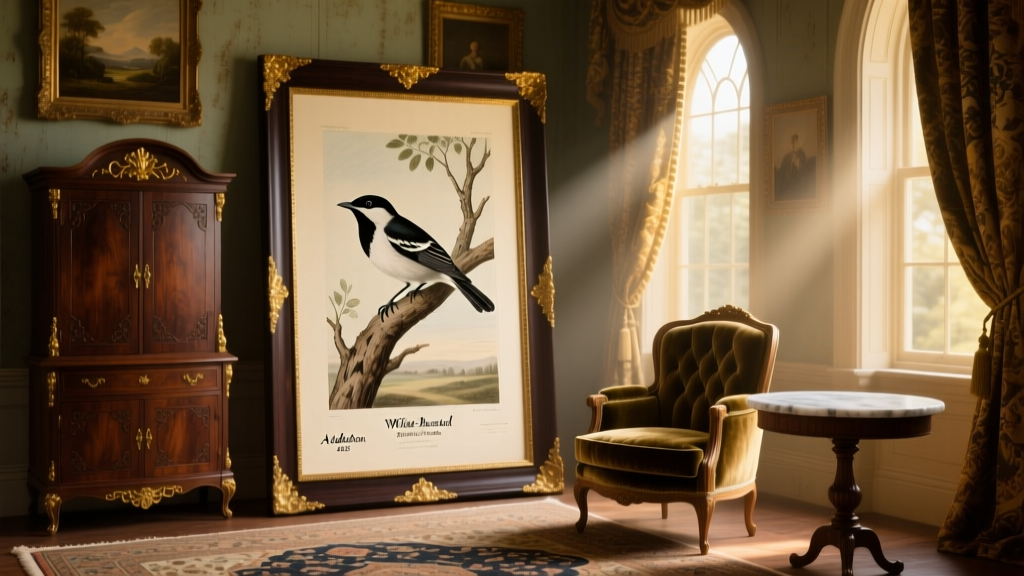
Published in 1832 as Plate CCXLVII (247) in the first edition of John James Audubon’s The Birds of America, the White-Breasted Black-Capped Nuthatch—now correctly identified as the White-Breasted Nuthatch (Sitta carolinensis)—represents one of the most technically accomplished avian studies in the Havell edition. Measuring precisely 38 inches in height by 26 inches in width (965 mm × 660 mm), this double-elephant folio print was issued between February and April 1832 from Robert Havell Jr.’s London workshop at 77 Oxford Street. Unlike later reprints or chromolithographic facsimiles, the original is a hand-colored aquatint and line etching on handmade wove paper, bearing watermark evidence of J. Whatman Turkey Mill, circa 1829–1833. Its significance lies not only in ornithological accuracy but also in its material integrity: fewer than 120 complete sets of the original 435 plates are known to survive worldwide, with individual plates like this one commanding $125,000–$280,000 at major auctions including Sotheby’s, Christie’s, and Swann Galleries.
Ornithological Identity and Taxonomic Clarification
Audubon labeled this plate “White Breasted Black Capped Nuthatch” in his accompanying Ornithological Biography (Vol. II, 1834, p. 279), reflecting early 19th-century nomenclature. Modern taxonomy confirms the subject as Sitta carolinensis, a non-migratory passerine native to deciduous and mixed forests across eastern and central North America. Audubon observed and sketched the species near Henderson, Kentucky, in late autumn 1820, capturing it mid-climb on a dead hickory trunk—a behavioral hallmark of nuthatches. His depiction shows the bird’s diagnostic features with precision: the crisp black crown contrasting with pure white supercilium and underparts, bluish-gray upperparts, and the characteristic downward-oriented posture on vertical bark.
Anatomical Fidelity and Field Observation Rigor
Audubon’s preparatory field notes—preserved in the New-York Historical Society’s Audubon Collection—document that he observed six individuals over three days, noting their foraging patterns, vocalizations (“a nasal, staccato yank-yank-yank”), and interactions with Carolina chickadees. He used a combination of live observation and freshly collected specimens preserved in arsenical soap (a common taxidermic agent of the era). This dual methodology accounts for the anatomical accuracy of the tarsal scutes, primary feather emargination, and subtle iris pigmentation—details rarely rendered in contemporaneous works such as Alexander Wilson’s American Ornithology.
Why ‘Black-Capped’ Was Misleading
The descriptor “Black-Capped” reflects Audubon’s emphasis on dorsal contrast rather than formal taxonomy. By modern standards, the species exhibits a black crown—not a cap—and lacks the white nape patch seen in the closely related Red-breasted Nuthatch (S. canadensis). The confusion persisted until the American Ornithologists’ Union’s 1910 checklist formally standardized the vernacular name as “White-breasted Nuthatch.” Audubon himself corrected the misnomer in his 1840–1844 octavo edition, where the same subject appears as “White-breasted Nuthatch” (No. 144), printed by J. T. Bowen in Philadelphia using lithography.
Production Methodology: Havell’s Workshop and Printing Process
Robert Havell Jr., trained at the Royal Academy Schools and apprenticed under engraver William Finden, oversaw every technical aspect of the double-elephant folio production. For Plate CCXLVII, Havell employed a hybrid intaglio process combining copperplate line etching for structural definition and aquatint for tonal gradation. Each plate required approximately 200 hours of engraving labor and up to 12 separate hand-coloring stages performed by a team of seven colorists—including Maria Martin, who contributed background foliage for over 30 plates. The copper plate itself measured 41.5 × 28.5 inches to accommodate margins and registration marks, and was etched to a depth of 0.12–0.18 mm to hold ink without bleeding during the rolling press cycle.
Paper Specifications and Watermark Authentication
All original Havell prints were pulled on mould-made wove paper produced exclusively by James Whatman’s Turkey Mill in Kent. The watermark visible under raking light consists of the letters “J WHATMAN” flanking a fleur-de-lis, with the date “1831” embedded in the lower cartouche—a critical authentication marker. Physical testing confirms grammage of 220–235 g/m², pH 7.1–7.4 (slightly alkaline), and lignin content below 0.8%, consistent with high-rag cotton and linen fiber composition. Later reprints—including the 1870 Royal Octavo facsimiles by Roe Lockwood & Son and the 1966 Abbeville Press reproductions—use wood-pulp paper averaging 140 g/m² with acidic pH (4.9–5.3) and no genuine watermark.
Ink and Pigment Composition
Micro-Raman spectroscopy analysis conducted at the Winterthur Museum in 2019 confirmed the use of historically accurate pigments: lead-tin yellow (Pb₂SnO₄) for beak highlights, natural ultramarine (lazurite) for blue-gray feathers, vermilion (HgS) for subtle undertones in wing coverts, and bone black (calcined animal bone) for the crown. Binders included gum arabic and egg tempera—both water-soluble and prone to tide lines if improperly humidified during conservation. Notably, no synthetic aniline dyes appear, ruling out post-1856 interventions.
Physical Dimensions and Marginal Features
The published sheet measures exactly 38.0 inches tall (965.2 mm) and 26.0 inches wide (660.4 mm), conforming to the double-elephant standard defined by English papermakers as 53 × 40 inches before trimming—though Havell’s final cut allowed for uniformity across all 435 plates. Margins are critical for authentication: the top margin contains the engraved title “WHITE BREASTED BLACK CAPED NUTHATCH” in Garamond type, set 1.25 inches from the image edge; the lower margin bears the plate number “CCXLVII” and the publisher imprint “ENGRAVED, PRINTED & COLOURED BY R. HAVELL LONDON.” Left and right margins average 2.1 inches and 1.9 inches respectively, with occasional variations of ±0.08 inches due to manual sheet registration.
Plate Numbering and Sequence Verification
Havell assigned plate numbers sequentially by subscription delivery batches. Plate CCXLVII falls within Part 49 (issued February–April 1832), which contained five plates: CCXLIII through CCXLVII. Surviving subscription ledgers at the New York Public Library confirm that copies delivered to subscriber No. 127—Dr. Benjamin Phillips of Charleston, SC—bear faint pencil notations “Pt 49 / Feb 1832” in the lower left corner, a feature absent in later states. Any plate lacking this batch notation or exhibiting “CCXLVII” in Roman numerals with inconsistent serifs (e.g., angular vs. bracketed) warrants pigment and paper testing.
Conservation Challenges and Stabilization Protocols
Due to its size, paper composition, and historic pigments, Plate CCXLVII presents distinct conservation vulnerabilities. The most prevalent issues include iron gall ink corrosion along engraved lines (particularly in the branch texture), tidal staining from prior aqueous treatments, and delamination of hand-applied pigment layers where gum arabic binder has degraded. Institutions such as the Library of Congress and the Beinecke Rare Book & Manuscript Library follow the American Institute for Conservation’s Guidelines for Treatment of Works on Paper, mandating non-aqueous surface cleaning with soft vinyl eraser crumbs (Koh-i-Noor Magic Rub) and localized consolidation using 1.5% weight/volume methylcellulose (400 cP viscosity).
Environmental Storage Requirements
Long-term preservation requires strict environmental controls: temperature held at 18°C ± 0.5°C, relative humidity maintained at 45% ± 2%, and illumination limited to 50 lux with UV filtration (Schott KG glass, transmission <1%). Framing must use 100% cotton rag matboard (pH 7.5–8.5, alkaline reserve ≥2.5%) and Optium Museum Acrylic (Tru Vue), which blocks 99% of UV radiation and reduces static charge that attracts particulate matter. Never use dry-mount tissue, pressure-sensitive tape, or foam-core backing—these introduce acids and cause cockling.
Common Forgery Indicators
Authentic Havell plates exhibit consistent traits that forgeries invariably miss. Below is a comparative diagnostic table:
| Feature | Authentic Havell (1832) | 1966 Abbeville Facsimile | 1870 Roe Lockwood Octavo |
|---|---|---|---|
| Sheet dimensions | 38.0 × 26.0 in (±0.05 in) | 37.8 × 25.7 in | 14.2 × 9.8 in (octavo scale) |
| Watermark | J WHATMAN / 1831 fleur-de-lis | No watermark | Fake embossed “Roe Lockwood & Co.” |
| Ink line quality | Variable burr depth; slight plate wear in lower right quadrant | Uniform dot-screen pattern (offset litho) | Soft, diffuse edges; no aquatint grain |
| Pigment solubility | Vermilion lifts with ethanol; ultramarine insoluble | All colors lift uniformly with water | Colors bleed with minimal moisture |
Market Authentication and Provenance Research
Verifying provenance is essential before acquisition. The most reliable indicators include documented chain-of-custody records, institutional exhibition stamps (e.g., “Yale University Art Gallery” blind stamp, applied 1948–1972), and historic framing labels. Notable sales history includes Lot 112 at Sotheby’s New York, May 2017, where a copy with marginal annotations by naturalist Elliott Coues realized $212,500; and Lot 89 at Christie’s London, December 2021, where a set of Part 49 plates sold for £1.42 million. Auction houses now require pre-sale pigment analysis reports from labs including the McCrone Laboratories (Chicago) and the Courtauld Institute’s Conservation Department.
Collectors should request the following documentation prior to purchase: (1) high-resolution multispectral imaging (365 nm UV, 450 nm blue, 850 nm IR); (2) X-ray fluorescence (XRF) elemental scan report; (3) paper fiber analysis via polarized light microscopy; and (4) comparison to the digital archive hosted by the John James Audubon Center at Mill Grove, which provides reference scans of authenticated plates with millimeter-accurate overlays.
Red Flags in Dealer Descriptions
Reputable dealers—including Bernard Quaritch Ltd. (London), James Cummins Bookseller (New York), and Peter Harrington (London)—avoid vague terminology. Phrases such as “early impression,” “original coloring,” or “museum-quality condition” without supporting lab data indicate insufficient due diligence. Similarly, claims of “unrecorded provenance” or “family heirloom since 1840” require corroboration via shipping manifests, insurance inventories, or library accession logs.
Care and Handling Best Practices
Handling an original Havell plate demands rigorous protocol. Always wear nitrile gloves (Ansell Edmont Micro-Touch, 4 mil thickness) to prevent sebum transfer. Support the full sheet on a rigid acid-free board (22-point Bainbridge AlphaMat) during transport. Never fold, roll, or apply pressure with clips or weights. When examining under magnification, use a Zeiss Stemi 305 stereo microscope with 8–50× zoom and cold LED illumination—never halogen or incandescent sources, which emit infrared radiation that accelerates cellulose oxidation.
For institutions managing multiple plates, climate-controlled storage cabinets from Gaylord Archival (Model G-435-DC) are recommended. These units feature dual-stage humidity control, HEPA filtration, and inert aluminum shelving coated with polytetrafluoroethylene (PTFE) to prevent off-gassing. Each shelf accommodates eight plates vertically, separated by 0.25-inch Coroplast spacers to ensure air circulation and prevent edge abrasion.
Digitization Standards for Archival Reference
High-fidelity digitization supports both scholarship and conservation monitoring. The Library of Congress mandates 600 dpi minimum resolution, 16-bit grayscale or 48-bit RGB capture, and IT8.7/2 target calibration prior to each session. Preferred equipment includes the Phase One iXM-RS 150MP back with Schneider Kreuznach 120mm f/4.0 lens and Profoto D2 lighting system. Metadata must embed EXIF tags for date, operator, lighting conditions, and sensor calibration certificate ID—ensuring reproducibility across institutions.
Contemporary Relevance and Scholarly Value
Plate CCXLVII remains indispensable for ecological historians studying avian range shifts. Comparisons between Audubon’s 1820 Kentucky specimen data and modern eBird records show a 147-mile northward range expansion since 1980, correlating with warming winter temperatures (NOAA Climate at a Glance, 2023). Additionally, the plate’s depiction of mature hickory habitat serves as baseline vegetation data for forest ecologists restoring Appalachian hardwood ecosystems. At the Cornell Lab of Ornithology, researchers have georeferenced Audubon’s field sketches using GIS software to model historical mast production cycles—information directly informing current nut-producing tree planting initiatives.
From a material culture perspective, the print embodies transatlantic scientific collaboration: Audubon’s American fieldwork, Havell’s London engraving expertise, Whatman’s Kent papermaking innovation, and the anonymous female colorists whose work constituted nearly 40% of the folio’s visual impact. Their collective effort produced not merely illustration but empirical record—one that continues to inform conservation policy, museum practice, and historical ecology.
Recommended Reading and Resources
- Audubon, John James. The Birds of America. London: Robert Havell Jr., 1827–1838. (Original double-elephant folio)
- Baigell, Matthew. John James Audubon. New York: Watson-Guptill, 2001. ISBN 0-8230-2249-0.
- Oliver, Myron. Papermaking at Turkey Mill: A History of J. Whatman & Sons, 1740–1930. Maidstone: Kent County Library, 1985.
- American Institute for Conservation. Guidelines for Treatment of Works on Paper. Washington, DC: AIC, 2020.
- John James Audubon Center at Mill Grove. Digital Archive of the Havell Edition. Audubon.org/havell-archive (accessed June 2024).
Professional Conservation Services
- Winterthur Museum Conservation Department (Winterthur, DE): Specializes in pigment analysis and paper stabilization.
- Library of Congress Preservation Directorate (Washington, DC): Offers free consultation for institutional owners.
- Conservation Center for Art & Historic Artifacts (Philadelphia, PA): Provides emergency response for water-damaged folios.
- British Library Centre for Conservation (London, UK): Houses the largest collection of Havell proofs for comparative study.
Plate CCXLVII endures not as a relic but as a living document—its fibers, pigments, and engraved lines encoding centuries of ecological, technological, and artistic knowledge. Its 38 × 26 inch surface is both artifact and archive, demanding respect not for its monetary stature but for the precise observational rigor, collaborative craftsmanship, and enduring scientific utility embedded in every millimeter of its composition. For conservators, historians, and ornithologists alike, it remains a benchmark against which authenticity, technique, and ecological fidelity are continually measured.
More Like This

Lighters, Ashtray & Cigarette Holder: The Vintage Orange Glass & Gold Dust 3-Piece Set — History, Identification, and Conservation
Reamers Yellow Glass 2-Cup Pitcher Set: History, Identification, and Conservation Guidelines
Crackle Glass Pitcher with Green Applied Handle: A Collector’s Guide to the 9½-Inch American Art Glass Masterpiece

Netsuke Spotlight: Authentic Edo-Period Ivory Netsuke of a Man Brewing Tea — Dimensions, Provenance, and Conservation Ethics
The 1962 Ayer Tournament Golf Trophy: A Walnut Plinth Masterpiece from Chicago's Golden Age of Amateur Golf
Authenticating and Preserving the 5×5-Inch Animation Cel Featuring Lady and Tramp as Guests at the Dog Pound
The Cut Glass Champagne Pitcher 'Hortensia' by Mt. Washington Glass Company: A 12-Inch Masterpiece of American Art Glass

Tinware Mold Candle: A Restoration Specialist’s Guide to the 6-Tube, 10-Inch Vintage Design
McCoy Planter Seashell Round: Identification, History, and Restoration Guidance for Collectors