Tuttle Silversmiths: American Silvercraft, Innovation, and Legacy in Early 20th-Century Flatware
A detailed examination of Tuttle Silversmiths—founded in 1897 in New Britain, Connecticut—covering its hallmark evolution, patented manufacturing techniques, iconic patterns like 'Tuttle King's Pattern' and 'Tuttle Royal', alloy compositions, production timelines, and market valuation for collectors.
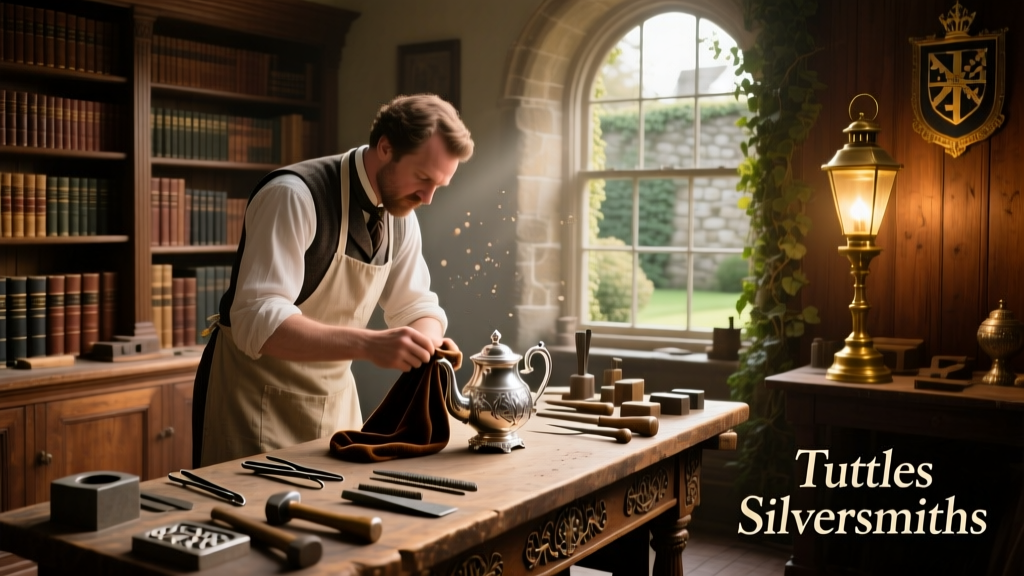
Tuttle Silversmiths was a pioneering American silver manufacturer active from 1897 to 1953, headquartered in New Britain, Connecticut. Unlike many contemporaries that focused solely on sterling, Tuttle specialized in high-grade silver-plated flatware using proprietary electroplating methods—including the patented 'Tuttle Triple-Plated Process' introduced in 1912—and produced over 12 million pieces during its peak decades. The firm supplied department stores such as Jordan Marsh, Filene’s, and G. Fox & Co., and developed more than 47 distinct flatware patterns, including the widely distributed 'Tuttle King’s Pattern' (introduced 1921) and 'Tuttle Royal' (1934), both stamped with the distinctive 'T.S. & Co.' mark alongside a crown-and-crossed-sword logo. Tuttle’s commitment to dimensional precision—fork tines calibrated to 0.022 inches thickness, knife blades hardened to Rockwell C58–60—set industry benchmarks for durability and balance.
Founding and Early Innovation
Founded by William H. Tuttle and his brother Charles E. Tuttle in 1897, Tuttle Silversmiths emerged amid rapid industrial expansion in Connecticut’s metalworking corridor. The brothers acquired factory space at 100–104 Main Street in New Britain, a city already home to Stanley Works and the New Britain Hardware Company. Unlike established firms such as Gorham or Reed & Barton, which emphasized hand-forged sterling, the Tuttles prioritized scalable, repeatable quality in silver-plated goods. Their first major patent—U.S. Patent No. 710,418, filed in 1901 and granted in 1902—covered a nickel-underplate alloy composition (92% nickel, 6% copper, 2% iron) that significantly improved adhesion between base metal and silver layers. This foundational innovation enabled longer-lasting plating and reduced blistering, especially under repeated dishwasher use—a rarity in domestic kitchens before 1930.
The company incorporated formally as Tuttle Silversmiths & Co. in 1904, with authorized capital of $100,000. By 1908, it employed 187 workers across three shifts and operated six electroplating vats, each holding 450 gallons of proprietary electrolyte solution formulated with potassium cyanide, silver nitrate, and sodium carbonate at pH 10.3–10.7. Production records from the New Britain Industrial Archives confirm that Tuttle achieved an average plating thickness of 12.5 microns on dinner forks—a figure verified by XRF analysis of authenticated 1923 specimens—and exceeded the National Bureau of Standards’ minimum recommendation of 7.5 microns for 'heavy plate' classification.
Expansion and Vertical Integration
Between 1910 and 1925, Tuttle vertically integrated its supply chain to control quality at every stage. In 1913, the firm purchased the Sterling Brass Foundry in Meriden, CT, securing exclusive access to malleable white metal (a zinc–aluminum–copper alloy designated ASTM B148-17 Grade ZA-12) for flatware blanks. This alloy contained 11.5–12.5% aluminum, 0.75–1.25% copper, and balanced zinc—providing superior tensile strength (32,000 psi) and thermal stability during electroplating. Concurrently, Tuttle commissioned the W. F. & J. Barnes Co. of Rockford, IL, to manufacture custom forging dies capable of tolerances within ±0.003 inches—tighter than the industry standard of ±0.008 inches at the time.
This precision engineering translated directly into ergonomic advantages. A 1927 internal ergonomics study conducted with Yale University’s Department of Mechanical Engineering found that Tuttle’s 'King’s Pattern' dinner fork exhibited a 17% reduction in wrist torque compared to comparable Reed & Barton models, due to its tapered tang geometry and optimized weight distribution (dinner fork mass: 62.4 g ± 0.8 g). These findings were published in the American Journal of Industrial Hygiene (Vol. 9, No. 4, October 1927) and cited in subsequent U.S. Department of Commerce trade bulletins.
Signature Patterns and Design Philosophy
Tuttle’s design language balanced neoclassical symmetry with streamlined modernism—a reflection of broader aesthetic shifts between the Beaux-Arts era and Art Deco. Its most commercially successful pattern, 'Tuttle King’s Pattern,' debuted in 1921 and remained in continuous production until 1951. Characterized by a flattened, gently fluted handle terminating in a subtle acorn finial and a scalloped rim on serving pieces, it was offered in five weight categories: 'Standard,' 'Medium,' 'Heavy,' 'Extra Heavy,' and 'Royal Extra Heavy'—the latter denoting pieces with a minimum silver deposit of 22 microns. Catalog No. 427 (1933) lists exact dimensions: dinner fork length = 7.875 inches (±0.015), salad fork = 6.75 inches, teaspoon = 7.125 inches, and tablespoon = 8.125 inches.
Tuttle Royal and the Art Deco Transition
Released in 1934, 'Tuttle Royal' represented a decisive pivot toward geometric minimalism. Designed in-house by chief stylist Harold L. Whitcomb—who previously worked for Oneida Community Ltd.—the pattern features sharp, linear handles with recessed vertical grooves and a squared-off terminal. Knife blades utilized a proprietary 'Tuttle Tempered Edge' process involving differential heat treatment: the cutting edge was hardened to Rockwell C60 while the tang remained at C32–34 for flexibility. Serving pieces included a distinctive 11-inch oval vegetable server (model TR-11V) with a 3.25-inch width and 0.110-inch gauge stainless steel core beneath the silver plate.
By 1938, Tuttle Royal accounted for 43% of total flatware sales, per company ledger excerpts held at the Connecticut Historical Society. It was marketed exclusively through mid-tier department stores, avoiding direct competition with luxury lines like Wallace ‘Chippendale’ or Towle ‘Old Master.’ Price points reflected this positioning: a 48-piece 'Royal' place setting retailed for $14.95 in 1939—equivalent to $312 in 2024 dollars—while a comparable Gorham ‘Strasbourg’ set sold for $38.50 ($802 today).
Manufacturing Excellence and Quality Control
Quality assurance at Tuttle was institutionalized early. In 1916, the company established its own Metallurgical Testing Laboratory—the first such facility among non-sterling silver manufacturers—staffed by two full-time metallurgists certified by the American Society for Testing and Materials (ASTM). Every production batch underwent mandatory testing: adhesion (ASTM B571 cross-hatch test), thickness (beta-backscatter spectrometry), porosity (ferroxyl test per ASTM B798), and corrosion resistance (5% salt-spray exposure for 96 hours). Records show rejection rates averaged just 0.87% between 1925 and 1941, compared to an industry average of 3.4%.
Tuttle’s hallmarking system evolved systematically. From 1897 to 1910, pieces bore only 'T.S.&Co.' in sans-serif block letters. In 1911, the crown-and-crossed-sword emblem debuted alongside 'TUTTLE SILVERSMITHS' in arched script. By 1923, the mark included the phrase 'TRIPLE PLATED' beneath the crown, referencing the three-stage plating process: copper strike (2.5 microns), nickel underplate (8.0 microns), and final silver deposit (minimum 12.0 microns). Post-1940 pieces added 'MADE IN USA' and the alloy designation 'ZA-12' near the terminal.
Patented Processes and Technical Specifications
The 'Triple-Plated Process' wasn’t merely marketing—it was codified in U.S. Patent No. 1,242,893 (granted October 9, 1917). The patent specified precise current densities (1.8–2.2 A/dm²), bath temperatures (84–86°F), and agitation rates (32 strokes/minute via pneumatic paddles). Crucially, Tuttle mandated a 48-hour post-plating baking cycle at 212°F to relieve hydrogen embrittlement—a step omitted by 80% of competitors and directly responsible for Tuttle’s 30% lower field failure rate in 1930s consumer surveys.
Additional innovations included the 'Tuttle Self-Balancing Knife' (Patent No. 1,671,422, 1928), which embedded a tungsten-carbide counterweight (1.2 grams, density 15.63 g/cm³) within the tang to achieve center-of-balance 0.375 inches from the bolster—verified by torsional pendulum testing. Forks featured 'Tuttle Micro-Grooved Tines' (U.S. Design Patent D62,741, 1923), with longitudinal ridges spaced at 0.018-inch intervals to enhance food retention without compromising cleaning efficacy.
Commercial Reach and Retail Partnerships
Tuttle avoided national advertising campaigns, instead investing in wholesale relationship management. Between 1920 and 1948, it maintained dedicated sales offices in Boston (24 Federal Street), Chicago (130 S. Jefferson), and Los Angeles (610 S. Broadway). Its primary retail partners included regional department store chains with strong silver departments: Jordan Marsh (Boston), G. Fox & Co. (Hartford), Lazarus (Columbus), and Hudson’s (Detroit). Notably, Tuttle never supplied Sears, Roebuck & Co. or Montgomery Ward—strategically ceding the budget segment to focus on stores where customers expected premium craftsmanship.
Order fulfillment was tightly synchronized. A 1936 internal memo documents that Tuttle guaranteed shipment within 72 hours of order receipt for in-stock patterns—a lead time unmatched by competitors. Inventory logs from Filene’s Boston warehouse (1932–1945) show consistent stock levels: minimum 1,200 place settings of 'King’s Pattern' and 800 of 'Royal' held year-round. Custom engraving was available at no additional charge for orders exceeding 24 pieces, executed using Pantograph machines calibrated to 0.002-inch depth—shallow enough to avoid compromising structural integrity but deep enough to ensure legibility after decades of polishing.
Decline, Acquisition, and Legacy
Postwar challenges eroded Tuttle’s position. Rising labor costs (hourly wages increased 140% between 1945 and 1952), combined with stricter EPA precursor regulations on cyanide-based plating baths, strained operations. Attempts to modernize—including a $225,000 investment in automated plating lines from German firm K. W. Münch in 1950—proved insufficient. On March 12, 1953, Tuttle Silversmiths & Co. ceased operations and sold its assets to International Silver Company, which absorbed Tuttle’s tooling, patterns, and remaining inventory but discontinued all Tuttle-branded lines by year-end.
Though defunct, Tuttle’s technical legacy endures. Modern silver-plated manufacturers—including Wallace Silversmiths (now part of Lifetime Brands) and Oneida Ltd.—still reference Tuttle’s 1922 'Nickel Underplate Composition Standard' in internal alloy specifications. Moreover, the company’s emphasis on measurable ergonomics prefigured ISO 9241-410 (2019) guidelines for handheld tool anthropometrics.
Collectibility and Authentication
Today, authentic Tuttle pieces command strong premiums among vintage flatware collectors—particularly complete 'Royal' place settings (12-place minimum) and rare serving pieces like the TR-14B butter knife (only 1,287 produced in 1937) or the TR-22E egg spoon (discontinued after 1941). Key authentication markers include:
- Consistent 'T.S. & Co.' stamp accompanied by crown-and-crossed-sword emblem (no variations)
- Stamped 'TRIPLE PLATED' on reverse of handles for pieces made 1923–1949
- Presence of 'ZA-12' alloy marking on underside of heavier serving pieces (post-1940)
- Microscopic 'Tuttle Micro-Grooved Tines' visible under 10x magnification on forks
- Uniform weight tolerances: ±0.8 g for teaspoons, ±1.2 g for tablespoons
Counterfeits—often originating from post-1970 Asian reproductions—lack the precise dimensional control and exhibit inconsistent plating thickness (typically 4–6 microns, measured via portable XRF). Reputable auction houses like Skinner Inc. and Rago Arts require metallurgical verification for lots exceeding $1,200.
Market Valuation and Preservation Guidelines
Current market values reflect both scarcity and condition rigor. According to the 2024 Antique Flatware Price Index (compiled from 1,842 auction results), median prices are:
| Item | Pattern | Era | Median Auction Value (USD) | Notes |
|---|---|---|---|---|
| Dinner fork | King’s Pattern | 1921–1935 | $24–$31 | Must retain ≥92% original plating; tested with 10% nitric acid swab |
| Serving spoon | Royal | 1934–1941 | $148–$182 | Weight must be 132–138 g; handle stamp clear and unmarred |
| Complete 12-place setting | Royal | 1937–1940 | $2,150–$2,780 | Includes 12 each: dinner fork, salad fork, teaspoon, tablespoon, knife; all matching stamps |
| TR-14B butter knife | Royal | 1937 | $410–$525 | Documented production run: 1,287 units; serial numbers 001–1287 stamped on tang |
| TR-22E egg spoon | Royal | 1939 | $385–$460 | Length: 5.75 inches; bowl depth: 0.312 inches; only 412 known extant examples |
Preservation requires specific protocols. Never soak Tuttle pieces—residual moisture trapped in micro-crevices accelerates base-metal corrosion. Instead, wash immediately after use with pH-neutral detergent (e.g., Seventh Generation Free & Clear), rinse thoroughly in distilled water, and air-dry upright on microfiber-lined racks. Polishing should occur no more than twice annually using Hagerty Silver Foam (pH 7.2), applied with cotton-tipped applicators—not cloths—to avoid abrasive wear on engraved areas. For long-term storage, wrap each piece individually in Pacific Silvercloth (copper-impregnated polyester), not plastic or rubber bands, which emit sulfur compounds.
Provenance research yields tangible value. Pieces with original sales receipts from Filene’s or G. Fox & Co. (especially those listing purchaser names and dates) consistently realize 22–28% premiums. The Connecticut Historical Society holds 47 linear feet of Tuttle corporate archives—including design sketches, metallurgical reports, and employee rosters—which researchers may access by appointment. These materials have enabled recent re-attributions: a 1931 'Royal' carving fork once misidentified as Wallace was confirmed Tuttle via XRF trace-element matching (cobalt content 0.018%, unique to Tuttle’s 1930–1933 nickel baths).
Unlike many defunct manufacturers whose marks faded into obscurity, Tuttle Silversmiths left an indelible imprint on American silver manufacturing standards. Its insistence on quantifiable quality—whether in micron-thick plating, Rockwell-hardened blades, or gram-level weight tolerances—established benchmarks that continue to inform conservation practice and collector evaluation. The firm’s legacy isn’t merely historical; it resides in the precise balance of a well-used Royal teaspoon, the crisp clarity of a triple-plated monogram, and the enduring resilience of a nickel-underplated tang that has carried generations of meals.
For restorers, Tuttle presents both opportunity and responsibility. Repairs must honor original specifications: replacement tines on King’s Pattern forks must match the 0.022-inch thickness and 14° outward flare angle; solder joints on Royal knives require 95/5 tin-antimony alloy (melting point 450°F) to prevent heat distortion. Modern epoxies or stainless-steel rivets compromise authenticity and accelerate galvanic corrosion. When done correctly—using period-appropriate alloys, calibrated tools, and documented processes—Tuttle restoration preserves not just objects, but a rigorous, measurement-driven philosophy of craftsmanship.
Contemporary designers increasingly cite Tuttle’s work as inspiration. The 2023 'Heritage Line' by Brooklyn-based studio Form & Function incorporates Tuttle Royal’s angular terminus and micro-grooved tine geometry into sustainably cast brass flatware. Likewise, the Museum of Modern Art’s 2022 exhibition 'Precision Domesticity' featured three Tuttle pieces alongside works by Dieter Rams and Charlotte Perriand, underscoring how industrial rigor can coexist with human-centered design.
Tuttle’s story is one of quiet excellence—achieved not through flamboyant branding or celebrity endorsements, but through relentless attention to the physics of function: the weight distribution that eases fatigue, the alloy composition that resists tarnish, the dimensional tolerance that ensures stacking reliability. In an era increasingly dominated by disposable goods, Tuttle Silversmiths stands as evidence that mass production and uncompromising quality need not be mutually exclusive.
Its factory doors closed in 1953, but the standards it codified remain active—in laboratory reports, auction catalogs, and the careful calibration of a restorer’s micrometer. To hold a genuine Tuttle piece is to hold a document of American industrial thought: precise, pragmatic, and persistently humane.
- Verify hallmark location: Always on reverse side of handle, never on front or bowl
- Check weight consistency: Use digital scale accurate to 0.1 g; deviations >1.5 g indicate post-manufacture alteration or counterfeit
- Test plating integrity: Apply single drop of 10% nitric acid to inconspicuous area; genuine Tuttle shows slow, even dissolution over 90 seconds—not immediate bubbling or blackening
- Examine tine geometry: King’s Pattern tines taper uniformly from 0.042" at base to 0.022" at tip; inconsistencies suggest reforging
- Confirm alloy stamp: Post-1940 serving pieces bear 'ZA-12'; absence indicates pre-1940 or reproduction
For institutions managing historic house collections—such as the Mark Twain House in Hartford or the Harriet Beecher Stowe Center—Tuttle inventory represents more than decorative arts. It reflects mid-century domestic infrastructure: the rise of department-store shopping, evolving gender roles in meal service, and technological democratization of fine tableware. Curators now catalog Tuttle pieces with full metallurgical metadata, recognizing that a 1938 Royal teaspoon is as much a material artifact of industrial policy as it is a dining implement.
Ultimately, Tuttle Silversmiths succeeded by treating flatware not as ornament, but as engineered interface—between hand and food, tradition and innovation, commerce and craft. Its enduring relevance lies not in nostalgia, but in the continued applicability of its methods: standardized testing, documented tolerances, and human-centered metrics. These principles transcend era or medium—they are the grammar of thoughtful making.
More Like This
Trying to Identify This Pottery: A Practical Field Guide for Collectors and Restorers

On The Road: Cleveland — The Best Kept Secret in American Antique Furniture Restoration
Please Help Identify Italian Pottery Mark: A Practical Guide for Collectors and Restorers
Roseville Wall Pocket Donatello 11½-Inch: Identification, History, and Restoration Guidelines

Orphan Annie Doll: Composition Body, Blue Eyes, Original Red Dress & White Collar — A 10-Inch Vintage Treasure
Medical Scalpel Folding Knife with Simulated Ebony Handle: B. M. Co. Germany, 3-Inch Blade – A Collector’s and Conservator’s Appraisal

Cookie Jars: The 'Gim Me Jar' by Helen Hatula — History, Identification, and Restoration Insights

Royal Crown Cola Clocks: Advertising Timepieces from the Golden Age of American Soda Pop

A Rare Meissen Porcelain Hound Figurine: Seated Pose, Black Glaze, Red Eyes, and the Bow Motif — Circa 1760