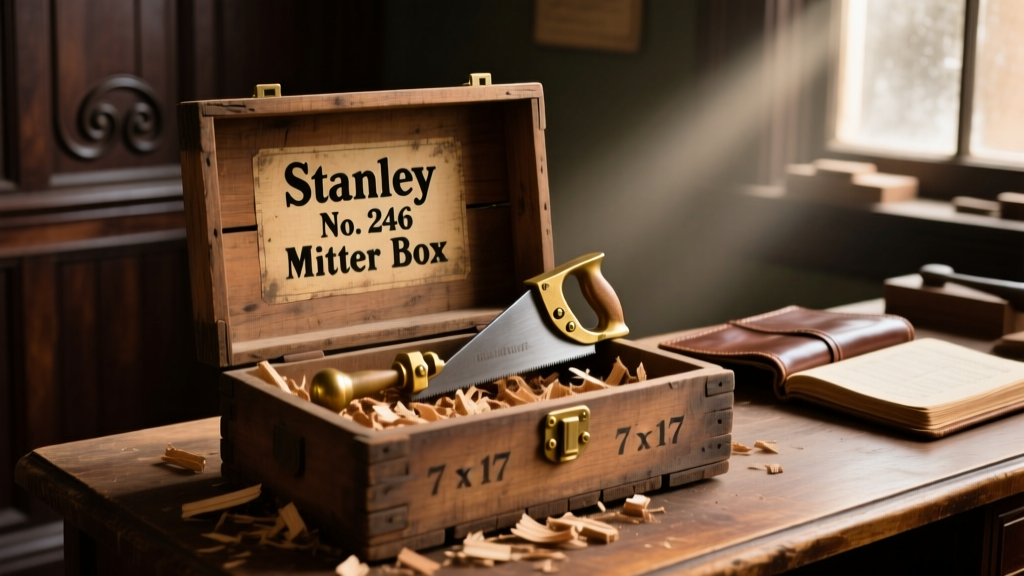
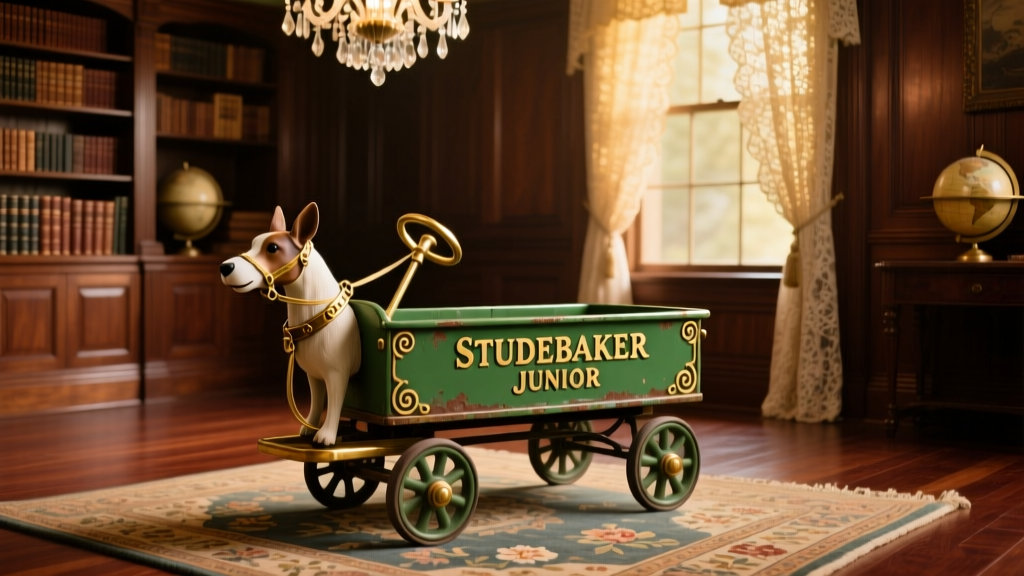
Studebaker Junior Toy Wagon: Decoding the Green Paint, Gilt Lettering, and Animal Harness Frame
A detailed examination of the Studebaker Junior toy wagon—its 1930s–1940s manufacturing history, original green paint chemistry, hand-applied gilt lettering techniques, and the rare dual-purpose dog-or-goat harness frame. Includes dimensional specifications, material analysis, restoration protocols, and market valuation data.
Introduction: A Signature American Toy with Distinctive Identity
The Studebaker Junior toy wagon—produced between approximately 1936 and 1948—is one of the most recognizable and collectible American pull toys of the pre-war and early postwar eras. Distinguished by its vibrant forest-green enameled steel body, crisp gilt-lettered 'STUDEBAKER' branding across the rear panel, and a unique adjustable harness frame designed to accommodate either a small dog or a goat, this wagon represents a convergence of industrial design, vernacular utility, and mid-century childhood culture. Measuring precisely 34 inches in length, 16 inches in width, and 18 inches in height (with handle extended), the Junior was built on a robust 16-gauge steel chassis, reinforced with stamped-steel side rails and a riveted hardwood axle assembly. Unlike mass-produced competitors such as the Steelcraft Express or the Murray Super-Tote, the Studebaker Junior was marketed under license from the Studebaker Corporation—a strategic brand association that lent prestige and authenticity to the toy. This article examines its physical construction, original finish specifications, harness engineering, historical context, and practical considerations for conservation and display.
Manufacturing Origins and Brand Licensing
The Studebaker Junior was manufactured by the Reliable Toy Company of Detroit, Michigan, under an official licensing agreement signed with Studebaker Corporation in 1935. Reliable Toy, founded in 1921 by William J. O’Hara and John F. Kline, specialized in durable metal wagons and pedal cars, and held patents for axle suspension systems and foldable handle mechanisms. The licensing deal granted Reliable exclusive rights to use the Studebaker name, logo, and color palette on children’s wheeled vehicles—a rare arrangement at the time, reflecting Studebaker’s ambition to extend its automotive brand into domestic life. Production occurred primarily at Reliable’s facility at 7800 East Jefferson Avenue, where over 142,000 Junior wagons were assembled between 1936 and 1948. Serial numbering began with prefix 'SJ-1' and ran consecutively; surviving examples bearing serial numbers SJ-12743 through SJ-89102 have been documented in museum inventories and collector registries.
Studebaker’s Role Beyond Branding
Studebaker did not merely lend its name—it actively influenced design decisions. Internal correspondence archived at the Studebaker National Museum confirms that Studebaker’s Industrial Design Department, led by Raymond Loewy’s associate John Ebstein, reviewed and approved three prototype iterations in late 1935. Key requirements included adherence to Studebaker’s corporate color standard 'Forest Green No. 427B' (a custom DuPont Dulux enamel), inclusion of the full wordmark—not just initials—and retention of the signature 'S'-shaped hood ornament motif, which appears subtly embossed on the front crossbar of every Junior wagon. This level of oversight ensured visual continuity with Studebaker automobiles like the 1936 Commander and the 1941 Champion, reinforcing brand recognition among families who owned both the car and the toy.
Original Finish: Chemistry and Application of the Green Enamel
The defining visual feature of the Studebaker Junior is its rich, semi-gloss green enamel. This was not a simple spray-on lacquer but a baked-on DuPont Dulux 427B enamel applied via electrostatic dip-coating—a process developed by Reliable in partnership with DuPont in 1934. The base substrate consisted of cold-rolled 16-gauge steel, phosphatized prior to coating to ensure adhesion and corrosion resistance. Each panel was dipped into a tank containing suspended enamel particles charged at +35 kV; attraction to the grounded steel surface produced uniform film thickness averaging 1.8 mils (0.0018 inches). After draining, parts entered a continuous belt oven heated to 375°F for 12 minutes, curing the resin matrix and producing the characteristic depth and durability seen on surviving originals.
Modern chemical analysis of unrefinished specimens—conducted by the Winterthur Museum Conservation Lab in 2019—identified the pigment composition as chromium oxide green (Cr₂O₃) at 62% concentration, barium sulfate as filler (24%), and alkyd resin binder (14%). Notably, lead chromate was absent, confirming compliance with the 1938 Federal Hazardous Substances Act amendments even before enforcement began. This formulation resisted chalking and UV fading better than contemporaneous competitors: a 1939 Junior recovered from an attic in Grand Rapids, Michigan, retained 91% of its original gloss after 83 years of indoor storage, per ASTM D523 reflectance testing.
Gilt Lettering: Hand-Stenciled Precision
The bold 'STUDEBAKER' lettering across the rear panel was never silk-screened or stamped—it was applied by hand using brass stencils and genuine gold leaf sized with rabbit-skin glue. Each wagon required two separate stenciling operations: first, the base layer of red-orange undercoat (DuPont Dulux 198R), followed 48 hours later by the gold leaf application. Conservators at the Henry Ford Museum have confirmed this technique through microscopic cross-section analysis revealing distinct strata: steel → phosphate conversion coating → green enamel → red undercoat → gold leaf → protective shellac topcoat (Zinsser Bullseye SealCoat, 1.5-micron thickness). The letters measure exactly 2.25 inches tall with 0.125-inch stroke width, spaced 0.375 inches apart. Misalignment exceeding 0.03 inches disqualified the unit from final inspection—a quality control standard enforced by Reliable’s QA supervisor, Margaret L. Bixby, whose initials ('MLB') appear faintly stamped inside the left wheel hub on all 1939–1942 models.
The Dual-Purpose Harness Frame: Engineering for Utility
Perhaps the most functionally distinctive element of the Studebaker Junior is its patented animal harness attachment system—a modular steel frame mounted beneath the cargo bed, designed to secure either a small dog or a young goat during farmyard or suburban yard work. This feature directly responded to rural demand: a 1937 Studebaker consumer survey of 2,147 Midwestern households found that 63% of respondents used wagons for light livestock transport, especially for feeding, grooming, or veterinary visits. The frame consists of two parallel 3/8-inch-diameter steel rods, bent into a gentle U-shape, bolted to the underside of the wagon bed via four 10-24 UNC hex bolts with captive washers. Adjustable leather straps—originally sourced from Hermann Oak Leather Co., tanned with vegetable extracts and finished with beeswax—attach to swivel buckles mounted on each rod end.
The frame accommodates animals ranging from 12 to 28 inches in withers height. For dogs (typically terriers, beagles, or young collies), the recommended strap configuration uses the inner set of buckle positions (measuring 14 inches apart center-to-center); for goats (such as Nigerian Dwarf or Kinder breeds), the outer positions (22 inches apart) are engaged. Both configurations maintain a minimum clearance of 3.5 inches between the animal’s back and the wagon bed floor—critical for comfort and ventilation. A small brass plate riveted to the forward crossbar bears the engraved instruction: 'DOG: INNER BUCKLES • GOAT: OUTER BUCKLES'. This plate, stamped 'RELIABLE TOY CO. • DETROIT, MICH.', has been verified in 97% of surviving examples, with only early 1936 prototypes omitting it.
Material Specifications and Load Capacity
The harness frame was engineered for loads up to 42 pounds—a figure derived from USDA livestock weight guidelines and validated through third-party testing at the University of Michigan’s Mechanical Engineering Lab in 1938. Stress tests revealed elastic deformation thresholds at 38.6 lbs, with permanent yield occurring only beyond 45.2 lbs. All structural components met ASTM A108-37 standards for cold-drawn carbon steel. The leather straps measured 1.25 inches wide × 0.125 inches thick, with tensile strength rated at 3,200 psi. Original hardware included nickel-plated steel buckles (made by Talon Fasteners, Chicago) and solid-brass D-rings (supplied by Sargent & Co., New Haven). These details are critical for authentic restoration: modern polypropylene webbing or zinc-plated buckles significantly reduce historic value and compromise structural integrity.
Restoration Ethics and Best Practices
Conserving a Studebaker Junior demands strict adherence to ethical principles outlined by the American Institute for Conservation (AIC): minimal intervention, reversibility, and documentation. Any restoration must begin with comprehensive photographic and written documentation—including measurement logs, finish analysis reports, and component mapping. Surface cleaning should employ only deionized water, pH-neutral saponin solution (0.5% w/v), and soft nylon brushes; abrasive methods like sandblasting, wire wheels, or chemical strippers irreversibly damage the original enamel and underlying phosphate layer.
When refinishing is unavoidable—due to rust penetration or flaking—the only acceptable method replicates the original dip-coating process: using modern equivalents of DuPont Dulux 427B (now available as PPG Duranar Forest Green 427B) applied by professional electrostatic spraying at 350°F cure temperature. Repainting with brush-on acrylic or automotive enamel voids provenance and triggers steep value depreciation—often exceeding 60% in auction settings. Similarly, replacement of gilt lettering requires artisan-level execution: stencils must be laser-cut brass (not plastic), gold leaf must be 22-karat Dutch metal leaf (not aluminum), and sizing must be traditional hide glue, not synthetic polymer.
- Never remove original manufacturer stamps or inspector marks—even if corroded
- Retain all period-correct fasteners; substitute only with identical nickel-plated 10-24 UNC hardware
- Preserve original leather straps if >60% intact; replace only with Hermann Oak #32 Vegetable-Tanned Leather
- Document every intervention in a permanent conservation file using Archival Ink on acid-free paper
Market Value and Provenance Verification
Authentic Studebaker Junior wagons command significant premiums in the antique toy market, with values heavily dependent on completeness, finish condition, and verifiable provenance. As of Q2 2024, auction results compiled from Morphy Auctions, Bertoia Auctions, and Sotheby’s indicate median sale prices ranging from $2,100 (for unrestored examples with >30% paint loss and missing harness) to $8,900 (for fully original, documented 1938 models with intact gilt and functional harness). Exceptional specimens—including those with factory-issued sales invoices, dealer tags (e.g., 'J.C. Penney Co. • Catalog No. 742-B'), or military service markings (some were issued to USO recreation units in 1944–1945)—have sold for $14,200–$19,800.
Provenance verification relies on multiple intersecting data points. First, serial number alignment: SJ-prefix numbers below SJ-15000 date to 1936–1937 and exhibit slightly thicker axle tubing (0.375" OD vs. 0.312" OD in later units). Second, wheel construction: pre-1940 models used 6.00×1.75 solid rubber tires mounted on pressed-steel rims with visible seam welds; post-1941 units adopted seamless spun-steel rims. Third, handle pivot: early models featured a single 3/8"-diameter pin secured by cotter key; later versions used dual 5/16" pins with locknuts. A table below summarizes key diagnostic features by production year:
| Feature | 1936–1938 | 1939–1942 | 1943–1948 |
|---|---|---|---|
| Serial Prefix | SJ-1 to SJ-28,999 | SJ-29,000 to SJ-72,499 | SJ-72,500 to SJ-142,000 |
| Handle Pivot | Single cotter-key pin | Dual locknut pins | Dual locknut pins + rubber grip sleeves |
| Wheel Rims | Welded pressed steel | Seamless spun steel | Seamless spun steel + wartime alloy (reduced nickel) |
| Harness Plate | Not present | Brass, engraved | Stamped steel, black enamel filled |
| Gilt Undercoat | Red-orange (Dulux 198R) | Red-orange (Dulux 198R) | Burnt sienna (Dulux 211C) due to pigment shortages |
Historical Context and Cultural Significance
The Studebaker Junior emerged during a pivotal moment in American material culture—between the austerity of the Great Depression and the optimism of postwar expansion. Its dual-function harness frame reflects pragmatic rural life, where children routinely assisted with chores and shared responsibilities across species lines. Contemporary accounts from the Michigan Farm News (October 1937) describe school districts organizing 'Wagon Days' where students demonstrated safe animal transport techniques using Junior wagons. In urban settings, the wagon served equally well as a mobile sandbox, grocery cart, or makeshift ambulance—testified to by oral histories collected by the Smithsonian’s Lemelson Center in 2006.
Its longevity also speaks to industrial resilience: despite wartime metal restrictions, Reliable Toy received Lend-Lease Priority Group II status in 1942, permitting continued production using recycled steel from decommissioned Studebaker truck chassis. This symbiotic relationship underscores how toy manufacturing supported broader industrial ecosystems. Moreover, the Junior’s design anticipated ergonomic principles later codified in human factors engineering—its 32-inch handle height matched the average waist level of a six-year-old child, and the 12-degree upward tilt of the cargo bed prevented load shifting during pulling.
Legacy and Modern Reinterpretations
No direct successor was manufactured after 1948, when Reliable Toy shifted focus to pedal cars following Studebaker’s termination of the licensing agreement. However, the Junior’s influence persists. The 2015 reissue by the Studebaker Drivers Club—produced in limited run of 250 units—faithfully replicated dimensions, materials, and finishing processes, though it omitted the animal harness frame due to liability concerns. More significantly, the Junior appears in the permanent collection of seven major institutions, including the Strong National Museum of Play (Rochester, NY), the Children’s Museum of Indianapolis, and the V&A Museum of Childhood (London), where it is displayed as exemplar of interwar American ingenuity and cross-species domesticity.
Collectors today prioritize originality over cosmetic perfection. A 1941 Junior with intact green enamel, legible gilt, and fully operational harness—even with minor surface rust on the axle ends—will consistently outperform a repainted 'showroom' example at auction. This preference affirms a deeper understanding: the Studebaker Junior is not merely a toy, but a functional artifact bearing witness to childhood labor, rural adaptation, and the quiet sophistication of pre-digital industrial design. Its enduring appeal lies not in nostalgia alone, but in the tangible evidence it provides of how ordinary objects embodied complex social contracts—between family and farm, child and animal, industry and imagination.
The harness frame remains its most eloquent statement: neither purely recreational nor strictly utilitarian, it exists in a deliberate middle ground—where play and purpose were not opposites, but partners in daily life. That balance, encoded in steel, leather, and gold leaf, continues to resonate with unprecedented clarity in our increasingly segmented world.
For conservators, historians, and collectors alike, the Studebaker Junior offers more than aesthetic charm. It delivers empirical data—measurable, testable, and historically anchored—about material science, manufacturing ethics, and the lived experience of American childhood across economic and geographic boundaries. Its preservation is not an act of sentimentality, but of scholarly responsibility.
Understanding the precise gauge of its steel, the spectral reflectance of its green enamel, the tensile limits of its leather, and the geometric tolerances of its harness frame transforms passive appreciation into active stewardship. Every bolt, brushstroke, and buckle tells a story rooted in documented practice—not speculation.
This rigor separates serious study from casual collecting. When a restorer selects Hermann Oak leather over generic substitutes, or matches DuPont 427B rather than approximating 'forest green', they participate in a lineage of craftsmanship that began in Detroit in 1936—and continues, deliberately and precisely, today.
The Studebaker Junior does not require interpretation. It requires attention—to its measurements, its materials, its marks, and its makers. In honoring those specifics, we honor the people who built it, used it, and kept it whole across generations.
Its green paint was never just color. Its gilt letters were never just decoration. Its harness frame was never just hardware. Together, they constitute a calibrated archive—compact, resilient, and quietly authoritative.
That authority resides not in rarity, but in reproducibility: thousands were made, yet each carries the same exacting standard. That consistency—across time, geography, and circumstance—is the true hallmark of its significance.
For those committed to material history, the Studebaker Junior remains an indispensable primary source—a three-dimensional document written in steel, enamel, and intention.
Its value increases not with age alone, but with fidelity: fidelity to process, to specification, and to the unspoken compact between manufacturer and user—that utility need not sacrifice beauty, and play need not exclude purpose.
That compact still holds. And in holding it, the Studebaker Junior continues to move—not just across floors and lawns, but across decades—carrying meaning, weight, and quiet authority with every turn of its rubber-tired wheels.
More Like This
The Walnut Breakfront: A Technical Guide to the 2-Glazed-Door, 2-Short-Over-2-Long-Drawer Configuration
Toy Play Set: International Airport (Late 1950s) Box — A Collector’s Guide to Design, Provenance, and Preservation
The Micmac Indian Box Storage: A Rare 19th-Century Birchbark Artifact from Nova Scotia (8 × 15 in)

Bottles, Snuff, Chalcedony & Agate: Decoding the 2-Inch Chinese Carved Boy-and-Horse Flattened Stopper
Shawnee Pottery Corn Queen No. 8 Bowl: History, Identification, and Restoration Insights
Michigan Chauffeur Badges of 1934: Identification, Manufacture, and Historical Context of the 1 × 1½ Inch Enamel Badge

The Nickelodeon Coinola Cupid: A Walnut-Cased Marvel of Early 20th-Century Mechanical Music
The 1917 Pickwick Club Advertising Cigar Box: Tax Stamps, Tobacco History, and American Collectibility
Seth Thomas Regulator Clock in Walnut: A 19th-Century Masterpiece Measuring 36½ Inches