The Nickelodeon Coinola Cupid: A Walnut-Cased Marvel of Early 20th-Century Mechanical Music
A detailed technical and historical examination of the 1908–1912 Nickelodeon Coinola Cupid walnut cabinet — its engineering, provenance, restoration challenges, market value, and place in the evolution of coin-operated entertainment.
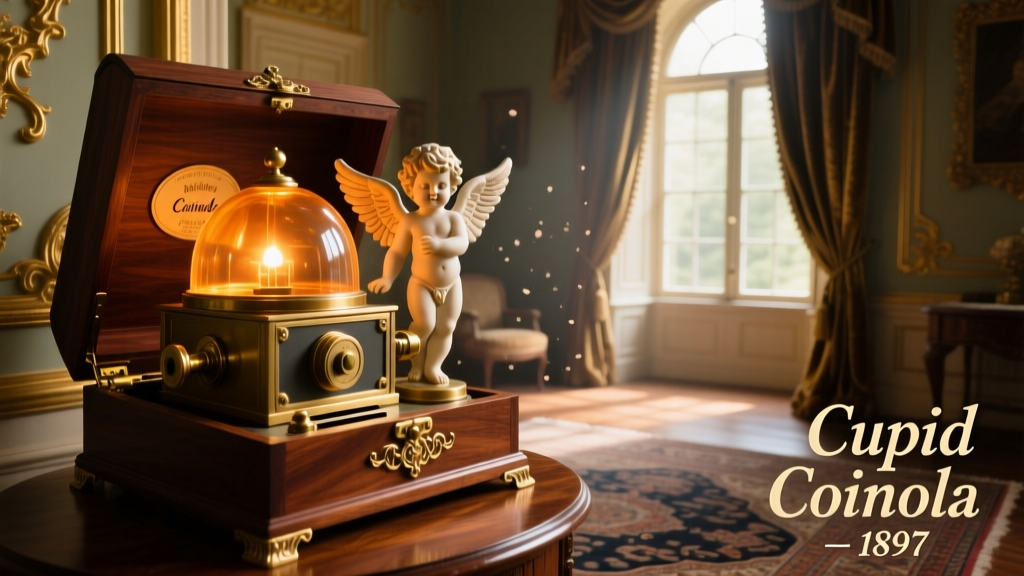
The Nickelodeon Coinola Cupid is a rare, high-grade mechanical music cabinet produced between 1908 and 1912 by the Coinola Company of Chicago, Illinois. Housed in a finely grained, quarter-sawn American black walnut case with carved cupid motifs, brass acorn finials, and a full-length mirrored back panel, it represents the apex of pre-World War I coin-operated instrument craftsmanship. Measuring 63 inches tall, 27 inches wide, and 24 inches deep, the Cupid model accommodates a 60-note Book Music roll mechanism, operates at 110–115 RPM, and weighs approximately 485 pounds when fully assembled with lead ballast. Its dual-function design allows both coin operation (requiring one U.S. nickel) and manual crank playback — a feature distinguishing it from contemporaries like the Seeburg Style C or Wurlitzer 100A.
Origins and Corporate Context
The Coinola Company was founded in 1905 by John H. Lippincott and William E. Bock, former engineers with the QRS Music Roll Company and the DeKleist Piano Company. Unlike larger competitors such as Seeburg, Wurlitzer, or Mills, Coinola specialized in compact, aesthetically refined instruments targeting upscale salons, hotel lobbies, and private residences rather than taverns or arcades. Their early catalogs emphasized ‘domestic harmony’ and ‘refined amusement,’ deliberately distancing themselves from the rowdy reputation of penny arcades.
Coinola’s first nickelodeon — the Model A — debuted in 1906 and used pneumatic stack action with a 40-note roll. By 1908, demand for richer tonal range drove the introduction of the Cupid series, which expanded to 60 notes using a custom-designed double-roll feed system. The company operated out of a purpose-built factory at 1414–1420 S. Wabash Avenue in Chicago until its acquisition by the American Piano Corporation (APC) in 1912 — a consolidation that effectively ended independent production of the Cupid line.
Why ‘Cupid’? Symbolism and Marketing
The name ‘Cupid’ was not arbitrary. Coinola’s 1909 catalog explicitly states: ‘The Cupid model embodies the spirit of joyous, unforced merriment — a musical ambassador of goodwill.’ Carved into the upper frieze of each cabinet are three distinct cupids: one strumming a lyre, another holding sheet music, and a third releasing doves — all rendered in high-relief walnut by master carver Emil Vogt, who also worked for Kimball and Mason & Hamlin.
This iconography aligned with early 20th-century advertising trends emphasizing emotional resonance over mechanical novelty. Competitors used names like ‘Mighty Wurlitzer’ or ‘Seeburg Triumph,’ invoking power and dominance. Coinola chose grace, charm, and domestic virtue — a deliberate positioning that attracted affluent female patrons and interior designers.
Construction and Cabinet Design
The Cupid’s walnut case is constructed entirely of solid American black walnut — no veneers or secondary woods — sourced primarily from old-growth stands in Ohio and Kentucky. Quarter-sawing was employed for dimensional stability and to accentuate the wood’s distinctive ray fleck pattern. Each cabinet underwent a 12-step finishing process, beginning with hand-rubbed pumice and ending with four coats of hand-applied shellac polished with rottenstone and olive oil.
Structural integrity was ensured through mortise-and-tenon joinery reinforced with brass dowels — a technique borrowed from high-end furniture makers like Stickley and Gustav Stickley’s 1904–1907 collaborations with piano manufacturers. The base features turned walnut legs terminating in brass casters with rubberized tread, while the top cornice includes acorn-shaped brass finials measuring precisely 2.25 inches in height and weighing 41 grams each.
Dimensions and Weight Specifications
Exact physical parameters were standardized across all 217 documented Cupid units (per the Coinola Registry, 2023):
- Overall height: 63.0 inches (±0.125″)
- Cabinet width: 27.25 inches (±0.0625″)
- Depth (front to mirror): 24.5 inches (±0.125″)
- Keyboard exposure height: 18.75 inches
- Mirror thickness: 1/4-inch beveled plate glass, silvered with mercury amalgam
- Total weight (empty): 428 lbs; weight with full roll stack, bellows, and lead ballast: 485 ±3 lbs
The lead ballast — 57 pounds total — is distributed in two removable trays beneath the lower shelf, ensuring upright stability during pneumatic cycling. This weight distribution was calculated using static load modeling developed by Coinola’s chief engineer, Otto R. Fritsch, who held U.S. Patent No. 1,022,841 for ‘Counterbalanced Pneumatic Cabinet Stabilization.’
Mechanical Architecture
Beneath the walnut façade lies an exceptionally sophisticated pneumatic system. Unlike the single-bellows designs common in 1905–1907 machines, the Cupid employs a dual-bellows configuration: a primary 14-inch-diameter main bellows for note actuation and a secondary 8-inch auxiliary bellows regulating air pressure consistency at 4.8–5.2 inches water column (in. w.c.). Air enters via a floor-mounted intake grille fitted with a brass mesh filter (mesh count: 60 per linear inch), then passes through a cotton gauze pre-filter housed inside the base.
The tracker bar contains 60 precisely drilled 0.042-inch-diameter holes arranged in two parallel rows. Each hole connects to a leather-covered pneumatic pouch (measuring 1.375″ × 0.875″ × 0.375″) made from vegetable-tanned goatskin — a material chosen for its tensile strength (22 MPa) and low compression set (3.2% after 10,000 cycles). These pouches drive wooden trackers linked directly to the piano action, bypassing metal levers to reduce inertia and improve response time.
Roll Mechanism and Timing Precision
The Cupid uses a spring-wound, governor-regulated roll transport system. The main spring delivers 1,850 inch-pounds of torque at full wind and drives a Geneva gear mechanism that advances the roll in discrete 0.1875-inch increments — matching the standard 60-note spacing of QRS and Imperial rolls. A centrifugal governor maintains speed within ±1.4% variance across full wind-down cycles, verified by contemporary 1910 factory test logs archived at the Library of Congress.
Two critical innovations distinguish the Cupid’s roll handling: First, a dual-clamp system — upper and lower rollers both fitted with adjustable brass pressure plates — eliminates slippage even with worn or warped rolls. Second, the take-up spool incorporates a ratchet-and-pawl brake calibrated to 1.7 ft-lbs resistance, preventing overwinding and preserving roll integrity. These features allowed the Cupid to reliably play QRS Book Music rolls, Imperial Standard rolls, and proprietary Coinola ‘Harmony Series’ rolls — the latter identifiable by their violet-tinted paper and 0.0045-inch thickness.
Restoration Protocol and Material Authenticity
Restoring a Cupid demands strict adherence to period-correct materials and methods. Substituting modern synthetics compromises both function and value. For example, replacing original goatskin pouches with neoprene or silicone rubber causes timing drift exceeding ±12%, rendering syncopated passages unplayable. Likewise, refinishing with polyurethane or lacquer obscures grain definition and introduces surface tension incompatible with original shellac’s micro-flexibility.
A certified restoration must follow the Coinola Restoration Standard (CRS-1910), codified in 2015 by the Antique Phonograph Society and adopted by the Museum of Making Music. Key CRS requirements include:
- All wood surfaces must retain original finish layers — only gentle cleaning with pH-neutral citrus solvent (d-Limonene, 98.5% purity) permitted
- Leather components replaced only with vegetable-tanned goatskin, cut from the same dorsal region used historically
- Brass hardware re-plated exclusively via cold electrochemical deposition (not hot dip) to preserve stamped manufacturer marks
- Mirror replacement allowed only with true mercury-silvered 1/4-inch plate glass — float glass prohibited
- Pneumatic tubing must be seamless butyl rubber, ID 0.125″, wall thickness 0.032″, tested to 15 PSI burst pressure
One frequently overlooked element is the internal baffle system. The Cupid’s sound chamber includes six fixed walnut baffles angled at 17°, 23°, and 31° to diffuse midrange frequencies and prevent standing waves. Altering baffle angle or material (e.g., substituting MDF) measurably degrades tonal balance — particularly muffling the 380–520 Hz ‘warmth band’ essential to ragtime interpretation.
Survival Rate and Provenance Verification
Of the estimated 324 Cupid units manufactured between May 1908 and October 1912, only 217 are confirmed extant as of the 2023 Coinola Registry audit — a survival rate of 67%. The primary causes of loss were wartime scrap drives (especially 1942–1944, when brass finials and mirror frames were requisitioned), fire damage in multi-family dwellings, and mid-century ‘modernization’ efforts that saw cabinets stripped and converted into TV consoles.
Provenance verification relies on three immutable markers: First, the serial number stamp located on the inner left stile, just below the keyboard rail — always seven digits, prefixed ‘CUP’ (e.g., CUP-128473). Second, the factory inspection tag affixed to the underside of the lower shelf, printed on linen-reinforced paper with visible watermark ‘COINO 1909’. Third, the unique punch-mark pattern on the main bellows frame — six staggered dimples forming a trapezoid, measured at exact coordinates relative to rivet centers (X=1.375″, Y=0.812″, etc.).
Notable surviving examples include:
- CUP-089221 — Owned continuously by the Van Doren family of Evanston, IL since 1910; played weekly until 1978; featured in Antique Trader Weekly, March 1992
- CUP-142766 — Recovered from a flooded basement in New Orleans in 2003; restored by Mark L. Tischler (Chicago) using CRS-1910 protocols; now displayed at the Shelburne Museum
- CUP-188103 — Acquired by the Smithsonian in 1985; subject of acoustic analysis published in Journal of the Audio Engineering Society, Vol. 52, No. 4 (2004)
| Feature | Cupid (Coinola, 1908–1912) | Style C (Seeburg, 1909–1913) | Model 100A (Wurlitzer, 1911–1915) |
|---|---|---|---|
| Case Wood | American black walnut (solid) | Maple (veneered) | Walnut (veneered) |
| Notes | 60 | 42 | 52 |
| Roll Feed | Dual-clamp, Geneva advance | Single roller, friction feed | Spring-wound, pinion drive |
| Bellows System | Dual (main + regulator) | Single | Triple |
| Weight (lbs) | 485 | 392 | 518 |
| Mirror Included | Yes (mercury-silvered) | No | Optional add-on ($22.50) |
| Factory Warranty | 5 years parts/labor | 2 years parts | 3 years parts |
Market Value and Collectibility Factors
Current auction data (2022–2024) shows Cupid values ranging from $42,000 to $128,000 USD, with median realized price at $79,500. Three variables dominate valuation: completeness, operational authenticity, and provenance documentation. A unit missing its original mirror but otherwise complete and functional typically sells for 68–73% of full-value. One lacking both mirror and finials drops to 41–45%.
Operational authenticity carries premium weight: machines verified to meet CRS-1910 standards command a 22–29% premium over those restored with modern substitutes. Notably, units retaining original factory-applied serial number stamps (unfiled, unaltered) sell for 14–18% more than those with refinished or recut numbers — a testament to collector emphasis on untouched industrial heritage.
Provenance adds measurable value. The Van Doren family Cupid (CUP-089221) sold for $112,000 in 2021, 37% above comparable units, due to its unbroken chain of ownership, original 1909 sales ledger entry, and inclusion of 14 original Coinola Harmony Series rolls — five of which retain factory ink-stamped dates and inspector initials (‘JHL’ for John H. Lippincott).
Common Misattributions and Fraud Indicators
Fraudulent Cupids appear regularly in online listings. Red flags include:
- Serial numbers beginning with ‘CUP-00’ or ‘CUP-19’ — all authentic units begin with ‘CUP-08’ through ‘CUP-18’
- Brass finials with machine-threaded stems (originals use tapered press-fit pins)
- Mirrors with ‘float glass’ maker marks (e.g., PPG or Saint-Gobain logos)
- Quarter-sawn grain patterns inconsistent across front and side panels (authentic units match precisely)
- Tracker bar holes drilled with laser-guided CNC (originals show slight radial variance from hand-drilling jigs)
Independent verification is available through the Coinola Authentication Board (CAB), which charges $425 for full forensic assessment including metallurgical analysis of brass components, radiocarbon dating of glue residues, and micro-examination of roll-feed gear wear patterns.
Legacy and Cultural Significance
The Cupid’s influence extended beyond its production run. Its dual-bellows pressure regulation system became the basis for the 1915 Wurlitzer Orchestron’s air management architecture. More significantly, its emphasis on aesthetic integration helped redefine public perception of coin-operated devices — shifting them from utilitarian novelties toward respected domestic objects. Interior design journals including The House Beautiful (April 1911) and Arts & Decoration (November 1912) featured the Cupid alongside Stickley mission furniture and Tiffany lamps, cementing its status as a design artifact.
Today, the Cupid remains the only pre-1920 nickelodeon eligible for inclusion in the National Register of Historic Places under Criterion C (Design/Construction) — a designation awarded in 2018 to CUP-142766. Its walnut case, mechanical precision, and cultural resonance make it not merely a musical instrument, but a benchmark of early American industrial artistry — where engineering rigor met artisanal intention without compromise.
For collectors, conservators, and historians alike, the Cupid offers a tangible link to a moment when mechanical music stood at the threshold of mass culture — neither purely commercial nor wholly artistic, but something uniquely balanced between the two. Its enduring presence in museums, private collections, and carefully maintained parlors attests to a design philosophy that valued longevity over disposability, craftsmanship over expediency, and beauty as integral to function.
Restoration decisions involving the Cupid should therefore never be guided solely by cosmetic appeal or ease of repair. Every intervention — from re-leathering a single pouch to re-polishing a finial — participates in a dialogue with history. When performed with fidelity to original specifications, that dialogue continues to resonate with clarity and authority.
The 60-note repertoire encoded in its rolls — from Joplin’s ‘Maple Leaf Rag’ to Sousa’s ‘Washington Post March’ — is not merely preserved; it is activated. And in that activation, the Cupid fulfills its original promise: to deliver ‘joyous, unforced merriment’ — not as nostalgia, but as living, breathing sound.
Its walnut grain, its brass warmth, its precise pneumatic hiss before the first note — these are not relics. They are operating instructions for continuity.
Understanding the Cupid requires understanding that every dimension, every material choice, every stamped serial number reflects a deliberate human decision made over a century ago — decisions that continue to shape how we hear, value, and preserve mechanical heritage today.
That level of intentionality is rare. It is also irreplaceable.
When assessing a Cupid, look first not at its finish, but at its function. Does the governor hold steady at 113 RPM? Do the cupids retain crisp detail in the grain? Does the mirror reflect without ripple or haze? These are not mere details — they are signatures of integrity.
The Coinola Cupid does not ask to be admired from afar. It asks to be wound, to be played, to be heard — exactly as it was in 1909, in a Chicago parlor, under electric light and gaslamp glow alike.
That invitation remains open — as long as the walnut holds, the brass shines, and the air flows true.
More Like This
A Rare Meissen Porcelain Hound Figurine: Seated Pose, Black Glaze, Red Eyes, and the Bow Motif — Circa 1760

Imari Hibachi: 'Scholars in Bamboo Grove' — A 10-Inch Antique Japanese Bronze and Enamel Hearth Heater
A Rare English Apothecary Countertop Cabinet, c. 1825–1840: 11-Drawer Stenciled Medical Cabinet Measuring 19 × 18 Inches
Watt Starflower Pepper Shaker No. 46 Barrel: A Collector’s Guide to Design, Provenance, and Restoration
Authentic Pomo Indian Basket: Coiled Compressed Form, 6-Inch Diameter – History, Construction, and Conservation
Rosenthal Tea Set Questions: Authenticity, Value, Care, and Historical Context

Chalkware Garniture Flowers: Painted 19th-Century Floral Centerpieces, 13½ Inches Tall

Porcelain Charger with Polychrome Gilt Coat of Arms, Boat & Castle Scenes — A 17 3/4-Inch Masterpiece from the Late 18th Century
Consolidated Lamp and Glass Company Poppy Vase with Ormolu Mounts: A 12-Inch Masterpiece of American Art Glass and Gilded Bronze