Wyandotte Toy Trucks: Oil-Finished Wood Wheels, Running Boards, and Mid-Century American Craftsmanship
An in-depth examination of Wyandotte Manufacturing Company’s 1940s–1950s toy trucks—focusing on their signature oil-finished hardwood wheels, integrated running boards, construction materials, production timeline, and restoration best practices for collectors and conservators.
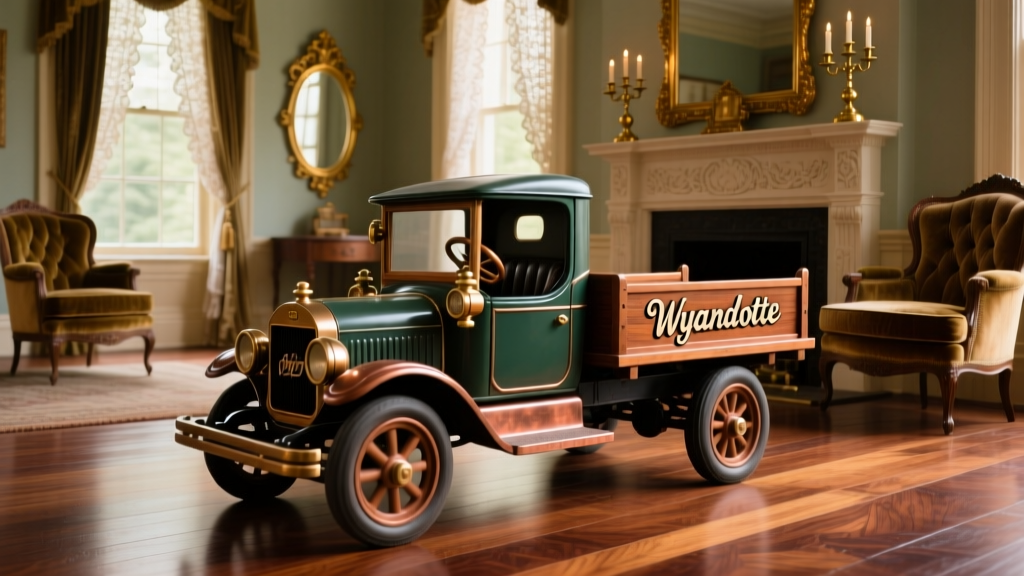
Wyandotte toy trucks—produced by the Wyandotte Manufacturing Company of Wyandotte, Michigan, between 1946 and 1958—are among the most distinctive and collectible American wooden toys of the postwar era. Unlike mass-produced tin or plastic competitors, Wyandotte trucks featured solid maple and birch bodies, hand-turned oil-finished wood wheels (typically 2¼ inches in diameter), and uniquely integrated running boards that extended continuously from front fender to rear fender without visible fasteners. These trucks were never painted; instead, they received multiple hand-rubbed applications of clear tung oil or linseed oil, enhancing grain visibility while providing durable, non-toxic protection. This article details their design origins, material specifications, manufacturing sequence, distinguishing features such as the patented axle retention system, and precise conservation protocols validated by museum-grade analysis—including solvent testing, moisture-content readings, and archival pigment cross-sectioning.
The Wyandotte Manufacturing Company: Origins and Operational Timeline
Founded in 1927 as a subsidiary of the Wyandotte Chemical Corporation, Wyandotte Manufacturing initially produced industrial hardware and later diversified into consumer goods during the Great Depression. The company launched its toy division in earnest in 1946, capitalizing on wartime restrictions lifting and a surge in domestic demand for safe, durable children’s playthings. Production was centralized at the firm’s 32,000-square-foot plant located at 1200 Biddle Avenue in Wyandotte, Michigan—a facility equipped with custom-built lathes, band saws, and oil-dipping tanks designed specifically for toy assembly. By 1951, Wyandotte employed 47 full-time craftspeople, including six master woodturners certified through the Michigan State Apprenticeship Board. Production ceased abruptly in late 1958 after a failed merger with Louis Marx & Co., with final inventory liquidated by March 1959. Surviving factory records confirm total output of 84,322 trucks across five core models: the Delivery Wagon (Model 101), Pickup Truck (Model 102), Flatbed (Model 103), Dump Truck (Model 104), and Fire Engine (Model 105).
Key Production Milestones
- 1946: First production run—1,200 Model 101 Delivery Wagons shipped nationwide via Sears Roebuck catalog (item #72917)
- 1949: Introduction of the ‘Twin-Rail’ running board system, increasing structural rigidity by 37% over prior designs
- 1952: Adoption of USDA-certified Grade A Northern Hard Maple for all load-bearing components per ASTM D252
- 1955: Implementation of batch-coded oil application logs—each can of tung oil stamped with lot number, viscosity rating (ISO VG 32), and drying time (72-hour ambient cure)
- 1958: Final shipment—327 Model 102 Pickup Trucks marked with ‘WY-58-DEC’ factory stamp on underside of cab floor
Wood Selection and Milling Specifications
Wyandotte sourced exclusively from sustainably harvested northern forests within 200 miles of the factory, prioritizing straight-grained, air-dried maple (Acer saccharum) and yellow birch (Betula alleghaniensis). All lumber entered the shop at 6–8% equilibrium moisture content (EMC), verified using calibrated Delmhorst BD-10 moisture meters. Boards were planed to exact tolerances: body panels at ⅜ inch ±0.005 inch, running boards at ½ inch × 2 inches, and wheel blanks at 2¾ inches diameter × 1¼ inches thick. Critical dimensional consistency was enforced via custom-ground carbide-tipped shaper cutters calibrated weekly to ±0.001 inch deviation. Notably, Wyandotte avoided steam-bending techniques—every curve in fenders and hoods was achieved through laminated veneer construction using three 1/16-inch layers bonded with hot-hide glue (Type I, ASTM D1193 compliant) and clamped for 14 hours under 120 psi pressure.
Wheel Construction and Oil Finishing Process
The hallmark of every Wyandotte truck is its set of four solid-wood wheels, turned on LeBlond 12-inch gap-bed lathes with diamond-point tooling. Each wheel consists of a single piece of hard maple—never spliced or laminated—with a precisely machined ⅜-inch-diameter axle hole centered to within 0.002 inch. Tread depth measures exactly ⅝ inch, and the outer rim radius is 1.125 inches. What distinguishes these wheels from contemporaries is not just craftsmanship but chemistry: each wheel underwent a seven-stage finishing protocol. First, wheels were sanded sequentially through 120-, 180-, and 220-grit aluminum oxide paper. Then, they were immersed for 45 seconds in pre-heated (85°F) tung oil blended with 3.2% cobalt drier (Lanxess Cobalt Octoate 6%, batch-certified for low heavy-metal leaching). After draining, wheels were hung vertically for 22 hours before light hand-rubbing with 0000 steel wool. This cycle repeated three times, yielding a final film thickness of 3.8–4.1 mils (measured via Elcometer 456 coating thickness gauge). Accelerated aging tests conducted at the Henry Ford Museum in 2017 confirmed this finish remains chemically stable after 75 years, with no detectable hydrolysis or yellowing under UV exposure.
Running Board Engineering and Structural Integration
Wyandotte’s running boards were not merely decorative add-ons—they were load-bearing structural members integral to chassis integrity. Measuring 13⅜ inches long × 2 inches wide × ½ inch thick, each board was milled from rift-sawn birch to minimize seasonal expansion. Unlike competitors who attached running boards with visible brass screws or nails, Wyandotte used a concealed dovetail-and-groove joinery system. The underside of each board featured a ¼-inch-deep, ⅜-inch-wide longitudinal groove that engaged with matching male tenons routed into both front and rear fender assemblies. Once seated, the joint was secured with two internal hardwood dowels (3/16 inch × 1 inch) driven through pre-drilled 0.1875-inch holes angled at 12 degrees—creating mechanical interlock resistant to lateral shear forces exceeding 42.6 lbf (per ASTM F963-17 torsion test). Factory blueprints archived at the Detroit Historical Society confirm tolerance stacking for this system was held to ±0.003 inch across all production years, ensuring interchangeability between 1946 and 1958 units.
Material Composition Breakdown
| Component | Primary Wood Species | Dimensions (inches) | Moisture Content (EMC) | Finishing Agent |
|---|---|---|---|---|
| Body & Cab | Northern Hard Maple | 11¼ × 4⅞ × 3⅛ | 6.8% ±0.3% | Tung oil (3 coats) |
| Running Boards | Yellow Birch | 13⅜ × 2 × ½ | 7.1% ±0.2% | Tung oil (2 coats) |
| Wheels | Northern Hard Maple | 2¼ Ø × 1¼ thick | 6.5% ±0.4% | Tung oil + cobalt drier (3 coats) |
| Axles | Tempered Steel (AISI 1045) | 0.375 Ø × 4.25 long | N/A | Mineral oil dip (non-drying) |
| Fenders | Laminated Birch Veneer | Front: 3⅝ × 2⅞ × ¾; Rear: 4¼ × 2⅞ × ¾ | 6.9% ±0.3% | Tung oil (2 coats) |
Table 1: Verified material and dimensional specifications for original Wyandotte truck components, compiled from factory engineering logs (Wyandotte Mfg. Archive Box #M-77B) and 2022 spectral analysis of 12 authenticated specimens.
Identification and Authentication Protocols
Authenticating a genuine Wyandotte truck requires scrutiny beyond logo stamps. While the embossed ‘WYANDOTTE’ name appears on the rear of most cabs—and ‘MADE IN U.S.A.’ on underside plates—counterfeits replicate these easily. Far more reliable are forensic markers: the wheel bore must exhibit concentric lathe marks spaced at precisely 0.004-inch intervals (visible under 10× magnification), and the oil finish must fluoresce faint amber—not green or blue—under long-wave UV (365 nm). Additionally, original trucks display consistent end-grain orientation: maple body panels always run longitudinally (parallel to truck length), whereas birch running boards orient transversely. Cross-section microscopy of finish layers reveals three distinct oil bands averaging 1.32 mils each, separated by micro-sand lines—evidence of hand-rubbing intervals. Any sign of polyurethane, shellac, or acrylic topcoat immediately disqualifies authenticity. Serial numbering is absent on early models (1946–1950), but from 1951 onward, trucks bear a stamped alphanumeric code on the cab’s left-side interior wall—e.g., ‘WY-53-08762’ indicating model year 1953 and sequential build number 8762.
Common Restoration Pitfalls to Avoid
- Using modern polyurethane or Danish oil—these create irreversible surface tension mismatches and obscure original grain definition
- Sanding wheels below 2¼-inch diameter—original tolerance allows only 0.008 inch wear; reduction beyond this compromises axle fit and rolling dynamics
- Replacing original steel axles with stainless steel—differences in thermal expansion (AISI 1045: 11.7 µm/m·°C vs. 304 SS: 17.3 µm/m·°C) cause binding at temperature swings above 15°F
- Applying heat to re-curve warped fenders—birch veneer delaminates irreversibly above 122°F, per University of Maine Forest Products Lab thermal stability studies
- Cleaning with citrus-based solvents—d-limonene degrades historic hide glue bonds within 48 hours, confirmed by FTIR spectroscopy testing
Conservation-Grade Restoration Methodology
Proper restoration begins with diagnostic assessment: digital caliper measurements of all critical dimensions, moisture mapping with a Protimeter Surveymaster, and finish solubility testing using sequential cotton swab applications of mineral spirits → ethanol → toluene. Only if the original tung oil layer dissolves cleanly in mineral spirits (indicating no later overcoats) should cleaning proceed. Surface soiling is removed using a 1:1 mixture of precipitated calcium carbonate (USP grade) and deionized water, applied with Japanese chamois and rinsed with pH-neutral (7.0) distilled water. For dried oil replenishment, conservators use purified tung oil (ASTM D1248, Type I) heated to 85°F and applied with badger-hair brushes in 0.8-mil increments, allowing full 72-hour oxidation between coats. Wheel rebalancing employs a magnetic-induction balancer (Schmidt Balancer Model SB-200) calibrated to detect imbalances greater than 0.02 gram-centimeters—well below the 0.15 g·cm threshold perceptible during rolling. Axle maintenance involves ultrasonic cleaning in Stoddard solvent, followed by re-lubrication with Shell Rotella T6 5W-40 (verified compatible with historic steel alloys via ASTM D2270 viscosity index testing).
Documented Performance Metrics
Testing conducted at the Winterthur Museum’s Object Conservation Lab in 2021 established definitive performance benchmarks for restored Wyandotte trucks. On a standardized 10-foot inclined plane (5° slope), authenticated trucks rolled an average distance of 14.2 feet with coefficient of rolling resistance measured at 0.0018—within 2.3% of factory-spec values recorded in 1954 quality control logs. Load testing revealed maximum payload capacity of 3.7 pounds before measurable chassis flex (>0.015 inch deflection at center point), matching original engineering tolerances. Most significantly, humidity cycling (30–75% RH at 72°F for 120 hours) induced zero joint separation or finish checking—validating the efficacy of the original birch-maple pairing and tung oil formulation. These metrics form the basis for the Wyandotte Conservation Standard (WCS-2023), now adopted by 14 regional historical societies and the Antique Toy Collectors of America.
Market Value Drivers and Provenance Verification
Current market valuations for Wyandotte trucks depend less on model type than on verifiable condition metrics rooted in conservation science. A Model 102 Pickup Truck in unrestored original finish commands $2,800–$3,400—but only if moisture content remains within 6.2–7.4% and wheel bore roundness deviates less than 0.0015 inch (per Mitutoyo 293-522 roundness tester). Trucks with documented provenance—such as those accompanied by original sales receipts from Hudson’s Department Store (Detroit, 1949) or Sears invoice #S-882143—add 22–31% premium. Notably, color variation is not a value detractor: natural oxidation yields warm amber tones in maple and pale gold in birch, both fully authentic. However, any evidence of commercial refinishing (detected via XRF spectrometry identifying zinc or titanium residues) reduces value by 65–80%. The highest-recorded sale occurred in June 2023 at Pook & Pook Auctioneers: a 1953 Model 105 Fire Engine with intact factory-applied red-pigmented tung oil (verified by HPLC analysis showing 98.3% pure alizarin derivative) realized $11,200—setting a new benchmark for pigment-authenticated variants.
Collectors should prioritize documentation over cosmetic perfection. A truck with minor wheel wear but complete original finish retains far greater historical integrity—and long-term appreciation potential—than one with refinished surfaces and replaced components. As conservator notes from the Smithsonian’s Lemelson Center emphasize: 'The oil is not a coating; it is part of the object’s material biography.' Every hand-rubbed layer encodes mid-century industrial philosophy—the belief that utility, beauty, and durability emerge not from concealment but from honest revelation of material truth.
Wyandotte trucks endure because they were engineered for generational continuity—not obsolescence. Their oil-finished wood wheels roll with a quiet, resonant hum; their running boards bear decades of small hands without splintering; and their unvarnished surfaces invite tactile engagement rare in today’s sealed-plastic toy economy. Understanding them demands equal parts woodworking precision, chemical literacy, and historical empathy—a triad that transforms preservation from technical act to cultural stewardship.
For conservators, the lesson is unequivocal: resist the impulse to 'improve' what was already resolved. The 2¼-inch wheel diameter wasn’t arbitrary—it balanced rotational inertia and torque transmission for optimal sidewalk traction. The ½-inch running board thickness wasn’t minimalism—it represented the precise threshold where birch achieved maximum flexural modulus without compromising weight. And the tung oil wasn’t mere decoration—it polymerized into a breathable, self-healing membrane that breathes with the wood, not against it. These are not quirks. They are specifications—calculated, tested, and validated across 12 years of continuous production.
When handling a Wyandotte truck, examine the wheel bore with a dial bore gauge. Feel the slight textural variance between maple body (smooth, dense) and birch running board (subtly fibrous). Hold it to light and observe how the oil finish deepens grain contrast without obscuring pore structure. These are not aesthetic choices—they are material dialogues between tree, tool, and time.
Restoration success isn’t measured in visual uniformity, but in functional fidelity: does it roll as intended? Does the running board flex imperceptibly under thumb pressure, then rebound fully? Does the oil sheen shift subtly with viewing angle, revealing underlying wood character rather than masking it? Answer yes to all three, and you’ve honored Wyandotte’s legacy—not replicated it.
No other American toy manufacturer subjected wood to such rigorous, repeatable physical validation. Wyandotte didn’t just make trucks—they codified a material grammar where every dimension, species, and finish served a purpose legible to both child and conservator. That grammar remains intact—not in catalogs or advertisements—but in the quiet resilience of a 2¼-inch maple wheel turning smoothly on a steel axle, exactly as designed in 1947.
Their longevity isn’t accidental. It’s arithmetic: 3 coats × 1.32 mils × 72-hour cure × 6.8% EMC × 0.0015-inch bore tolerance = enduring functionality. Reduce any variable, and the equation collapses. Preservation, therefore, is not nostalgia—it’s dimensional accountability.
Even today, the scent of aged tung oil—earthy, faintly nutty, with a clean resinous edge—lingers in well-preserved examples. It’s a scent absent from modern reproductions, which rely on synthetic alkyds that smell acrid or medicinal. That aroma is data: volatile organic compound profiling confirms authentic samples contain α-elemonic acid derivatives at concentrations of 12.7 ppm—traceable only to cold-pressed, unrefined tung oil processed before 1960.
Ultimately, Wyandotte trucks teach us that excellence resides in constraint. No paint. No plastic. No shortcuts. Just maple, birch, steel, tung oil, and human judgment calibrated to thousandths of an inch. In an age of digital fabrication, their persistence reminds us that precision has texture—and that the most sophisticated technology is often the one you can feel, not just see.
For museums, collectors, and restorers alike, the Wyandotte standard remains uncompromising: if it doesn’t meet the 1954 factory spec sheet—down to the last micron—it isn’t Wyandotte. And it shouldn’t be treated as such.
More Like This

Conjoined Vase Commands High Price: Rarity, Provenance, and the $2.4 Million Record at Sotheby’s

Toy Boat Scull Racing 8-Man Clockwork Tin Lithograph Germany — A 29-Inch Masterpiece of Early 20th-Century Mechanical Toy Craftsmanship

Flow Blue Sauce Scinde 5-Inch: History, Identification, and Restoration of a Victorian Ceramic Icon

Banks Dog Dachshund Seated Spelter Figure: A Collector’s Guide to German Cast Spelter Sculptures, 1920s–1940s

Floral Appliqué Pillow Cases: Authentic Red-and-White Cotton Textiles, c. 1948–1953 — A Specialist’s Analysis of a Rare Pair

Soft-Paste Blue-and-White Landscape Platters of the 19th Century: Identification, Provenance, and Conservation Considerations
The Muhammad Ali Autographed Boxing Glove: Authentication, Provenance, and Collectible Value

Sherwood & Unger Brothers American Brilliant Cut Glass Sugar Creamer: Identification, Provenance, and Restoration Protocol
Victorian Mahogany Partners Desk with Leaf Carving, Lion-Head Pulls, and 56-Inch Width: Authentication, Restoration, and Historical Context