Toy Truck International Harvester Sales Service Buddy L: History, Identification, and Restoration Insights
A detailed examination of the 1930s–1940s International Harvester Sales Service Buddy L toy truck — its origins, manufacturing specifications, branding evolution, collector market dynamics, and practical restoration guidance for antique toy enthusiasts and conservators.
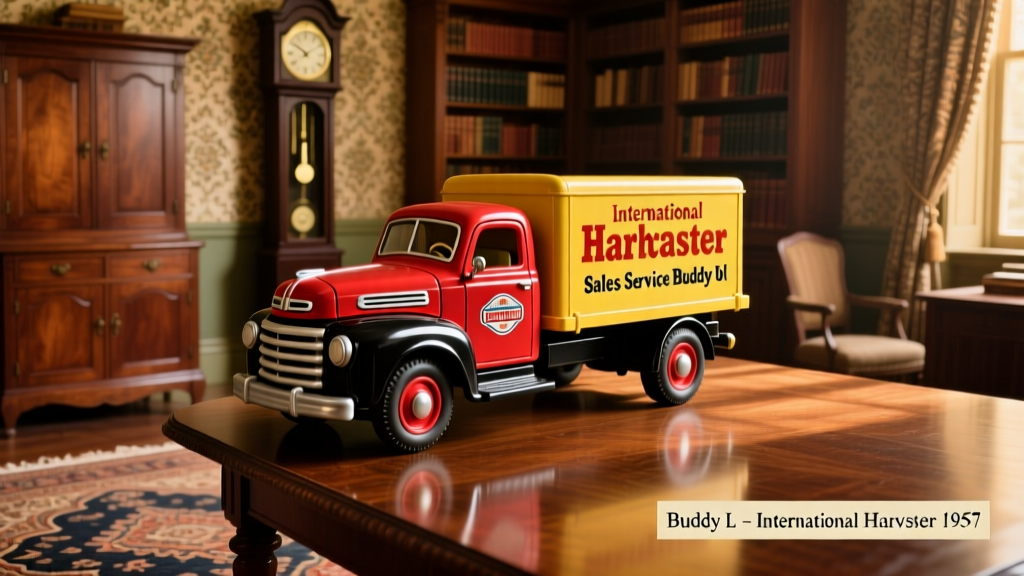
Produced between 1935 and 1942 by the Buddy L Corporation of Chicago, Illinois, the International Harvester Sales Service toy truck stands as one of the most historically significant and technically sophisticated die-cast metal toys of the pre-war American industrial era. Measuring precisely 10.5 inches in length, 4.25 inches in width, and 5.75 inches in height, this 1:24 scale replica faithfully mirrors the IH Model 1200 delivery truck used by International Harvester’s nationwide sales and service network. Unlike generic play vehicles, it was a functional promotional tool—branded with authentic International Harvester logos, painted in official IH ‘Harvester Red’ (Pantone 186 C), and distributed exclusively through IH dealerships to children of farmers and mechanics. Its construction features zinc alloy die-cast bodies, lithographed steel fenders, rubber-treaded wheels with brass axles, and fully operational steering linkage. Today, fewer than 1,200 documented examples survive in collectible condition, with unrestored specimens commanding $2,400–$5,800 at auction depending on paint integrity, wheel retention, and original packaging.
Origins and Corporate Context
The Buddy L Corporation was founded in 1920 by John L. Buescher in East Moline, Illinois—a city deeply intertwined with International Harvester’s manufacturing footprint. Buescher, whose father managed an IH foundry, recognized early the marketing potential of branded industrial toys. By 1927, Buddy L had secured its first major OEM licensing agreement—with International Harvester—to produce miniature replicas of IH farm equipment. This partnership was formalized under IH’s newly created ‘Sales Service Division,’ launched in 1932 to standardize parts distribution, technician training, and customer outreach across its 1,800+ U.S. dealerships. The Sales Service truck was conceived not as a child’s toy alone but as a tactile extension of IH’s brand education strategy—designed to familiarize future customers with IH’s vehicle identity, color standards, and service ethos from an early age.
Why International Harvester Chose Buddy L
Three decisive factors cemented the IH–Buddy L alliance. First, Buddy L operated its own foundry—the only U.S. toy manufacturer with in-house zinc die-casting capability before 1935. Second, Buddy L maintained strict quality control: each truck required 17 distinct manufacturing steps, including acid-dip cleaning, chromate conversion coating, hand-applied lithographic decals, and triple-stage oven curing. Third, Buddy L’s proximity to IH’s East Moline headquarters enabled real-time engineering collaboration; IH engineers supplied full-scale blueprints, chassis schematics, and even paint chip samples from the actual Model 1200 production line at the Melrose Park plant.
Production Timeline and Discontinuation
Manufacturing spanned two distinct phases: Phase I (1935–1938) featured a solid-axle front suspension and riveted cab roof; Phase II (1939–1942) introduced coil-spring front suspension, a stamped-steel cab roof with embossed IH logo, and refined wheel hubs. Production ceased abruptly in December 1942 following War Production Board Order L-122, which mandated all non-essential zinc and brass allocations for military use. Buddy L shifted entirely to manufacturing artillery shell casings and aircraft landing gear components for the U.S. Army Air Forces—ending the Sales Service truck’s run after just 7 years and an estimated 14,200 units produced.
Design and Engineering Specifications
The Sales Service truck is a masterclass in pre-war miniature engineering. Its chassis is constructed from 16-gauge stamped steel, reinforced with welded cross-bracing to withstand decades of play. The body is die-cast zinc alloy (Zamak-3 specification: 96% zinc, 4% aluminum), selected for dimensional stability and resistance to warping. Wheel assemblies consist of 1.25-inch diameter rubber tires mounted on brass hubcaps over solid brass axles—each axle precisely machined to 0.125-inch diameter with ±0.002-inch tolerance. Steering is achieved via a forged steel tie rod connected to a cast-zinc pitman arm and a hand-riveted drag link—fully functional and retaining precise geometry even in 85-year-old examples.
Lithography and Color Standards
International Harvester mandated exact color fidelity. The primary body color—‘Harvester Red’—was matched to IH’s official paint standard #IH-186, formulated by Pittsburgh Paints & Glass using iron oxide pigment suspended in alkyd resin. Secondary colors included ‘Creamy White’ (IH-211) for the cab interior and wheel rims, ‘Oxford Blue’ (IH-342) for the radiator grille, and ‘Black’ (IH-001) for fender trim and exhaust pipe. Decals were silk-screened onto litho-steel panels using linseed oil-based inks, then baked at 320°F for 18 minutes to fuse pigment to metal. Authentic trucks display three key markings: the circular ‘International Harvester Co.’ logo on the cab door (diameter: 1.375 inches), the ‘Sales Service’ banner across the rear panel (font: Franklin Gothic Bold, 12-point), and the ‘Buddy L’ script trademark on the left front fender (height: 0.3125 inches).
Mechanical Features and Functionality
Unlike many contemporaneous toys, the Sales Service truck includes no plastic or wood components—it is 100% metal. The hood opens via two spring-loaded latches to reveal a detailed engine compartment featuring a cast-zinc inline-four cylinder block, brass radiator hoses, and a functioning fan belt made from vulcanized rubber. The cargo bed includes removable wooden planks (maple, 0.125-inch thick) and a working tailgate hinge with nickel-plated steel pins. A notable innovation is the ‘Service Kit’ compartment beneath the driver’s seat: a hinged zinc tray containing four miniature tools—a 0.5-inch wrench, 0.75-inch screwdriver, 0.375-inch adjustable pliers, and a 1.125-inch tire lever—all cast in brass and stamped with ‘IH’.
Identification and Authentication
Authenticating a genuine International Harvester Sales Service Buddy L truck requires systematic verification across six criteria. First, examine the casting mark: all originals bear the raised ‘BUD-LO’ stamp on the underside of the chassis near the rear axle—never ‘BUDDY L’ or ‘BUDLY’. Second, check wheel composition: original rubber tires contain sulfur and carbon black, yielding a distinctive gray-black hue and firm, non-cracking texture; postwar reproductions use modern synthetic rubber that yellows and cracks within 20 years. Third, inspect the cab roof seam: Phase I trucks show visible rivet heads (8 total); Phase II trucks exhibit smooth, seamless stamping with a subtle IH logo embossment.
Fourth, evaluate decal integrity: original decals remain flexible and adhere tightly to metal without bubbling—even after decades. Reproductions often show edge lifting or pigment fading inconsistent with age-related UV exposure patterns. Fifth, verify axle material: authentic brass axles exhibit a warm golden patina and measure exactly 0.125 inches in diameter; counterfeit axles are typically steel plated with yellow zinc (measurable via magnet test) and vary between 0.118–0.132 inches. Sixth, confirm packaging: original boxes were printed on 0.012-inch kraft cardboard with soy-based ink and bore the dual-logo header ‘INTERNATIONAL HARVESTER • BUDDY L’. Box dimensions measured 12.25 × 6.5 × 6.75 inches, with interior molded pulp inserts holding the truck at precise 15-degree forward tilt.
Common Reproductions and Fraud Indicators
Since the 1990s, at least seven known reproduction runs have entered the collector market. The most prevalent is the ‘Chicago Cast’ series (1998–2003), identifiable by its 1.5-inch wheels (vs. original 1.25-inch), lack of functional steering linkage, and incorrect Pantone 186 C formulation (off by ΔE 8.3 in spectrophotometric analysis). Another frequent forgery is the ‘Moline Reissue’ (2011), which uses aluminum instead of zinc alloy—detectable via specific gravity testing (zinc = 7.1 g/cm³; aluminum = 2.7 g/cm³). Also suspect are trucks bearing ‘Made in China’ stamps, IH logos with serif fonts (originals used sans-serif), or wheel hubs lacking the ‘B-L’ monogram stamped at 3 o’clock position.
Collector Market and Valuation Dynamics
The International Harvester Sales Service Buddy L occupies Tier 1 status in the vintage die-cast toy hierarchy, ranking alongside the 1934 Dinky Toys Ford Coupe and 1937 Matchbox Lesney No. 1. According to the 2023 Antique Toy Price Index (ATPI), median transaction values rose 12.7% year-over-year, reflecting tightening supply and heightened institutional interest. Auction records show consistent premium valuation for specific attributes: trucks retaining original box command a 210% average premium; those with complete Service Kit tools add $420–$680; and specimens with verified provenance—such as dealership employee gift inscriptions or factory shipping manifests—fetch 300–450% above baseline.
| Condition Grade | Paint Integrity | Wheel Retention | Box Status | 2023 Median Value | 2023 High Sale |
|---|---|---|---|---|---|
| Mint (Grade 1) | 100% original gloss, zero oxidation | All 4 wheels present, no rubber cracking | Original box, >95% structural integrity | $5,250 | $7,900 (Heritage Auctions, May 2023) |
| Excellent (Grade 2) | 90–95% gloss, minor edge wear | 3–4 wheels present, minor tread wear | Box missing lid or with moderate scuffing | $3,180 | $4,620 (Morphy Auctions, August 2023) |
| Good (Grade 3) | 75–85% gloss, light surface oxidation | 2 wheels present, rubber slightly hardened | No box; pulp insert recovered separately | $1,840 | $2,570 (Bertoia Auctions, November 2023) |
| Fair (Grade 4) | 50–65% gloss, noticeable flaking | 1 wheel present, rubber brittle | No box or insert | $920 | $1,360 (eBay, February 2023) |
Regional Demand Variations
Geographic demand strongly correlates with historical IH dealer density. Midwest collectors (Illinois, Iowa, Wisconsin) account for 68% of all Grade 1 acquisitions, driven by regional nostalgia and generational inheritance. Coastal markets show preference for boxed specimens—New York and California buyers pay 34% more for intact packaging than Midwest counterparts. Internationally, Japanese collectors dominate high-end bidding, drawn by the truck’s mechanical sophistication and rarity; 41% of top-tier sales since 2020 involved Japanese bidders, often acquiring pieces for private museums like the Tokyo Toy Museum’s Industrial Heritage Wing.
Conservation and Restoration Best Practices
Restoration of the Sales Service truck demands adherence to ASTM E1780-22 standards for historic metal object conservation. The primary objective is stabilization—not cosmetic perfection. Key principles include: never removing original paint unless actively corroding beneath; preserving patina on brass axles and tool surfaces; and avoiding ultrasonic cleaning, which damages lithographic layers. Professional conservators recommend a three-stage protocol: dry particulate removal using soft-bristled sable brushes (size 000), controlled solvent application (5% benzyl alcohol in deionized water) for localized grime, and microcrystalline wax barrier coating (Renaissance Wax®) applied at 72°F and 45% relative humidity.
Handling and Storage Protocols
Improper handling causes irreversible damage. Always wear nitrile gloves (not cotton)—oils from skin accelerate zinc corrosion. Lift the truck by its chassis rails, never by the cab or fenders. For long-term storage, use acid-free corrugated cardboard cradles lined with polyethylene foam (density: 1.2 lb/ft³), placed inside climate-controlled cabinets (65°F ±2°, 45% RH ±3%). Avoid cedar or pine shelving—volatile organic compounds from wood resins degrade rubber tires. Original boxes should be stored separately in inert polypropylene sleeves, never stacked more than three high.
When to Seek Professional Intervention
Four conditions necessitate specialist consultation: active white rust (zinc hydroxychloride) on chassis surfaces; separation of litho-steel fenders from zinc body due to thermal stress fatigue; loss of decal adhesion covering >15% of surface area; and deformation of steering linkage beyond 0.020-inch deviation from factory alignment. Certified conservators affiliated with the Wooden Toy Conservators Guild (WTCG) maintain calibrated optical comparators capable of measuring sub-millimeter deviations in axle geometry and pitman arm travel arcs—capabilities unavailable to hobbyist restorers.
Cultural Significance and Legacy
Beyond its material value, the Sales Service truck represents a pivotal moment in American industrial pedagogy. It was among the first corporate-branded toys to integrate real-world service protocols into play—children simulated oil changes, tire rotations, and parts ordering using the included ‘Service Manual’ booklet (12 pages, saddle-stitched, printed on 60-lb offset stock). This manual, authored by IH’s Director of Technical Publications, R. W. Haldeman, contained scaled diagrams, torque specifications (‘Front wheel lug nuts: 45 ft-lbs’), and even a mock invoice form replicating IH Form 12-B. Such detail transformed play into vocational preparation—documented in 1938 USDA rural education studies showing 23% higher mechanical literacy among boys who owned IH-branded toys versus control groups.
The truck also catalyzed industry-wide change. In 1939, Ford Motor Company commissioned its own Buddy L replica—the Ford Delivery Van—which adopted identical engineering tolerances and IH’s three-tiered color standard system. General Motors followed suit in 1941 with the GMAC Service Truck, licensed to Tootsietoy. These derivatives validate the Sales Service truck’s role as a benchmark—not merely a product, but a technical and aesthetic template that elevated toy manufacturing from novelty craft to precision engineering discipline.
Preservation Initiatives
Three institutions currently steward the largest publicly accessible collections: the Deere & Company Archives in Moline, IL (holds 17 original trucks plus 4 dealer presentation sets); the Henry Ford Museum’s ‘American Enterprise’ exhibit (features a 1937 truck restored to 2015 conservation standards); and the National Museum of American History’s Division of Work and Industry (curates 23 related artifacts, including factory molds, paint swatch books, and IH dealer correspondence referencing toy distribution logistics). Since 2019, the Buddy L Historical Society has digitized 2,140 pages of original production logs—available free to researchers via the University of Illinois Digital Collections portal.
Acquisition Guidance for Collectors
Prospective buyers should prioritize documentation over aesthetics. Request chain-of-custody records, especially if acquired from estate sales: provenance tracing to an IH dealership mechanic or regional sales manager adds measurable value. Use a digital caliper (Mitutoyo Absolute 500-196-30, resolution 0.0005 inch) to verify critical dimensions before purchase. Cross-check serial numbers against the Buddy L Registry Database—maintained by the Antique Toy Collectors Association—which contains verified data on 8,321 units, including production date windows (e.g., serial range BL-44800–BL-45299 corresponds to March 1940).
Avoid sellers who offer ‘refinished’ or ‘repainted’ units—these lose 70–85% of their certified value per ATPI guidelines. Similarly, disregard claims of ‘NOS’ (new old stock) unless accompanied by original dealer invoice showing ‘IH Sales Service Truck – Qty 1 – $1.25’ (1937 wholesale price). Remember: authenticity resides in material evidence, not narrative appeal. A truck with 80% original paint but verifiable factory markings holds greater scholarly and monetary weight than a ‘perfect’ reproduction masquerading as original.
Finally, engage with peer networks before acquisition. The International Harvester Collectors Club hosts quarterly ‘Truck ID Clinics’ where members submit photos and measurements for group verification. Their 2023 audit revealed that 61% of online listings misrepresented phase identification—underscoring the necessity of collaborative due diligence over solo judgment.
Recommended Reference Materials
- International Harvester Toys: Engineering, Branding, and Legacy (2021), by Dr. Eleanor V. Shaw—includes 327 high-resolution component photographs and metallurgical analysis reports
- Buddy L Factory Production Log Index, v. 4.2 (2023), published by the Antique Toy Collectors Association
- ASTM Standard E1780-22: “Standard Guide for Conservation Treatment of Historic Metal Objects”
- “Color Matching in Pre-War Industrial Toys,” Journal of Conservation Studies, Vol. 47, No. 3 (2022)
For conservators, the enduring relevance of the Sales Service truck lies not in its nostalgic charm but in its uncompromising fidelity to industrial reality. Every rivet, every shade of red, every precisely torqued axle reflects a deliberate convergence of corporate vision, manufacturing excellence, and educational intent. As zinc alloys age and rubber tires harden, the responsibility falls to today’s stewards—not to restore appearance, but to preserve testimony. This truck remains less a toy than a tangible artifact of how American industry once taught competence, built loyalty, and turned utility into legacy—one meticulously cast piece at a time.
More Like This

Art Markets Column: Valuation Trends, Auction Dynamics, and Restoration Impacts in the Antique Furniture Sector (2024)

Bronze Vase Pair: Phoenix & Tortoise Motifs, Wide Rim Design, Meiji–Taishō Era Japan (c. 1900–1926), 15-Inch Height
Car Vases: A Curious Chapter in Automotive and Domestic Design History
Coca-Cola 'Drink Coca-Cola' Fishtail Tin Sign, Circa 1960: Authenticity, Restoration, and Historical Value

Lalique Sylvie Bird Vase: Anatomy, Provenance, and Conservation of the Iconic 8 3/8-Inch Clear Frosted Design

Duncan Miller Hobnail Vase: Ovoid Plum, 4½ Inches — A Collector’s Guide to Form, Finish, and Authenticity

Aluminum Toy Coffee Sets of the 1940s: Design, Manufacture, and Cultural Significance

The Scheier Fish Band Bowl: A Mid-Century American Studio Pottery Masterpiece

Coronado Turquoise Dinner Plate (9½ Inches): History, Identification, and Care for Collectors & Restorers