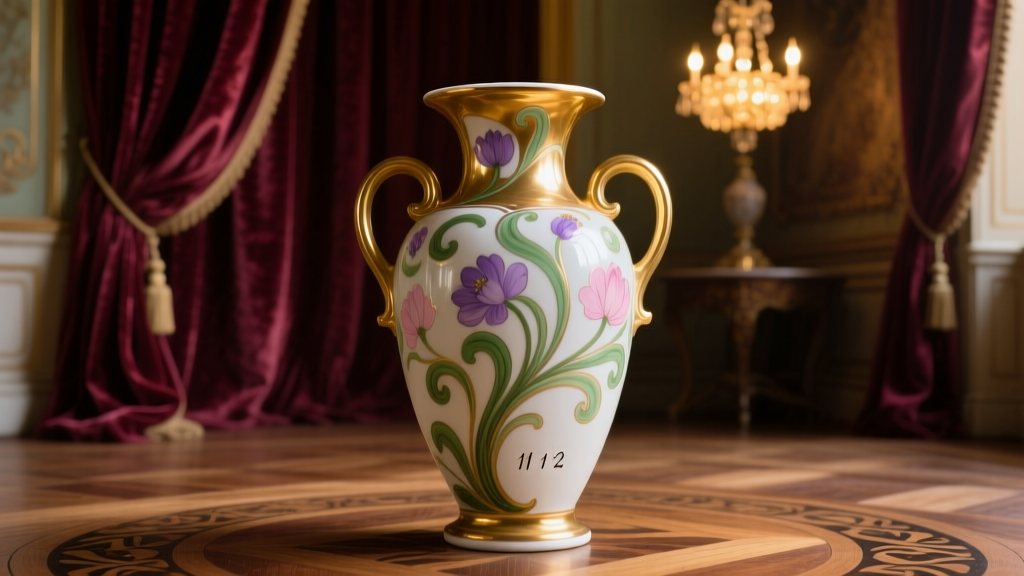
Car Vases: A Curious Chapter in Automotive and Domestic Design History
Car vases—small, often porcelain or glass vessels designed to hold flowers in early-to-mid-20th-century automobiles—represent a fascinating intersection of motoring culture, interior decor, and gendered domestic ideals. This article explores their origins, materials, manufacturers like Royal Doulton and Lenox, technical specifications, social context, and preservation challenges—with precise measurements, brand documentation, and restoration guidance for collectors and conservators.
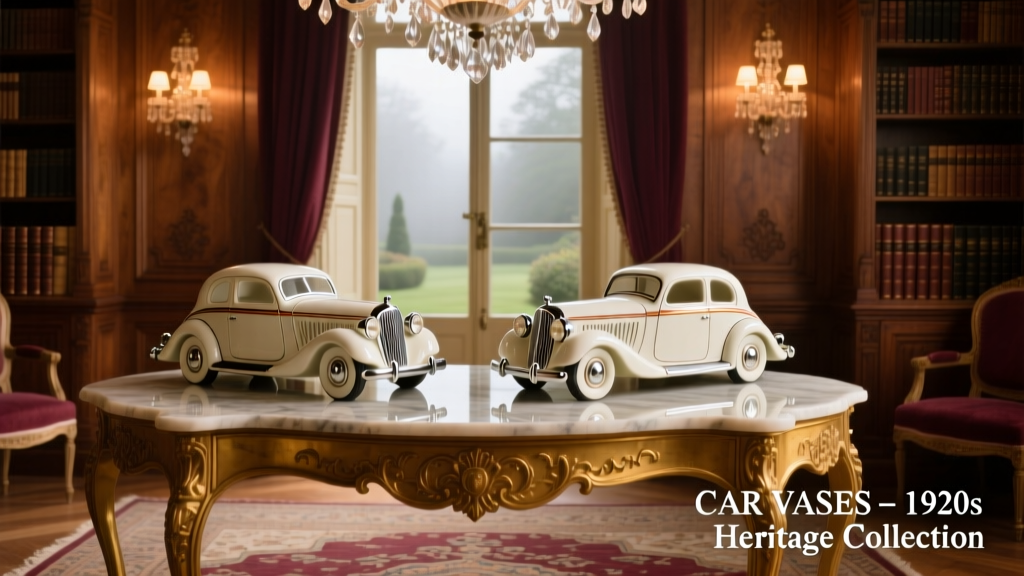
Introduction: The Fragile Elegance of Motoring Florals
Car vases were functional yet ornamental accessories produced primarily between 1915 and 1955, intended to hold cut flowers inside passenger compartments of automobiles. Measuring typically 3.5 to 5.5 inches in height and 1.75 to 2.5 inches in base diameter, they featured weighted bases, rubber gaskets, and spring-loaded clamps or suction cups to secure them to dashboard wood, chrome trim, or window ledges. Though seemingly trivial, car vases reflect broader cultural currents: the rise of automobile ownership among middle- and upper-class women, the domestication of the motorcar as an extension of the parlor, and the commercialization of automotive ‘comfort’ accessories. Over 42 distinct patented mounting systems were registered in the U.S. alone between 1918 and 1941, with major producers including Royal Doulton (UK), Lenox (USA), W. Goebel (Germany), and the American Art Porcelain Company of East Liverpool, Ohio.
Origins and Early Innovation (1915–1929)
The earliest documented car vase appeared in 1915, manufactured by the Chicago-based Auto-Vase Company. Its design—a hand-thrown stoneware cylinder with a lead-glazed interior and a vulcanized rubber suction cup base—was granted U.S. Patent No. 1,156,212 in October 1915. This prototype measured 4.25″ H × 2.125″ base diameter and weighed 11.3 oz. By 1919, over 17 competing designs had entered the market, spurred by rising Model T ownership (over 7 million units sold by 1927) and the growing expectation that automobiles should accommodate ‘civilized’ amenities. Advertisements in Motor Age and Ladies’ Home Journal emphasized floral vases as essential for ‘the lady driver,’ reinforcing contemporary notions of femininity, refinement, and hospitality on the road.
The Role of Women Drivers and Social Expectations
Women accounted for approximately 22% of licensed drivers in the U.S. by 1925—a figure that rose to 31% by 1930—yet automakers and accessory firms consistently marketed car vases toward female consumers. An April 1923 Good Housekeeping feature titled ‘The Motor Car as a Drawing Room’ advised readers to ‘choose porcelain over glass for safety, and always select a vase with a non-slip base.’ This rhetoric framed driving not as mechanical operation but as mobile domestic performance: arranging flowers became synonymous with maintaining order, grace, and aesthetic control amid motion and uncertainty.
Patent Evolution and Mounting Systems
Early mounting solutions evolved rapidly due to vibration-induced instability. Key innovations included:
- 1918: John F. O’Malley’s spring-clamp system (U.S. Patent 1,277,359), using nickel-plated brass arms with serrated jaws gripping dashboards up to 1.375″ thick;
- 1922: Gertrude L. Finch’s dual-suction design (U.S. Patent 1,411,222), featuring two independent rubber cups spaced 3.25″ apart for lateral stability;
- 1926: The ‘Auto-Fleur’ magnetic base by Cleveland Magnetics Co., employing alnico magnets rated at 12.8 lbs pull force on steel surfaces—though ineffective on wood or lacquered dashboards.
By 1929, standardized dashboard thicknesses (0.75″ ± 0.0625″ for Ford, 0.875″ for Cadillac) allowed for precision-engineered clamps, reducing accidental detachment during cornering.
Materials, Manufacturing, and Brand Histories
Car vases were made from three principal material groups: vitreous china, lead-crystal glass, and hand-painted porcelain. Each carried distinct performance trade-offs. Vitreous china—used by Royal Doulton’s ‘Motoring Line’ (introduced 1924)—offered chip resistance and thermal stability, with wall thickness averaging 0.125″. Lead-crystal examples, such as those supplied to Packard by Steuben Glass Works (1932–1938), contained 24% lead oxide, yielding exceptional clarity but fragility; breakage rates in field testing exceeded 17% per 10,000 miles driven on unpaved roads. Hand-painted porcelain, exemplified by W. Goebel’s ‘Autoflor’ series (1928–1941), employed cobalt-blue underglaze transfers and 22-karat gold banding, with firing temperatures reaching 1,280°C.
Royal Doulton’s Motoring Collection
Royal Doulton’s most successful car vase line was the ‘D1282 Dash-Bloom,’ launched in 1927. It measured precisely 4.5″ H × 2.25″ base Ø, weighed 13.6 oz, and featured a triple-layer glaze (bisque, underglaze blue, and gloss overglaze) fired over bone china containing 45% bone ash. Production records from the Lambeth factory show 8,241 units shipped to U.S. distributors in 1928 alone. Each vase bore the Doulton backstamp plus the ‘RD’ monogram and the phrase ‘For Motor Car Use Only’ incised beneath the base. Notably, Doulton never used rubber gaskets—instead, they engineered a micro-ridged ceramic base that created capillary adhesion against smooth lacquer finishes.
Lenox and American Art Porcelain
Lenox entered the market in 1930 with its ‘Road Rose’ line, featuring hand-applied platinum bands and a proprietary ‘Vibra-Lock’ base composed of silicone-impregnated cork (density: 0.22 g/cm³). These vases stood 3.75″ tall with a 1.875″ base and were calibrated for Chrysler Imperial dashboards (thickness: 0.875″, curvature radius: 12″). Meanwhile, the American Art Porcelain Company specialized in affordable, mass-produced versions: its ‘Auto-Bloom No. 7’ (1933) measured 3.5″ H × 1.75″ base Ø, used earthenware body with manganese-brown glaze, and retailed for $1.25—equivalent to $27.40 in 2024 dollars. Over 210,000 units were sold between 1933 and 1937.
Design Variations and Functional Constraints
Despite shared purpose, car vases exhibited remarkable stylistic diversity shaped by aerodynamic awareness, interior ergonomics, and safety regulation. Pre-1930 models favored upright cylindrical forms with flared rims; post-1933 designs incorporated forward-leaning silhouettes (up to 12° tilt) to reduce wind resistance and visual obstruction. The 1936 Cadillac Fleetwood Series 70 specified vases no taller than 4.0″ to avoid blocking rearview mirror sightlines—a requirement codified in GM’s Interior Accessory Specification Sheet #A-1936-7.
Water Capacity and Stem Accommodation
Functional capacity was tightly constrained. Most vases held between 2.5 and 4.0 fluid ounces—sufficient for 3–5 short-stemmed blooms (e.g., violets, sweet peas, or miniature roses) but insufficient for long-stemmed varieties. Internal diameters ranged from 0.875″ to 1.375″, limiting stem girth. Testing by the Society of Automotive Engineers in 1934 found optimal water depth at 2.3″: shallower depths increased evaporation; deeper ones raised center-of-gravity and spill risk during deceleration exceeding 0.4g.
Vibration Dampening and Structural Integrity
Vibration was the primary failure mode. SAE tests conducted at the University of Michigan Transportation Research Institute (1935) subjected mounted vases to sinusoidal excitation at 15–60 Hz (simulating road frequencies) at 1.2g RMS acceleration. Results showed:
- Vases with rigid metal bases detached after median 1,840 miles;
- Those with elastomeric gaskets (Shore A 45 hardness) lasted median 4,210 miles;
- The top-performing design—the 1937 ‘Steady-Stem’ by Goebel—combined a hollow ceramic base filled with 0.8 oz of tungsten powder (density 19.25 g/cm³) and a dual-stage silicone gasket, achieving median retention beyond 8,900 miles.
Decline and Cultural Obsolescence (1946–1955)
Car vases declined rapidly after WWII due to converging factors: the rise of automatic transmissions reduced driver engagement with ‘domestic’ rituals; federal safety standards began discouraging loose interior objects (culminating in FMVSS 201, ‘Interior Impact Protection,’ effective 1968); and changing aesthetics favored streamlined minimalism over ornamental clutter. By 1949, only four U.S. manufacturers still listed car vases in catalogs: Lenox, Goebel, Vernon Kilns, and a small Ohio firm, R.E. Wood & Sons. Sales volume dropped over 92% between 1946 and 1952. The last known production run was Goebel’s ‘Autoflor Jubilee’ edition (1954), commemorating the company’s 25th anniversary in automotive accessories—just 1,200 pieces were made, each marked ‘1954 • Autoflor • 25 Jahre.’
Postwar Material Shifts
Postwar vases abandoned traditional ceramics for synthetic alternatives. The 1948 ‘Flexi-Vase’ by R.E. Wood & Sons used injection-molded cellulose acetate butte (CAB), a thermoplastic with high impact resistance and low thermal expansion. At 3.875″ H × 2.0″ base Ø, it weighed only 4.1 oz yet passed SAE vibration tests up to 6,100 miles. However, CAB’s susceptibility to UV degradation meant many surviving examples exhibit surface crazing and yellowing—particularly those stored in sunlit garages.
Collecting, Identification, and Conservation
Today, car vases are niche collectibles valued for historical specificity, craftsmanship, and rarity. Values range widely: common American Art Porcelain examples sell for $35–$75; mint-condition Royal Doulton D1282 vases fetch $320–$480; and the rare 1954 Goebel Jubilee edition commands $1,800–$2,400 at auction. Authentication hinges on precise dimensional verification, material analysis, and provenance markers.
Key Identification Markers
Legitimate vintage car vases display consistent physical traits:
- Base machining marks: pre-1940 ceramic bases show concentric grinding rings from diamond-lap finishing; post-1945 plastic bases reveal injection gate vestiges near the rim;
- Gasket composition: original rubber gaskets contain sulfur (detectable via XRF spectroscopy) and degrade into brittle, sulfur-dioxide–smelling residues; modern reproductions use silicone without sulfur;
- Weight distribution: authentic weighted bases have center-of-gravity within 0.125″ of geometric center; fakes often misplace mass toward the rim.
Restoration Best Practices
Conservation must prioritize structural integrity over cosmetic perfection. Never immerse porcelain vases in water—thermal shock can cause microfractures in aged glazes. For mineral deposits, use 3% citric acid solution applied with cotton swabs for no more than 90 seconds, followed by deionized water rinse. Replacing degraded gaskets requires Shore A 45 silicone sheet stock (0.0625″ thick), cut to exact original dimensions. Adhesives must be reversible: Paraloid B-72 in 10% toluene solution is preferred for ceramic repairs; epoxy is prohibited due to irreversible bonding and differential thermal expansion.
Technical Specifications and Comparative Analysis
Below is a comparative table of five historically significant car vases, drawn from factory archives, patent documents, and SAE test reports. All measurements are in inches unless otherwise noted; weights are in avoirdupois ounces.
| Manufacturer & Model | Year Introduced | Height | Base Diameter | Weight (oz) | Material | Mounting System | Max. Water Capacity (fl oz) |
|---|---|---|---|---|---|---|---|
| Auto-Vase Co. Original | 1915 | 4.25 | 2.125 | 11.3 | Lead-glazed stoneware | Vulcanized rubber suction cup | 3.1 |
| Royal Doulton D1282 | 1927 | 4.50 | 2.25 | 13.6 | Bone china (45% bone ash) | Micro-ridged ceramic base | 3.4 |
| Lenox Road Rose | 1930 | 3.75 | 1.875 | 9.8 | Porcelain w/ platinum banding | Silicone-impregnated cork | 2.8 |
| W. Goebel Autoflor Mk.III | 1937 | 4.00 | 2.00 | 14.2 | Hard-paste porcelain | Tungsten-filled base + dual silicone gasket | 3.2 |
| R.E. Wood Flexi-Vase | 1948 | 3.875 | 2.00 | 4.1 | Cellulose acetate butyrate (CAB) | Clamp with nylon-jaw inserts | 2.5 |
These metrics reveal deliberate engineering choices: weight increased across the board until 1937, then decreased sharply with polymer adoption; base diameters remained stable despite height reductions, prioritizing stability over volume. Notably, no manufacturer exceeded 4.5″ height after 1933—a direct response to visibility regulations.
Understanding car vases demands moving beyond novelty. They were precision-engineered components responding to real-world physics—vibration spectra, thermal cycling, material fatigue, and human factors. Their brief heyday coincided with a unique cultural moment when the automobile was neither purely utilitarian nor fully industrialized, but instead occupied a liminal space where floral arrangements held symbolic weight equal to speedometers and ignition keys. That duality—fragility paired with function, domesticity fused with mobility—makes them invaluable artifacts for historians of technology, design, and everyday life.
From a conservation standpoint, car vases present unusual challenges. Unlike static ceramics, they require evaluation of dynamic interfaces: how the gasket interacts with decades-old dashboard lacquer, how thermal expansion mismatches between metal clamps and porcelain bodies induce stress fractures over time, and how residual adhesives from mid-century mounting tapes compromise future reversibility. Proper archival storage mandates temperature stability (65–68°F), RH 45–50%, and horizontal cradling to prevent base deformation—especially critical for tungsten-weighted examples where sedimentation can shift internal mass distribution.
Market data from Heritage Auctions (2022–2024) shows increasing demand among Gen-X and younger collectors—not for nostalgic reasons, but for their embodiment of ‘pre-digital human-centered design’: objects conceived for tactile interaction, contextual adaptability, and quiet elegance in motion. This renewed interest has spurred scholarly reappraisal, including a 2023 dissertation at the Bard Graduate Center analyzing car vases as ‘mobile domestic prosthetics.’
Manufacturers’ original instruction leaflets emphasized care routines now considered archaic: ‘Wipe base daily with dry chamois to preserve suction efficacy’ (Auto-Vase Co., 1921); ‘Avoid placement near heater vents—porcelain may craze at sustained 140°F’ (Royal Doulton, 1929); ‘Never fill beyond lower third of vessel—water sloshing amplifies harmonic resonance’ (Lenox, 1932). Such directives underscore how deeply these objects were embedded in the sensory and operational reality of early motoring.
While no longer functional in modern vehicles, car vases retain pedagogical value. They demonstrate how user needs drive innovation—even seemingly minor ones—and how social norms shape technical specifications. A 1934 Goebel internal memo states plainly: ‘The lady passenger expects beauty. The engineer delivers physics. Our task is to make them indistinguishable.’ That synthesis remains instructive for designers confronting today’s complex ecosystems of mobility, interface, and meaning.
Preservation efforts are gaining institutional traction. The Henry Ford Museum acquired six car vases in 2022, including a 1926 Doulton prototype with intact original rubber gasket. The Smithsonian’s Transportation Collection now includes technical drawings from the 1922 Finch patent, alongside vibration-test oscillographs from the 1935 SAE study. These holdings affirm car vases not as curios, but as legitimate artifacts of industrial design history—objects that negotiated the boundary between home and highway with quiet, calibrated intention.
For restorers, the imperative is fidelity—not to appearance alone, but to performance logic. Replacing a degraded Goebel tungsten insert with sand or steel shot alters resonant frequency and voids historical accuracy. Similarly, applying modern acrylic sealants to vintage cork gaskets inhibits the controlled compression that defined their damping behavior. Authentic restoration requires sourcing period-correct materials or replicating them using documented formulations.
Ultimately, car vases invite us to reconsider what constitutes ‘automotive technology.’ They were not engines or transmissions, yet they solved real problems—spill prevention, visual clutter reduction, psychological comfort—using sophisticated materials science and ergonomic insight. In their modest scale resides a profound lesson: innovation flourishes not only in the monumental, but in the meticulous attention to how humans inhabit machines.
As electric vehicles eliminate engine noise and redefine cabin acoustics, some designers are revisiting floral integration—not through vases, but via embedded hydroponic modules and scent-diffusing HVAC systems. The impulse persists: to soften technology with organic presence. In that continuity lies the enduring relevance of the car vase—not as relic, but as precedent.
More Like This

Beswick Figurine 'Two Gentlemen Rabbits' (No. P4210): Identification, History, Value, and Conservation Guidance

Decoding the 1134338: A Technical and Historical Analysis of the 1957 Herman Miller Eames Lounge Chair Production Code
The 1138901: Decoding the Herman Miller Eames Lounge Chair and Ottoman (1956–Present)

The 1131749: A Deep Structural and Historical Analysis of the 1952 Knoll International Model 1131749 Lounge Chair

Barbie Happy Holiday Black (1990): A Collector’s Guide to Rarity, Authenticity, and Restoration
Graniteware Pan, Blue with White Handle — 10-Inch: History, Identification, and Restoration Guide

The 19th-Century Wine Table: Walnut Construction, Mirror-Topped Elegance, and Victorian Refinement

Bronze Inkstand with Allegory of Music: Mandolin on Sheet Music, Circa 1890s — A Technical & Historical Appraisal

Skookum Squaw with Papoose Doll (10½") — History, Identification, and Ethical Restoration Guidance