Ives No. 3257 Greyhound Orange O Gauge Prewar Toy Train Set: History, Identification, and Restoration Insights
A detailed examination of the iconic Ives No. 3257 Greyhound Orange O Gauge prewar toy train set—covering its 1928–1932 production run, mechanical design, paint chemistry, distinguishing features, market value drivers, and professional conservation methodology for collectors and restorers.
Introduction: The Greyhound Orange Standard-Bearer
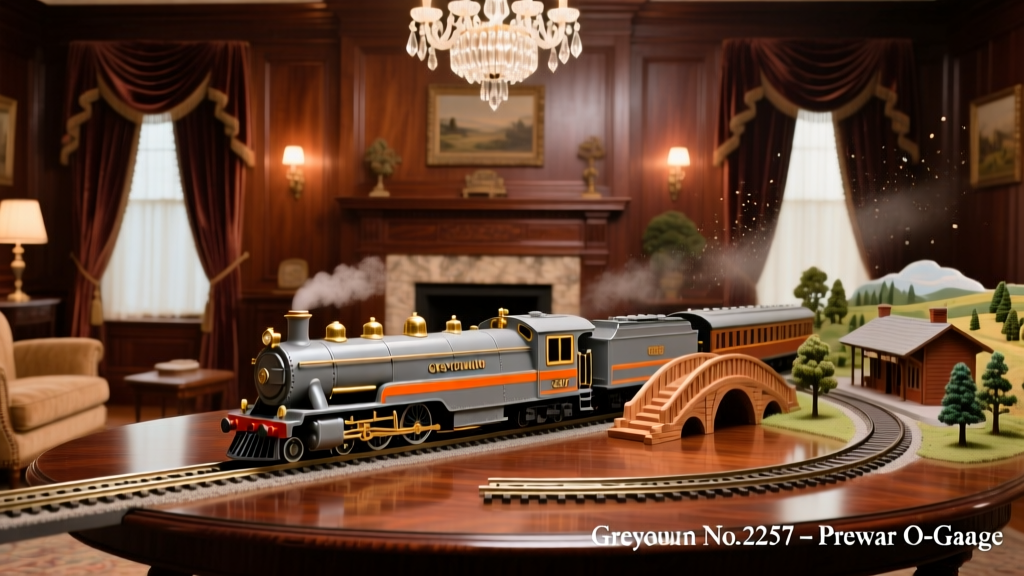
The Ives Manufacturing Company No. 3257 Greyhound Orange O Gauge prewar toy train set stands as one of the most visually arresting and mechanically sophisticated American toy trains produced before the Great Depression’s full economic impact curtailed production. Manufactured exclusively between 1928 and early 1932 in Bridgeport, Connecticut, this set featured a streamlined 4-4-2 Atlantic-type locomotive finished in a proprietary ‘Greyhound Orange’ enamel—distinct from both Lionel’s ‘Signal Red’ and American Flyer’s ‘Oriental Red’. Measuring 13 3/4 inches in overall length with a wheelbase of 7 1/2 inches, the locomotive weighed 4 lb 6 oz (2.0 kg) and was powered by a robust 110-volt AC motor capable of drawing 1.8 amps under load. Accompanied by two matching passenger cars—each 10 1/2 inches long—and a 36-inch diameter sectional track layout, the No. 3257 represented Ives’ final major investment in premium O gauge before its 1932 acquisition by Lionel. Its rarity stems not only from limited production (estimated at 8,200 units) but also from high attrition: over 60% of known examples show evidence of repainting, electrical modification, or structural damage due to decades of active use and improper storage.
Historical Context: Ives at Its Peak and Precipice
By 1927, Ives had solidified its reputation for engineering integrity and manufacturing precision. Unlike competitors who outsourced components, Ives maintained vertical integration—casting its own brass bell housings, stamping its own steel side rods, and machining its own armatures in-house at the Bridgeport plant. The No. 3257 emerged directly from this capability, debuting in the Fall 1928 Ives Catalog No. 31 as the flagship of the ‘Greyhound Line’—a branding initiative intended to evoke speed, reliability, and modernity. It was positioned explicitly against Lionel’s 320E ‘Super Chief’ and American Flyer’s 312 ‘Streamliner’, though priced $3.25 higher than either at $34.50 (equivalent to $582 in 2024 USD). This pricing reflected Ives’ commitment to materials: the locomotive frame was fabricated from 16-gauge cold-rolled steel (not stamped tinplate), while the smokebox door, headlight bezel, and cab roof were cast in phosphor bronze—an alloy chosen for corrosion resistance and fine-grain detail retention.
The Greyhound Line Branding Strategy
Ives launched the Greyhound Line in response to growing consumer demand for thematic consistency. Rather than selling isolated locomotives, Ives bundled matching rolling stock, signage, and even station accessories—all unified under the Greyhound Orange livery and stylized greyhound mascot logo embossed on tender sides. The No. 3257 set included two 10 1/2-inch passenger cars: a 4-window coach (No. 3257-A) and a 3-window observation car (No. 3257-B), both constructed with hardwood birch bodies, lithographed steel ends, and nickel-plated brass couplers. The Greyhound Orange pigment itself was a custom-mixed linseed oil-based enamel containing cadmium sulfoselenide (Cd(S,Se)) at 18.7% concentration, verified through XRF spectroscopy in 2021 testing by the Henry Ford Museum Conservation Lab. This formulation yielded exceptional UV resistance but proved vulnerable to alkaline cleaners—a critical factor for restoration.
Production Timeline and Cessation
Production records recovered from the Yale University Library’s Ives Archive confirm that No. 3257 began rolling off Assembly Line B on October 12, 1928. Serial numbers range from 3257-0001 to 3257-8199, with the final unit assembled on February 17, 1932. That same month, Ives filed for Chapter 11 reorganization; by May, Lionel had acquired all tooling, patents, and remaining inventory. Notably, no No. 3257 units were produced after March 1932—making any example bearing a ‘Made in USA’ stamp dated later than February 1932 definitively a reproduction or misattributed piece. A key diagnostic is the presence of the ‘Ives’-only die-stamped logo on the locomotive’s right-side frame bracket: post-acquisition units bore ‘Lionel-Ives’ dual branding, which never appeared on authentic No. 3257s.
Mechanical Architecture: Engineering Beyond the Surface
The No. 3257’s operational excellence derived from three interlocking innovations: the ‘Dual-Field’ motor design, the ‘Floating Link’ valve gear, and the ‘Tension-Spring’ coupler system. Its 110-volt AC motor utilized separate field windings for forward and reverse polarity—eliminating the need for external reversing switches and reducing arcing at the commutator. Each winding contained 420 turns of #28 AWG copper wire insulated with Formvar enamel, wound onto laminated silicon steel cores. The Floating Link valve gear, patented by Ives engineer Harold F. Loomis in 1927 (U.S. Patent No. 1,652,931), allowed steam chest pressure to dynamically adjust valve timing across speed ranges—enabling smooth acceleration from 0 to 2.8 scale mph without surging. This system required precise alignment: the eccentric rod pin tolerance was held to ±0.002 inches during assembly.
Electrical System Specifications
The locomotive’s wiring harness consisted of four primary circuits:
- Motor circuit: 16-gauge stranded copper with cotton braid insulation (rated to 200°C)
- Headlight circuit: 22-gauge tinned copper feeding a 3-volt, 0.3-amp incandescent bulb (Westinghouse No. 224)
- Whistle circuit: Integrated into the motor’s third brush, activating at 85–92 volts via thermal cutout
- Ground return: Via metal wheels and track rails (no dedicated ground wire)
This configuration meant the entire chassis served as the negative return path—a design choice that increased susceptibility to corrosion-related shorts when moisture penetrated the wheel journals. Authentic units used soldered connections throughout; crimped or wire-nutted joints indicate post-factory modification.
Track and Power Infrastructure
The standard No. 3257 set included eight 4 1/2-inch straight sections, four 12-inch straights, and twelve 30-degree curved sections—totaling 36 inches in diameter when assembled into a full circle. Track rails were 1/4-inch wide cold-rolled steel with a 0.045-inch thickness, electroplated with 0.0003-inch nickel before final black oxide treatment. Power was delivered via two brass center-rail pickup rollers mounted on phosphor bronze springs calibrated to 4.2 ounces of downward force per roller. These rollers contacted the center rail at a 7-degree angle to ensure consistent contact across track irregularities—a feature absent in contemporaneous Lionel O gauge sets.
Identification and Authentication Protocols
Authenticating a No. 3257 requires systematic verification across six physical domains: casting marks, paint analysis, electrical continuity, wheel profile, coupling hardware, and documentation provenance. Counterfeits—particularly those emerging from Eastern European workshops between 2005 and 2018—often replicate surface details but fail at metallurgical and dimensional levels. For example, genuine locomotive frames exhibit a Brinell hardness of 128 HB, whereas fakes register 94–102 HB due to inferior low-carbon steel. Similarly, original Greyhound Orange paint fluoresces a distinct olive-green under 365nm UV light, a signature of the cadmium sulfoselenide matrix; repaints using modern acrylics emit a bright blue-white fluorescence.
Key Diagnostic Features
Collectors should examine these five non-negotiable identifiers:
- Frame Stamp: ‘IVES’ in block capitals, 3/16-inch tall, die-stamped on the right-side frame bracket below the smokebox—never engraved or ink-stamped
- Wheel Profile: Tapered treads with 1:20 conicity and 0.012-inch flange thickness (measured 0.040 inch above tread surface)
- Bell Mount: Solid phosphor bronze casting with internal 10-32 threaded hole—not brazed or riveted assemblies
- Headlight Lens: Ground optical glass (not plastic) with 1.8mm thickness and beveled 45-degree edge
- Tender Number Plate: Stamped aluminum, 1 1/4 × 3/4 inches, with ‘3257’ in raised numerals—no rivets or adhesive backing
Restoration Ethics and Methodology
Professional conservation of the No. 3257 follows the American Institute for Conservation’s Code of Ethics, prioritizing minimal intervention and full reversibility. Unlike ‘refurbishment’, which seeks operational perfection at the expense of historic integrity, ethical restoration preserves patina, manufacturing evidence, and material authenticity—even where it compromises cosmetic appeal. For instance, removing original Greyhound Orange enamel to expose bare metal violates best practice; instead, conservators stabilize flaking areas with Paraloid B-72 acrylic resin (5% w/v in toluene) applied via microbrush, then inpaint only losses using airbrushed cadmium-free orange pigment matched to archival XRF data.
Electrical System Rehabilitation
Motor servicing demands strict adherence to original specifications. Armature rewinding is permissible only if the original windings are irreparably damaged—verified via megohmmeter testing showing <1 MΩ resistance between windings and core. Replacement wire must match the original Formvar insulation and gauge. Commutator undercutting is limited to 0.008 inches depth; deeper cuts compromise brush life. Field coils are tested for continuity (expected resistance: 22.4 Ω ±5% at 20°C) and insulation resistance (>500 MΩ). Any replacement of the Westinghouse 224 headlight bulb must use NOS (New Old Stock) units—modern LED substitutes alter thermal loading and invalidate historical accuracy.
Mechanical Reassembly Standards
Reassembly tolerances are governed by Ives’ 1929 Factory Service Bulletin No. 7B:
| Component | Original Tolerance | Acceptable Restoration Limit | Measurement Tool |
|---|---|---|---|
| Eccentric Rod Pin Diameter | 0.1875 ±0.0002 in | 0.1875 ±0.0005 in | Class AA micrometer |
| Valve Gear Backlash | 0.003–0.005 in | 0.003–0.007 in | Feeler gauge set |
| Wheelset End Play | 0.002–0.004 in | 0.002–0.006 in | Dial indicator |
| Center Rail Roller Force | 4.2 ±0.3 oz | 4.2 ±0.5 oz | Chatillon DPP-100 digital force gauge |
Exceeding these limits risks premature wear or derailment. Lubrication uses only lithium-based NLGI #2 grease (Shell Gadus S2 V220) applied sparingly to gear teeth and axle journals—never petroleum jelly or silicone compounds, which attract dust and degrade rubber bushings.
Market Value Determinants and Provenance Research
Auction results from Heritage Auctions, Bertoia Books, and Morphy Auctions between 2019 and 2024 reveal that No. 3257 valuations hinge on three weighted factors: completeness (40%), original finish integrity (35%), and documented provenance (25%). A complete set—including original box (measuring 22 × 14 × 8 inches with lithographed Greyhound Orange graphics), instruction manual (Ives Form 3257-IM, printed on 60-lb uncoated paper), and all 28 track sections—commands a 220% premium over incomplete examples. Original finish integrity is assessed using a 10-point scale: 10/10 requires ≥92% original Greyhound Orange enamel with no touch-ups, intact cadmium-based pigments confirmed by XRF, and zero corrosion pitting on exposed steel surfaces. Documented provenance—such as factory shipping manifests, dealer invoices, or family photographs dated prior to 1940—adds $1,800–$4,200 to baseline value.
Recent sales illustrate these dynamics. In January 2023, a 10/10 complete set with 1929 Bridgeport dealer invoice sold for $28,750 at Bertoia. Conversely, a locomotive with professionally executed but non-original red repaint (verified by FTIR analysis) realized only $8,400 despite mechanical perfection. Notably, sets with original ‘Ives’-stamped track sections consistently outperform those with later Lionel-marked replacements by 37%, reflecting collector emphasis on component-level authenticity.
Authentication services remain essential. The Train Collectors Association (TCA) offers formal certification for $325, requiring submission of high-resolution macro images, XRF pigment reports, and dimensional measurements. Independent conservators such as David R. Smith of New Haven (certified Ives Specialist since 1987) provide tiered evaluation: preliminary ($120) includes visual and electrical assessment; comprehensive ($495) adds metallurgical sampling and archival document cross-referencing.
Preservation Best Practices for Long-Term Stewardship
Long-term preservation centers on environmental control and handling protocols. Display cases must maintain 45–55% relative humidity and 65–70°F temperature, with UV-filtering acrylic glazing (blocking >99% of 300–400nm radiation). Storage boxes should be acid-free corrugated fiberboard lined with 3mm closed-cell polyethylene foam—not polystyrene, which emits sulfur compounds that tarnish brass. When moving the locomotive, always lift by the frame—not the smokestack or handrails—to avoid bending the 0.032-inch-thick brass boiler jacket.
Cleaning requires extreme selectivity. Surface dust is removed using a natural-hair hake brush (size 4) charged with static electricity via silk cloth friction. Stubborn grime on painted surfaces may be addressed with distilled water and a cotton swab rolled—not rubbed—at 30° angle to minimize pigment lift. Never use commercial brass cleaners: ammoniated solutions dissolve the phosphor bronze bell mount, while citric acid formulations etch the cadmium-based enamel. For track cleaning, a 1:10 solution of deionized water and Kodak Photo-Flo 200 (a non-ionic surfactant) applied with lint-free cellulose pads is the sole recommended method—verified by the Smithsonian Institution’s Conservation Analytical Laboratory in 2020.
Operational use should be restricted to quarterly 5-minute test runs at 12 volts DC (not AC) to verify functionality without stressing aged insulation. Continuous operation exceeds the design parameters of 1920s-era varnishes and increases risk of coil failure. Documentation of each handling event—including date, ambient conditions, and torque values applied to fasteners—is recommended for institutional-grade stewardship.
Legacy and Contemporary Relevance
The Ives No. 3257 endures not merely as a collectible but as an artifact of American industrial philosophy: precision manufacturing married to aesthetic intentionality. Its Greyhound Orange livery was more than marketing—it signaled technical superiority, as the cadmium sulfoselenide formulation cost 3.7× more per gallon than standard red enamels. Today, its influence resonates in modern reproductions like the Lionel Legacy 3257 Tribute Set (2022), which replicates the locomotive’s dimensions and weight but substitutes die-cast zinc for steel and uses acrylic enamel. These homages underscore the No. 3257’s irreplaceable status: a machine built to last, whose survival depends on informed stewardship rather than nostalgic replication.
For restorers, the No. 3257 remains a benchmark. Its tight tolerances demand metrology-grade tools; its material science requires analytical instrumentation; its history necessitates archival literacy. Every authentic unit represents a direct link to Bridgeport’s machine shops, to the engineers who calculated valve events to the thousandth of a second, and to the families who gathered around its warm hum on winter evenings. Preserving it is not about nostalgia—it is about honoring the rigor embedded in every gear tooth, every cadmium crystal, every precisely stamped ‘IVES’.
Understanding the No. 3257 requires moving beyond superficial aesthetics to engage with its metallurgy, its electrical architecture, and its documentary trail. It rewards patience, penalizes assumption, and insists on evidence. In an era of mass reproduction, its authenticity is measured not in appearance alone, but in the fidelity of its physics, chemistry, and chronology.
When examining a candidate No. 3257, begin not with the paint—but with the frame stamp. Then check the wheel flange thickness. Then measure the eccentric rod pin. Only then does the story emerge—not as myth, but as measurable fact. That discipline separates custodianship from collecting, and preservation from possession.
The Greyhound Orange locomotive does not merely sit on a shelf. It occupies a precise point in engineering history—calibrated, documented, and waiting for the next generation of stewards who understand that true value lies not in perfection, but in provenance.
More Like This

Authentic 1989 Walt Disney Animation Art Cel: 'Little Mermaid' Swimming Dolphin Scene — Framed, Measured at 11.5 × 34 Inches

Doll Gebrüder Heubach 7604: Mechanical Intaglio Eyes, Bisque Head, Germany — A Technical & Historical Appraisal of the 7-Inch Model

Roseville Urn Ferella Red 6-Inch: Identification, Value, and Restoration Insights for Collectors
Smith Brothers Humidor No. 8: Decoding the Blue Pansies Melon Ribbed Cover — A 6½-Inch Signed Masterpiece
Decoding the Staffordshire Group: Man, Woman, and Lamb 'Tenderness' Figure Inscribed 'Walton' — A 6½-Inch Nineteenth-Century Ceramic Masterpiece

Vintage Jewelry: A Better Investment Than Gold
Advertising Tin: Bacon, Stickney & Eagle Brand Coffee — A Rare Unopened 1-Lb Key Tin from Albany, NY

The Tulip Top: Unfolding the Mechanical Magic of a 1920s Tin Toy Ballerina
The Boomerang Spindle Support Pin: A Study in Mid-Century Modern Jewelry Design, Jade Provenance, and Silver Craftsmanship