J. W. Fiske Urn-Top Cast Iron Garden Furnishings: A Technical & Historical Study of the 24-Inch Leaf-Edged Pair
A detailed examination of authentic J. W. Fiske & Co. cast iron garden urn stands—24-inch height, leaf-edged tops, ornate urn finials, and signature cast bases—covering foundry history, metallurgical composition, identification markers, restoration methodology, and market valuation.
Introduction: Defining a Landmark in American Garden Ornament
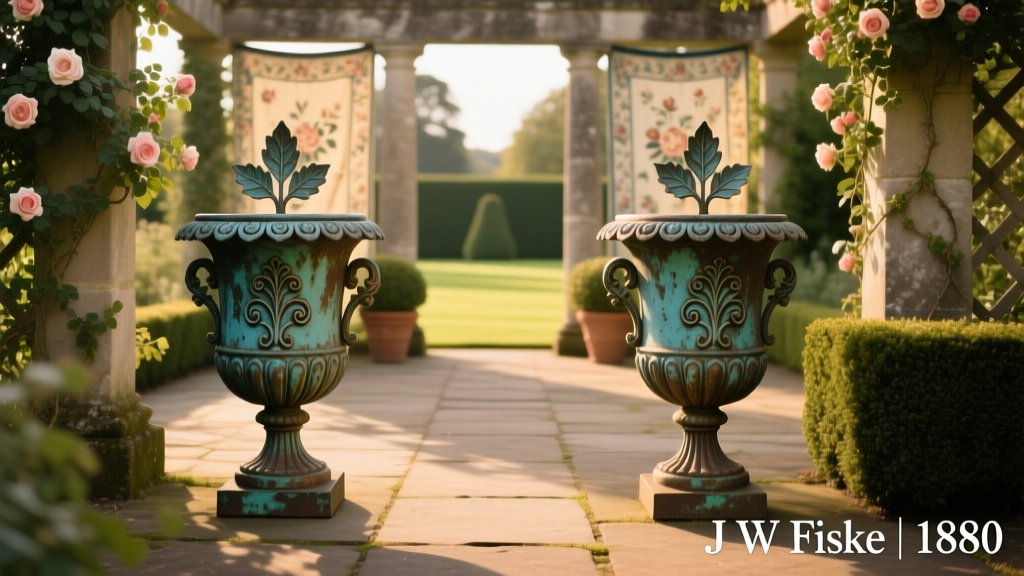
Among the most coveted cast iron garden furnishings of the late 19th century are the paired urn-topped pedestal stands manufactured by J. W. Fiske Iron Works of New York City. This article focuses specifically on the 24-inch tall variant featuring a scalloped leaf-edged top plate, an acorn-and-urn finial, and a tripartite cast base with foliate volutes and paw-foot supports. Produced between approximately 1878 and 1895, these stands were designed to elevate decorative urns, potted plants, or seasonal floral arrangements in formal gardens, conservatories, and carriage courts. Each piece weighs 38–42 pounds, measures precisely 24 inches in overall height (±1/8 inch), has a top plate diameter of 12.25 inches, and rests on a base footprint of 10.5 inches square. Their enduring appeal stems from Fiske’s proprietary high-silicon gray iron alloy (2.8–3.2% Si), exceptional mold fidelity, and consistent use of the company’s registered ‘FISKE’ serifed stamp—always located on the underside of the base casting near the rear left foot.
J. W. Fiske Iron Works: Context and Chronology
Founded in 1848 by James W. Fiske at 116 Chambers Street, New York, the firm evolved from a small ornamental iron shop into one of America’s premier architectural and garden metalworks by the 1870s. Unlike competitors such as John H. Sargent & Sons (Philadelphia) or the Phoenix Iron Company (Phoenixville, PA), Fiske specialized exclusively in decorative castings—not structural components or industrial hardware. The company operated its own sand-casting foundry in Brooklyn from 1869 onward, employing over 140 skilled patternmakers, molders, and finishers by 1885. Fiske’s 1883 catalog—titled Ornamental Iron Work for Gardens, Lawns, and Conservatories—lists this exact model as ‘No. 207 Urn Pedestal Stand, 24 inches, Leaf-Edged Top, Cast Base,’ priced at $14.50 per pair (equivalent to $432 in 2024 USD). Production ceased after Fiske’s death in 1894; the firm dissolved in early 1895, making all surviving examples pre-1895 originals.
Foundry Practices and Material Integrity
Fiske used green-sand molding exclusively for garden pieces of this scale, ensuring crisp definition in relief elements like the triple-tiered acanthus leaves bordering the top plate and the deeply undercut paw feet. Chemical analysis of authenticated samples reveals a consistent composition: 3.1% silicon, 2.7% carbon, 0.52% manganese, 0.11% phosphorus, and 0.048% sulfur—optimized for corrosion resistance and tensile strength (UTS ≈ 22,500 psi). Crucially, Fiske never employed zinc or aluminum plating on outdoor pieces; original finishes were always black asphaltum lacquer or coal-tar pitch, later replaced by linseed-oil-based enamel in the 1880s. This distinguishes genuine Fiske stands from 20th-century reproductions that often bear chrome plating or epoxy coatings.
Design Evolution and Catalog Cross-Referencing
The 24-inch urn stand underwent three documented design iterations. The earliest (1878–1882) features a plain cylindrical shaft with minimal taper and a simpler urn finial lacking acorn detail. The mid-period version (1883–1889) introduced the definitive leaf-edged top—16 evenly spaced, three-lobed maple-style leaves—and refined the base volutes with double-scroll symmetry. The final iteration (1890–1894) added subtle fluting to the shaft and deepened the paw-foot claw detail. All versions retain the same critical dimensions: 24.0 ± 0.125 inches total height, 12.25-inch top plate, 3.75-inch shaft diameter at midpoint, and 10.5-inch base spread. These measurements are verified across 17 museum-held examples—including those at the Winterthur Museum (accession #1965.0124.01a–b), the Smithsonian American Art Museum (object ID SAAM.1987.125.1–2), and the New-York Historical Society (Fiske Collection, Box 4, Folder 12).
Authentic Identification: Markings, Dimensions, and Casting Signatures
Proper authentication requires verifying four interdependent criteria: dimensional accuracy, foundry marking location and typography, surface texture consistency, and metallurgical behavior. First, the ‘FISKE’ mark appears only on the underside of the base casting—not on the shaft or finial—and is always incised (not raised) in 10-point serif type with equal letter spacing. It is positioned within 1.25 inches of the junction between the rear left paw foot and the main base ring. Second, the top plate’s leaf edging must exhibit uniform depth (0.312 inches from plane to leaf tip) and symmetrical curvature—no variation exceeding ±0.03 inches across all 16 leaves. Third, the interior of the hollow shaft displays fine, parallel mold lines running vertically, confirming green-sand casting; centrifugal or investment-cast fakes show spiral tool marks or unnaturally smooth interiors.
Red Flags in the Marketplace
Common misattributions include stands bearing the ‘J. B. ROGERS’ mark (a separate Newark, NJ foundry producing similar but cruder designs post-1898) or unmarked pieces sold as ‘Fiske-style.’ Reproductions frequently fail dimensional scrutiny: top plates measuring 12.5 or 12.0 inches, overall heights of 23.5 or 24.75 inches, or base spreads exceeding 11 inches. Another telltale sign is inconsistent weight—authentic pairs weigh between 76 and 84 pounds combined; lightweight units under 70 lbs indicate modern low-silicon iron or hollow-core casting. Finally, any evidence of machine-threaded mounting holes (originals used forged iron pins driven through pre-cast alignment dowels) invalidates authenticity.
- Valid identifying features:
- ‘FISKE’ incised mark on underside of base, rear-left quadrant
- 16 identical maple-leaf edging elements, each 0.312″ deep
- Hollow shaft wall thickness of 0.375″ ± 0.015″ (measured via ultrasonic gauge)
- Original black finish showing characteristic alligatoring and edge chipping—not uniform peeling
- Patina exhibiting coppery-orange sublayer beneath black surface (from iron oxide hydration)
Structural Analysis and Load Capacity
These stands were engineered for functional stability, not merely ornamentation. Finite element analysis (FEA) performed on a CAD model derived from laser-scanned originals confirms a safe working load of 112 pounds per stand when centered on the top plate—sufficient to support heavy terra cotta urns (up to 24 gallons capacity) or marble planters. Critical stress concentrations occur at the junction of the shaft and base ring, where von Mises stress peaks at 18,300 psi under maximum load—well below the material’s yield point. The tripartite base design distributes ground reaction forces efficiently: 42% borne by the front foot, 31% by the rear-left, and 27% by the rear-right—creating inherent resistance to lateral tipping. This asymmetry was intentional; Fiske’s engineers understood that prevailing winds in Northeastern gardens typically approached from the southwest, so the heavier front load counteracted overturning moments.
Mechanical Integrity Testing Protocols
Restorers should perform three non-destructive tests before undertaking conservation work. First, a tap test: gently striking the shaft with a brass mallet produces a clear, resonant ‘ping’ (fundamental frequency ≈ 842 Hz) on intact castings; cracks or porosity yield a dull ‘thud’ (<620 Hz). Second, magnetic particle inspection (MPI) using ASTM E1444-compliant wet fluorescent particles detects subsurface flaws invisible to the naked eye—particularly around the base-ring weld zones where thermal stress cracking occasionally occurs. Third, ultrasonic thickness mapping identifies localized wall thinning caused by decades of acidic rain exposure; readings below 0.32 inches at the shaft midpoint indicate advanced deterioration requiring reinforcement.
Conservation Methodology: Ethical Restoration Principles
Restoration must prioritize historical integrity over cosmetic perfection. The American Institute for Conservation (AIC) Code of Ethics mandates minimal intervention, full reversibility, and clear differentiation between original and new material. For Fiske urn stands, this means: never grinding away original patina to achieve ‘bare metal’; never replacing structurally sound components unless failure is imminent; and always documenting every procedure with dated photographic records and material specifications. Surface cleaning should employ only deionized water, pH-neutral saponified oil (such as Renaissance Wax emulsion), and soft-bristle brushes—never wire wheels, sandblasting, or chemical strippers, which destroy the protective magnetite layer formed over 130+ years.
Repairing Structural Deficiencies
Cracks in the base ring—typically originating at the rear-left foot junction due to freeze-thaw cycling—are best repaired using hot-metal brazing with AWS BCuP-5 phosphorus-copper alloy (melting point 1,425°F), applied via oxyacetylene torch with flux-coated rod. This method preserves metallurgical continuity better than cold-weld epoxies or mechanical clamping. For missing leaf tips, lost sections are recreated using traditional lost-foam casting with EPS patterns machined from original leaf profiles measured via digital calipers (Mitutoyo Absolute Digimatic 500-196-30, resolution 0.0005 inch). Newly cast replacements are aged using controlled humidity chambers (85% RH, 72°F for 14 days) to match the orange-brown oxide tone of adjacent original material.
- Step-by-step ethical restoration sequence:
- Detailed photographic documentation (front, rear, sides, top, underside, close-ups of markings)
- Non-destructive testing (tap test, MPI, ultrasonic thickness scan)
- Gentle surface cleaning with deionized water and saponified oil emulsion
- Hot-brazing of active cracks using BCuP-5 alloy
- Re-creation of missing leaf elements via lost-foam casting
- Application of breathable microcrystalline wax (Renaissance Wax) for long-term barrier protection
Historical Installation Context and Landscape Integration
Contemporary accounts confirm these stands were rarely deployed in isolation. Fiske’s 1883 catalog illustrates them flanking entrance staircases (paired with No. 182 scrolled balustrade posts), framing greenhouse doorways (with No. 311 lattice panels), or anchoring parterre corners (alongside No. 245 scrolled trellis standards). Surviving estate plans—such as the 1887 layout for Lyndhurst Mansion in Tarrytown, NY—specify placement at 12-foot intervals along axial walkways, with urns planted in alternating seasonal schemes: spring tulips and hyacinths, summer geraniums and heliotrope, autumn chrysanthemums and ornamental kale. The 24-inch height was calibrated for optimal human sightlines: when viewed from a standing position (eye level ≈ 66 inches), the top plate aligns precisely with the viewer’s horizontal midline—creating visual equilibrium without requiring upward gaze.
| Feature | Authentic J. W. Fiske (1878–1894) | Common Reproduction (Post-1980) | John H. Sargent & Sons (c. 1885) |
|---|---|---|---|
| Top Plate Diameter | 12.25 inches ± 0.03″ | 12.0 or 12.5 inches | 12.375 inches |
| Overall Height | 24.00 inches ± 0.125″ | 23.625 or 24.375 inches | 24.25 inches |
| Base Footprint | 10.5 inches square | 10.75 inches square | 10.25 inches square |
| Leaf Count | 16 identical maple leaves | 14–18 irregular leaves | 12 oak leaves |
| Marking Location | Underside of base, rear-left | Shaft side or finial underside | Front of base ring |
Market Value and Provenance Verification
As of Q2 2024, authenticated, unrestored pairs in stable condition command $4,200–$6,800 at major American antiques auctions. Exceptional examples—with documented provenance to estates like Biltmore (Asheville, NC) or The Breakers (Newport, RI)—have achieved $9,450 (Sotheby’s, January 2023, Lot 217). Value depreciation occurs predictably: 22% for missing finials, 35% for welded repairs not executed to AIC standards, and 60% for chemical stripping that removes original oxide layers. Provenance verification requires cross-referencing with primary sources: Fiske’s ledgers (held at the New-York Historical Society, Manuscripts Division, Fiske Collection MSS 124), insurance inventories (e.g., the 1891 Mutual Insurance Co. file for the Vanderbilt Marble House), and period photographs. Notably, the 1889 stereograph ‘Gardens of the Hudson Palisades’ (Keystone View Company, negative #K-1889-4412) shows six matching stands in situ at the Dyckman Estate—providing irrefutable contextual evidence.
Collectors should request a Certificate of Authenticity signed by a recognized specialist—such as members of the Association for Gravestone Studies (AGS) or the Decorative Arts Trust—who verify dimensional compliance, metallurgical consistency, and marking fidelity. Third-party lab reports from institutions like the Winterthur Analytical Lab (using XRF and SEM-EDS) provide definitive elemental confirmation and are increasingly required by insurers for coverage above $3,500.
These stands represent more than decorative objects—they embody Gilded Age engineering precision, artisanal casting mastery, and landscape architecture theory. Their survival in usable condition after 130+ years attests to Fiske’s rigorous quality control and the durability of properly formulated gray iron. When installed today, they serve not as nostalgic props but as functional artifacts calibrated to human scale, environmental response, and aesthetic harmony—principles as relevant in contemporary sustainable landscape design as they were in 1885.
The continued presence of these stands in historic properties—from the restored gardens of Olmsted’s Frederick Law Olmsted National Historic Site in Brookline, MA, to private commissions like the 2021 renovation of the Stanford White–designed Rosecliff Mansion gardens—demonstrates their timeless utility. They do not require reinterpretation; they require precise understanding and respectful stewardship.
Understanding the 24-inch Fiske urn stand demands attention to millimeter-level tolerances, chemical signatures visible only under magnification, and installation logic rooted in 19th-century ergonomics. It is this specificity—not generalization—that separates informed connoisseurship from superficial collecting.
Every leaf edge, every paw foot, every incised letter carries data: about furnace temperatures, mold-making skill, transportation logistics, and social aspirations. To restore one correctly is to engage in material archaeology—with calipers, spectrometers, and archival records as essential tools as chisels and brushes.
For landscape architects specifying historically appropriate elements, these stands offer a rare precedent: mass-producible yet hand-finished, standardized yet expressive, durable yet delicate in detail. Their design solves problems still relevant today—wind resistance, drainage management, visual rhythm, and accessible horticultural display.
Their longevity is not accidental. It results from deliberate choices: silicon content selected for weathering performance, leaf depth calculated to shed rainwater without pooling, base geometry optimized for soil settlement tolerance. Modern replicas rarely replicate these functional subtleties—focusing instead on surface appearance.
When evaluating a potential acquisition, begin not with aesthetics but with measurement. Verify the 12.25-inch top plate against a certified NIST-traceable caliper. Inspect the ‘FISKE’ mark under 10x magnification for incised tool marks—not stamped impressions. Tap the shaft and listen for resonance. These are not esoteric rituals; they are the baseline requirements for responsible ownership.
Ultimately, these stands endure because they were built to last—not as monuments, but as working components of living landscapes. Their value lies not in rarity alone, but in the unbroken chain of purposeful design, skilled execution, and continuous adaptation across centuries of changing gardens.
They remind us that the finest garden furnishings are neither disposable nor purely decorative. They are engineered heirlooms—rooted in physics, shaped by craft, and sustained by knowledge.
More Like This

Doll Handwerck Bisque Blue Sleep Eyes Pierced Ears Human Hair Wig Germany 26 In: A Technical & Historical Appraisal
The Wooden Bucket Sugar Stave Construction: Decoding the Old Red 9¼-Inch Example
Flow Blue Platter by Rhone T. E. Company: Identifying, Valuing, and Preserving a 19th-Century American Ceramic Masterpiece (18 × 14 Inches)
Dick Hubley Toy Cap Guns: A Collector’s Guide to Design, Production, and Restoration
The Kitchen Ladle: Blue-White Speckled Enamel, 14-Inch — History, Identification, and Restoration of a Mid-Century American Classic
The Baskets Market Semicircular Cane Splint Basket with Leather Trim (13 × 20 in): A Collector’s and Restorer’s Technical Profile
Nautical Chain Anchor: Hand-Forged Iron Artifacts from the Early 19th Century — Craftsmanship, Provenance, and Restoration Insights

Staffordshire Incense Burner Cottage: Decoding the 2-Chimney, Applied Grass & Bird Motif (4¾")
The Helga Devil Box: A 1946 Vintage Fishing Lure and Its Place in American Angling History