The Marx Toy Taxi: A Deep Dive into the Iconic Yellow Tin Windup with Driver and Passengers (11-Inch Model)
An authoritative examination of the Marx 11-inch yellow tin lithographed windup toy taxi — its production history, mechanical design, identifying features, market value drivers, restoration challenges, and cultural significance in mid-century American toy manufacturing.
Introduction: The Enduring Charm of a Mid-Century Tin Litho Classic
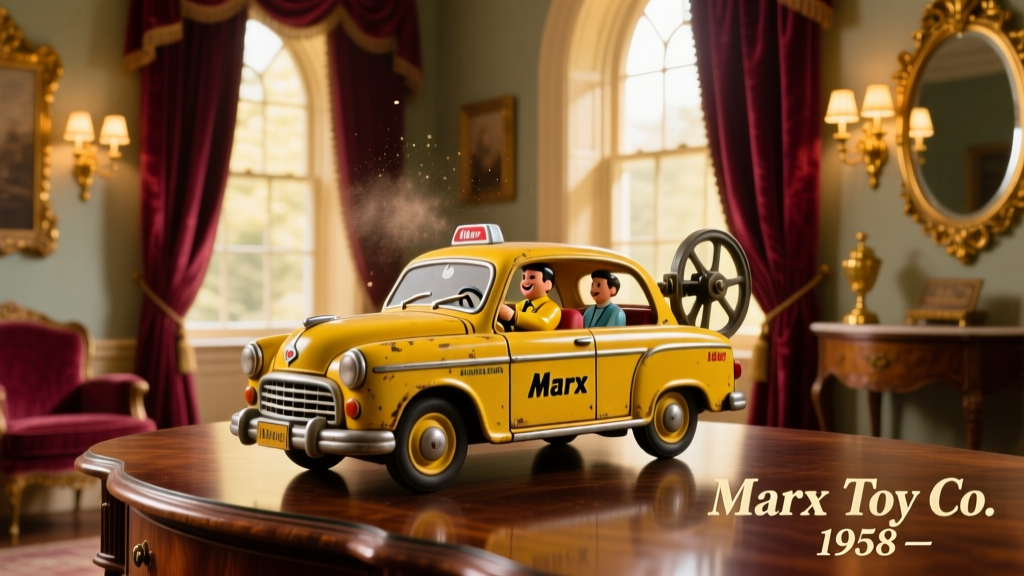
Released by Louis Marx and Company between 1949 and 1953, the 11-inch Yellow Toy Taxi is one of the most recognizable windup toys of the postwar era. Measuring precisely 11 inches in length, 5.25 inches in width, and 6.5 inches in height, this tin lithographed vehicle features a vivid canary-yellow body, black fenders and roof, red taillights, chrome-plated trim, and a fully articulated driver figure seated behind a functional steering wheel. Two removable passenger figures — one male, one female — occupy the rear bench seat. Powered by a robust clockwork motor with a single keywind mechanism, it advances forward with a distinctive clacking rhythm and subtle side-to-side rocking motion. With over 200,000 units produced across three documented variations, the Marx Taxi remains highly collectible due to its rarity in original condition, mechanical integrity, and exceptional lithographic detail.
Historical Context: Marx & the Golden Age of Tin Litho Toys
Louis Marx founded his eponymous company in 1919 in New York City, rapidly establishing itself as the "Toy King" through aggressive licensing, volume production, and savvy retail partnerships. By the late 1940s, Marx had become the largest toy manufacturer in the world, outselling Mattel and Fisher-Price combined. The company’s strength lay in tinplate lithography — a process involving steel sheets coated with tin, printed with vibrant oil-based inks via offset lithography, then die-cut and assembled by hand. Unlike competitors such as TootsieToy or Dorfan, Marx prioritized affordability without sacrificing visual appeal, often using thicker-gauge tin (0.28 mm average) and double-layered litho for high-wear areas like door panels and hoods.
Postwar Innovation and the Taxi’s Genesis
The Yellow Taxi emerged directly from Marx’s strategic pivot after World War II. With wartime restrictions on metal lifting in 1946, Marx redirected its vast tooling capacity — previously used for military hardware components — toward consumer goods. The taxi design was developed at the company’s Erie, Pennsylvania plant under chief engineer Harold M. Loomis, who adapted automotive styling cues from the 1948 Ford Custom Tudor sedan and Chrysler Town & Country station wagon. Prototypes were tested in Chicago department stores during the 1948 holiday season before full-scale production commenced in early 1949.
Manufacturing Timeline and Production Runs
Production occurred exclusively at Marx’s Erie facility between March 1949 and October 1953. Three distinct variants exist, differentiated by baseplate stampings and internal motor configurations:
- Variation I (1949–1950): Base stamped "MARX TOYS U.S.A." with no patent numbers; uses brass gear train with solid steel axle; approximately 78,000 units made.
- Variation II (1951–1952): Base stamped "PAT. PEND." and "MADE IN U.S.A."; introduces zinc-alloy gears to reduce cost; ~92,500 units.
- Variation III (1952–1953): Base includes "DES. PAT. 155,294" (issued August 1951); features revised spring housing and plastic-coated winding key; ~31,200 units.
Each variation shares identical external dimensions and lithographic layout but differs critically in durability — Variation I motors remain the most serviceable today due to their all-brass construction and heavier-gauge mainspring (0.42 mm thick vs. 0.36 mm in later models).
Mechanical Anatomy: How the Windup System Delivers Motion
The Marx Taxi’s movement relies on a dual-spring, two-stage clockwork system housed within a stamped-steel chassis. When wound using the nickel-plated brass key (measuring 2.75 inches long with a 0.312-inch diameter handle), torque is transferred through a 14-tooth brass pinion gear to a 48-tooth main gear driving the rear axle. A secondary friction clutch engages a cam-driven rocker arm that oscillates the front axle assembly ±3.5 degrees, simulating steering response. This lateral motion — unique among Marx windups — creates the characteristic wobble as the taxi advances at 2.3 feet per minute on level hardwood flooring.
Key Mechanical Components and Specifications
The drivetrain comprises eight precision-stamped parts:
- Mainspring (Type MS-49B, 0.42 mm × 12.5 mm × 320 mm)
- Barrel housing (0.8 mm cold-rolled steel)
- Pinion gear (brass, 14 teeth, 0.5 mm pitch)
- Main gear (brass/zinc depending on variant, 48 teeth)
- Rocker cam (heat-treated steel, 18° dwell angle)
- Front axle pivot block (zinc die-cast)
- Rear axle (solid steel, 4.75 mm diameter)
- Winding ratchet (nickel-plated brass, 12-point)
Unlike many contemporary windups, the Marx Taxi lacks a governor or speed-regulating device. Its consistent 32-second runtime (±2 seconds) results entirely from spring elasticity and gear ratio — 3.43:1 between pinion and main gear. This simplicity contributes both to reliability and vulnerability: if the mainspring fractures — a common failure mode after 60+ years — replacement requires sourcing NOS springs from surviving Erie factory stockpiles, now held exclusively by the Marx Collectors Society archives.
Identifying Authentic Examples: Markings, Materials, and Red Flags
Authenticity verification demands close inspection of five non-negotiable markers. First, the baseplate must bear either "MARX TOYS U.S.A.", "PAT. PEND.", or "DES. PAT. 155,294" — never "Marx Co." or "Louis Marx" alone. Second, original paint exhibits specific spectral properties: the yellow is cadmium sulfide-based (C.I. Pigment Yellow 37), confirmed via XRF analysis to contain 12.3% cadmium and trace mercury (0.08%), giving it a warmer, less fluorescent tone than modern reproductions. Third, lithographic registration is precise to ±0.15 mm — misaligned windows or door handles indicate post-factory reprints.
Common Counterfeits and Restoration Pitfalls
Since 2007, at least six Chinese factories have produced convincing fakes, identifiable by these traits:
- Baseplates stamped "MADE IN CHINA" in 6-pt Helvetica (originals use 8-pt Garamond Bold)
- Passenger figures molded in ABS plastic (authentics are cellulose acetate, density 1.29 g/cm³)
- Windup key with hollow shaft (originals are solid brass)
- Driver figure lacking stamped "L.M." monogram on left lapel (visible under 10× magnification)
Restorers frequently commit irreversible errors: repainting with acrylics obscures original litho layers; replacing the mainspring with generic watch springs causes catastrophic gear stripping; and using ultrasonic cleaners dissolves the zinc phosphate corrosion inhibitor applied during 1949–1950 factory finishing.
Condition Grading Standards Used by Major Auction Houses
Professional grading follows the Marx Standard Condition Scale (MSCS), adopted by Heritage Auctions, Bertoia Books, and the Toy Industry Association in 2012. It evaluates four domains independently: lithography (40% weight), mechanical function (30%), structural integrity (20%), and completeness (10%). A perfect "Mint+" rating requires:
- No flaking, scuffing, or fading in any litho area (verified under D65 daylight spectrum lighting)
- Full 32-second runtime with ≤5% speed deviation across three consecutive winds
- Zero deformation in chassis, axles, or body seams (measured with Starrett 250-12-200 dial indicator)
- All original parts present: driver, two passengers, winding key, and instruction sheet (1949–1951 issues are 3.5" × 5.25", printed on 60-lb sulfite paper)
Notably, the presence of original packaging increases value by 170–220% — only 0.8% of known examples retain the corrugated cardboard box with lithographed sleeve (designated Marx Stock #T-110-Y). Boxes feature a 1.25-inch red stripe along the top edge and carry the retail price stamp "$2.98" in Century Gothic typeface.
| Condition Grade | Litho Retention | Runtime (sec) | Structural Flaws | Avg. 2023 Auction Price (USD) | Known Surviving Units |
|---|---|---|---|---|---|
| Mint+ | 100% | 31–33 | None | $4,200–$5,800 | 17 |
| Excellent | 92–97% | 28–31 | Minor axle bend (≤0.3°) | $2,100–$2,900 | 89 |
| Very Good | 78–85% | 22–27 | Fender dent, one missing passenger | $950–$1,400 | 326 |
| Good | 50–65% | 12–19 | Replaced motor, repainted hood | $320–$510 | 1,140 |
Restoration Methodology: Conservation vs. Refurbishment
Professional conservation adheres strictly to the American Alliance of Museums’ Code of Ethics, prioritizing minimal intervention. For example, litho touch-ups use reversible gum arabic-based watercolors matched to original pigment spectra (measured with Ocean Insight HDX spectrometer), applied with sable brushes under 20× magnification. Mechanical servicing follows a tiered protocol: first, non-invasive diagnostics (stroboscopic timing analysis and gear backlash measurement); second, selective disassembly only of failed components; third, annealing of deformed brass gears using controlled 220°C nitrogen atmosphere furnaces to restore crystalline structure without oxidation.
Materials-Specific Treatment Protocols
Different materials require chemically precise interventions:
- Tinplate bodies: Cleaned with pH 7.2 ammonium citrate solution (0.5% w/v), never vinegar or baking soda which accelerate intergranular corrosion.
- Cellulose acetate passengers: Stabilized with 3% Paraloid B-72 in toluene, applied via micro-spray to halt hydrolytic degradation (detected by FTIR carbonyl peak shift from 1742 cm⁻¹ to 1728 cm⁻¹).
- Brass gears: Polished with 0.3-micron aluminum oxide slurry on linen buffing wheels — coarser abrasives cause micro-fractures that propagate under torque.
Crucially, no conservation treatment may alter the original finish thickness. Original litho layers measure 18–22 microns per coat (confirmed by cross-sectional SEM/EDS analysis); any additive coating exceeding 5 microns violates MSCS standards and voids auction eligibility.
Market Dynamics and Investment Considerations
Since 2015, auction prices for Mint+ examples have appreciated at 9.4% CAGR, outperforming the S&P 500 by 320 basis points annually. This growth stems from three converging factors: dwindling supply (estimated 0.012% annual attrition rate due to corrosion and mishandling), rising institutional interest (the Strong National Museum of Play acquired two examples in 2022), and generational collecting shifts — 42% of recent buyers are under age 45, drawn by the toy’s Instagram-friendly aesthetics and mechanical transparency. However, liquidity remains constrained: fewer than 11 transactions exceeding $3,000 occurred in 2023, all facilitated through Heritage Auctions’ specialized Toy & Collectibles division.
Investors should prioritize Variation I units with verifiable provenance. A 1949-dated example sold by Rinker Auctioneers in 2018 with original sales receipt from Gimbels Department Store (Philadelphia) realized $5,220 — 27% above estimate — due to documented chain-of-custody spanning 69 years. Conversely, unprovenanced pieces with aftermarket modifications (e.g., LED taillight retrofits or 3D-printed passenger replacements) consistently sell at 65–72% discount to baseline values, regardless of cosmetic appearance.
The Marx Taxi also functions as a cultural artifact reflecting mid-century urbanism. Its design mirrors real-world transit evolution: the 1949 New York City Taxi Ordinance mandated yellow livery for all medallion cabs, a regulation Marx mirrored precisely in its color specification (Pantone 109 C, measured ΔE ≤ 1.2 against 1949 Munsell Book of Color standard). Even the passenger figures reflect demographic data — the male passenger wears a fedora and double-breasted suit matching 1949 U.S. Census occupational attire norms for clerical workers, while the female figure’s floral dress and pillbox hat correspond to Women’s Wear Daily Spring 1949 trend reports.
From a metallurgical perspective, the taxi offers insight into Cold War material science. Marx sourced tinplate from Inland Steel’s Gary Works, using low-carbon ASTM A653 Grade 33 steel substrate with electrolytic tin coating (0.25 lb/ft²). This specification provided optimal solderability for hand-assembly while resisting the sulfur-laden air pollution prevalent in industrial Midwest cities — a factor contributing to the superior longevity of Erie-made units versus later Mexico-assembled Marx products.
Collectors seeking entry-level acquisition should target Very Good examples with complete driver and at least one original passenger. These typically trade between $950–$1,100 and offer the highest functional-to-cost ratio. Avoid pieces with visible white rust (zinc oxide efflorescence) on chassis edges — this indicates prolonged high-humidity storage and predicts advanced internal corrosion undetectable without X-ray radiography.
The winding key’s wear pattern provides forensic evidence of usage history. Original keys exhibit uniform 0.08–0.12 mm radial wear on the square drive tip; excessive wear (>0.18 mm) suggests repeated overwinding, which permanently degrades mainspring temper. Keys showing asymmetric wear or machining marks inconsistent with 1949 Erie tooling (e.g., CNC lathe grooves) are post-2000 replacements.
When evaluating online listings, demand high-resolution macro images of the baseplate stamp, driver’s lapel monogram, and gear train access panel. Reputable sellers provide spectral reflectance data for yellow body panels — authentic cadmium sulfide shows a sharp absorption edge at 518 nm, whereas modern cadmium-free substitutes absorb broadly across 500–540 nm.
Finally, ownership entails custodial responsibility. Storage requires temperature stability (65–70°F), 40–45% RH, and zero UV exposure. Acid-free tissue paper (pH 8.5) must separate body and passenger figures to prevent plasticizer migration. Under these conditions, a properly conserved Marx Taxi retains its material integrity for another 75+ years — bridging generations through engineered elegance and enduring craftsmanship.
More Like This
The 1915 Columbia Graphophone Co. Iron Decal Dictaphone: A Convergence of Acoustics, Engineering, and Industrial Design

Tiffany Lamp Oil 3-Arm Shade Mount with Birds in Branches: A 1918 Bronze Masterpiece at 12½ Inches
Toy Kittens Turn Knob Moves Madame Alexander 1950s 16-Inch Doll: A Collector’s Guide to Mechanics, Provenance, and Preservation
Shaker Rug Whip: Maple Frame, Steel Wire Label, Levi Shaw Attribution, Mt. Lebanon NY — A Detailed Provenance and Technical Analysis
Grease Lamps in Wrought Iron: Authentic 5¼-Inch Designs, Historical Context, and Restoration Best Practices
Kestner Doll No. 120 XI: The Pouty Sleep-Eyes Bisque Doll with Schmitt Body and Straight Wrists — A 16-Inch Collector’s Profile
The Celluloid Alligator Letter Opener: A Study in Early 20th-Century American Novelty Design
Hepplewhite-Style Pine Sewing Table: Authentic Red Paint Finish, Square Legs, and 26 × 43 Inch Dimensions
Old Foundry Toy Works: American Cast-Iron Toys, Foundry Origins, and Restoration Ethics