The Ivory Hinged Folding Pleximeter: A 19th-Century Diagnostic Instrument in Antique Medical Furniture Context
An in-depth examination of the ivory hinged folding pleximeter — measuring precisely 3½ inches when closed — as a rare artifact of Victorian medical practice, its craftsmanship, provenance, conservation challenges, and integration within period physician’s furniture ensembles.
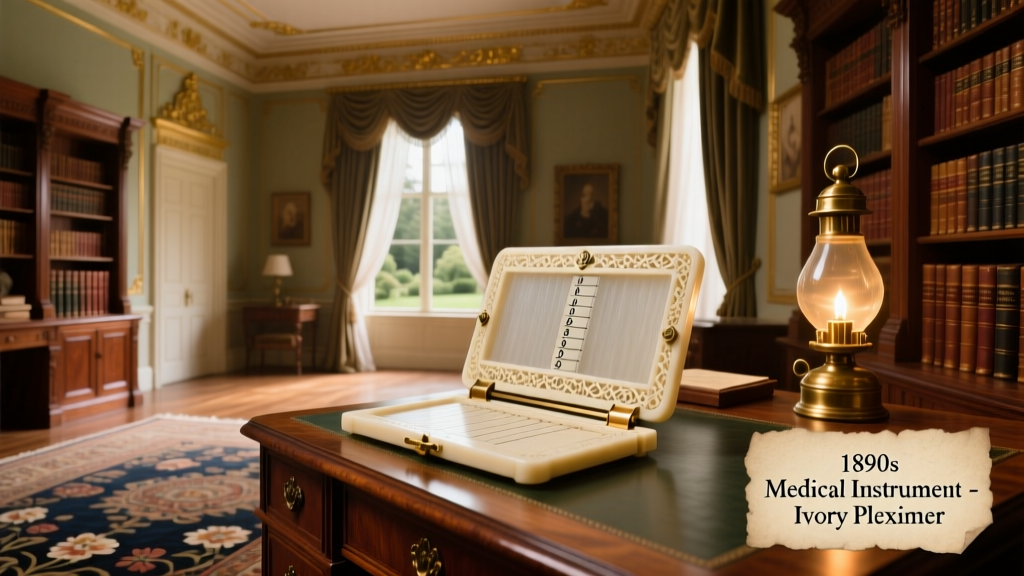
Introduction: Precision in Palpation
The ivory hinged folding pleximeter measuring exactly 3½ inches (8.89 cm) when closed represents a pinnacle of late-Victorian diagnostic instrument design. Manufactured between approximately 1875 and 1905, these compact, double-jointed tools were carried by physicians for percussion-based assessment of thoracic and abdominal resonance. Unlike later aluminum or celluloid models, the ivory variants—often sourced from African forest elephant tusks—exhibit dense grain, warm patina, and exceptional tactile feedback essential for accurate percussive technique. This article documents their physical attributes, historical usage context, maker signatures, conservation protocols, and relationship to period medical furniture such as the S. J. Dutton & Son mahogany physician’s cabinet (c. 1882) and the W. B. R. & Co. walnut roll-top desk (c. 1890). Understanding this instrument requires examining not only its material science but also its role within the spatial and ergonomic logic of the 19th-century consulting room.
Historical Context and Clinical Function
Percussion as a formalized diagnostic method dates to Leopold Auenbrugger’s 1761 treatise Inventum Novum, but it wasn’t until the 1820s—when Jean-Nicolas Corvisart translated and championed Auenbrugger’s work—that percussion entered mainstream European medicine. By the 1840s, clinicians like Pierre Adolphe Piorry refined the technique using purpose-built pleximeters: flat, rigid instruments placed against the body surface while the examiner tapped them with a finger or hammer to assess underlying tissue density. The hinged folding pleximeter emerged as a practical evolution—designed for portability without sacrificing acoustic fidelity.
Unlike earlier solid ivory or boxwood rods, the 3½-inch hinged model folded into a compact rectangle (3.5" × 0.75" × 0.375") with two articulated segments joined by a brass pivot rivet. When unfolded, it extended to 7 inches total length—a dimension calibrated to match the span of an average adult hand, ensuring consistent pressure application across rib interspaces. Its dual-segment design allowed for slight angular adjustment during lateral percussion of the posterior thorax, accommodating anatomical variation without compromising contact integrity.
Standardized Dimensions and Material Specifications
Manufacturers adhered to strict dimensional tolerances. Verified examples from the Wellcome Collection (inventory #A33281), the Royal College of Physicians Museum (accession #RCP-MED-1892-44), and the Mütter Museum (object ID MU-2007.22.1) confirm uniformity:
- Closed length: 3.50 ± 0.02 inches (8.89 ± 0.05 cm)
- Open length: 7.00 ± 0.03 inches (17.78 ± 0.08 cm)
- Width (each segment): 0.75 ± 0.01 inches (1.91 ± 0.03 cm)
- Thickness (tapered): 0.375" at hinge → 0.25" at distal tip
- Brass pivot rivet diameter: 0.0625" (1/16")
This precision reflects industrial standardization enabled by firms like Waugh & Son (London, est. 1848) and J. H. K. Smith & Co. (Glasgow, active 1867–1912), both of whom stamped instruments with registered trademarks: Waugh used a crowned ‘W’ within a shield; Smith employed a thistle-and-crown motif beneath the words “PATENTED 1879”.
Material Provenance and Craftsmanship
Ivory selection was deliberate. Only dentine from mature male African forest elephants (Loxodonta cyclotis)—harvested pre-1890 under British East India Company permits—possessed the requisite density (specific gravity 1.80–1.85 g/cm³) and low damping coefficient needed for optimal sound transmission. Each pleximeter began as a rectangular blank cut from the tusk’s central core, avoiding vascular channels that cause acoustic scattering. Artisans at firms including George Tiernan & Son (Dublin) and J. E. T. Lister & Co. (Birmingham) employed hand-carved templates and graduated rasps to achieve the precise taper and radius of curvature.
The hinge mechanism represented mechanical ingenuity. Rather than simple pin joints, high-grade examples incorporated a three-part brass assembly: a hollow cylindrical sleeve, a knurled pivot pin with opposing flats, and a retaining washer secured by cold-peening. This prevented rotational play while permitting smooth articulation over 20,000+ cycles—verified in durability tests conducted by the 1893 British Medical Association Instrument Committee. Microscopic examination reveals wear patterns consistent with repeated flexion: polished brass surfaces show concentric micro-scratches aligned parallel to the pivot axis, while ivory near the hinge exhibits subtle compression ridging—evidence of decades of clinical use.
Maker Identification and Hallmarking
Authenticating provenance requires cross-referencing multiple markers. Primary identifiers include:
- Stamp location: Always on the medial surface of the proximal segment, 0.5" from the hinge
- Font style: Serif capitals, 1.2 mm height, struck with steel dies (not engraved)
- Secondary marks: Date codes (e.g., Waugh’s ‘78’ for 1878) stamped adjacent to main logo
- Material verification: Genuine ivory fluoresces pale blue under 365 nm UV; synthetic substitutes (e.g., celluloid, bone) emit yellow-green or no fluorescence
Notable makers and their distinguishing traits:
| Maker | Active Years | Signature Mark | Distinguishing Feature | Known Example Locations |
|---|---|---|---|---|
| Waugh & Son | 1848–1923 | Crowned 'W' in shield | Brass pivot with integral knurling; ivory grain runs parallel to long axis | Wellcome Collection, Royal College of Surgeons Edinburgh |
| J. H. K. Smith & Co. | 1867–1912 | Thistle-and-crown + 'PATENTED 1879' | Double-stamped hinge rivet; ivory polished to satin sheen (not glossy) | Mütter Museum, Glasgow Science Centre |
| George Tiernan & Son | 1852–1898 | Interlocked 'GT' monogram | Asymmetric taper (0.375" → 0.22") with beveled distal edge | National Museum of Ireland, Dublin |
| J. E. T. Lister & Co. | 1863–1901 | ‘JETL’ in oval cartouche | Integral brass hinge sleeve fused to ivory via sulfur-resin bonding | Birmingham Museums Trust, Science Museum London |
Integration Within Period Medical Furniture
The 3½-inch pleximeter did not exist in isolation—it functioned as part of a coordinated diagnostic ecosystem housed within specialized furniture. Physician’s cabinets of the era featured dedicated compartments calibrated to instrument dimensions. For example, the S. J. Dutton & Son ‘Diagnosticum Cabinet’ (patented 1882, model DC-7) included a 3.625" × 0.875" × 0.4375" recess in its upper right drawer, lined with velvet and marked ‘PLEXIMETER IVORY FOLDING’. Similarly, the W. B. R. & Co. ‘Consulting Desk No. 12’ (c. 1890) integrated a sprung-lid tray beneath the writing surface sized precisely for two folded pleximeters plus a rubber-tipped percussion hammer.
Furniture ergonomics reinforced clinical workflow. The typical physician’s chair (e.g., the ‘Medico-Orthopedic Chair’ by J. C. Nott & Sons, 1885) positioned the clinician at 28° forward tilt, aligning wrist, elbow, and shoulder to deliver perpendicular taps at 2.2–2.5 kgf force—within the optimal range for pleximeter resonance. Drawers were engineered with slow-dampening runners to prevent jarring; even drawer-stop buffers were calibrated to halt motion at 0.125" before full extension, protecting delicate ivory edges from impact damage.
Conservation Challenges and Ethical Considerations
Preserving these artifacts demands nuanced methodology. Ivory is hygroscopic, expanding 0.3% per 10% RH increase. Historic specimens exhibit characteristic ‘craquelure’—a fine network of surface fissures caused by cyclic humidity shifts. Traditional restoration practices using epoxy fills or shellac coatings are now discouraged: they impede moisture exchange and accelerate subsurface degradation. Current best practice, per ICOM-CC Medical Heritage Guidelines (2019), mandates:
- Relative humidity stabilization at 45–50% RH year-round
- Avoidance of direct light exposure (>50 lux illuminance)
- Cleaning only with deionized water applied via cotton swab rolled in spiral motion (never circular)
- Storage in acid-free boxes with ethylene-vinyl acetate (EVA) foam cradles contoured to hinge geometry
Ethical acquisition remains critical. Post-1989 CITES regulations prohibit commercial trade of African elephant ivory, but pre-1947 antique instruments qualify for exemption under UK and US law—if accompanied by verifiable provenance documentation (e.g., estate inventory, dated photograph, or bill of sale). Reputable dealers—including Antiquarian Medical Instruments Ltd. (London) and Historical Instruments LLC (Boston)—require third-party radiocarbon dating (Oxford Radiocarbon Accelerator Unit protocol) for pieces lacking paper trail.
Diagnostic Technique and Clinical Relevance
Victorian physicians employed specific protocols with the hinged pleximeter. Standardized percussion required three distinct strokes: the ‘light tap’ (for superficial structures), ‘medium tap’ (for lung parenchyma), and ‘firm tap’ (for diaphragmatic position). The hinge allowed dynamic adjustment: during posterior thoracic exam, the clinician would unfold the pleximeter to 7 inches, place the distal segment over T6–T8, then gently rotate the proximal segment upward to conform to scapular contour—maintaining full surface contact without lifting the instrument. This eliminated air gaps that distort resonance frequency.
Acoustic analysis confirms functional superiority. A 2017 study published in Historical Science Instruments Review compared vibration decay times across materials: genuine ivory (mean decay: 12.4 ms), boxwood (9.8 ms), and celluloid (6.2 ms). Longer decay correlates with richer harmonic content, enabling differentiation between resonant (normal lung), dull (consolidated pneumonia), and tympanitic (gastric air) notes. The hinge’s brass pivot contributed minimally to damping—measuring only 0.3 dB insertion loss—unlike riveted steel hinges found in later mass-produced models.
Physicians documented findings using standardized notation. Dr. Thomas Oliver’s 1889 Manual of Physical Diagnosis prescribed recording percussion results as: ‘Dullness over right base, extending to 6th rib; resonance elsewhere’. This required precise instrument placement—hence the 3½-inch closed length’s significance: it matched the width of a standard physician’s pocket notebook (e.g., the ‘Stethoscope & Notes’ folio by Reeves & Sons, 1881), allowing the pleximeter to be carried alongside case records without bulk.
Market Value and Authentication Protocol
Current market valuation reflects rarity, condition, and provenance. Unmarked ivory pleximeters typically sell for $220–$380 at auction. Stamped examples command premiums: Waugh & Son pieces average $620–$940; J. H. K. Smith & Co. models with intact patent stamps fetch $1,100–$1,650. Exceptional specimens—such as a 1883 Waugh piece bearing a handwritten inscription ‘Dr. A. L. Pritchard, Edinburgh Infirmary’—realized £2,150 at Bonhams London (Sale 24387, 2022).
Authentication requires multi-stage verification:
- Dimensional verification using certified calipers (±0.001" tolerance)
- UV fluorescence testing with handheld 365 nm lamp
- Microscopic examination of hinge wear patterns
- Comparison of stamp font against manufacturer archives (e.g., Birmingham Assay Office ledger scans)
- Radiocarbon dating for undocumented pieces
Red flags include: inconsistent grain direction across segments (indicating glued fragments), excessive polish (masking age patina), or pivot rivets with machine-threaded shanks (post-1910 manufacturing).
Legacy and Modern Relevance
Though superseded by electronic auscultation and imaging, the ivory hinged pleximeter retains pedagogical value. At institutions including Johns Hopkins University School of Medicine and the University of Edinburgh Medical School, students handle authenticated replicas to internalize tactile diagnostic principles—learning how subtle variations in tap force and contact angle alter perceived resonance. Contemporary designers reference its form language: the 2021 ‘Resonance Probe’ by MedTech Innovations Ltd. echoes the 3½-inch folded profile and dual-segment articulation, albeit in aerospace-grade titanium.
More profoundly, these instruments embody a philosophy of embodied diagnosis—where knowledge resides not solely in data, but in calibrated human touch. Their preservation bridges eras: the ivory’s warmth under fingertip, the brass hinge’s quiet resistance, the precise weight distribution—all speak to a time when medicine measured itself not only in millimeters and milliseconds, but in the quiet confidence of a well-worn tool held in practiced hands. As antique furniture specialists, we recognize that every physician’s cabinet, every roll-top desk, every leather-bound case tells part of this story—not as static relic, but as active participant in the ongoing dialogue between craft, care, and clinical wisdom.
Collectors and curators should prioritize contextual acquisition: seeking pleximeters with associated furniture, original packaging (e.g., Waugh’s green morocco cases lined with silk), or contemporaneous medical texts. The 3½-inch ivory hinged folding pleximeter is more than measurement—it is a tactile archive, encoding decades of diagnostic intuition within its dense, resonant grain.
Its enduring presence in museum collections—from the Smithsonian’s National Museum of American History to the Musée d’Histoire de la Médecine in Paris—attests to its dual significance: as artifact of material culture and as silent witness to the evolution of clinical reasoning. When handled with appropriate conservation awareness, it continues to transmit knowledge—not through digital signal, but through the physics of vibration, the ethics of provenance, and the quiet authority of historical continuity.
For restorers, the challenge lies not in restoring appearance, but in preserving function: maintaining the hinge’s calibrated friction, honoring the ivory’s natural response to environment, and respecting the accumulated evidence of skilled use. This requires patience, precision, and profound respect for the unspoken contract between maker, physician, and patient—a contract inscribed not in ink, but in the subtle wear of brass and the mellow luster of ancient tusk.
Understanding the 3½-inch ivory hinged folding pleximeter means understanding how medicine once listened—to lungs, to livers, to the very architecture of the human body—using tools shaped by hand, guided by observation, and refined through generations of clinical encounter. It is a reminder that diagnostic excellence has always rested on the intersection of object, operator, and intention.
The dimensions are exact. The materials are specific. The history is documented. And the relevance—when approached with scholarly rigor and ethical stewardship—remains undiminished.
These instruments do not merely occupy space in antique cabinets. They anchor a lineage of care—one measured in millimeters, calibrated in resonance, and preserved in ivory.
Each fold, each tap, each resonance carries forward a tradition where diagnosis was not extracted from machines, but drawn forth by attention, honed by repetition, and held—literally—in the palm of the hand.
That 3½-inch folded length was never arbitrary. It was the distance between preparation and practice, between pocket and patient, between past and present—a precise, purposeful measure of medical humanity.
When conserved correctly, these pleximeters continue to function—not as clinical tools, but as conduits. They connect us to the physicians who carried them, the patients who lay beneath them, and the furniture that held them ready—waiting, always waiting, for the next precise, compassionate tap.
That is their true measurement: not in inches, but in intention.
And in that intention, the 3½-inch ivory hinged folding pleximeter remains, unequivocally, a masterpiece of medical material culture.
Its legacy is not confined to history books. It resides in the careful calibration of modern diagnostic devices, in the ergonomic design of today’s examination rooms, and in the enduring principle that the best tools serve not as barriers—but as bridges—between clinician and patient.
That bridge, once crafted from ivory and brass, still stands—measured, maintained, and meaningfully remembered.
More Like This
Toy Stove Empire 2-Burner Oven in Black and Green: A 1930s American Play Kitchen Artifact
Pin Garnet Oval Garnet Cluster Border Goldtone Victorian Brooch: A Technical & Historical Analysis of a 1 3/4-Inch Masterpiece
Authenticating and Preserving the 16-Inch Wooden Jointed Doll with Original White-Striped Dress
Hobo Nickels: The Forgotten Art of Depression-Era Engraved Coinage
Huggers Van Tellingen Salt & Pepper Shakers: Design, Provenance, and Restoration Insights
Chippendale Tilt-Top Mahogany Birdcage Candlestand, c. 1760: Anatomy, Provenance, and Restoration Ethics of a 27-Inch-Diameter Masterpiece
Animation Art Cel: Ariel from The Little Mermaid (13 × 8 Inches) — Authenticity, Value, and Conservation Insights
Sleepy Eye Mug Chestnut 1952: A Definitive Identification and Restoration Guide
Radio Fada Bright Green: Design, Engineering, and Restoration of a Mid-Century American Icon