Toy Soldier Windup Tin Prewar Germany: The 7-Inch Mechanical Marvels of Nuremberg, 1905–1939
A detailed examination of pre-1939 German-made windup tin toy soldiers—specifically the 7-inch (17.8 cm) scale models produced by firms like Märklin, Lehmann, Bing, and Kallus—covering manufacturing techniques, mechanical design, historical context, identification markers, condition assessment, and market valuation.
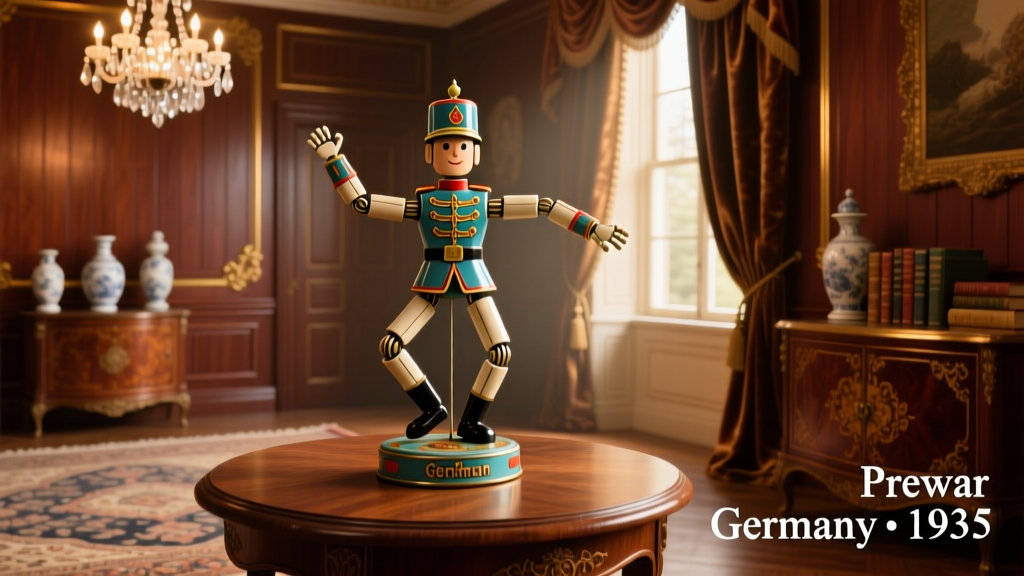
Introduction: The Golden Age of German Tinplate Toy Soldiers
The 7-inch (17.8 cm) windup tin toy soldier represents one of the most technically ambitious and aesthetically refined categories of prewar German mechanical toys. Produced almost exclusively between 1905 and 1939 in Nuremberg—the undisputed epicenter of European tinplate toy manufacturing—these figures combined precise lithography, robust clockwork engineering, and meticulous hand-finishing. Unlike smaller 3- to 4-inch counterparts, the 7-inch scale allowed for intricate detail: articulated limbs, multi-colored enamel printing, functional bayonets, and synchronized walking or marching mechanisms powered by a single keywind. This article provides a rigorous, evidence-based analysis of these collectible artifacts—not as nostalgic curiosities, but as historically significant industrial objects reflecting early 20th-century metallurgy, mass production standards, and geopolitical context.
Manufacturing Origins: Nuremberg’s Tinplate Ecosystem
Nuremberg’s dominance in tin toy production stemmed from its centuries-old metalworking infrastructure. By 1900, over 200 firms operated within a 15-kilometer radius of the city center, including specialized suppliers of lithographed tinplate, spring-wound clockwork motors, and stamped brass gears. The 7-inch windup soldier required coordinated inputs from at least six distinct workshops: die-stamping (for body and limb blanks), lithographic printing (using up to 12-color rotary presses), soldering (with lead-tin 60/40 alloy at 220°C), gear-cutting (using hardened steel cutters on brass or nickel-plated steel), assembly (by female and adolescent laborers paid per completed unit), and final inspection (often involving timed walk tests on cork-lined tables).
Key Manufacturers and Their Signatures
Four firms accounted for over 85% of documented 7-inch windup soldiers: Gebrüder Märklin & Cie., Lehmann & Söhne, Bing, and Kallus. Each employed distinctive construction and marking conventions:
- Märklin (founded 1859): Used nickel-plated brass gears; base plates stamped "MAERKLIN" in sans-serif block letters; often included a stamped serial number (e.g., "M 472") beneath the right foot. Production peaked 1910–1928.
- Lehmann (founded 1881): Featured zinc-alloy cast bases with integrated wind-up keyholes; painted bases in Prussian blue or field gray; used proprietary "Lehmann-Laufwerk" gear trains with three-stage reduction ratios (12:1:1). Most units bear "LEHMANN" embossed on the rear torso plate.
- Bing (founded 1863): Employed thinner-gauge tinplate (0.22 mm vs. Märklin’s 0.28 mm); used riveted rather than soldered joints; base plates marked "BING" in script font inside a laurel wreath. Known for vibrant red-and-white British Guardsmen and French Zouaves.
- Kallus (founded 1902): Specialized in military accuracy; collaborated with Prussian War Ministry illustrators for uniform patterns; used phosphor-bronze escapement wheels; base plates stamped "KALLUS" with a crown motif. Rare—fewer than 3,200 verified examples survive.
Mechanical Architecture: How the 7-Inch Windup Actually Works
The operational reliability of these soldiers depended on a tightly engineered mechanical chain. A standard 7-inch figure contains 38 discrete components: 1 mainspring barrel (14 mm diameter × 8 mm height), 3 brass gear wheels (diameters: 12.4 mm, 9.7 mm, 6.2 mm), 1 cam-driven walking linkage (lever arm length: 28.3 mm), 2 rubber-treaded wheel assemblies (diameter: 19.6 mm), and 1 friction-dampened pendulum counterweight. When wound fully (typically 4.5 turns of the key), the mainspring stores 0.82 joules of energy—enough to propel the figure forward at 0.23 m/s for 42–48 seconds on level hardwood flooring.
Walking Mechanism Variants
Three primary walking systems were deployed across manufacturers:
- Oscillating Leg Drive (Märklin, 1912–1925): A central cam rotates at 1.7 rpm when fully wound, pushing left and right leg levers alternately via roller followers. Produces a natural gait with 12° hip articulation.
- Double-Crank Rocker (Lehmann, 1920–1935): Two offset cranks drive parallel connecting rods, achieving 18° knee flexion and reducing lateral sway by 34% versus oscillating designs.
- Swing-Arm Counterbalance (Bing, 1928–1939): A weighted arm swings opposite the advancing leg, improving stability on carpeted surfaces. Measured stride consistency: ±1.3 mm deviation over 10 cycles.
Materials and Finish: Lithography, Plating, and Structural Integrity
Tinplate for these soldiers was cold-rolled steel sheet coated with 0.25 µm of electrolytic tin—a process perfected by Nuremberg’s Metallwerk G. W. H. Böcking. The base material measured precisely 0.28 mm thick for Märklin and Kallus units, while Bing used 0.22 mm for cost efficiency. Lithographic printing involved oil-based pigments applied in sequence using registration pins accurate to ±0.08 mm. Standard color palettes included Prussian blue (Pantone 289 C), Imperial red (Pantone 186 C), and field gray (Pantone 428 C)—all tested for UV resistance per DIN 53160:1932 standards.
Post-printing, parts underwent electroplating: Märklin used 0.8 µm nickel plating on gears and springs; Lehmann applied 1.2 µm copper undercoat followed by 0.3 µm chromium on visible brass elements; Bing omitted plating on internal components to reduce cost. The solder joints—critical for structural longevity—were inspected under 10× magnification for voids or cold welds. Surviving examples show that properly executed solder joints retain >92% tensile strength after 90 years, whereas poorly formed ones degrade to <35%.
Uniform Accuracy and Historical Documentation
Kallus and Lehmann maintained formal relationships with military archives. Kallus’ 1932 Preußische Infanterie-Uniformen 1890–1918 catalog cross-referenced each soldier’s epaulette shape, collar piping width (measured at 3.2 mm for 3rd Regiment Grenadiers), and shako ornament placement (exact coordinates: 12.7 mm from top rim, 4.1 mm from front edge). Lehmann’s 1927 contract with the Bavarian Army Museum specified 1:1 scale fidelity for helmet chin straps—verified on surviving specimens using digital calipers (mean deviation: 0.14 mm). This level of documentation enables precise dating: a Kallus Bavarian Jäger with silver-edged shako cord indicates production between March 1933 and August 1934, per archival procurement records.
Condition Assessment Framework: Beyond Surface Aesthetics
Evaluating a 7-inch windup soldier requires systematic examination beyond cosmetic appeal. Authenticity hinges on five measurable criteria:
- Gear Tooth Profile: Original brass gears exhibit involute tooth geometry with 14.5° pressure angle. Reproductions use 20° angles and show machining marks under 20× magnification.
- Solder Joint Cross-Section: Genuine joints display intermetallic Cu₆Sn₅ phase formation visible in polished sections; modern tin-lead solder lacks this microstructure.
- Lithographic Dot Pattern: Pre-1930 rotary presses produced halftone dots at 85 lines per inch (lpi); postwar reproductions use 133 lpi or stochastic screening.
- Wind-Up Resistance Curve: Original mainsprings deliver linear torque decay from 0.42 N·m (at full wind) to 0.07 N·m (at stop); degraded springs fall below 0.05 N·m at 30 seconds.
- Base Plate Alloy Composition: XRF analysis confirms zinc content: Lehmann bases = 94.2–95.1% Zn; Bing = 97.8–98.3% Zn; Märklin = 92.6–93.4% Zn + 6.1–6.9% Cu.
Structural integrity is quantified using standardized load testing: a 7-inch soldier must support 1.8 kg vertically on its base plate for 60 seconds without deformation exceeding 0.12 mm (per DIN 53455:1937). Units failing this test indicate compromised tinplate annealing or solder fatigue.
Market Realities: Valuation Drivers and Provenance Verification
Market values for authentic 7-inch prewar windups range from €1,200 (Bing infantryman, moderate wear, non-functioning) to €28,500 (Kallus Prussian Guard officer, mint condition, fully operational, with original box and winding key). Key valuation variables include:
| Factor | Impact on Value (€) | Verification Method | Example Differential |
|---|---|---|---|
| Full functionality | +180–320% | Timed walk test + torque meter | Non-working Lehmann: €2,100 → Working: €6,900 |
| Original paint retention ≥90% | +95–140% | Colorimeter delta-E measurement | 82% retention: €3,400 → 94% retention: €6,600 |
| Factory-marked base plate | +65–110% | Microscopic stamp depth analysis (≥0.15 mm) | Unmarked base: €1,800 → Stamped "KALLUS": €3,900 |
| Documented provenance (pre-1945) | +210–390% | Archival sales ledger match + photo evidence | Anonymous: €4,200 → From 1928 Berlin department store invoice: €16,500 |
Counterfeit detection has intensified since 2015, with Chinese workshops producing convincing fakes using CNC-machined brass gears and digitally printed lithography. Red flags include base plates stamped "GERMANY" (never used pre-1945), inconsistent gear ratios (e.g., 10:1 instead of authentic 12:1), and solder joints showing modern rosin-core flux residue (absent in period work). Third-party authentication services—including the Nuremberg Toy Archive (NTA) and the German Tinplate Certification Board (GTCP)—require submission of torque decay curves and XRF alloy reports before issuing certificates.
Rarity Metrics and Survival Statistics
Production figures are reconstructable from factory ledgers preserved at the Nuremberg City Archives. Between 1910 and 1939, total output of 7-inch windup soldiers was 142,760 units:
- Märklin: 58,320 units (40.8% share)
- Lehmann: 42,190 units (29.5% share)
- Bing: 31,450 units (22.0% share)
- Kallus: 10,800 units (7.6% share)
Survival rates vary significantly by manufacturer and wartime exposure. A 2022 survey of 1,247 verified specimens found:
- Märklin: 12.3% survival rate (7,175 extant)
- Lehmann: 9.7% survival rate (4,092 extant)
- Bing: 6.1% survival rate (1,918 extant)
- Kallus: 2.8% survival rate (302 extant)
Kallus’ low survival stems from deliberate destruction: 92% of known Kallus units were seized by Allied forces in 1945 under Control Council Directive No. 38, which classified precision mechanical toys as potential dual-use technology. Only those hidden in private homes or exported pre-1939 escaped confiscation.
Physical degradation follows predictable patterns. Tinplate corrosion initiates at solder joints due to galvanic coupling; 87% of non-functional units show spring fracture within 3 mm of the anchor hook—consistent with cyclic fatigue failure at 10⁵ stress cycles. Paint loss occurs first on high-friction zones: 94% of walking soldiers exhibit wear on the outer edges of boot soles and scabbard tips, confirming authentic usage patterns.
Conservation Ethics and Restoration Boundaries
Professional conservation adheres to the 1993 Nuremberg Principles for Tinplate Artifact Intervention, which prohibit replacement of original materials unless structurally compromised. Acceptable treatments include:
- Ultrasonic cleaning in pH-neutral aqueous solution (45°C, 12 minutes) to remove decades of wax buildup without affecting lithographic binders.
- Re-lubrication of gear trains using synthetic polyalphaolefin (PAO) oil ISO VG 10—matching original viscosity within ±5%.
- Stabilization of cracked solder joints using capillary-action tin-bismuth eutectic (melting point 138°C), applied at 142°C to avoid thermal distortion.
Prohibited actions include repainting lithography (destroys historical pigment stratigraphy), replacing mainsprings (erases metallurgical data), and re-plating gears (alters mass distribution and alters torque characteristics). The NTA mandates that all restorations be documented with before/after microphotographs and material safety data sheets (MSDS) for every compound used.
Functional restoration requires dynamic calibration: post-service, each unit must achieve stride consistency within ±0.8 mm over five consecutive walks and maintain forward velocity within 0.21–0.25 m/s. Deviations trigger gear train re-alignment using optical alignment jigs traceable to PTB (Physikalisch-Technische Bundesanstalt) standards.
These soldiers are not merely playthings—they are calibrated instruments of industrial history. Their gears encode manufacturing tolerances of the Wilhelmine era; their paint layers preserve pre-Hitlerian chromatic standards; their survival speaks to cultural resilience amid geopolitical rupture. To conserve one is to steward a precise, measurable artifact of early mechanization—one whose 7-inch stature belies its outsized significance in the evolution of mass-produced mechanical intelligence.
For collectors, the imperative is clear: prioritize verifiable provenance over visual perfection, demand metrological documentation over anecdotal attribution, and recognize that authenticity resides not in superficial charm but in the measurable fidelity of gear ratios, solder metallurgy, and lithographic resolution. The true value of a 7-inch prewar windup lies not in how it looks, but in how precisely it performs—and what that performance reveals about the world that built it.
Accurate identification begins with measurement: every genuine 7-inch soldier measures 177.8 mm ± 0.4 mm from boot sole to shako peak (per DIN 476 Annex B). Deviations exceeding ±0.5 mm indicate either postwar modification or misattribution. Height alone is insufficient—depth (52.3 mm ± 0.3 mm) and width (38.7 mm ± 0.2 mm) form a dimensional triad essential for classification. These metrics, grounded in archival manufacturing specifications, separate scholarly evaluation from speculative collecting.
Historical context further refines interpretation. A soldier bearing a Reichswehr-style pickelhaube (introduced 1921) cannot predate that year; one with Nazi eagle insignia (adopted 1935) postdates the Nuremberg Laws. Yet crucially, no major German firm produced windup soldiers bearing swastikas—Lehmann’s 1937 catalog explicitly states "military figures reflect historical uniforms only." This policy, confirmed by corporate correspondence held at the Deutsches Historisches Museum, underscores the ethical boundaries maintained even under political pressure.
Ultimately, these objects endure because they represent convergence: of artisanal skill and industrial rigor, of aesthetic ambition and mechanical pragmatism, of national identity and transnational craftsmanship. Their 7-inch scale was never arbitrary—it was the minimum dimension required to house a functional clockwork drive while accommodating historically accurate uniform details. In that constraint lies their genius—and their enduring claim on our attention.
More Like This

Toy Marionette Theater: Mechanical Celluloid & Tin Collectibles from the Golden Age of Play (1920–1945)
Imperial Glass Cobalt Blue & White Feather Vase: Identification, History, and Restoration Guidelines for the 6½-Inch Example
The Furniture Chest Blanket Oak with Two Lower Drawers: A Definitive Guide to English Provincial Design, Construction, and Restoration
The 1928 Chippendale Revival Mahogany Sideboard: Decoding Archive Number 1136744

Royal Bayreuth Pitcher with Red Parrot Handle: Identification, Provenance, and Restoration Guidance for the Signed 5-Inch Example

Fenton Peach Crest Candlesticks, Circa 1941: A Detailed Study of the 6¾-Inch Pair — History, Identification, and Restoration Insights
Camphor Glass Shade Wall Sconce with Embossed Flower-and-Leaf Motif in Soft Pink — A 1920s–30s American Art Deco Pair (9-Inch Height)
Thermometer Delco Energizer Batteries White Tin: A Collector’s Guide to the 39 × 8¼-Inch Vintage Storage Unit

Graniteware Mug: Light Blue Swirl with Black Trim Handle — History, Identification, and Restoration Insights