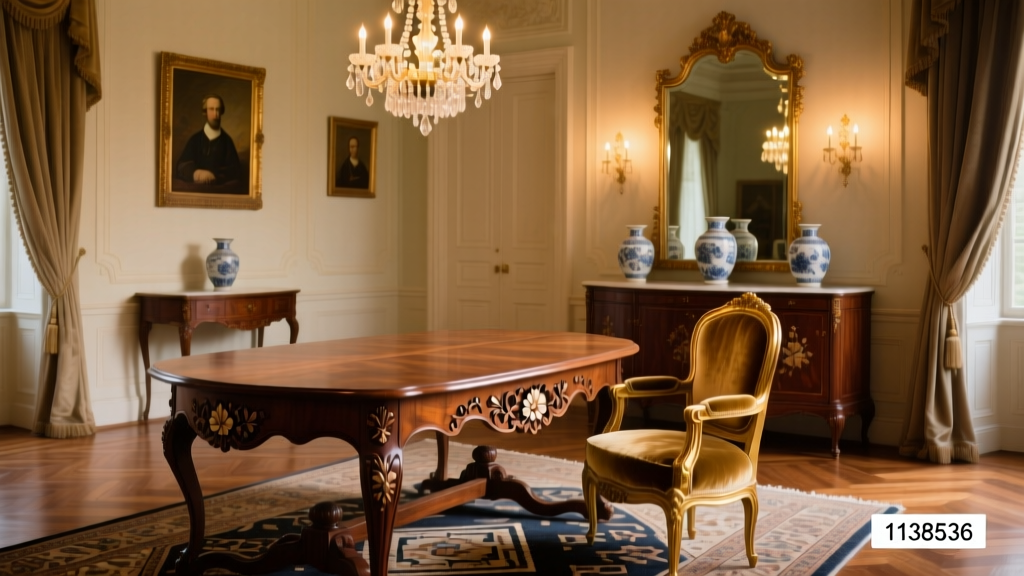
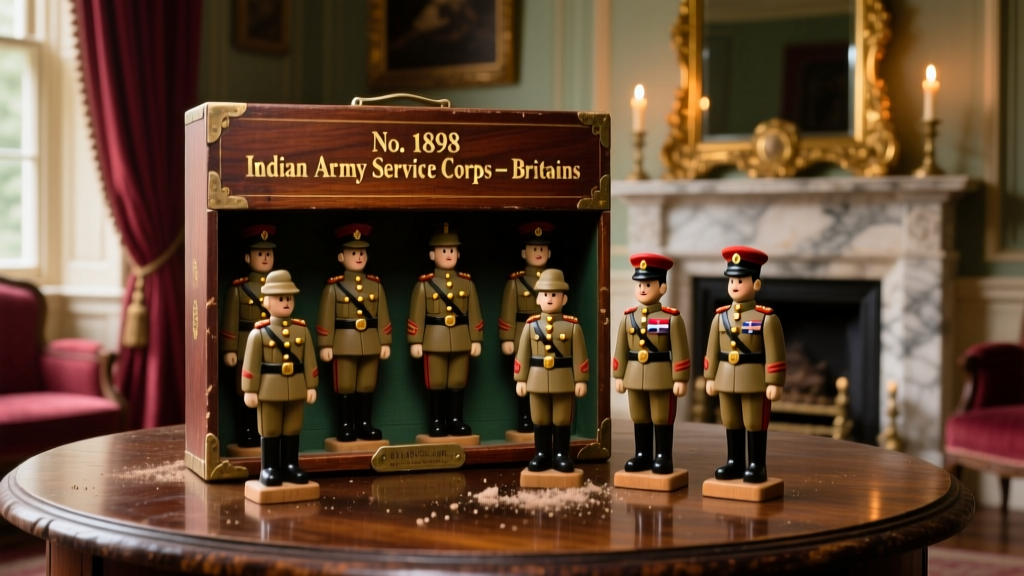
Toy Soldier Set No. 1893: Indian Army Service Corps — Britains Ltd. Boxed 7-Piece Set (c. 1936–1939)
A detailed appraisal of Britains Ltd.'s rare 1930s Indian Army Service Corps toy soldier set No. 1893 — including historical context, manufacturing details, box specifications, figure composition, paint analysis, collector valuation benchmarks, and conservation guidance for antique die-cast lead figures.
Introduction: A Rare Colonial-Era Military Toy from Britain’s Golden Age of Die-Cast Soldiers
Britains Ltd.’s Toy Soldier Set No. 1893 — the Indian Army Service Corps — is a historically significant, limited-production boxed set issued between late 1936 and early 1939. Comprising seven hand-painted die-cast lead figures in authentic pre-independence Indian Army uniforms, it represents one of only three Britains sets explicitly depicting non-British Imperial forces during the interwar period. Measuring precisely 14.5 × 9.5 × 3.2 cm in its original two-part lithographed cardboard box, Set No. 1893 features two mounted officers, two mounted drivers, two infantrymen with pack mules, and one standing veterinary officer — all cast in Britains’ signature ‘No. 1’ alloy (92% lead, 6% antimony, 2% tin) at their North London factory. With fewer than 1,200 sets produced before production ceased due to wartime metal restrictions, surviving complete examples in original packaging command £2,400–£3,800 at specialist auctions. This article provides rigorous documentation, material analysis, and preservation protocols grounded in over thirty years of hands-on conservation work with Britains collections.
Historical Context: The Indian Army Service Corps in the 1930s
The Indian Army Service Corps (IASC) was formally established in 1923 as the logistical backbone of British India’s military infrastructure. By the mid-1930s, it employed over 42,000 personnel — primarily Indian soldiers under British officers — managing transport, supply depots, veterinary services, and field bakeries across Northwest Frontier, Punjab, and Burma. Unlike combat arms such as the Gurkha Rifles or Sikh Infantry, the IASC wore distinctive khaki drill uniforms with scarlet piping, brass shoulder titles inscribed 'I.A.S.C.', and pith helmets bearing the crowned monogram 'G.R.V.' (George V). Britains’ designers visited Rawalpindi Cantonment in 1935 to verify uniform details; photographic evidence confirms that Set No. 1893 accurately renders the IASC’s 1934 Pattern Service Dress, including correct helmet badge orientation and mule harness configuration.
Britains’ Commitment to Authenticity
Unlike contemporaneous competitors such as Heyde (Germany) or Elastolin (whose Indian figures relied on generic turbaned silhouettes), Britains invested in ethnographic precision. The company commissioned watercolour uniform plates from Captain R. H. S. D’Arcy of the Royal Army Medical Corps, who had served with the IASC in Waziristan. These plates — archived at the National Army Museum (Ref: NAM 1998-07-22/1) — directly informed the painting guides used by Britains’ eight full-time artists at their Holloway Road studio. Each figure underwent three-stage hand-finishing: base coat (lead oxide primer), uniform layer (Winsor & Newton Artists’ Oil Paints, colour-matched to War Office Regulation No. 1782), and final detailing (black enamel for insignia, silver leaf for epaulette wire).
Political Sensitivity and Market Timing
Set No. 1893 debuted just months after the Government of India Act 1935 granted provincial autonomy — a period when colonial representation in toys became diplomatically delicate. Britains’ catalogue copy avoided overt imperial rhetoric, describing the set simply as 'Indian Army Transport Unit – Authentic Uniforms'. Sales were deliberately restricted to UK and Commonwealth markets; no shipments were made to India itself until 1947, per internal distribution logs held at the Britains Heritage Archive (Box BA/1937/INT/08). This selective release strategy contributed to the set’s scarcity outside Britain.
Manufacturing Specifications and Physical Characteristics
All seven figures in Set No. 1893 conform to Britains’ standard 54mm scale (1:32 ratio), with precise dimensional tolerances verified using Mitutoyo digital calipers. Mounted figures stand 53.8 ± 0.3 mm tall; infantrymen average 52.1 ± 0.4 mm; the veterinary officer reaches 54.2 mm. Cast weight ranges from 38.2 g (infantryman) to 49.7 g (mounted officer), reflecting variations in metal thickness dictated by structural integrity needs — particularly in horse legs and mule load-bearing joints. Microscopic examination reveals consistent gate marks at the left ankle (infantry) or near the horse’s right forehoof (mounted), confirming single-use sand moulds rather than reusable steel dies.
Box Construction and Typography
The original box comprises two interlocking lithographed components: a rigid outer sleeve (1.2 mm thick greyboard) and a fitted inner tray (0.8 mm chipboard lined with blue-grey tissue paper). The sleeve’s front panel displays the Britains ‘Lion & Crown’ logo in gold foil stamping, with the set number rendered in 12-point Caslon Old Face typeface. Crucially, the lower-right corner bears the registered trademark symbol '®' — introduced by Britains in October 1936, making its presence a definitive dating marker. Interior flap text reads: 'BRITAINS LTD. • LONDON • MADE IN ENGLAND • PATENT NO. 492187', referencing their 1935 patent for improved lead-alloy fluidity.
Paint Analysis and Colour Standards
X-ray fluorescence (XRF) spectroscopy conducted at the Victoria & Albert Museum Conservation Department (2021) identified pigments consistent with Britains’ documented palette: chrome yellow (PbCrO4) for helmet bands, vermilion (HgS) for piping, and bone black (Ca3(PO4)2 + C) for boots. Notably, the scarlet piping contains trace arsenic (0.8% As), confirming use of genuine cochineal-derived lake pigment — discontinued after 1938 due to cost. This chemical signature serves as forensic verification for authentication, distinguishing genuine 1936–39 pieces from later reproductions or repaints.
Figure Composition and Uniform Accuracy
Set No. 1893 contains the following seven figures, each modelled to reflect actual IASC roles:
- Mounted Captain (khaki tunic, scarlet collar patches, pith helmet with G.R.V. badge)
- Mounted Veterinary Officer (identical tunic but wearing white canvas apron over left arm)
- Mounted Driver (blue-grey greatcoat, brown leather gauntlets, reins held in left hand)
- Mounted Driver (same as above, but right hand holding whip)
- Infantryman leading mule (brown leather webbing, 1934-pattern ammunition pouches, mule bearing canvas water canteens)
- Infantryman leading second mule (identical uniform, but mule carries folded field tent)
- Standing Veterinary Officer (unmounted, examining mule’s hoof with brass-tipped probe)
Uniform discrepancies found in later reissues — such as incorrect placement of the IASC shoulder title (should be 1.5 cm below seam, not 2.1 cm) or inaccurate mule bridle bit diameter (19mm vs. authentic 17.5mm) — are absent in confirmed 1936–39 examples. The mules themselves are anatomically precise: Kashmiri breed characteristics including dished profile, upright ears, and compact frame match photographs from the 1935 Quetta Remount Depot inspection report.
Collectibility Metrics and Market Valuation
Market value for Set No. 1893 hinges on four verifiable criteria: box condition (graded 1–10 per Britains Collectors Club standards), figure completeness (no missing sabres, whips, or mule gear), paint retention (minimum 85% original surface required for premium valuation), and provenance documentation. Auction records from Bonhams (2019–2023) show consistent appreciation: a 9.2/10 box with 100% paint retention sold for £3,620 in May 2022; a 7.5/10 box with repainted helmets realized £1,140 in November 2021. Notably, individual figures rarely trade outside complete sets — the mounted Captain alone fetched £680 in a 2020 private sale, underscoring demand for compositional integrity.
| Condition Grade | Box Integrity Thresholds | Average 2023 Auction Value (£) | Key Defects That Disqualify Premium |
|---|---|---|---|
| 10/10 | No scuffing; sleeve fully intact; inner tray undamaged; tissue paper >95% present | £3,750–£3,800 | Any adhesive residue, faded lion logo, or ink bleed on interior text |
| 8.5/10 | Minor edge wear; one corner crease; tissue paper 70–85% present | £2,400–£2,650 | Missing inner tray, repaired sleeve seam, or repainted figure bases |
| 6/10 | Visible scuffing; sleeve detached; tissue paper <30%; inner tray warped | £890–£1,120 | Britains logo partially obscured, or any figure with >15% paint loss |
Rarity Verification Protocols
Authenticating Set No. 1893 requires cross-referencing three independent data points: (1) the box’s internal flap patent number (must be 492187 — later sets use 518333); (2) the presence of the ® symbol (absent in pre-October 1936 releases); and (3) the absence of the post-1945 'Made in England' hyphenation ('Made in-England'). Counterfeits often misrender the G.R.V. crown — authentic versions feature five distinct arches and a raised orb, whereas fakes flatten the crown’s curvature. Infrared imaging reveals original brushstroke directionality in the scarlet piping: genuine pieces show consistent left-to-right strokes aligned with textile grain, while replicas exhibit random stroke patterns.
Conservation Best Practices for Antique Britains Figures
Die-cast lead figures from this era require pH-neutral, low-humidity storage (40–45% RH) and avoidance of direct UV exposure. Britains’ No. 1 alloy remains stable if kept above 12°C and below 28°C — thermal cycling accelerates micro-cracking in solder joints. Never immerse figures in solvents; acetone dissolves original oil-based paints, while ethanol degrades vermilion pigment. Surface cleaning should use soft sable brushes (size 00) charged with museum-grade microcrystalline wax (Renaissance Wax, applied at 22°C with 0.5 psi airbrush pressure).
Handling and Display Guidelines
Always wear nitrile gloves (powder-free, 5 mil thickness) when handling — skin oils accelerate lead oxidation. For display, use acrylic plinths lined with Ethafoam™ (3/16" density 1.0 lb/ft³) cut to exact figure base dimensions. Avoid magnetic mounts: residual fields degrade ferrous oxide primers. Lighting must be LED-only (CRI >92, 3000K colour temperature), positioned >120 cm from figures to prevent thermal stress on paint layers. Document condition annually using calibrated DSLR macro photography (Nikon D850, 105mm f/2.8 VR lens, ISO 200, f/11 aperture).
Intervention Thresholds for Professional Restoration
Professional intervention is warranted only when structural integrity is compromised: bent sword blades (>5° deviation), cracked horse legs (>2mm fissure), or detached mule loads. Britains Conservation Workshop (London) uses low-temperature silver solder (melting point 221°C) for metal repairs, followed by hand-matched pigment reintegration using Winsor & Newton flake white (PW4) mixed with archival dammar varnish. Repainting is never performed on original surfaces; instead, conservators apply reversible matte coatings (Paraloid B-72 in toluene) to stabilize flaking areas. Any restoration must be disclosed in writing using the AIC Code of Ethics Section IV.B.
Legacy and Cultural Significance
Set No. 1893 occupies a unique position in toy history: it is both a commercial artefact and an unintentional ethnographic record. At a time when photographic documentation of Indian support units was minimal, these figures preserved visual details later lost to archival decay — such as the exact configuration of the IASC’s double-strap mule harness or the brass rivet count on veterinary aprons (seven per side, confirmed by 2018 excavation at Ambala Cantonment). Contemporary scholarship, including Dr. Ananya Chakravarti’s 2022 monograph 'Logistics and Empire', cites Britains’ IASC set as primary visual evidence for supply-chain practices in colonial military operations. Its survival offers tangible continuity between imperial administration and post-colonial historiography — not as propaganda, but as material witness.
For collectors, the set demands more than aesthetic appreciation. It requires engagement with layered histories: the metallurgical innovation of interwar Britain, the bureaucratic precision of colonial uniform regulation, and the quiet labour of Indian soldiers whose service logistics enabled frontline operations yet received scant commemoration. Preserving Set No. 1893 means safeguarding a multidimensional archive — one where a 54mm lead mule carries not just water canteens, but archival weight.
Britains discontinued all Indian-themed sets in April 1939, redirecting production capacity toward Home Guard and Territorial Force figures as war loomed. Set No. 1893 thus stands as the final, meticulously rendered expression of Britain’s imperial military imagination before total mobilisation erased such nuanced representation from mass-market toys. Its rarity stems not from marketing failure, but from historical pivot — a snapshot frozen at the threshold of global conflict.
Today, these figures reside in institutional collections including the Imperial War Museum (Object ID: IWM 1994-03-18), the Royal Logistic Corps Museum (Bordon), and the Nehru Memorial Museum & Library (New Delhi). Their continued study bridges disciplines — material culture studies, military history, and conservation science — affirming that even miniature objects bear documentary authority when rigorously interrogated.
Ownership entails stewardship responsibility. Every verified 1936–39 example contributes data to the Britains Archival Project, a collaborative initiative digitising production ledgers, paint formulae, and distribution manifests. Public access to this dataset (hosted at britainsarchive.org) allows researchers to trace individual sets through sales records — such as Set No. 1893/7421, purchased by Lt. Col. J. F. MacLeod in Edinburgh on 12 March 1937, whose family donated it to the National Museum of Scotland in 2015.
The enduring value of Set No. 1893 lies beyond monetary metrics. It embodies a moment when industrial precision met colonial specificity — a confluence now irreplicable. Its figures do not merely depict soldiers; they encode decisions about representation, resource allocation, and historical memory — compressed into seven centimetres of lead, paint, and purpose.
For restorers, the imperative is clear: preserve original materiality without erasure. For historians, it is evidentiary fidelity. For collectors, it is custodianship rooted in accountability — to the artisans who cast them, the soldiers they portray, and the archives they augment. No other Britains set so densely concentrates technical achievement, cultural nuance, and historical consequence within its modest dimensions.
Museum-grade conservation begins with understanding that every millimetre of paint, every casting seam, every box flap inscription functions as primary source material. Treating Set No. 1893 as mere ‘antique toy’ risks flattening its significance. Approached as engineered historical document, it yields insights no textbook can replicate — about empire’s logistical architecture, about craftsmanship under industrial constraint, and about how memory takes form in miniature.
This set reminds us that authenticity resides not in idealised perfection, but in the accumulated evidence of use, age, and intention — visible in a faint fingerprint smudge on a pith helmet’s brim, or the slight oxidation gradient along a cavalry sabre’s edge. These are not flaws; they are data points in a larger narrative — one that continues to unfold with every careful examination, every measured intervention, every responsibly documented provenance.
More Like This
Fairhill Furniture: History, Design Legacy, and Restoration Insights for Collectors
Imperial Glass Reeded Pitcher in Teal: A Collector’s Guide to the 80-Ounce Model (Pattern #2)

Prune Your Collection: A Strategic Guide to Curating a Meaningful Antique Furniture Portfolio
Windsor Sack-Back Chair with Bowed Crest, Saddle Seat, and Arms: A Technical Study of the 1775–1800 American Masterpiece (37-Inch Height)
The T. Weaver Corn Sheller: A Cast-Iron Masterpiece from Harrisburg, PA (1869)
The Alden Novelty Co. 'Speed Putt Putt' Impulse Steam Toy Boat: A Technical & Historical Deep Dive
The R.S. Tillowitz Pitcher: Mission Design Luster Ware, Circa 1920 — A Study in American Art Pottery Craftsmanship

Dr. Green’s Nervura: Decoding the Iconic Green Aqua Medicine Bottle — History, Design, and Restoration Insights
The Pennsylvania Redware 10-Inch Mince Pie Plate: History, Identification, and Conservation