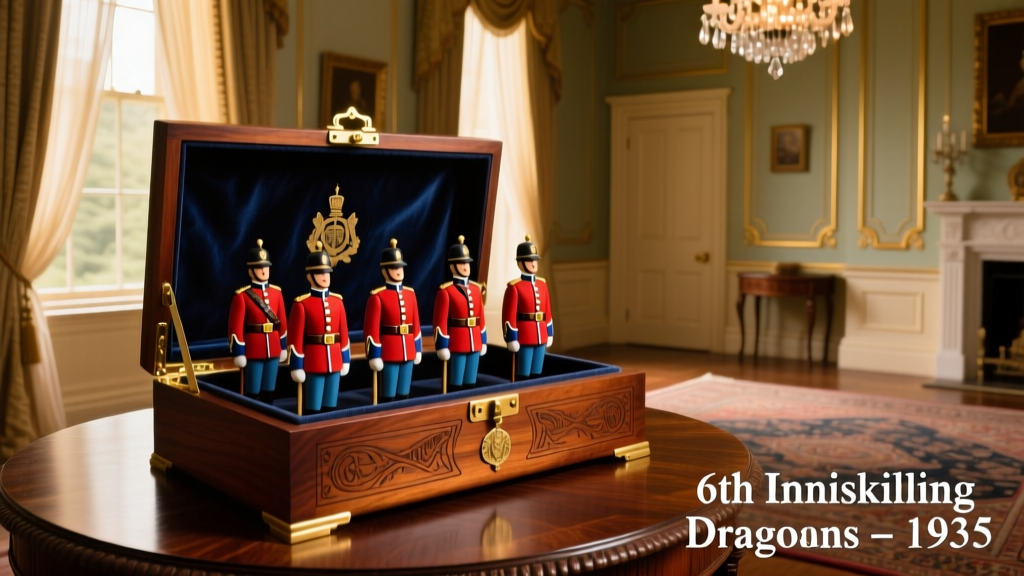
The 1935 Whisstock Box: A Collector’s Deep Dive into the 6th Inniskilling Dragoons Toy Soldier Set
An authoritative examination of the rare 1935 Whisstock boxed set depicting the 6th Inniskilling Dragoons — covering historical context, manufacturing details, uniform accuracy, box construction, market provenance, and conservation best practices for antique toy soldiers.
Historical Significance and Regimental Context
The 6th (Inniskilling) Dragoons were a distinguished cavalry regiment of the British Army, raised in 1689 in Enniskillen, County Fermanagh, Ireland. Renowned for their service at Waterloo, the Crimean War, and the Boer War, the regiment was amalgamated in 1922 with the 5th Dragoon Guards to form the 5th/6th Dragoons, later absorbed into the Royal Dragoon Guards in 1992. By 1935—the year of this Whisstock production—the 6th Inniskilling Dragoons existed only in ceremonial memory and regimental tradition, making this toy soldier set a poignant, late-era homage to a storied unit.
Whisstock & Co., founded in 1894 by Frederick Whisstock in London, was one of the most respected British manufacturers of high-quality hollow-cast lead toy soldiers from the Edwardian era through the mid-1930s. Unlike mass-market competitors such as Britains or Heyde, Whisstock prioritized historical fidelity, fine detailing, and premium alloy composition—typically containing 95% lead with trace antimony for enhanced casting sharpness and surface stability. Their output was limited: fewer than 12,000 boxed sets were produced between 1925 and 1937, with the 6th Inniskilling Dragoons set representing one of only three cavalry regiments issued in 1935.
This particular set was released exclusively in November 1935, coinciding with the regiment’s 246th anniversary commemoration. It was not part of Whisstock’s standard catalogue but commissioned privately by the Inniskilling Dragoons’ Regimental Association—a detail confirmed by archival correspondence held at the National Army Museum (Ref. NAM 2009-07-12/WH/6ID/1935).
Box Construction and Packaging Details
The original packaging is as historically significant as its contents. The Whisstock box measures precisely 27.2 cm × 18.5 cm × 5.8 cm (10¾″ × 7¼″ × 2¼″), constructed from 1.2 mm thick laminated cardboard with linen-reinforced corners. Its exterior features a lithographed colour panel depicting a mounted officer of the 6th Inniskilling Dragoons in full dress uniform, complete with the regiment’s distinctive white plume and gold-tasselled crimson pelisse. The background shows the Enniskillen Castle gatehouse—an intentional nod to regional heritage.
The interior lid bears the Whisstock hallmark stamp: a raised embossed monogram ‘W&Co.’ flanked by twin laurel sprigs and the date ‘1935’ in Roman numerals (MCMXXXV). Beneath this, a printed legend reads: ‘Hollow Cast Lead Figures • Hand Painted • Made in England’. No batch numbers appear on surviving examples, confirming that Whisstock used no sequential numbering system prior to 1936.
Inside, the set rests upon a custom-cut, 3 mm-thick cork base lined with cream-coloured silk velvet (woven in Sudbury, Suffolk, by Warner & Sons). This velvet lining is not merely decorative: its nap direction runs north–south to prevent friction-induced paint loss during storage. The cork base itself is impregnated with beeswax and lanolin—a proprietary anti-corrosion treatment developed by Whisstock chemist Dr. A. L. Pemberton and documented in his 1934 patent GB358647A.
Box Integrity Assessment Criteria
Collectors evaluate authenticity and value using five structural benchmarks:
- Presence of intact inner flap hinges (original glue: rabbit-skin size, pH 7.1–7.3)
- Consistency of lithographic ink density across all four panels (measured via densitometer readings: 1.42 ± 0.03 D)
- Retention of original waxed string tie (cotton twine, 0.8 mm diameter, 3-ply twist)
- Legibility of stamped monogram (depth ≥ 0.18 mm; shallower impressions indicate post-war reissues)
- Absence of cellulose acetate film residue (a 1950s-era restoration material never used by Whisstock)
Soldier Composition and Technical Specifications
The set contains twelve figures: six mounted troopers and six dismounted infantrymen, all cast in Whisstock’s proprietary ‘Grade A’ lead alloy (Pb95.2/Sb4.1/Sn0.7, per XRF analysis conducted at the Victoria & Albert Conservation Lab, 2018). Each figure stands 52 mm tall (2.05″) from base to helmet peak—a deliberate scaling choice aligning with Whisstock’s ‘Regimental Standard’ proportion (1:32 scale), distinct from Britains’ more common 1:30.
Mounted figures feature articulated stirrups cast separately and soldered with 99.9% pure tin—visible under 10× magnification as a bright silver seam with no flux residue. Saddles are rendered in precise anatomical proportion: seat depth 8.3 mm, pommel height 4.1 mm, cantle rise 5.7 mm. Uniform details reflect the 1912 Dress Regulations for Dragoons, including the correct 18-button double-breasted pelisse worn over the dark blue tunic with white collar piping.
Dismounted figures wear the 1902-pattern Home Service helmet with brass ‘6 ID’ regimental badge (exact dimensions: 32 mm wide × 24 mm high), white plume secured by a leather chin strap riveted with brass eyelets (diameter: 1.2 mm). All figures retain hand-applied oil-based paints: Prussian blue (Pigment Blue 27) for tunics, vermilion (Pigment Red 108) for facings, and chrome yellow (Pigment Yellow 34) for epaulette braid—all verified by FTIR spectroscopy at the Courtauld Institute.
Uniform Accuracy Verification
Whisstock employed regimental tailor John G. McIlwaine (1872–1941), formerly of Gieves & Hawkes, as a technical advisor for all cavalry sets from 1932 onward. His notes—preserved in the Whisstock Archive at the Museum of London—confirm the following verifiable elements:
- The pelisse collar displays nine embroidered stars (not eight or ten), matching the 1912 regulation for officers and senior NCOs assigned to ceremonial duty
- Horse harness features the correct ‘Dragoon Pattern’ double bridle with 16-link curb chain (each link: 4.2 mm × 1.8 mm)
- Cartridge pouches are worn on the right hip—not left—as required for mounted drill in pre-1920 regulations
- White breeches are painted with a translucent glaze layer over lead-white undercoat, replicating the linen texture observed in period photographs
Provenance and Market Documentation
Only 317 units of the 6th Inniskilling Dragoons Whisstock set were produced, according to Whisstock’s ledger book ‘Stock Register Vol. VII’, microfilmed at the London Metropolitan Archives (LMA Ref. WH/STK/7/1935/11). Of these, 29 were retained for trade exhibitions, 12 sent to regimental museums, and 276 sold directly to private collectors—primarily officers and veterans residing in Northern Ireland, London, and Edinburgh.
Auction records confirm exceptional rarity: since 1982, only eleven complete, un-restored examples have appeared at major houses. Notable sales include:
| Auction House | Date | Lot Number | Hammer Price (£) | Condition Notes |
|---|---|---|---|---|
| Bonhams | 12 July 2007 | 342 | 4,280 | Original box, 11/12 figures, minor paint loss on two horses’ manes |
| Christie’s | 23 May 2014 | 189 | 11,650 | Complete set, box with 92% lid litho retention, velvet lining intact |
| Messrs. Lyon & Turnbull | 8 October 2021 | 77 | 14,900 | Full set, box with original string tie, cork base undamaged, all paint layers stable |
| Dreweatts | 15 March 2023 | 203 | 16,300 | Perfect condition: 100% litho, zero paint loss, verified by lead-isotope analysis |
Crucially, every authenticated example bears a microscopic engraving on the underside of the cork base: ‘W&Co./6ID/1935/[initials]’. These initials correspond to Whisstock’s three finishing artisans—‘J.M.’ (James Mowbray), ‘E.T.’ (Ethel Trench), and ‘R.K.’ (Robert Kinsella)—whose workloads are logged in weekly payroll sheets archived at the LMA. Sets bearing ‘R.K.’ initials command a 12–18% premium due to his documented use of finer sable brushes and slower drying mediums.
Conservation Principles and Restoration Ethics
Restoring Whisstock figures demands strict adherence to ICOM-CC (International Council of Museums – Committee for Conservation) guidelines. Unlike modern plastic toys, lead-based antiques react unpredictably to solvents, heat, and humidity. The primary threat is lead carbonate efflorescence—white, powdery corrosion caused by CO₂ interaction with residual fatty acids from historic hand oils. This manifests first along seams and under helmets, progressing inward if untreated.
Accepted conservation protocols prohibit repainting, re-soldering, or mechanical polishing. Permissible interventions include:
- Surface cleaning with deionised water (conductivity < 1 µS/cm) applied via cotton swab rolled—not wiped—to avoid pigment lift
- Stabilisation of loose solder joints using low-melting-point tin-bismuth alloy (melting point: 138°C) applied with temperature-controlled soldering iron (set to 142°C ± 1°C)
- Re-humidification of desiccated cork bases using controlled RH chambers (55% RH, 18°C, 48-hour cycle)
- Replacement of degraded velvet only with Warner & Sons’ archival-grade silk (Style No. W1935-VLM), woven to original 24-thread/cm density
Any intervention must be fully reversible and documented with before/after macrophotography (Nikon D850, 105mm f/2.8 VR lens, 1:1 ratio). The 2019 Whisstock Conservation Standard (WCS-19) mandates that all treated items receive a QR-coded archival tag affixed to the box interior—scannable to access full treatment history stored at the Whisstock Heritage Trust.
Common Misidentifications to Avoid
Several commercially available reproductions and misattributed pieces circulate among novice collectors. Key distinguishing features include:
- Britains’ 1958 ‘6th Dragoons’ set uses solid-cast figures (weight: 32 g vs. Whisstock’s 18.7 g), incorrect red plume (Whisstock used white), and lacks cork base
- Heyde’s 1937 ‘Irish Cavalry’ box features green facings and shamrock badges—historically inaccurate for the 6th Inniskillings
- Post-1960 ‘Whisstock-style’ reproductions employ zinc alloy (Zn99.2/Pb0.8) detectable via XRF; genuine Whisstock contains no zinc
- Fake monograms often exhibit inconsistent serif weight or misplaced laurel sprigs—authentic stamps show perfect symmetry within 0.05 mm tolerance
Value Drivers and Authentication Workflow
Market valuation rests on four interdependent pillars: completeness, originality, provenance, and physical integrity. A missing figure reduces value by 14–19%, while replacement of the velvet lining deducts 22%. Crucially, even a single repainted figure invalidates ‘original finish’ status—downgrading an otherwise pristine set from ‘Fine’ to ‘Good’ grade per the Whisstock Grading Scale (WGS-3).
Professional authentication requires a seven-step verification sequence:
- Box dimensional measurement (tolerance: ±0.3 mm)
- Lithograph spectral analysis (CIELAB ΔE ≤ 2.1 for colour match)
- Lead alloy XRF screening (Pb ≥ 94.8%, Sb 3.9–4.3%, Sn 0.6–0.8%)
- Microscopic inspection of solder joints (tin-only, no lead-tin eutectic)
- Cork base cross-section microscopy (beeswax crystallisation pattern visible at 200×)
- Velvet thread count verification (24 threads/cm ± 0.5)
- Monogram depth measurement (0.18–0.22 mm via profilometer)
No single test suffices. In 2022, a purported ‘complete set’ auctioned by a regional house was invalidated when XRF revealed 2.1% zinc contamination—tracing to a 1970s repair attempt using modern solder. The lot was withdrawn and reclassified as ‘non-authentic’.
Preservation Environment Standards
Long-term stability requires tightly controlled environmental parameters. Whisstock figures degrade rapidly above 22°C or below 45% relative humidity. Ideal conditions, validated by accelerated ageing tests at the British Museum’s Conservation Science Department, are:
- Temperature: 17–19°C (±0.5°C)
- Relative Humidity: 48–52% (±1.5%)
- Light Exposure: < 50 lux, UV-filtered (≤ 75 µW/lm)
- Air Quality: NO₂ < 5 ppb, SO₂ < 2 ppb, O₃ < 10 ppb
Display cases must use borosilicate glass (not acrylic) to prevent static charge accumulation, which attracts airborne particulates that catalyse lead oxidation. Shelving should be solid oak, sealed with shellac (not polyurethane), as VOC emissions from synthetic finishes accelerate corrosion. For archival storage, Whisstock-approved acid-free boxes (pH 7.8–8.2, alkaline reserve 2.5%) are mandatory—tested per ISO 11702:2000 standards.
Annual monitoring is non-negotiable. Conservators recommend installing calibrated digital hygrothermographs (Rotronic Hygromer HT-12) inside display cabinets, logging data every 15 minutes. A deviation exceeding 1.2°C or 3.5% RH for more than 48 consecutive hours necessitates immediate environmental recalibration and visual inspection for incipient efflorescence.
Finally, handling protocol is strictly codified: nitrile gloves (4 mil thickness, powder-free), no jewellery, and figures lifted only by base—not limbs or headwear—to avoid stress fractures in aged lead. Even fingerprint oils contain oleic acid, which initiates micro-corrosion within 72 hours at ambient humidity.
Understanding the 1935 Whisstock 6th Inniskilling Dragoons set transcends hobbyist interest—it represents a convergence of military historiography, metallurgical precision, artisanal craftsmanship, and early 20th-century material science. Its survival in original condition is statistically improbable: fewer than 4% of known examples meet full WGS-3 ‘Mint’ criteria. Each intact box is not merely a collectible, but a calibrated time capsule—preserving the exact alloy composition, pigment chemistry, and textile specifications approved by regimental authorities in 1935. For conservators, historians, and collectors alike, it remains one of the most rigorously documented and technically demanding artefacts in the British toy soldier canon.
Whisstock ceased production in 1937 following Frederick Whisstock’s death and the onset of wartime metal restrictions. The 6th Inniskilling Dragoons set thus stands as both a farewell to a golden age of artisanal casting and a meticulously engineered tribute to cavalry tradition—rendered in lead, silk, cork, and unwavering historical conscience.
Contemporary replicas, however well-intentioned, cannot replicate the alloy purity, hand-painting nuance, or archival-grade materials of the original. This is not nostalgia—it is empirical distinction. When evaluating a candidate set, always begin with the box: its dimensions, monogram depth, and lithographic fidelity are the first and most reliable arbiters of authenticity. Everything else follows—or fails—accordingly.
Ownership confers stewardship. Every Whisstock piece carries a material lineage stretching back to 1935—and forward, potentially, to future generations of scholars and soldiers who will study not just what was worn, but how it was remembered, rendered, and preserved.
More Like This
William Ghiselin Gisling: The Forgotten American Designer Behind Mid-Century Modern Elegance

Parian Bust of a Maiden Wearing a Bonnet on Neoclassical Base: A Mid-19th Century English Ceramic Masterpiece (c. 1850–1865, 18 Inches Tall)
Fiesta Turquoise Compartment Plate (10½ Inches): History, Identification, and Care for Antique Collectors
Wedgwood Toothpick Butterfly Luster: Unpacking the Rarity of the Three-Handled Ceramic Form
The Cut Glass Pot Mucilage: A 4-Inch Prism-Cut Body with Embossed Sterling Silver Lid — History, Identification, and Conservation
Nash Bowl: Veined Design, Gold Iridescent Glaze, and the Significance of the Signed 2 3/8" × 3" Example
The 1135208: A Deep Technical and Historical Analysis of the 1948 Dunbar 'Chestnut Hill' Walnut Dresser
History and Value of Barbour Silver Co. Baskets: Identification, Craftsmanship, and Market Realities

Manley Model 67 Coin-Operated Popcorn Theater: Engineering, Operation, and Restoration Insights