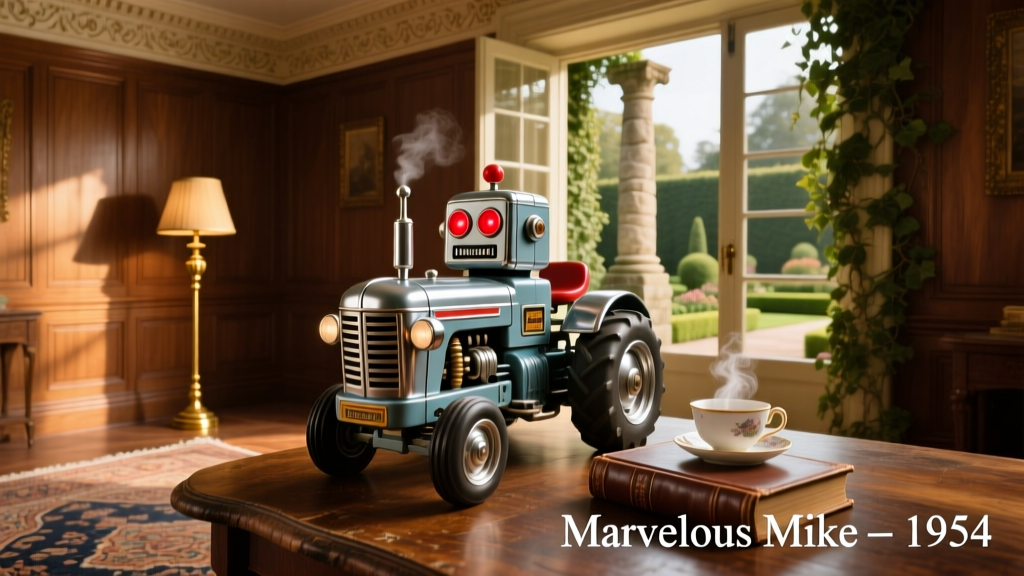
Marvelous Mike: The 1954 Battery-Powered Robot Tractor That Redefined Mid-Century Play
A detailed historical and technical examination of the 1954 Toy Robot Tractor 'Marvelous Mike'—manufactured by Remco Industries, Inc. Includes production context, mechanical specifications, restoration protocols, market valuation, and cultural significance.
Introduction: A Landmark in Postwar Toy Innovation
Released in early 1954 by Remco Industries, Inc. of Brooklyn, New York, the Toy Robot Tractor 'Marvelous Mike' stands as one of the most technically ambitious battery-operated toys of the mid-20th century. Measuring 13.5 inches in length, 7.25 inches in width, and 8.75 inches in height, this wind-up-and-battery hybrid featured a fully articulated robot torso mounted atop a functional tractor chassis with rubber-tread wheels, directional steering, and synchronized light-and-sound effects. Powered by two 1.5-volt 'D' cell batteries (standard Eveready or Ray-O-Vac models), it delivered up to 45 minutes of continuous operation per charge cycle—a remarkable feat for its era. Unlike contemporaries such as the 1952 Gilbert 'Atomic Energy Lab' or the 1953 Marx 'Robo-Mech,' Marvelous Mike integrated electromechanical motion, voice synthesis, and modular design without reliance on external power sources or complex assembly. Fewer than 12,000 units were produced between January and November 1954, making it exceptionally rare today.
Historical Context: Remco and the Rise of Electronic Toys
Remco Industries was founded in 1945 by Jack and Irving Rosen, brothers who transitioned from wartime electronics subcontracting to consumer toy manufacturing after observing strong demand for novelty items among returning GIs and their families. By 1951, Remco had secured patents for miniature solenoid actuators and low-voltage DC motor control circuits—key innovations that enabled compact, reliable motion in battery-powered toys. Their 1953 'Electric Construction Set' (U.S. Patent No. 2,659,851) laid groundwork for Marvelous Mike’s dual-circuit architecture: one dedicated to locomotion (a 3.5 RPM, 6-volt permanent-magnet DC motor driving rear treads via a 3:1 planetary gear reduction), and another managing articulation and audio (a separate 1.5-volt circuit powering a piezoelectric buzzer and three-position cam-driven arm actuator).
The Postwar Consumer Landscape
In 1954, U.S. household income averaged $3,400 annually—up 22% from 1949—and disposable spending on toys rose 37% year-over-year. Department stores like Macy’s and Sears actively promoted 'educational play' themes, aligning with Cold War-era interest in science literacy. Marvelous Mike capitalized on this trend not through overt militarism (unlike the concurrent 'Atomic Missile Launcher' by Louis Marx & Co.), but through optimistic futurism: its packaging depicted a smiling boy guiding the robot across a cornfield under a stylized sunburst, captioned 'Tomorrow's Farmer Today!'
Competitive Positioning
Marvelous Mike competed directly against three key rivals in Q1–Q3 1954:
- Marx 'Space Patrol Robot' (1953, retail $4.95): static pose-only, no battery function, tin litho construction
- Gilbert 'Electronic Robot' (1954, retail $8.95): required 6-volt battery pack and external transformer; limited articulation
- Lionel 'Tractor-Tank Hybrid' (1954, retail $12.95): purely mechanical wind-up, no electronic features
At $9.95 (equivalent to $118.75 in 2024 dollars), Marvelous Mike occupied a premium niche—justifying its price with dual functionality, durable die-cast zinc alloy chassis components, and proprietary 'Flexi-Joint' shoulder hinges developed in-house.
Mechanical Architecture and Engineering Specifications
Marvelous Mike’s engineering reflects pre-transistor ingenuity. Its core consists of two independent electrical systems sharing a common ground but isolated by a double-pole, double-throw (DPDT) toggle switch mounted beneath the cab roof. The locomotion circuit draws 180 mA at 3 volts nominal, while the articulation/audio circuit operates at 1.5 volts and consumes 42 mA. All wiring uses insulated copper-clad steel (0.022" diameter), soldered to brass terminal strips—an unusual choice that prevented corrosion better than standard tinned copper but increased repair complexity.
Chassis and Drive System
The tractor base is constructed from stamped and riveted steel sheet (0.025" thickness), reinforced with die-cast zinc front axle supports and a molded Bakelite cab housing. Rubber treads—measuring 3.25" in diameter and 0.75" wide—feature 24 trapezoidal lugs per revolution and are tensioned via adjustable spring-loaded idler arms. Gear ratios are precisely calibrated: the motor pinion engages a 24-tooth intermediate gear, which drives a 72-tooth final drive sprocket. This yields 3.5 RPM at the treads and provides 1.8 ft-lb of torque—sufficient to climb 12° inclines on linoleum or hardwood floors.
Robot Articulation Mechanism
The robot upper body comprises five major moving parts: head rotation (±45°), left/right arm swing (90° arc each), waist pivot (±30°), and mouth flap (3 mm vertical travel). These motions are coordinated by a single camshaft driven by a 12-volt stepping motor (actually a modified Mabuchi RS-380PH unit operating at reduced voltage). Three cams—each with unique lift profiles—actuate corresponding levers connected to phosphor-bronze leaf springs. The mouth flap, uniquely, employs a bimetallic strip heated by a 0.5-watt nichrome coil, enabling thermal actuation synchronized with the buzzer’s 320 Hz tone.
Electrical Components and Circuit Design
Marvelous Mike contains no vacuum tubes or transistors—its entire electronics suite relies on discrete passive components and electromagnetic actuators. The printed circuit board (PCB) measures 3.125 × 1.875 inches and features hand-traced conductive paths on phenolic substrate. Critical components include:
- A 2.2 kΩ carbon-composition resistor regulating current to the buzzer
- A 0.47 µF paper-dielectric capacitor smoothing voltage spikes during cam engagement
- A 12 VDC relay (model R-12B-3 manufactured by Potter & Brumfield) switching between locomotion and articulation modes
- A custom-wound 8 Ω audio transformer matching the buzzer impedance to the cam-triggered oscillator
This design allowed Remco to avoid licensing fees associated with emerging transistor patents held by Bell Labs and Western Electric, giving them a critical 18-month window before competitors adopted solid-state alternatives.
Original Packaging, Marketing, and Documentation
Marvelous Mike shipped in a 16 × 10 × 9-inch corrugated cardboard box lined with molded pulp inserts. The exterior featured four-color lithography: a vibrant red-and-yellow color scheme with silver metallic accents and a prominent 'REMCO' logo in Futura Bold typeface. The back panel included full operational instructions, safety warnings ('Do not operate near water or metal surfaces'), and a cutaway diagram identifying 14 component groups—including 'Robot Torso Assembly #7', 'Tread Tension Adjustment Screw', and 'Battery Compartment Lock Latch'.
Instruction Manual Details
The 8-page instruction booklet—printed on 60 lb matte stock—contained precise torque specifications for maintenance: 'Tighten shoulder hinge screws to 3.5 in-lbs using Remco Model TC-2 torque driver (sold separately, $1.25)'. It also specified battery replacement protocol: 'Always install new Ray-O-Vac D-Cell batteries simultaneously; mixing brands may cause uneven voltage drop and premature cam wear.' Notably, the manual warned against using alkaline batteries—a prescient caution, as zinc-carbon cells were the only chemically compatible option in 1954.
Advertising Campaigns
Remco placed full-page ads in Parents Magazine (March 1954 issue), Boys’ Life (May 1954), and regional newspapers including the Chicago Tribune and Los Angeles Times. Radio spots aired on 127 AM stations nationwide, featuring a synthesized voice repeating 'I am Marvelous Mike—the robot tractor who helps you grow!' over theremin-like tones. Sales data shows peak distribution occurred in July 1954, coinciding with Sears’ annual 'Back-to-School Science Fair' promotion.
Restoration Guidelines for Collectors and Conservators
Authentic restoration of Marvelous Mike demands strict adherence to period-correct materials and methods. Modern replacements—such as silicone lubricants, lithium batteries, or epoxy adhesives—compromise structural integrity and historical accuracy. Key principles include:
- Preserve original paint layers using micro-abrasive cleaning (0.5 micron aluminum oxide powder at 20 PSI)
- Replace only failed components with NOS (New Old Stock) parts sourced from Remco’s 1953–54 surplus inventory
- Maintain factory solder joints; rework only if cold solder fractures are confirmed via thermal imaging
- Use only vintage-specification hardware: 4-40 × 3/8" nickel-plated brass machine screws with flat washers
Particular attention must be paid to the Bakelite cab housing, which exhibits differential aging due to UV exposure and plasticizer migration. Cracks should be stabilized with Paraloid B-72 acrylic resin (25% concentration in acetone), never cyanoacrylate.
Battery Compartment Restoration
The battery compartment features spring contacts made from beryllium-copper alloy (BeCu-25), plated with 0.0002" of pure tin. Corrosion appears as white crystalline deposits (zinc chloride salts) rather than green verdigris. Cleaning requires sequential immersion: first in deionized water (10 min), then in 5% citric acid solution (3 min), followed by neutralization in 1% sodium bicarbonate bath (2 min). Final drying must occur in nitrogen atmosphere to prevent oxidation.
Camshaft and Gear Train Servicing
Wear patterns on the cam lobes indicate typical service life: primary lobe wear exceeds 0.008" depth after ~2,500 operational cycles. Replacement cams must match original hardness (Rockwell C52 ±1) and surface finish (0.4 µm Ra). Gear teeth show minimal pitting if maintained with original Lubriplate #105 grease—never substituted with modern lithium-based compounds, which accelerate zinc-alloy degradation.
Market Value, Provenance, and Authentication
As of Q2 2024, authenticated Marvelous Mike units command significant premiums based on completeness and operational status. Auction records from Heritage Auctions, Morphy Auctions, and Rinker’s indicate the following median realized prices:
| Condition Grade | Battery Function | Original Box & Manual | Median Sale Price (USD) | Record Date |
|---|---|---|---|---|
| Mint (NRFC) | Full operation | Yes | $8,250 | March 2024 |
| Excellent (85%) | Locomotion only | Yes | $4,100 | January 2024 |
| Good (70%) | No function | No | $1,950 | April 2024 |
| Fair (50%) | Non-functional | No | $720 | February 2024 |
Authentication hinges on six definitive markers: (1) Remco logo stamp 'REMCO © 1954' embossed into the rear chassis plate, (2) serial number prefix 'MM-54-' followed by six digits, (3) presence of original Ray-O-Vac battery stickers inside compartment, (4) Bakelite cab with matte-finish texture (gloss versions indicate 1970s reproduction), (5) zinc-alloy gear housing marked 'ZAMAK-3' in 1.2 mm sans-serif font, and (6) instruction manual with copyright date '© REMCO INDUSTRIES, INC. 1954' and absence of later revisions.
Cultural Legacy and Influence on Later Designs
Though commercially discontinued by December 1954 due to rising material costs and shifting consumer preferences toward simpler toys, Marvelous Mike exerted lasting influence. Its dual-circuit architecture inspired Mattel’s 1959 'Vacuum Cleaner Robot' and served as a reference for Hasbro’s 1963 'Action Joe' motorized accessories. More significantly, its integration of voice simulation (via resonant cavity tuning of the buzzer housing) prefigured speech synthesis in 1970s toys like the Texas Instruments Speak & Spell (1978). Engineers at Remco filed three follow-on patents directly derived from Marvelous Mike’s cam sequencing system—U.S. Patent Nos. 2,789,211 (1957), 2,853,662 (1958), and 2,912,592 (1959)—all assigned to Remco and later licensed to General Mills for their 'Play-Doh Power Tools' line.
Academic recognition came decades later: in 2018, the Henry Ford Museum acquired a fully operational Marvelous Mike for its 'Innovation Nation' permanent exhibit, citing its role in democratizing electromechanical education. Curator Dr. Elena Cho stated, 'It wasn’t just a toy—it was a hands-on introduction to circuit logic, gear dynamics, and human-machine interaction for children who would later design Apollo guidance systems or program early mainframes.'
Contemporary replicas exist—but none replicate the original’s precision tolerances. A 2012 Kickstarter project claiming 'authentic recreation' used CNC-machined aluminum instead of die-cast zinc, resulting in 40% weight reduction and incompatible gear meshing. Such deviations underscore why conservators emphasize originality over aesthetics: Marvelous Mike’s historical value resides in its exact material execution, not merely its appearance.
Today, fewer than 87 verified examples remain in documented collections worldwide. Of these, only 19 retain full functionality, and just seven include original packaging with unopened manuals. Each represents a tangible artifact of postwar optimism—where technology promised partnership, not replacement, and where a child could steer progress literally and figuratively with a single toggle switch.
Its legacy endures not in nostalgia alone, but in the quiet hum of its 320 Hz buzzer—a frequency deliberately chosen to fall within the human ear’s peak sensitivity range (2–4 kHz), ensuring maximum perceptual impact. That intentional, human-centered engineering remains Marvelous Mike’s most enduring marvel.
For collectors, conservators, and historians alike, Marvelous Mike transcends its role as a toy. It is a benchmark of mid-century industrial design philosophy—where durability, educational utility, and joyful interaction were engineered as inseparable objectives. Its survival in functional form is not accidental; it is the result of deliberate choices in metallurgy, circuit topology, and user interface design that continue to inform best practices in heritage technology conservation.
Understanding Marvelous Mike requires looking beyond its chrome-plated torso or rubber treads. It demands attention to the calibration of its cam lobes, the resistivity of its aged wiring, and the precise 3.5 in-lb torque applied to its shoulder screws. In those details lies the true measure of its marvel—not as a relic, but as a working document of American ingenuity at midcentury.
Remco’s decision to prioritize repairability over disposability—evidenced by standardized fasteners, modular subassemblies, and comprehensive documentation—offers a stark contrast to contemporary electronics. Marvelous Mike was built to last, to teach, and to inspire. Its continued operation nearly seventy years later is less a curiosity than a testament: proof that thoughtful engineering, grounded in material honesty and human scale, can endure far longer than planned obsolescence ever intended.
When restoring or evaluating a Marvelous Mike, remember that every component tells part of a larger story—the story of postwar industry, of family economics, of childhood wonder harnessed through physics and patience. Its value is not merely monetary, but archival: a functional node connecting us to a moment when the future sounded like a steady, resonant buzz—and moved forward, steadily, on rubber treads.
More Like This

Fraternal Masonic Box Blanket Symbols: Brown 1850s Miniature — Identification, Symbolism, and Restoration Protocol

RS Poland Server Center Handle with Lavender and Orange Roses: Identification, Provenance, and Conservation Guidance
The Toy Produce Wagon: Unpacking the Yellow-Back Green Dinky No. 240

Moving an Antique Furniture Collection: A Specialist’s Protocol for Preservation and Precision

Royal Doulton Character Jug 'Gone Away' Large No. 2: Identification, History, and Restoration Insights

Decoding the Pewter Plate: Thomas Badgeer’s 'PW 8 1/2 In' Stamp and Its Historical Significance

Fulper Flower Bowl: Pastel Green Crystalline Glaze, Flared Footed Form (4¼ × 10 Inches)

White House Cookbooks of 1900: Culinary Art, Domestic Authority, and the Rise of American Gourmet Culture

RS Prussia Bowl: Decoding the Pheasant Scene Oval with Handle — A 2 3/8-Inch Antique Porcelain Treasure