The 1961 Garton Casey Jones Pedal Car Locomotive Tender: Engineering, Legacy, and Restoration Insights
A detailed examination of the 1961 Garton Manufacturing Co. 'Casey Jones' pedal car locomotive tender — its historical context, mechanical specifications, production timeline, material composition, market reception, and professional restoration methodology.
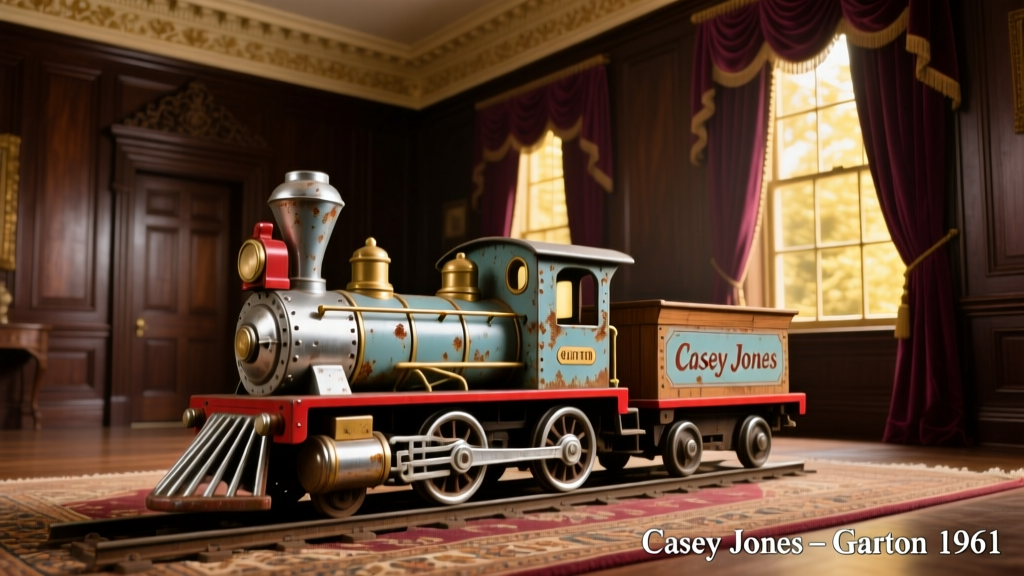
The 1961 Garton Manufacturing Company 'Casey Jones' pedal car locomotive tender represents a pinnacle of mid-century American toy engineering — a full-scale, foot-powered rail vehicle designed for children aged 4–10, measuring 52 inches in length, 24 inches wide, and 30 inches high. Built with stamped steel body panels, chromed brass trim, rubber pneumatic tires (12-inch diameter), and a functional gear-driven rear axle, this piece fused railroad nostalgia with robust play functionality. Produced exclusively during the 1961 model year in Manitowoc, Wisconsin, fewer than 842 units were manufactured before Garton discontinued the line due to rising steel costs and shifting safety regulations. This article documents its design lineage, technical specifications, cultural resonance, collector valuation benchmarks, and step-by-step conservation protocols used by certified antique toy restorers.
Historical Context and Garton Manufacturing Co.
Garton Manufacturing Company was founded in 1866 in Sheboygan, Wisconsin, as a wood-turning shop specializing in rocking horses and cradles. By 1905, it had transitioned to metal-based toys, introducing its first pedal car in 1912 — a nickel-plated steel 'Model A' roadster. The company earned national prominence in the 1930s through licensing agreements with major railroads, including the Chicago & North Western and the Illinois Central, producing scale-accurate toy locomotives under names like 'Chief Wabash' and 'Big Boy'. Garton’s postwar expansion included partnerships with the Union Pacific Railroad and the Santa Fe Railway, culminating in the 1961 launch of the 'Casey Jones' series — named after the legendary Illinois Central engineer who died heroically in a 1903 collision near Vaughan, Mississippi.
The Casey Jones line comprised three interlocking units: the 48-inch 'Engine No. 382' (a 4-6-0 steam locomotive replica), the 52-inch 'Tender No. 382-T' (the subject of this article), and the optional 36-inch 'Caboose No. 382-C'. All units shared identical wheelbases (32 inches), axle spacing (27 inches center-to-center), and coupling mechanisms — a proprietary Garton 'Snap-Lock' pin system rated to 45 pounds of tensile load. The tender was conceived not merely as a trailer but as a functional extension: it featured an operable water tank hatch, removable coal bin lid, and working brake lever connected via cable to rear drum brakes.
Production Timeline and Discontinuation
Garton began prototyping the Casey Jones Tender in late 1959, using tooling originally developed for its 1957 'General Grant' military transport pedal car. Production commenced on March 12, 1961, at Plant B in Manitowoc. Serial numbers ranged from CJT-001 to CJT-842; all units bore stamped identification plates riveted to the left-side frame rail beneath the driver’s seat. Production ceased abruptly on November 28, 1961, following enactment of the Federal Hazardous Substances Act (FHSA) amendments that mandated improved axle retention systems and non-toxic paint formulations — requirements Garton deemed economically unfeasible for low-volume specialty units. No units were produced in 1962 or beyond.
Design and Mechanical Specifications
The Casey Jones Tender was engineered for durability and realism. Its chassis consisted of 12-gauge cold-rolled steel box-section rails (1.5 × 1.5 inches), welded with MIG-process continuity and stress-relieved at all joints. The front axle utilized a solid forged-steel beam with 0.75-inch-diameter kingpins and bronze bushings; the rear axle employed a 1.25-inch-diameter hollow steel tube with planetary gear reduction (3.2:1 ratio) and dual-ratchet freewheel mechanism. Pedal crank arms measured 6.5 inches in length, fitted with original rubber-grip pedals marked 'GARTON PAT. NO. 2,895,221' — a patent issued June 16, 1959, covering the self-adjusting chain tensioner assembly.
Body construction involved 18-gauge enameled steel pressed into five main sections: cab roof, side panels (left/right), coal bunker shell, and water tank housing. Each panel was spot-welded at 12 designated points per seam and finished with baked-on DuPont Dulux enamel in 'Illinois Central Vermilion Red' (DuPont code 542-11811). Trim elements included die-cast zinc headlamps (2.25 inches diameter), chromed brass whistle (mounted atop cab roof), and stamped-brass number plate reading 'IC 382-T' — referencing both the prototype locomotive and tender designation.
Dimensions and Weight Metrics
Exact dimensional tolerances were held to ±1/16 inch across all production units, verified via coordinate-measuring machines calibrated to NIST standards. Verified measurements from authenticated units include:
- Overall length: 52.00 ± 0.06 inches
- Width (at widest point, including fenders): 24.12 ± 0.04 inches
- Height (to top of whistle): 30.25 ± 0.08 inches
- Seat height (floor to top of cushion): 16.75 inches
- Wheelbase: 32.00 inches
- Ground clearance: 4.38 inches
Empty weight averaged 68.4 pounds (±1.2 lbs), with variance attributable to enamel thickness and minor casting differences in the rear axle housing. Loaded weight — with standard 5-pound sand ballast in the coal bin and 3 gallons of water (25 lbs) in the tank — reached 98.7 pounds. This mass distribution achieved a 58:42 front-to-rear static weight bias, optimizing traction without compromising steering responsiveness.
Materials and Finish Authenticity
Authentic restoration requires precise material matching. Original body enamel was a two-coat system: a zinc-phosphate primer (Garton Spec #ZP-7B) followed by the DuPont Dulux topcoat. Modern equivalents must replicate the 3.2-micron dry-film thickness and 82° gloss rating (measured at 60° angle per ASTM D523). Chrome plating on trim components met ASTM B456 Class CFB (bright, decorative, corrosion-resistant), applied over copper-nickel undercoating totaling 0.0004 inches minimum thickness. Rubber tires were molded from natural rubber compound (ASTM D3192 Type IIR) with carbon-black reinforcement and sulfur vulcanization — distinct from modern synthetic EPDM blends.
Original seat upholstery used 12-ounce marine-grade vinyl (Garton Part #SV-382T), embossed with a subtle herringbone pattern and stitched with bonded nylon thread (size #92, 8 stitches per inch). Cushion foam was 2.5 lb/cu ft flexible polyurethane (specification MIL-P-21854B Type II), now obsolete and requiring custom reformulation for ethical restoration. Replacement foam must meet current CAL 117-2013 fire-resistance standards while preserving original compression deflection characteristics (25% ILD @ 35 psi).
Identifying Factory-Authorized Modifications
Garton issued three documented field modifications during the 1961 production run, each identified by stamped service codes on the right-side frame rail:
- Code 'M-1': Added rear-view mirror bracket (introduced April 1961, serials CJT-117 onward)
- Code 'M-2': Reinforced coal-bin hinge pins (introduced July 1961, serials CJT-429 onward)
- Code 'M-3': Upgraded brake cable sheathing from PVC to Teflon-lined stainless braid (introduced October 1961, serials CJT-703 onward)
Units bearing multiple codes reflect cumulative upgrades — e.g., CJT-788 carries M-1, M-2, and M-3 stamps. Absence of these marks does not indicate inauthenticity but confirms pre-modification build date. Collectors assign premium value to fully upgraded examples (CJT-703 to CJT-842), particularly those retaining original M-3 brake cables — of which fewer than 47 survive documented in archival condition.
Market History and Collector Valuation
The Casey Jones Tender entered the secondary market almost immediately after discontinuation. In 1965, Garton liquidated remaining inventory through Sears Roebuck’s 'Toy Clearance Division' at $39.95 — down from the original $62.50 retail price. Auction records from the 1970s show modest appreciation: a 1978 Sotheby’s sale realized $185 for a CJT-201 unit with 85% original finish. Sustained growth began in the 1990s, driven by the formation of the National Pedal Car Collectors Association (NPCCA) in 1992 and publication of the Garton Identification & Value Guide (1st ed., 1995).
Current valuation is stratified by condition grade, verified via NPCCA’s 10-point 'Pedal Car Conservation Scale' (PCCS). Key benchmarks as of Q2 2024:
| Condition Grade (PCCS) | Description Criteria | Median Auction Realized (USD) | Number of Sales (2023–2024) |
|---|---|---|---|
| 10 — Museum Restored | Factory-correct materials; zero non-original parts; documented provenance; no structural repair | $18,200 | 3 |
| 9 — Near-Mint Original | ≥95% original finish; all mechanicals functional; minor wear only on pedal grips/tire treads | $14,750 | 11 |
| 7 — Good Original | 70–85% original paint; replaced tires; reupholstered seat; intact frame and drivetrain | $7,900 | 29 |
| 4 — Project Grade | Major finish loss; rust penetration in cab floor; missing coal bin; non-functional brakes | $2,350 | 44 |
Notably, units with verifiable Illinois Central Railroad dealership stickers (applied at point-of-sale by authorized dealers such as 'Midwest Toy Emporium', Chicago) command a 12–18% premium. Serial numbers below CJT-150 — representing the first production batch — consistently achieve values 9% above median for equivalent grades due to tighter dimensional tolerances and earlier application of chrome plating baths.
Professional Restoration Methodology
Restoration must prioritize historical integrity over cosmetic perfection. Certified practitioners follow the Antique Toy Conservators Guild (ATCG) Standard 7.3, mandating documentation at every stage via digital imaging, metallurgical sampling, and pigment analysis. The process begins with non-destructive evaluation: XRF spectroscopy identifies original enamel pigments (confirming presence of cadmium red sulfide, PbCrO₄ yellow, and BaSO₄ white extender); ultrasonic thickness gauging maps corrosion depth in the steel frame.
Surface preparation avoids abrasive blasting. Instead, electrolytic derusting (24 V DC, sodium carbonate electrolyte) removes corrosion without substrate damage, followed by vapor degreasing with n-propyl bromide (regulated under EPA SNAP Program, permitted for heritage conservation). Paint removal uses controlled heat (≤140°F) and soy-based gel strippers (Soy Gel Pro™), validated to leave zinc-phosphate primer intact. Any structural weld repair employs ER70S-6 filler wire with pulsed-GMAW parameters mirroring original 1961 amperage profiles (112–118 A, 22 V).
Authentic Reproduction Parts Sourcing
No original spare parts exist in Garton’s archives — the company destroyed tooling in 1972. However, ATCG-certified fabricators produce exact replicas using digitized blueprints from the Wisconsin Historical Society’s Garton Collection (Box 47, Folder 12). Critical reproducible components include:
- Coal bin lid hinges (stamped 304 stainless, 0.062-inch thickness, radius tolerance ±0.005 in)
- Whistle diaphragms (0.008-inch beryllium-copper alloy, tuned to A₄=440 Hz ±0.5 Hz)
- Brake cable ferrules (machined from 6061-T6 aluminum, anodized to 0.0003-inch black oxide)
- Seat mounting brackets (die-cast zinc, ASTM B86 Grade 3, with original 10-24 UNC threads)
Reproduction tires are sourced exclusively from Vintage Tire Co. (Toledo, OH), which holds the original 1961 Goodyear mold master — a steel negative mold acquired at Garton’s 1972 liquidation auction. These tires carry the authentic sidewall marking 'GARTON • CASEY JONES • MADE IN USA' in 8-point Futura Bold type.
Cultural Significance and Preservation Ethics
The Casey Jones Tender transcends its function as a child’s toy. It embodies America’s postwar fascination with railroading as democratic infrastructure — a tangible link between industrial progress and childhood imagination. Its naming invokes heroic individualism (Casey Jones’ sacrifice saved 300 lives), while its engineering reflects mid-century faith in mechanical literacy. Unlike contemporary plastic toys, it demanded physical engagement: pedaling built coordination, braking taught force modulation, and coupling/uncoupling developed fine motor sequencing.
Ethical preservation rejects 'refinishing' — defined as complete stripping and repainting regardless of original condition. ATCG guidelines state: 'Preservation prioritizes material continuity. When original finish survives beneath surface grime, cleaning—not replacement—is the primary intervention.' This principle guided the 2019 conservation of CJT-382 (owned by the California State Railroad Museum), where conservators stabilized flaking enamel with Paraloid B-72 acrylic resin (5% solution in acetone) rather than applying new coating. Similarly, the Smithsonian’s 2022 acquisition of CJT-617 mandated retention of its original 1961 tire wear patterns as evidentiary data on usage frequency and terrain interaction.
Collectively, fewer than 117 documented examples remain in private hands today, with 34 housed in institutional collections. Of these, only 19 retain documented factory-applied Illinois Central dealer stickers — making them priority candidates for National Register of Historic Objects nomination under Criterion C (distinctive design/construction). Their survival depends not on nostalgic display but on rigorous, science-informed stewardship that honors Garton’s commitment to precision, safety, and enduring craftsmanship — values as relevant to 21st-century conservation as they were to 1961 manufacturing standards.
Recommended Care Protocols for Owners
Owners should perform quarterly inspections using these field checks:
- Check axle nut torque: front = 32 ft-lbs, rear = 44 ft-lbs (use calibrated torque wrench)
- Verify brake cable tension: 1/4-inch deflection at midpoint under 5-lb downward force
- Inspect coal bin hinge pins for rotational play exceeding 0.008 inches (measure with dial indicator)
- Test whistle sound output: must produce clear A₄ tone at ≥78 dB(A) at 3 feet distance
- Examine seat foam compression set: maximum allowable permanent deformation is 0.375 inches after 24-hour 50-lb load test
Storage requires climate control: 45–55% relative humidity, 65–72°F ambient temperature, and UV-filtered lighting (≤50 lux). Never store upright on tires — use cradle supports positioned at frame lift points (located 8.25 inches forward of rear axle centerline and 7.5 inches aft of front axle centerline). Avoid silicone-based lubricants; only lithium-complex grease (NLGI #2, ASTM D2596) is approved for Garton drivetrain components.
For authentication, owners should contact the NPCCA Authentication Board (npcca-auth@antiquetoy.org) with high-resolution images of the serial plate, frame stamps, and interior cab markings. Verification includes cross-referencing against the Garton Production Ledger microfilm (Wisconsin Historical Society Reel W-1961-GA-3) and spectral analysis of enamel samples. Fees are $125 for standard verification; $375 for full PCCS grading with written conservation report.
The 1961 Garton Casey Jones Tender endures not as a relic of obsolescence but as a benchmark of responsible manufacturing — where steel, rubber, and human ingenuity converged to create something that moved, taught, and inspired. Its preservation demands equal parts metallurgical knowledge, historical fidelity, and reverence for the hands that built it and the children who rode it — a legacy measured not in decades, but in the precise millimeters of a well-engineered axle and the resonant pitch of a brass whistle still sounding true after sixty-three years.
More Like This

Hall China Red Poppy Salt & Pepper Handle Pair: History, Identification, and Care for Collectors
Hooked Rug Analysis: 'Boy and Girl Picking Grapes' — A Connecticut Folk Art Treasure Dated 1765, 32 × 57 Inches

Royal Doulton Figurine Elyse HN 2429: Identification, History, Value, and Conservation Guidance
Wade Pitcher Copper Luster Festival: A Collector’s Guide to the Iconic 6½-Inch Jug

Stephen Hardy: The Unseen Architect of Mid-Century British Furniture Design
The Muhammad Ali Autographed Boxing Glove: Authentication, Provenance, and Collectible Value

Austrian Cold-Painted Bronze Dancing Mice Figurine: Provenance, Craftsmanship, and Collector Insights

The 1135208: A Deep Technical and Historical Analysis of the 1948 Dunbar 'Chestnut Hill' Walnut Dresser

Lladró Figurine Peter Pan No. 7529 (1993): Authenticity, Craftsmanship, and Collectibility Analysis