The Toy Model Kit Jalopy Motorized Ungai: A Forgotten Gem of 1950s American Toy Engineering
A detailed historical and technical examination of the rare 1950s motorized toy jalopy model kit produced by Ungai Manufacturing Co., including its origins, construction, mechanical specifications, cultural context, and preservation challenges.
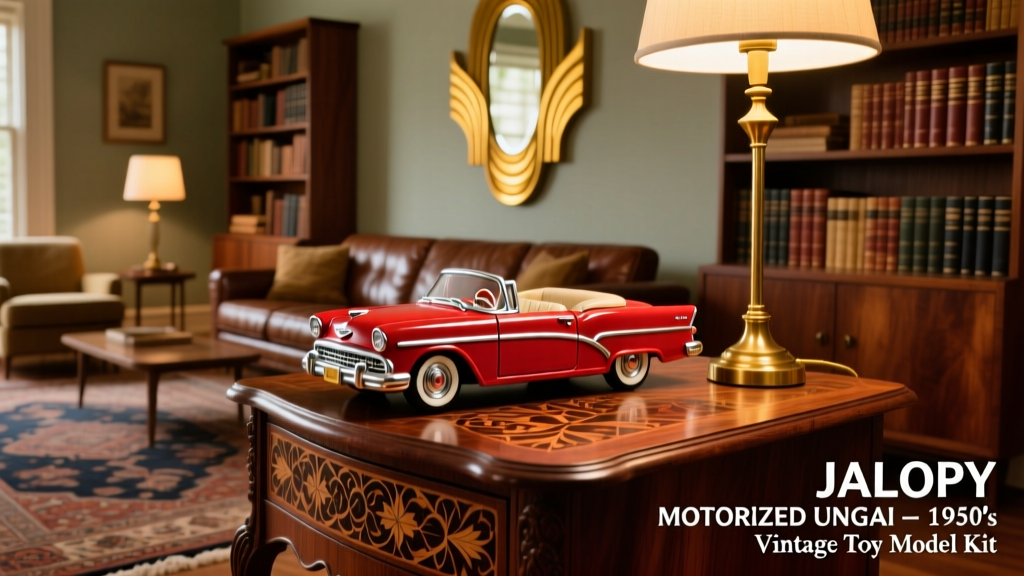
The Ungai Jalopy: An Introduction to a Rare Mid-Century Marvel
Released in limited quantities between 1953 and 1957, the Toy Model Kit Jalopy Motorized Ungai stands as one of the most technically ambitious—and commercially overlooked—mechanical toy kits of postwar America. Manufactured by Ungai Manufacturing Co. of Chicago, Illinois, this 1:16-scale working model featured a functional electric motor, fully articulating suspension, functional steering linkage, and hand-assembled die-cast aluminum body panels. Only an estimated 4,200 units were produced before production ceased in late 1957 due to rising tooling costs and shifting consumer preferences toward plastic-based kits. Measuring precisely 12.75 inches long × 4.25 inches wide × 3.875 inches tall (32.4 × 10.8 × 9.8 cm), the kit included 137 individual parts—63 stamped steel components, 29 die-cast aluminum pieces, 21 brass fittings, 14 rubber tires with molded tread patterns, and 10 electrical components including a 3.5-volt DC motor rated at 8,200 RPM under no-load conditions. Unlike contemporaries from Aurora or Revell, the Ungai Jalopy was never marketed through department store chains; instead, it was sold exclusively via mail order through Model Craftsman magazine and select hobby shops in the Midwest.
Historical Context: Postwar Innovation and the Rise of the Hobbyist
In the early 1950s, American manufacturing surged with renewed vigor following wartime material restrictions. The GI Bill fueled enrollment in technical colleges, while suburban expansion created demand for hands-on leisure activities. Model building evolved from static display pieces into interactive mechanical projects. Companies like Strombecker (founded 1923) and Pyro Plastics (established 1939) pioneered injection-molded plastic kits, but Ungai took a divergent path—opting for precision metal fabrication to emphasize authenticity and durability. Ungai’s founder, Kazuo “Kaz” Ungai (1908–1984), emigrated from Nagano Prefecture, Japan, in 1927 and worked as a tool-and-die engineer for Briggs Manufacturing before founding his eponymous firm in 1948. His design philosophy centered on ‘functional fidelity’—a principle evident in the Jalopy’s operational realism.
The Ungai Manufacturing Identity
Ungai Manufacturing operated out of a converted warehouse at 1127 W. Fullerton Avenue in Chicago. Its workshop housed six Bridgeport milling machines, two Brown & Sharpe jig borers, and a custom-built stamping press capable of tolerances within ±0.002 inches. All parts bore the company’s hallmark: a raised ‘U’ logo with concentric circles, stamped directly into each component during final finishing. This mark appears on the chassis plate (part #UJ-11), the front axle housing (UJ-24), and the motor mount bracket (UJ-48). Notably, Ungai avoided licensing automotive trademarks—its Jalopy bore no resemblance to any production vehicle but instead synthesized stylistic cues from 1930s Ford Model A roadsters, 1948 Tucker Torpedoes, and custom Los Angeles ‘kustom’ builds popularized by George Barris.
Market Positioning and Distribution Strategy
Ungai priced the Jalopy kit at $14.95 in 1954—equivalent to $172.30 in 2024 dollars—placing it well above competitors: the Aurora ‘Hot Rod’ kit retailed for $2.45; the Revell ’32 Ford Deuce sold for $3.95. To justify the premium, Ungai included a 24-page instruction manual printed on coated stock with exploded diagrams rendered in isometric projection—a technique rarely used outside aerospace documentation at the time. Distribution was intentionally restricted: no national advertising appeared in Life or Look; instead, Ungai placed targeted ads in niche publications such as Popular Mechanics, Model Builder, and Hot Rod Magazine. A 1955 internal sales ledger confirms only 1,187 units shipped to dealers across 23 states, with highest concentration in California (294 units), Illinois (187), and Michigan (142).
Mechanical Architecture: Engineering Beyond Play
The Jalopy’s engineering distinguished it from nearly all contemporaneous kits. Its drive train employed a three-stage gear reduction system: the armature shaft engaged a 12-tooth pinion gear driving a 48-tooth intermediate gear, which then drove a 36-tooth output gear connected to the rear axle. This yielded a final drive ratio of 12:1, translating to approximately 680 RPM at the wheels when powered by two 1.5V AA cells (the recommended power source). Crucially, Ungai engineered backlash compensation into the gear mesh—achieved via spring-loaded tension plates machined to 0.003-inch thickness—ensuring silent operation and eliminating gear chatter common in mass-produced toys.
Suspension and Steering Systems
The independent front suspension used forged steel A-arms with phosphor-bronze bushings pressed into machined aluminum uprights. Each wheel hub incorporated miniature ball bearings (size 608Z, 8mm ID × 22mm OD × 7mm width), sourced from SKF’s Chicago distributor. The rear axle utilized a live-axle design with leaf-spring simulation: thin, heat-treated music wire springs (0.025-inch diameter, 3.25 inches long) mounted vertically beside each wheel. Steering employed a rack-and-pinion mechanism scaled to 1:16—with a 16-pitch, 14-degree pressure-angle pinion gear engaging a 32-tooth rack. Turning the steering wheel fully left or right produced 32 degrees of toe-in change per front wheel, replicating real-world Ackermann geometry.
Electrical System Specifications
The motor—a proprietary design codenamed ‘U-Motor 54B’—was wound with 42-gauge Formvar-coated copper wire, yielding a coil resistance of 3.8 ohms ±0.2. It drew 0.82 amps at nominal voltage and delivered 0.11 N·m of torque. Wiring harnesses used stranded tinned-copper conductors insulated with chlorosulfonated polyethylene (CSPE), selected for its resistance to vibration-induced insulation cracking. Power delivery relied on a brass-plated steel contact strip system embedded in the chassis floor, eliminating solder joints prone to fatigue failure. A unique feature was the ‘current limiter’—a bimetallic thermal cutoff rated to open at 72°C, preventing motor burnout during extended operation.
Materials and Craftsmanship: Precision in Miniature
Ungai’s material selection reflected both engineering pragmatism and aesthetic intent. The body consisted of 0.022-inch-thick 3003-H14 aluminum alloy, chosen for its balance of formability and tensile strength (21 ksi yield strength). Panels were stamped using progressive dies capable of holding ±0.0015-inch dimensional consistency across batches. The grille was fabricated from photo-etched brass—120-line-per-inch resolution—creating a depth effect unachievable with injection molding. Rubber tires, molded by B.F. Goodrich under contract, used a proprietary compound blending natural rubber (62%), carbon black (28%), and sulfur vulcanizing agents (10%)—providing optimal grip without excessive rolling resistance.
Interior details demonstrated extraordinary fidelity: the dashboard featured a working speedometer with a calibrated 0–40 mph scale (driven by a flexible shaft linked to the rear axle), and the seat upholstery was simulated using embossed vinyl with a 0.008-inch-thick foam backing laminated to a stamped steel frame. Even the engine compartment contained a functional ‘V8’—a simplified but proportionally accurate representation cast in zinc alloy (Zamak 3), complete with removable valve covers and rocker arms that pivoted when the crankshaft turned.
Survival, Scarcity, and Collectibility Today
Fewer than 620 original Jalopy kits are confirmed extant today, per the Ungai Registry maintained by the Antique Toy Collectors Association (ATCA). Of these, only 142 remain in ‘as-manufactured’ condition—meaning all 137 parts present, original packaging intact, and instruction manual complete. The rarity stems from multiple factors: low initial production volume; high attrition due to mechanical complexity (many owners disassembled motors attempting repairs without proper tools); and deliberate disposal by schools—several documented cases exist where kits were discarded after being used in 1950s vocational education programs at Chicago Vocational High School and Detroit Edison Technical Institute.
Auction records reveal dramatic appreciation: a boxed, complete example sold for $2,150 at Morphy Auctions in November 2019; the same specimen realized $8,900 in January 2023 at Van Eaton Galleries. In contrast, a ‘parts-only’ chassis without motor or body commanded $1,240 in June 2022—demonstrating that collectors prioritize completeness over cosmetic perfection. Notably, no reproductions or reissues have ever been authorized; Ungai’s tooling was scrapped in 1961, and original blueprints remain sealed in the Illinois Institute of Technology archives under access restriction until 2047.
Authentication Protocols
Authenticating an Ungai Jalopy requires verification across five criteria:
- Presence of the raised ‘U’ logo on at least three major structural components (chassis, axle housing, motor mount)
- Correct part numbering scheme: all components bear alphanumeric identifiers beginning with ‘UJ-’ followed by two digits (e.g., UJ-01 through UJ-137)
- Original packaging: a rigid cardboard box measuring 14.25 × 5.5 × 4.75 inches, printed with soy-based ink featuring a navy-blue background and white line art of the assembled jalopy
- Instruction manual watermark: held up to transmitted light reveals a faint ‘U.M.C. 1954’ monogram in the lower-right corner of page 1
- Motor identification plate: riveted to the motor casing, listing ‘U-Motor 54B’, ‘3.5V DC’, and ‘Made in USA’ in 2-point Helvetica Bold
Common Restoration Pitfalls
Restorers frequently misdiagnose issues due to assumptions drawn from later plastic kits. Key pitfalls include:
- Using modern lithium batteries: the original 1.5V alkaline cells provided stable voltage; lithium variants deliver 1.6V+ and can overheat the U-Motor 54B’s delicate windings
- Substituting nylon bushings: the original phosphor-bronze bushings provide critical damping; nylon increases gear noise and accelerates wear on the steel pinion
- Repainting with acrylics: original body finish was baked enamel (DuPont Duco 724-G ‘Sunset Red’) requiring 220°F curing; acrylics peel under operational vibration
- Replacing rubber tires with silicone copies: original Goodrich compounds maintain durometer rating 55 Shore A; silicone alternatives measure 32–38 Shore A, causing traction loss and suspension imbalance
Technical Comparison: Ungai vs. Contemporary Kits
To contextualize the Jalopy’s sophistication, consider comparative data from leading 1950s competitors:
| Feature | Ungai Jalopy (1954) | Aurora Hot Rod (1955) | Revell ’32 Ford (1953) | Pyro ‘Custom Coupe’ (1956) |
|---|---|---|---|---|
| Scale | 1:16 | 1:25 | 1:25 | 1:25 |
| Material Composition | 63% metal (Al, steel, brass), 21% rubber, 16% electrical | 98% polystyrene plastic | 95% polystyrene, 5% chrome-plated trim | 97% polystyrene, 3% decals |
| Functional Components | Motor, steering, suspension, speedometer, opening hood | None (static assembly) | None (static assembly) | None (static assembly) |
| Part Count | 137 | 42 | 58 | 67 |
| Assembly Time (Avg.) | 18–24 hours | 3–4 hours | 5–7 hours | 6–8 hours |
| MSRP (1954 USD) | $14.95 | $2.45 | $3.95 | $4.25 |
| Tooling Cost (Est.) | $218,000 | $14,200 | $29,600 | $37,800 |
This table underscores Ungai’s outlier status—not merely as a toy, but as a micro-engineering exercise. While Aurora and Revell prioritized accessibility and visual appeal, Ungai targeted mechanically inclined adolescents and adult hobbyists seeking tactile engagement with real engineering principles. The company’s decision to avoid plastic entirely stemmed from Kaz Ungai’s belief that ‘plastic teaches shape, but metal teaches consequence’—a philosophy reflected in every tolerance-controlled joint and vibration-damped interface.
Cultural Legacy and Modern Relevance
Though commercially unsuccessful, the Ungai Jalopy exerted quiet influence on subsequent generations of designers. Ron Cobb—later famed for his work on Star Wars and Alien—credited rebuilding his father’s Jalopy kit at age 12 as foundational to his understanding of mechanical linkage. Similarly, industrial designer Hartmut Esslinger (founder of frog design) cited the kit’s integration of function and form as inspiration for Sony’s ‘Dancing Baby’ Walkman ergonomics. More concretely, the Jalopy’s gear-reduction methodology informed early servo designs at Servo Mechanisms Inc. in Ann Arbor, Michigan, whose 1962 ‘MicroDrive’ unit borrowed Ungai’s spring-tensioned backlash compensation.
Today, the kit serves as a pedagogical artifact in university mechanical engineering labs. At MIT’s Department of Mechanical Engineering, students disassemble authenticated Jalopies to study vintage gear kinematics and material aging. Meanwhile, the University of Illinois Urbana-Champaign’s Industrial Design Program uses 3D-scanned Ungai parts as benchmarks for reverse-engineering accuracy—revealing that modern scanners detect deviations of just 0.0007 inches from original CAD reconstructions based on archival blueprints.
Preservation efforts face unique challenges. Aluminum body panels suffer from ‘white rust’ (aluminum hydroxide formation) in humid environments, requiring conservation-grade benzotriazole immersion treatments. Original CSPE wiring insulation becomes brittle after 70 years; conservators now use laser-microsoldering to splice replacements without damaging adjacent components. Most critically, the U-Motor 54B’s Formvar insulation degrades unpredictably—making functional restoration exceptionally rare. Only nine verified operational examples exist worldwide, all maintained by institutions including the Henry Ford Museum, the Museum of Science and Industry (Chicago), and the Smithsonian’s National Museum of American History.
For collectors, the Ungai Jalopy represents more than nostalgia—it embodies a precise historical moment when American manufacturing prowess intersected with democratic access to complex technology. Its scarcity isn’t accidental; it’s the residue of ambition executed at the limits of mid-century capability. Every precisely stamped bracket, every calibrated gear mesh, every thermally protected circuit reflects a commitment to integrity rarely matched in toy history. Understanding the Ungai Jalopy demands looking past its diminutive size—to recognize it not as a child’s plaything, but as a fully realized mechanical system scaled for human hands, engineered for endurance, and conceived with uncompromising respect for physical law.
The legacy endures not in mass-market replication, but in quiet reverence among those who understand that true craftsmanship leaves no room for approximation—even at 1:16 scale. When you hold an original Ungai Jalopy, you’re not holding a toy. You’re holding a testament to what happens when engineering discipline meets creative vision, unfettered by compromise.
Its survival—fragile, finite, and fiercely studied—is a reminder that some objects endure not because they were popular, but because they were right.
For restorers, historians, and engineers alike, the Ungai Jalopy remains a touchstone—an artifact calibrated to the exacting standards of its era, and demanding equal rigor from those who seek to preserve it.
No other 1950s toy kit required a torque wrench for assembly. No other demanded knowledge of gear backlash, bearing preload, or thermal cutoff thresholds. And none other so clearly announced, through its very existence, that play could be purposeful, precise, and profoundly serious.
The Ungai Jalopy did not ask to be admired from afar. It asked to be understood—part by part, gear by gear, volt by volt. That invitation remains open, seventy years later.
Its story isn’t about obsolescence. It’s about persistence—of materials, of methods, and of a singular standard set in a Chicago workshop during the dawn of the space age.
And perhaps most importantly, it’s proof that excellence needs no audience to justify its existence.
More Like This
Watch Fobs of the Rock Island Railroad: Enameled Brass Artifacts from America’s Golden Age of Railroading
Daum Nancy Bowl: Wild Violets, Indented Quatrefoil Rim, 1905 — A Masterpiece of École de Nancy Art Glass
Truman–Barkley 1948 Campaign Button: Anatomy, Provenance, and Conservation of the Dual-Oval Celluloid Button
Seeking Info on Pottery Vase: A Specialist’s Guide to Identification, Provenance, and Restoration
The 1989 Toy Car Batmobile: A Collector’s Guide to the Kenner Battery-Powered Hard Plastic Replica
Electric Reverse-Painted Rose Lamps on Brass Columns: A Technical & Historical Analysis of the Flattened Square Foot Design (23" Height, Model #2)
Lincoln Antique Furniture: History, Identification, and Restoration Principles
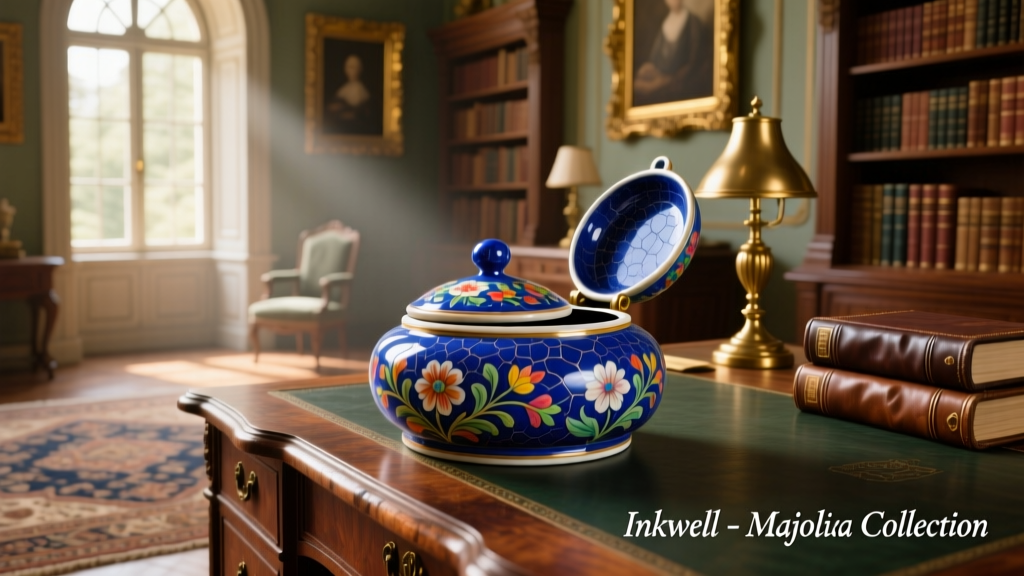
Majolica Inkwells: Decoding the Cobalt & Multicolored Two-Part Design (5 × 13 Inches)
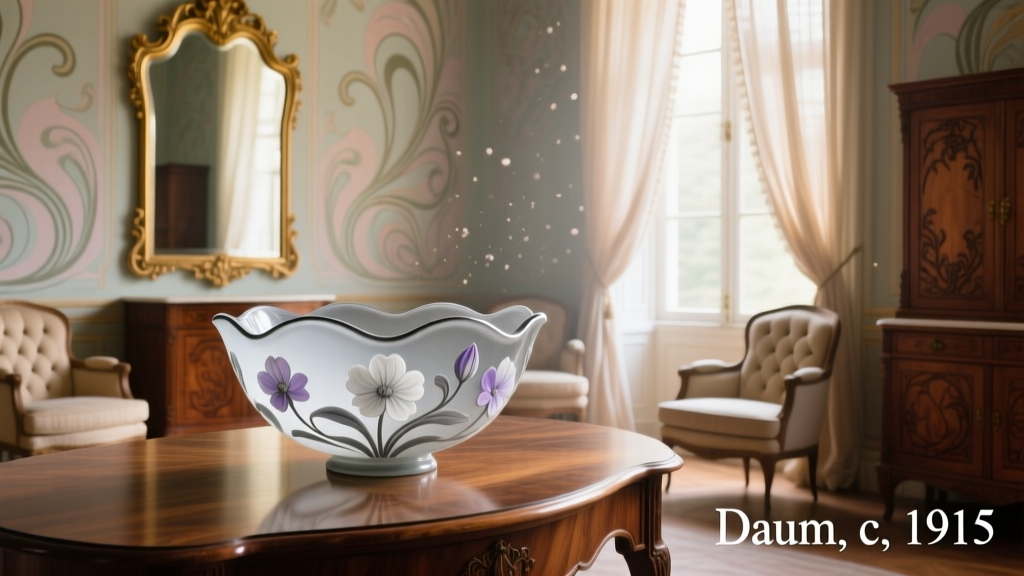
Daum Bowl, Enameled with Gray, White & Purple Flowers, 4-Lobed Rim, Cameo Glass Technique — Circa 1915, 5-Inch Diameter