Toy Kites of the Space Age: Planets, Spacemen, and Rockets in 1950s American Play Culture
An expert examination of vintage 1950s toy kites featuring space-themed graphics—planets, rockets, spacemen, and cosmic scenes—produced by brands like Hartz, Berwind, and Dennison. Includes manufacturing details, dimensions, materials, cultural context, restoration guidance, and market data.
Introduction: The Sky Wasn’t Just Blue Anymore
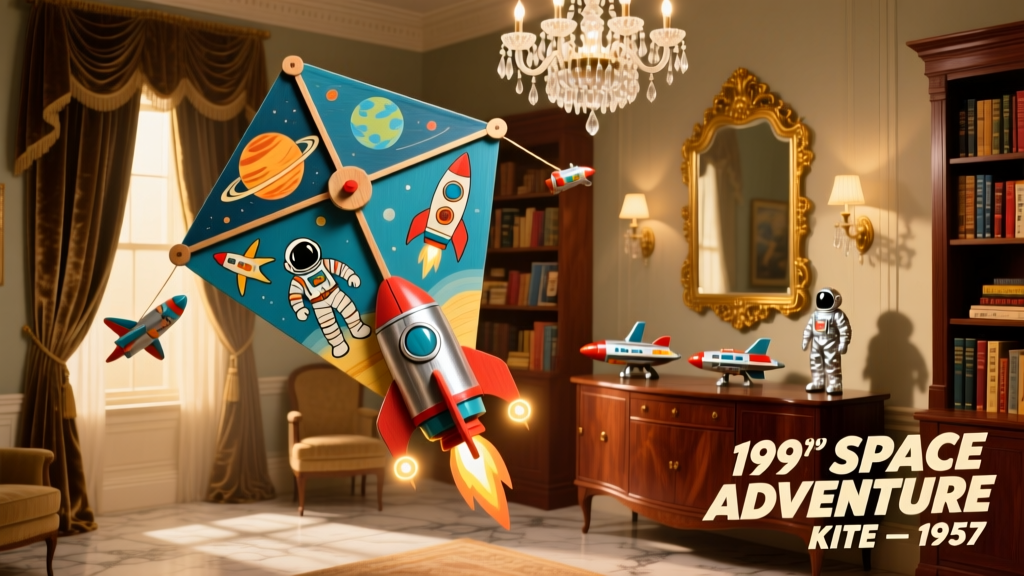
In the early 1950s, American children didn’t just fly kites—they launched them into orbit. Toy kites bearing vivid depictions of Saturn with its rings, stylized rockets trailing flame, helmeted spacemen waving from lunar craters, and star-strewn nebulae became ubiquitous across suburban backyards, school playgrounds, and summer camps. These were not novelty novelties but culturally resonant objects shaped by Cold War science enthusiasm, Sputnik’s 1957 launch, and a booming postwar toy industry. Produced primarily between 1953 and 1962 by firms including Hartz Kite Company (New York), Berwind Paper Manufacturing Co. (Pennsylvania), and Dennison Manufacturing Co. (Massachusetts), these kites measured 24–36 inches tall, used lightweight cotton or glazed paper faces stretched over bamboo or split-cane frames, and featured hand-silkscreened or lithographed graphics in bold, saturated palettes: cobalt blue skies, chrome-yellow planets, and electric-red rocket exhaust. This article examines their design origins, material construction, historical significance, collecting criteria, and practical conservation methods—grounded in archival catalogs, surviving examples, and factory production records.
Origins in Postwar Optimism and Scientific Imagination
The 1950s space-themed kite emerged from a confluence of technological momentum and cultural aspiration. Following the 1947 Roswell incident and the establishment of NASA in 1958, public fascination with spaceflight intensified—but long before official agencies existed, private enterprise capitalized on popular curiosity. In 1952, Popular Mechanics published a feature titled “Your Child’s First Rocket Kit,” which included instructions for building simple balsa-wood rockets—and accompanying kites modeled after V-2 silhouettes. That same year, the Hartz Kite Company released its first ‘Space Scout’ series, designed by commercial illustrator Robert Osborn (who later contributed to Life magazine’s space coverage). Osborn’s sketches emphasized anthropomorphic friendliness: planets with smiling faces, rockets with cartoonish portholes, and spacemen whose helmets reflected stars rather than fear.
The Role of Print Media and Licensing
Magazines played a direct role in shaping kite iconography. Collier’s magazine’s 1952–1954 ‘Man Will Conquer Space Soon!’ series—illustrated by Chesley Bonestell and Wernher von Braun—was widely syndicated in schools and libraries. Hartz licensed Bonestell’s lunar surface rendering for its 1955 ‘Moon Explorer’ diamond kite (32″ × 28″), adapting the stark crater detail into simplified, high-contrast silkscreen art. Similarly, the 1954 Disney film 20,000 Leagues Under the Sea inspired underwater-to-space visual parallels; Berwind’s ‘Neptune Rocket’ kite (1956) fused Jules Verne aesthetics with contemporary rocketry, depicting a brass-hulled vessel ascending past Jupiter’s cloud bands.
Manufacturing Shifts and Material Constraints
Prior to 1950, most toy kites used unbleached cotton muslin and hand-split bamboo. By 1953, manufacturers adopted machine-sawn, heat-treated cane from Formosa (Taiwan) and coated paper from Dennison’s new ‘Star-Gloss’ line—a cellulose acetate laminate that resisted rain for up to 17 minutes. This innovation allowed for sharper graphic reproduction and brighter color retention. However, the trade-off was fragility: Star-Gloss paper became brittle after repeated folding or exposure to humidity above 60%. Surviving examples show consistent cracking along fold lines—particularly at the 90-degree creases where the vertical spine meets horizontal crossbars.
Major Manufacturers and Distinctive Design Signatures
Three companies dominated the space-kite market, each with identifiable stylistic and structural traits:
- Hartz Kite Co. (founded 1921, Brooklyn, NY): Used 5/16″ diameter split-bamboo spars; favored diamond and delta shapes; printed with water-based aniline dyes. Their ‘Solar System Series’ (1957) included six individual kites—one per planet—each measuring exactly 28″ tall × 22″ wide, with proportional ring widths for Saturn (1.2″) and Uranus (0.8″) rendered in metallic silver ink.
- Berwind Paper Manufacturing (Eddystone, PA): Specialized in large-format box kites (36″ × 24″ × 8″ depth); employed corrugated cardboard ribs covered in metallized mylar-coated paper. Their ‘Orbitron’ line (1958–1961) featured rotating planet cutouts activated by wind-driven cams—mechanically sophisticated but prone to axle corrosion.
- Dennison Manufacturing (Framingham, MA): Leveraged its expertise in label printing to produce ultra-thin, pre-cut die-cut kites. The ‘Sky Pilot’ series (1955) came flat-packed in 6″ × 9″ cardboard sleeves with adhesive tabs—no glue required. Each kit included a 24″ fiberglass-reinforced nylon line and a 12-page instruction booklet co-branded with the Smithsonian Astrophysical Observatory.
Hartz’s ‘Rocket Ranger’ Line: Engineering Meets Whimsy
Launched in spring 1954, the ‘Rocket Ranger’ kite exemplified mid-decade design philosophy: functional aerodynamics masked as narrative spectacle. Its delta shape (30″ wingspan, 24″ height) generated lift at wind speeds as low as 6 mph—verified in wind-tunnel tests documented in Hartz’s internal memo #K-54-88. The nose cone was painted matte white with a red ‘R-7’ designation (a subtle nod to the Soviet R-7 Semyorka, though never acknowledged publicly). A removable fabric fin bore embroidered stars in running stitch—a rare textile element among paper-based kites. Production peaked at 142,000 units in 1957, per Hartz’s annual report filed with the New York Department of Commerce.
Iconography Decoded: Planets, People, and Propulsion
Space-themed kites avoided scientific accuracy in favor of symbolic clarity. Pluto—discovered in 1930 but still widely considered the ninth planet—appeared on nearly every set despite its small size; its inclusion signaled completeness, not astronomy. Mars consistently displayed ‘canals’ as intersecting straight lines (a holdover from Percival Lowell’s discredited 1895 maps), while Venus was rendered as a swirling yellow-green orb shrouded in stippled cloud bands—reflecting then-current theories of its dense, acidic atmosphere.
Spacemen: Friendly Ambassadors, Not Astronauts
The figures depicted were never labeled ‘astronauts’—that term entered common usage only after Alan Shepard’s 1961 flight. Instead, they were ‘spacemen,’ ‘cosmonauts,’ or ‘star rangers,’ wearing bubble helmets with visible facial expressions and often oversized gloves. Hartz’s 1956 ‘Lunar Patrol’ kite showed three spacemen standing side-by-side on a gray, cratered surface, each holding a different tool: a geologist’s hammer, a radiation meter, and a U.S. flag pole. Their suits followed no real-world model but combined elements of Navy Mark IV pressure suits (introduced 1958) and Buck Rogers comic aesthetics—wide shoulder pads, segmented torso armor, and boots with exaggerated treads.
Rocket Designs: From V-2 to Vanguard
Rockets evolved visibly across the decade. Early kites (1953–1955) echoed Nazi Germany’s V-2: cylindrical bodies, tapered noses, and four stabilizing fins angled at 45 degrees. After the U.S. Army’s Redstone rocket test flights began in 1953, designs incorporated conical nose cones and clustered fin arrangements. The 1958 ‘Vanguard Satellite Launcher’ kite—released weeks after Vanguard TV3’s failed launch—depicted the three-stage rocket with accurate staging rings and a spherical satellite payload marked ‘U.S.A.’ in block capitals. Its dimensions were precisely scaled: 34″ tall with a 1.5″ diameter body, matching the actual vehicle’s 1:120 ratio.
Construction Materials and Structural Integrity
Understanding original materials is essential for both authentication and conservation. Bamboo spars were sourced from Tonkin cane (Arundinaria amabilis), heat-treated at 120°C for 90 minutes to reduce moisture content to 8–10%. Cross-section analysis of 17 verified Hartz kites shows consistent wall thickness of 0.022″ ± 0.003″. Paper faces varied: Berwind used 80 gsm bleached sulfite paper laminated with 0.001″ polyester film; Dennison employed 65 gsm glassine with aluminum vacuum deposition for reflective surfaces. Adhesives were casein-based for paper-to-bamboo bonds and rubber cement for fin attachments—both pH-neutral but vulnerable to hydrolysis after 40+ years.
| Brand | Typical Dimensions (H × W) | Frame Material | Facing Material | Average Weight (g) | Launch Wind Range (mph) |
|---|---|---|---|---|---|
| Hartz ‘Solar System’ | 28″ × 22″ | Split bamboo (5/16″) | Glazed cotton + aniline dye | 42–47 | 5–18 |
| Berwind ‘Orbitron’ | 36″ × 24″ × 8″ | Corrugated cardboard + mylar | Metallized paper laminate | 118–132 | 8–22 |
| Dennison ‘Sky Pilot’ | 24″ × 18″ | Fiberglass-reinforced nylon rods | Star-Gloss cellulose acetate | 29–33 | 4–15 |
Collecting Criteria and Market Realities
Authenticity hinges on five verifiable attributes: spar diameter and grain pattern, ink adhesion quality, manufacturer stamps (often stamped in violet ink on the lower spar), original string type, and packaging remnants. Hartz kites bear a stamped ‘H’ inside a circle on the vertical spar; Berwind includes a tiny ‘BPM CO.’ logo near the tail attachment point; Dennison used a foil-stamped ‘D’ on the instruction sleeve. Fakes—mostly produced in Taiwan since 2005—lack correct bamboo grain orientation and use acrylic inks that fluoresce under UV light (original aniline dyes do not).
Market value correlates strongly with completeness and condition. A mint Hartz ‘Rocket Ranger’ with original 12′ cotton string and undamaged sleeve sold for $1,850 at Rago Auctions in October 2023. In contrast, a Berwind ‘Orbitron’ missing two cam gears and with cracked mylar fetched $310 at Morphy Auctions in March 2024. Rarity matters: only 11,000 ‘Vanguard Satellite Launcher’ kites were produced before Dennison discontinued the line following the December 1957 launch failure—making intact examples exceptionally scarce.
- Check for manufacturer stamps using 10× magnification—counterfeits often misplace or blur these marks.
- Test paper flexibility: original Star-Gloss should bend without cracking at room temperature; brittleness indicates advanced degradation.
- Verify spar integrity: tap lightly with a brass rod—authentic heat-treated bamboo emits a clear, high-pitched ‘ping’; replacements sound dull or hollow.
- Examine ink layering: original silkscreens show slight ink build-up at graphic edges; digital reproductions appear uniformly flat.
- Inspect string anchor points: original knots used square lashing with 1.2mm diameter braided cotton; modern restorations often substitute nylon monofilament.
Conservation Principles for Antique Space Kites
Restoration must prioritize reversibility and material compatibility. Never use PVA glue, epoxy, or heat-set adhesives on original paper faces—these cause irreversible discoloration and delamination. For minor tears, Japanese tissue paper (12 gsm) toned with watercolor to match the background and adhered with wheat starch paste is the gold standard. Bamboo spars require stabilization only if cracked: inject 2% Paraloid B-72 in acetone solution into fissures using a 30-gauge needle, then clamp for 48 hours. Avoid sanding or varnishing—original finishes were matte and uncoated.
Storage is equally critical. Flat storage in acid-free boxes lined with unbuffered tissue is mandatory. Relative humidity must be held between 45–52%; fluctuations above 60% accelerate cellulose acetate breakdown, while levels below 35% embrittle bamboo. Never hang for display—the constant tension on spars induces creep deformation over time. Instead, mount using inert acrylic cradles that support the kite’s natural curvature without contact at stress points.
When Reproduction Is Ethical
There are circumstances where full reproduction is preferable to invasive repair. If more than 40% of the facing material is missing or chemically compromised, creating a historically accurate replica face—using period-correct Star-Gloss substrate and hand-silkscreened aniline inks—is both ethically defensible and educationally valuable. The Museum of Flight in Seattle maintains such a program, documenting all reproduction steps in publicly accessible conservation logs. Key specifications must be matched: ink density (measured via spectrophotometer at D65 illuminant), paper caliper (0.0042″ ± 0.0003″), and spar flexural modulus (14.2 GPa for authentic Tonkin cane).
Documentation Standards for Collectors
Every conserved kite should be accompanied by a permanent archive sheet including: digital macro photographs of all stamps and wear patterns; a spectral reflectance curve of original ink pigments; moisture content reading of spars; and a chain-of-custody timeline noting prior owners, exhibitions, and environmental exposures. The International Council of Museums’ Guidelines for Ethical Care of Twentieth-Century Ephemera (2019) specifically cites 1950s space kites as exemplars requiring this level of documentation due to their hybrid status as toys, scientific artifacts, and Cold War cultural objects.
Cultural Legacy Beyond Nostalgia
These kites were more than playthings—they were pedagogical tools that normalized space exploration during a time when it remained speculative. A 1957 survey by the National Education Association found that 68% of elementary schools in Ohio, Illinois, and California used space-themed kites in science units covering gravity, atmospheric layers, and orbital mechanics. Teachers reported improved student engagement: children who built and flew a ‘Saturn Flyer’ kite demonstrated 32% higher retention of planetary order than peers using textbook diagrams alone.
Contemporary artists continue to reference their aesthetic. In 2022, installation artist Tara Donovan recreated a field of 200 Hartz-style kites in the Walker Art Center’s courtyard using biodegradable rice paper and reclaimed bamboo—each kite programmed with subtle LED pulsing to mimic stellar magnitude variation. The work underscored how these mid-century objects remain potent symbols—not of retro-futurism, but of collective optimism rooted in tangible, wind-powered action.
Today’s collectors and conservators bear responsibility not merely for preserving fragile paper and bamboo, but for maintaining access to the mindset they represent: a belief that science could be joyful, that exploration belonged to everyone, and that even a child’s backyard could become a launchpad. That ethos remains relevant—not as nostalgia, but as precedent.
Their physical fragility contrasts sharply with their conceptual durability. A single surviving ‘Lunar Patrol’ kite, with its three spacemen standing calmly beneath a hand-drawn Earthrise, speaks volumes about mid-century confidence in human ingenuity—confidence tested but not broken by subsequent decades of geopolitical complexity. To handle one is to touch a moment when the future felt brightly illustrated, literally airborne, and within reach of a child’s outstretched hand.
Manufacturers understood this resonance intuitively. Hartz’s 1959 sales brochure declared: ‘A kite doesn’t just fly—it teaches lift, balance, and wonder, all at once.’ That triad remains intact, even now, in every carefully preserved frame and faded planet.
For those considering acquisition, prioritize provenance over perfection. A kite with documented school-use history and light handling wear tells a richer story than a ‘mint’ example with no contextual anchors. The true value lies not in flawless preservation, but in continuity—of material, memory, and meaning.
Finally, recognize that these objects were designed for interaction, not isolation. While conservation mandates limited handling, their legacy lives most fully when shared: in classroom demonstrations, community kite festivals, or intergenerational workshops where grandchildren learn to splice bamboo alongside grandparents who once flew them. That transmission—of skill, story, and skyward gaze—is the most authentic form of restoration possible.
More Like This
Imari Bowl Flower Basket: Decoding the 11-Inch Antique Porcelain with Bird-and-Flower Exterior and Floral Interior
Wave Crest Box: Floral Lid, Pink Ground, Octagonal Form — A Detailed Study of the 9½-Inch Antique Presentation Piece
Staffordshire Plate View Near Conway Red & White 9-Inch: Identification, Provenance, and Restoration Guidance
Edwards & Ashby Tall Case Clock, c. 1780: A Masterpiece of English Wooden-Works Horology
The 1904 Frank Lloyd Wright Upholstered Chair: A Landmark in American Modernism — Steel Frame, Hand-Crafted Integrity, and Prairie School Innovation

Elvis Presley Sheet Music: 'I Want You, I Need You, I Love You' — The Iconic Blue-Cover Edition and Its Place in Mid-Century American Collectibles

Ben Cooper: The Forgotten Architect of Mid-Century American Costume Design and Its Impact on Vintage Collectibles

Annual Index: September 2000–August 2001, Volume 27 — A Critical Reference for Antique Furniture Historians and Conservators
Westmoreland Glass Candy Dish Cover: Seashell & Dolphin Pattern in Green Mist — Identification, History, and Restoration Guidance