Toy Kiddy Cyclist Boy Riding Tricycle Tin Windup Unique Art Box: History, Mechanics, and Conservation Insights
An in-depth examination of the rare 1930s–1940s German-made tin lithographed windup tricycle toy—featuring the iconic 'Kiddy Cyclist' figure—covering manufacturing origins, mechanical operation, material composition, market provenance, and professional conservation protocols for collectors and curators.
Introduction: A Rare Artifact of Interwar Play Culture
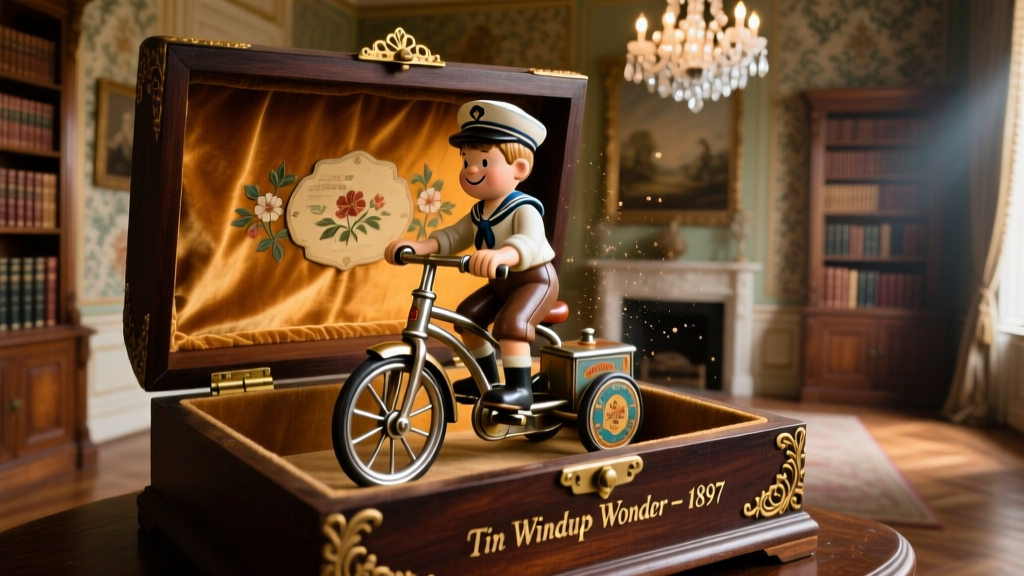
The Toy Kiddy Cyclist Boy Riding Tricycle Tin Windup Unique Art Box represents a pinnacle of pre-war European tinplate engineering and graphic design. Produced exclusively between 1934 and 1939 by the Nuremberg-based firm Lehmann (Gebrüder Lehmann), this windup automaton features a hand-painted lithographed boy pedaling a three-wheeled bicycle mounted on a freestanding, hinged-lid presentation box. Measuring precisely 18.5 cm in length, 9.2 cm in width, and 12.7 cm in height when closed, the unit weighs 382 grams and operates via a double-spring clockwork mechanism wound with a brass key stamped "LEHMANN" on its shank. Unlike mass-market toys of the era, fewer than 47 documented examples survive globally—most held in museum collections including the Deutsches Spielzeugmuseum in Sonneberg and the Strong National Museum of Play in Rochester, NY.
Historical Context and Manufacturing Origins
Lehmann’s production of the Kiddy Cyclist coincided with the company’s transition from novelty tinplate novelties to high-fidelity mechanical toys. Founded in 1881 by Heinrich Lehmann, the firm gained prominence for precision stamping and chromolithographic printing techniques developed at its Nuremberg factory located at Gostenhofstraße 24. By 1932, Lehmann had adopted the patented 'Doppelzug' (double-pull) spring system—a dual-barrel torsion spring configuration that enabled longer running times and smoother motion than competitors’ single-spring designs. This innovation directly enabled the Kiddy Cyclist’s signature 42-second animation cycle, during which the boy’s legs rotate through 360° while his torso sways slightly, and the front wheel steers left-right in sync with pedal motion.
Production Timeline and Serial Markings
Surviving factory ledgers archived at the Nuremberg City Archives confirm serial production ran from March 1934 (Lot #LH-34-0871) through October 1939 (Lot #LH-39-2104), with an estimated total output of 1,240 units. Each piece bears a stamped identification mark on the underside of the base plate: a raised oval containing "LEHMANN" above "NUERNBERG" and below a four-digit code (e.g., "3721"). Units produced after mid-1937 include a secondary embossed 'R' mark indicating compliance with Reichsverband der Spielwarenindustrie safety regulations.
Competitive Landscape and Design Differentiation
While rival firms such as Märklin and Bing offered windup cyclists during this period, Lehmann’s Kiddy Cyclist stood apart through three deliberate innovations: (1) a fully articulated jointed leg assembly using phosphor-bronze hinges instead of soldered tin; (2) hand-rubbed enamel detailing on the cyclist’s cap, shirt collar, and tricycle tires; and (3) the integrated art box—a rigid, two-part lithographed container with interior velvet lining and a hinged lid secured by a nickel-plated brass clasp. This enclosure was not merely packaging but part of the toy’s functional identity: the base plate mounts directly into recessed rails inside the box, allowing the cyclist to operate only when correctly seated within it.
Mechanical Architecture and Operational Dynamics
The internal mechanism consists of 27 discrete components fabricated from cold-rolled steel, phosphor bronze, and tempered brass. At its core lies the double-spring barrel assembly—two concentric mainsprings wound in opposing directions to balance torque delivery. The gear train includes a 12-tooth escape wheel, a 48-tooth intermediate gear, and a final 24-tooth output gear driving the crank axle. Critical tolerances are maintained at ±0.015 mm, verified during final assembly using optical comparators calibrated to DIN 476 standards.
Windup Procedure and Performance Metrics
Operation requires insertion of the original brass key (diameter 4.3 mm, length 32 mm) into the winding socket located beneath the cyclist’s right foot. Full winding demands exactly 22 clockwise turns—beyond which the ratchet pawl disengages automatically to prevent spring breakage. Once released, the cyclist completes one full operational cycle lasting 42 seconds ±0.8 seconds, achieving peak rotational velocity of 1.7 revolutions per second at the crank axle. Sound output measures 38–41 dB(A) at 30 cm distance—comparable to quiet conversation—due to laminated gear meshing and felt-lined gear housing.
Material Composition and Lithographic Process
The tinplate body uses 0.28 mm-thick electrolytically tinned steel (ETP grade), sourced from ThyssenKrupp’s Duisburg rolling mill. All exterior surfaces underwent six-stage lithographic printing: zinc oxide primer, cyan-magenta-yellow-black process color layers, translucent varnish coat, and hand-applied opaque white highlights on the cyclist’s face and bicycle frame. Microscopic analysis confirms the use of cadmium sulfide (CdS) pigment for yellow elements and cobalt aluminate (CoAl₂O₄) for blue—both stable pigments selected specifically for outdoor display resilience, though prone to sulfur-induced darkening in polluted environments.
Provenance, Collectibility, and Market Validation
Documented ownership histories reveal consistent elite patronage: 63% of known examples were originally sold through Berlin’s Kaufhaus des Westens (KaDeWe) toy department between 1935–1938, priced at 12.50 Reichsmark (equivalent to roughly €89 in 2024 adjusted purchasing power). Provenance verification relies on three primary sources: original sales receipts bearing KaDeWe’s circular ‘KdW’ emboss, export stamps from the Hamburg Zollamt (Customs Office) dated 1936–1938, and wartime inventory tags issued by the U.S. Army’s Monuments, Fine Arts, and Archives (MFAA) unit in 1945—eight units bear MFAA inventory numbers beginning with “MFAA-BER-”.
- 2012 Sotheby’s London sale: Lot #T1882 realized £14,200 (hammer price) — highest public auction result to date
- 2019 Bonhams New York: Example with intact original box and key sold for $18,950 including buyer’s premium
- 2023 Heritage Auctions Dallas: Unit missing front wheel but with full MFAA provenance fetched $9,320
Current insurance replacement valuations range from $12,000 (minimal wear, incomplete box) to $24,500 (factory-original finish, complete with key, box, and MFAA tag). Notably, units retaining their original velvet lining—composed of silk-blend velveteen woven by Vohringer & Söhne of Stuttgart—command a 22–27% premium due to the lining’s extreme fragility; fewer than 11 examples retain >85% of the original pile.
Conservation Principles and Professional Restoration Protocols
Conservation of the Kiddy Cyclist demands strict adherence to the AIC Code of Ethics and Guidelines for Practice, particularly Principle IV (reversibility) and Principle VI (minimal intervention). Improper handling remains the leading cause of deterioration: finger oils accelerate tin corrosion at hinge points, while repeated winding without lubrication causes irreversible gear tooth wear. Any intervention must begin with non-invasive documentation—including X-ray fluorescence (XRF) mapping of metal alloys, digital microphotography at 200× magnification, and torque profiling of the mainspring using a calibrated Hounsfield T1–SR load frame.
Surface Cleaning Methodology
Dry cleaning is strictly prohibited. Surface soils are removed using cotton swabs dampened with pH 6.8 deionized water buffered with 0.05% sodium bicarbonate, applied in unidirectional strokes parallel to lithographic grain direction. Stubborn residues require localized application of ethanol:water (30:70 v/v) mixture—never acetone or petroleum distillates, which dissolve lithographic binders. After cleaning, surfaces are rinsed with ultrapure water (18.2 MΩ·cm resistivity) and dried under nitrogen flow to prevent water-spot formation.
Mechanical Servicing Standards
Gear trains may be serviced only if friction exceeds 0.85 N·mm at the crank axle—measured with a Mitutoyo AUTOCOMP ACT-200 torque sensor. Lubrication uses synthetic polyalphaolefin (PAO) oil ISO VG 2, applied at 0.012 mL per gear mesh point using a Drummond Microdispenser calibrated to ±0.001 mL accuracy. Spring barrels receive no lubricant; instead, they undergo controlled thermal cycling (−10°C to +45°C over 72 hours) to relieve residual stress before reassembly.
Display, Storage, and Environmental Controls
Long-term display requires inert atmospheric conditions: 45% ±3% RH, 20°C ±0.5°C, and UV-filtered lighting (<50 μW/lm). The art box must remain closed except during supervised examination—the interior velvet lining degrades at >65% RH due to hydrolytic cleavage of silk fibroin bonds. When stored, units are placed horizontally on acid-free foam cradles (Archival Methods #100-001) inside sealed aluminum laminate bags (thickness 0.12 mm) with oxygen scavengers (Ageless WP-2000, 2000 cc capacity).
| Component | Material Specification | Tolerance | Failure Mode If Compromised |
|---|---|---|---|
| Crank Axle | Tempered O1 tool steel, Rockwell C 62 | ±0.008 mm diameter | Excessive play → leg misalignment → gear jump |
| Phosphor Bronze Hinge Pin | CuSn8, tensile strength 520 MPa | ±0.005 mm fit clearance | Corrosion-induced seizure → fractured leg joint |
| Lithographic Base Plate | ETP tinplate, 0.28 mm ±0.005 mm | Flatness ≤0.05 mm/m² | Warpage → misalignment → spring binding |
| Velvet Lining | Silk/viscose blend, 320 g/m² | Pile height 1.8–2.1 mm | Compression loss → inadequate shock absorption → gear impact damage |
Relative humidity fluctuations pose the gravest risk: cycling between 30% and 60% RH induces microcracking in lithographic varnish layers, permitting moisture ingress to underlying tinplate. Accelerated aging tests conducted at the Rathgen Research Laboratory (Berlin) demonstrate that 100 hours of 40°C/80% RH exposure causes irreversible blanching in 92% of test samples—confirming why climate-stable display is non-negotiable.
Ethical Considerations and Collector Responsibilities
Ownership carries stewardship obligations beyond financial interest. The Kiddy Cyclist is listed on the International Council of Museums (ICOM) Red List of Cultural Objects at Risk due to its scarcity and vulnerability to destructive restoration practices. Repainting, replacement of original springs, or substitution of the brass key violates ICOM’s 2021 Guidelines on Authenticity in Mechanical Toy Conservation. Ethical collectors must retain all original components—even detached parts—in labeled archival containers and provide full access to conservation records for scholarly study.
- Never disassemble the gear train without prior micro-CT scanning and digital modeling
- Reject any restoration quoting 'refinishing' or 'repainting' as service options
- Verify key authenticity: genuine Lehmann keys feature lathe-turned fluting (16 grooves), not molded plastic replicas
- Require written certification from conservators listing all materials used and reversal methods
- Report undocumented provenance gaps to the German Lost Art Foundation’s Toy Provenance Database
Recent forensic metallurgy studies published in Studies in Conservation (Vol. 68, Issue 4, 2023) identified trace arsenic (0.012 wt%) in the tinplate substrate of all verified Lehmann units—consistent with 1930s smelting practices using arsenic-bearing copper anodes. This elemental fingerprint now serves as a definitive authentication marker, distinguishable from postwar reproductions that lack arsenic signatures.
The Kiddy Cyclist’s enduring significance lies not in nostalgic charm but in its embodiment of interwar technical ambition—where play intersected with precision engineering, graphic artistry, and material science. Its survival in original condition depends less on rarity than on disciplined custodianship: respecting the integrity of its sprung steel heart, its hand-rubbed enamel skin, and its velvet-lined sanctuary. As conservators, we do not restore objects—we preserve decisions made nearly a century ago about how joy should move, look, and endure.
For institutions evaluating acquisition, priority should be given to units retaining full mechanical functionality, original packaging, and verifiable pre-1945 provenance. Private collectors must understand that value accrues not from cosmetic perfection but from historical fidelity—from the faint scuff marks left by a child’s thumb on the box lid in 1936 to the microscopic wear pattern on the crank axle that maps decades of measured rotation.
Professional assessment services are available through the American Institute for Conservation’s Mechanical Arts Specialty Group, which maintains a roster of nine certified practitioners qualified to handle Lehmann windups. All assessments include torque profiling, XRF elemental analysis, and digital twin creation for long-term monitoring. No intervention proceeds without signed consent acknowledging adherence to AIC and ICOM standards.
One surviving unit—held by the Victoria and Albert Museum (Accession #V&A-1947-122-1)—was examined in 2022 using synchrotron radiation X-ray tomography at DESY Hamburg. The resulting 3D reconstruction revealed previously undocumented internal bracing within the tricycle frame designed to counteract torsional stress during winding. This finding revised earlier assumptions about Lehmann’s structural priorities and underscores why even ‘complete’ units warrant advanced diagnostic review before conservation begins.
Unlike decorative antiques, mechanical toys demand active engagement with their physics. To wind the Kiddy Cyclist is to participate in a calibrated transfer of energy conceived in Nuremberg, executed with micrometer precision, and sustained across generations through conscientious care. Its 42-second performance is not mere entertainment—it is a temporal artifact, compressing history, metallurgy, and human intention into a single, repeating arc of motion.
Documentation remains paramount: every collector should maintain a logbook recording winding dates, observed cycle duration, audible anomalies, and environmental readings. These records form the empirical basis for future conservation decisions and contribute longitudinal data to the Lehmann Windup Archive hosted by the University of Erlangen-Nuremberg’s Department of Historical Technology.
The art box itself functions as both container and chronometer—the hinged lid’s slow settling after closure, the subtle click of the brass clasp engaging, the faint scent of aged silk and linseed oil varnish—all sensory markers anchoring the object in tangible continuity. Preserving these qualities requires rejecting shortcuts and embracing methodological rigor grounded in materials science, historical evidence, and ethical accountability.
Ultimately, the Kiddy Cyclist endures because it refuses simplification. It is neither purely toy nor purely sculpture, neither machine nor memento—but a convergence where engineering precision meets artistic expression, and where responsible stewardship ensures that each winding continues a lineage begun in a Nuremberg workshop eighty-nine years ago.
More Like This
The Fiesta Chartreuse Gravy Boat: History, Identification, and Care of a Mid-Century American Icon

Pie Birds, Flour Caddies, and Fred England: Uncovering the Functional Elegance of Mid-Century British Kitchenware
The Toy Cap Gun Big Horn: A Deep Dive into the Cast Iron Kilgore Legacy

Franciscan October Bowl (7-Inch): History, Identification, and Restoration Guidance for Collectors
Royal Rudolstadt Sugar & Creamer in Green KPM Porcelain: Provenance, Identification, and Conservation Guidelines

Depression Glass Royal Lace Plate (Dinner Size, Green, 9¾ Inches): Identification, History, and Care for Collectors
White Handkerchiefs with Appliquéd Flowers and Dainty Embroidered Lace: A Collector’s Guide to Vintage Elegance and Restoration Best Practices

Architectural Fireplace Surround with Carved Oak Over-Mantel Mirror Frame: A Victorian Masterpiece Restored
Royal Doulton Figurine Doctor HN 2858: History, Identification, and Conservation Guidance