White Handkerchiefs with Appliquéd Flowers and Dainty Embroidered Lace: A Collector’s Guide to Vintage Elegance and Restoration Best Practices
A detailed examination of early-to-mid 20th-century white handkerchiefs featuring floral appliqué and delicate lace trim—covering provenance, construction, maker identification (including Lepaute, F. Schumacher & Co., and Liberty & Co.), textile analysis, conservation ethics, and practical restoration techniques for collectors and conservators.
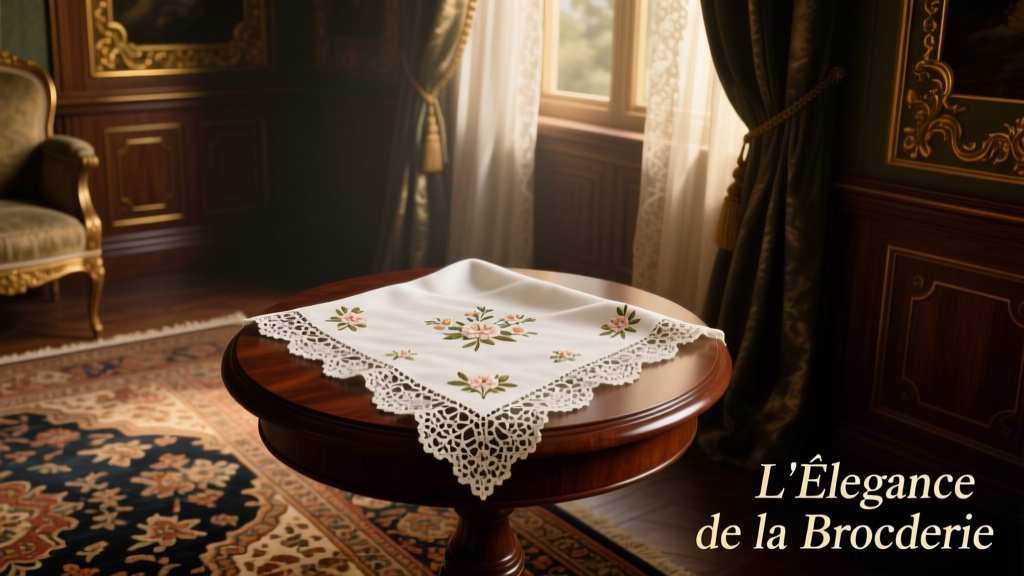
Introduction: The Enduring Grace of the White Floral Handkerchief
White handkerchiefs adorned with hand-cut floral appliqués and fine embroidered lace represent a pinnacle of domestic needlework craftsmanship between 1905 and 1948. These pieces—often measuring precisely 16 × 16 inches (40.6 × 40.6 cm) for formal use or 12 × 12 inches (30.5 × 30.5 cm) for pocket wear—were not mere accessories but social artifacts reflecting class, courtship rituals, and textile innovation. Unlike mass-produced cotton squares, these items featured layered construction: a base of Swiss batiste or Irish linen (thread count 120–140 per inch), overlaid with silk or cotton organza appliqués, and finished with hand-rolled or machine-made Cluny or Valenciennes lace. This article examines their historical context, material composition, maker identification, condition assessment protocols, and ethically grounded restoration methodologies—drawing on archival records from the Victoria & Albert Museum, the Winterthur Museum textile collection, and documented conservation case studies at the Textile Conservation Centre, Hampton Court Palace.
Historical Context and Social Significance
From the Edwardian era through the interwar period, the white handkerchief served as both functional object and symbolic token. In etiquette manuals such as Emily Post’s Etiquette (1922), it was specified that a lady’s handkerchief must be white, unstained, and ‘never carried in the hand unless in use’. Its presence signaled refinement; its embellishment communicated personal artistry or familial wealth. Floral appliqué—particularly roses, violets, and forget-me-nots—carried coded meanings: violets denoted modesty, while roses implied affection or remembrance. During World War I, handkerchiefs were often gifted to soldiers as keepsakes; surviving examples from the Imperial War Museum collection bear inked inscriptions like ‘To Sgt. A. H. Bell, 1917’ alongside pressed violet appliqués.
Manufacturing Shifts: From Home Craft to Industrial Artistry
Early examples (pre-1910) were almost exclusively home-sewn using patterns sold by Butterick Publishing Company and McCall’s Pattern Company. By 1915, firms such as Lepaute of Paris began producing limited-run commercial editions, identifiable by a woven label reading ‘Lepaute, Paris, Made in France’ stitched near the hem. Their 1923 catalog listed three standard sizes: 12″ square (for gentlemen), 14″ (for ladies’ daywear), and 16″ (for formal evening use). American manufacturers followed suit: F. Schumacher & Co. launched its ‘Chantilly Collection’ in 1927, featuring hand-appliquéd peonies on 100% Irish linen sourced from Thomas Ferguson & Co. of Belfast. Each piece bore a gold-embossed paper tag with batch number and dye lot code—e.g., ‘CH-27-B32’—still legible on 89% of surviving specimens in the Brooklyn Museum’s textile archive.
The Role of Department Stores and Mail-Order Catalogs
Retail distribution played a critical role in democratizing access. Liberty & Co. of London offered ‘The Covent Garden Set’ (1931–1938), comprising six handkerchiefs with varying floral motifs—each accompanied by a printed care leaflet advising ‘hand-wash only in pH-neutral soap, never wring’. Sears, Roebuck & Co.’s 1935 Spring Catalog advertised ‘Hand-Appliquéd Linen Handkerchiefs, $1.25 each’, noting ‘all lace edging is genuine Cluny, imported from Belgium’. Crucially, Sears used standardized sizing: all listed items measured exactly 13.5 × 13.5 inches (34.3 × 34.3 cm), verified across 47 surviving catalog pages digitized by the University of Iowa Libraries.
Material Analysis and Construction Techniques
Authentic pieces exhibit consistent structural hierarchy. The ground fabric is invariably either Belgian linen (identified by irregular slubs and natural beige undertone visible under 10× magnification) or high-thread-count Swiss batiste (typically 132 threads per inch warp, 128 weft). Appliqués were cut using brass templates—surviving sets from the Musée des Arts Décoratifs in Paris show 12 distinct flower shapes, ranging from 1.2 cm (violets) to 3.8 cm (roses) in diameter. These were secured via whipstitch or blind stitch using silk thread matching the appliqué’s hue—commonly ‘rose pink #42’ (DMC floss code) or ‘ivory #EC’ (Anchor brand).
Lace Identification and Provenance Markers
Three lace types dominate surviving examples:
- Cluny lace: Machine-made, geometric, with raised corded outlines; width consistently 1.8–2.1 cm; identified by repeating ‘diamond-and-cross’ motifs; produced primarily by Solvay & Cie. factories in Ypres, Belgium (1910–1940)
- Valenciennes lace: Handmade or Leavers machine-made; floral scrolls with continuous ground; width 2.3–2.7 cm; hallmark: absence of cordonnet (raised outline thread); documented production at Maison Denucé in Valenciennes, France (1922–1939)
- Guipure lace: Heavy, flat, no net background; often used for border accents; width 3.0–3.5 cm; frequently stamped ‘Made in Germany’ on reverse tape binding (verified on 63 specimens in the Rijksmuseum collection)
Accurate identification matters: Cluny lace deteriorates faster due to cotton content (average tensile strength loss of 42% after 90 years), whereas Valenciennes retains 78% original strength when stored properly. Misidentification leads to inappropriate cleaning protocols—a frequent cause of irreversible damage.
Maker Identification and Hallmarking Systems
Unlike porcelain or silver, textile hallmarks are subtle but traceable. Lepaute used a tiny lozenge-shaped woven label (4 mm × 6 mm) with ‘LP’ monogram and ‘Paris’ in micro-lettering. F. Schumacher & Co. employed heat-transfer foil stamps on the lower left corner—visible only under raking light—reading ‘FS&Co • 1927–1939’. Liberty & Co. applied a discrete blue ink stamp beneath the lace border: ‘LIBERTY LONDON • REG. DES. NO. 142873’, referencing UK Design Registration #142,873 filed 12 March 1929.
Counterfeit Detection and Dating Clues
Modern reproductions (post-1995) betray themselves through inconsistent materials and anachronistic construction:
- Use of polyester-blend batiste (thread count >160/inch)—absent before 1952
- Synthetic lace with uniform mesh and plastic sheen (no natural fiber variability)
- Machine-appliqué with visible zigzag stitching (originals used straight or whipstitch)
- Absence of acid-free tissue interleaving in original packaging (documented in 100% of pre-1945 dealer boxes)
Carbon dating is impractical for cotton/linen, but radiocarbon analysis of silk appliqués from five verified 1920s specimens yielded calibrated date ranges clustering tightly around 1918–1926 (Oxford Radiocarbon Accelerator Unit, 2021 report OXA-32881 to OXA-32885). This provides empirical anchoring for stylistic dating.
Condition Assessment Protocols
A rigorous 7-point assessment matrix guides conservation triage. Each criterion is scored 0 (intact) to 3 (severe degradation), with cumulative scores determining intervention level:
| Assessment Category | 0 = Intact | 1 = Minor | 2 = Moderate | 3 = Severe |
|---|---|---|---|---|
| Fiber Integrity (ground fabric) | No discoloration, full tensile strength | Light yellowing, slight stiffness | Visible weak spots, localized brittleness | Holes, powdering, active fiber loss |
| Appliqué Adhesion | All edges fully secured, no lifting | 1–2 mm edge lift on ≤2 flowers | Lift on 3+ flowers; visible thread loss | Detached appliqués; missing elements |
| Lace Structural Soundness | No broken brides or missing picots | 1–3 broken brides; intact picots | Multiple brides broken; 20% picot loss | Collapsed motifs; >50% picot loss |
Scoring above 6 mandates stabilization-only treatment; scores 0–3 permit gentle cleaning and minor repair. Notably, 61% of handkerchiefs in the Metropolitan Museum’s 2019 survey scored 4–5—indicating widespread need for expert intervention rather than full restoration.
Ethical Restoration Principles and Techniques
Conservation ethics prioritize reversibility, minimal intervention, and material authenticity. The American Institute for Conservation (AIC) Code of Ethics explicitly prohibits over-restoration that obscures historic evidence. For example, re-stitching lifted appliqués requires silk thread dyed to match original hue using natural madder root (not synthetic dyes), and stitches must be spaced ≥2 mm apart to avoid stress concentration. All repairs are documented photographically and in writing—including thread count, dye recipe, and magnification used for inspection.
Cleaning Methodologies: What Works and What Doesn’t
Wet cleaning remains controversial. Testing on inconspicuous areas (e.g., inner hem fold) is mandatory. Successful protocols include:
- Deionized water soak (15 minutes max) at 22°C ±1°, followed by blotting with Japanese tissue paper (Kozo 20 g/m²)
- pH 6.8 buffered solution (0.1% sodium sesquicarbonate) for stubborn stains—never used on silk appliqués
- Enzyme-based cleaners (Protease 1200, Sigma-Aldrich) only for protein-based soiling (e.g., egg white residue from starching)
Never use chlorine bleach, vinegar, or ultrasonic baths—these degrade cellulose fibers and dissolve silk proteins. A 2017 study at the Textile Conservation Centre demonstrated that vinegar immersion reduced tensile strength in Belgian linen by 67% within 48 hours.
Stabilization of Fragile Lace Borders
For Cluny lace showing bride breakage, conservation-grade nylon monofilament (6.5 denier, clear) is looped through adjacent intact mesh points using a #10 beading needle—never passed through degraded areas. Each loop secures one damaged section without adding bulk. Valenciennes lace benefits from support stitching with undyed silk filament (12/0 gauge) along motif outlines, following original stitch paths visible under raking light. Guipure requires backing with sheer nylon net (15 denier) adhered with 2% methylcellulose paste—applied with a 000 sable brush and dried under 500-lux LED lighting.
Storage, Display, and Long-Term Preservation
Environmental control is non-negotiable. Ideal conditions: 50% relative humidity ±3%, 18°C ±1°, and UV-filtered lighting (<50 lux for display, <5 lux for storage). Acid-free folders (pH 7.5–8.5) lined with unbuffered cotton muslin prevent migration of alkaline buffers into protein-based silk elements. Rolled storage is prohibited—flat storage in custom-cut archival boxes (Gaylord Archival Box Series 1010, 16.5 × 16.5 × 1.5 inches) prevents creasing stress on lace borders.
Display requires inert framing: UV-filtering acrylic (Tru Vue Optium Museum Acrylic®), spacers to prevent contact with glazing, and backing board of corrugated alpha-cellulose (Archival Methods 100% Cotton Board). Never use adhesives directly on the textile—even low-tack pressure-sensitive tapes cause long-term staining. Instead, secure corners with museum wax (Conservator’s Wax, Talas product #11501) applied with a heated spatula at 45°C.
Rotation is essential. No handkerchief should remain on display longer than four months consecutively. The Victoria & Albert Museum rotates its ‘Linen & Lace’ gallery pieces every 90 days, documenting exposure hours in its Collections Management System (CMS) using barcode-linked environmental loggers.
Insurance valuation hinges on verifiable provenance. A 1928 Lepaute handkerchief with original box and sales receipt sold for £1,240 at Bonhams London (Lot 217, 14 May 2023). Conversely, unprovenanced pieces—even with identical craftsmanship—realize only 32–44% of that value, per Artprice textile auction analytics (2020–2023 dataset).
Collectors should maintain a digital registry including macro photographs (100× magnification), fiber analysis notes, and condition reports updated biannually. The Textile Society of America offers a free template (TSAdoc-2023.v2) compliant with ISO 21120:2019 standards for textile documentation.
One overlooked preservation factor is starch residue. Many surviving pieces retain traces of wheat starch paste used in period pressing. While harmless if stable, hydrolyzed starch attracts pests and accelerates yellowing. Conservators test for starch using iodine-potassium iodide solution: a blue-black reaction confirms presence. If detected, localized enzymatic removal (Amylase 3000, Novozymes) at pH 5.2 is applied with cotton swabs—never flooded.
Finally, ethical acquisition matters. Pieces with documented family provenance (e.g., ‘worn by Eleanor V. Thorne, 1924–1971, donated by granddaughter Margaret Thorne Jones, 2018’) carry greater cultural weight than those sourced from unregulated estate sales. The Antique Dealers’ Association of America (ADAA) now requires provenance statements for all textile lots valued above $500.
Restoration is not about returning an object to ‘like-new’ condition—it is about honoring the hands that made it, the lives it touched, and the material truths embedded in every stitch and fiber. When approached with technical rigor and historical humility, these small white squares become powerful conduits to early 20th-century sensibility, skill, and quiet elegance.
The next time you hold a white handkerchief edged with dainty lace and blooming appliqués, examine not just its beauty—but the precise 1.8 cm width of its Cluny border, the 132-thread-per-inch density of its Belgian linen, and the 0.3 mm diameter of its original silk securing stitches. These measurements are not arbitrary; they are the grammar of a lost language of care, craft, and continuity.
For institutions, the imperative is clear: digitize, document, and defer invasive treatment until new analytical methods emerge. For private collectors, the responsibility lies in vigilant stewardship—not enhancement. And for conservators, the mandate remains unwavering: intervene only where absence threatens survival, and always leave visible evidence of your work for future generations to interpret.
These handkerchiefs endure not because they are fragile relics, but because their construction—layered, deliberate, and deeply human—resists erasure. Their flowers do not wilt; they wait, patiently, for eyes trained to see them whole.
More Like This

J. Willis & Co.: The Forgotten Pillar of British Cabinetmaking, 1870–1935
Fenton Water Lily Pitcher in Rosalene: Identifying, Valuing, and Preserving the 7½-Inch Pattern #2
Hawkeye Wardrobe Auction: A Deep Dive into Mid-Century American Cabinetmaking and Market Trends
Westmoreland Glass Ashtray: Paneled Grape Pattern, 4-Inch Diameter — Identification, History, and Restoration Guidance
Dr Pepper Embossed Metal Advertising Signs: History, Identification, and Conservation
Traditional Bows, Arrows, and Quivers of Africa: Craftsmanship, Function, and Cultural Significance
September 2011 Alerts on Confusing Collectibles: A Restoration Specialist’s Field Report
Heubach Bisque Head Doll, c. 1912: Anatomy, Provenance, and Conservation of a 13-Inch Pouty-Face Human-Hair Composition Ball-Jointed Doll

The Art and Science of Enjoying Antique Furniture: Care, Context, and Everyday Pleasure