Toy Horse on Wheeled Platform: Key-Wind Galloping Mechanism and Carved Wood Craftsmanship, 1890–1930
A detailed examination of antique mechanical toy horses mounted on wheeled platforms with key-wind clockwork mechanisms—focusing on German and American makers including Märklin, Lehmann, Schoenbach, and Schoenhut. Covers construction, materials, movement engineering, provenance, restoration ethics, and market valuation.
Introduction: The Galloping Toy Horse as Mechanical Marvel
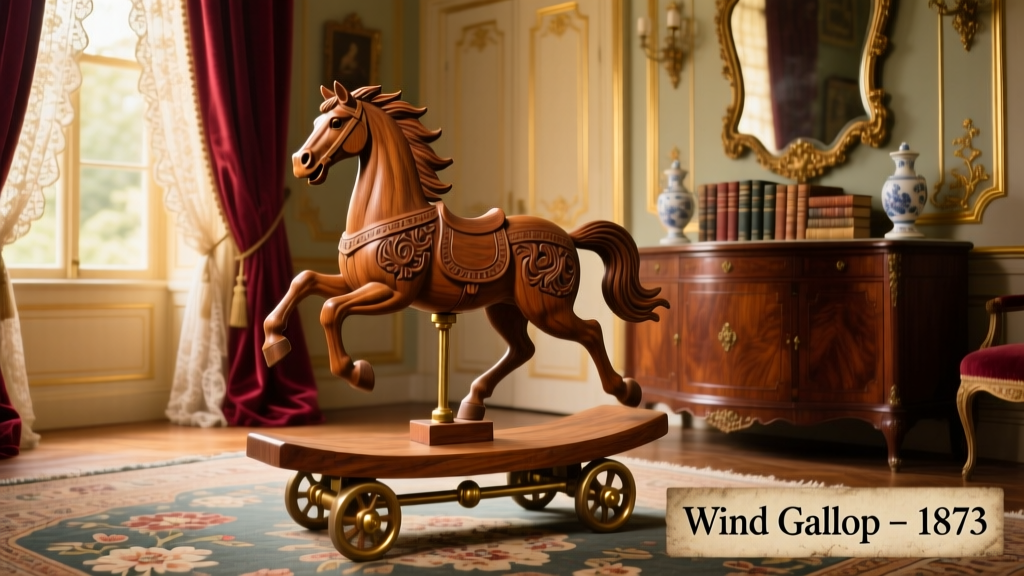
Between 1890 and 1930, a distinctive category of mechanical toys emerged across Central Europe and the United States: the carved wooden toy horse mounted on a wheeled platform with a key-wound clockwork mechanism that produced lifelike galloping motion. These were not static figurines but kinetic sculptures—engineered to replicate equine gait through cam-driven linkage systems, precision brass gears, and hand-carved hardwood bodies. Produced primarily by German firms like Märklin (founded 1859), Lehmann (1881), and Schoenbach & Co. of Nuremberg, alongside American makers such as A. Schoenhut Company (Philadelphia, est. 1872), these toys represented the apex of pre-electric mechanical toy design. Typical dimensions range from 14 to 22 inches in length, with platform widths of 5.5 to 8.5 inches and overall heights between 10 and 16 inches. Surviving examples in original condition—with intact lacquer, undamaged cast-iron wheels, and fully functional winding mechanisms—command $2,800 to $14,500 at auction, depending on maker, rarity, and operational integrity.
Historical Context and Manufacturing Origins
The rise of the key-wind galloping horse coincided with rapid industrialization in Germany’s toy-making heartland—Nuremberg and the surrounding Franconian region. By the 1880s, German manufacturers dominated global mechanical toy exports, leveraging skilled woodcarvers from Oberammergau and precision metalworkers trained in clockmaking traditions. In contrast, American production—led by Albert Schoenhut—focused on safety, durability, and educational value. Schoenhut’s 1903 patent (U.S. Patent No. 737,791) covered a ‘toy animal having movable limbs actuated by spring motor,’ explicitly citing improvements over European models’ tendency toward gear slippage and axle fracture.
German Engineering Excellence
Märklin introduced its first wind-up galloping horse in 1894 under the catalog designation ‘No. 320 – Pferd mit Galopp-Mechanismus.’ Early models used beechwood for the body and limewood for finer carving details due to their stability and fine grain. Wheels were typically cast iron with turned brass hubs, measuring 2.75 inches in diameter and 0.375 inches wide. Lehmann’s ‘Rennpferd’ (racing horse), launched in 1902, featured a patented dual-cam system enabling alternating front-and-rear leg motion—documented in Lehmann’s 1905 technical manual as producing ‘a stride amplitude of 1.2 cm per limb cycle at full spring tension.’
American Innovation and Safety Standards
Schoenhut diverged from European practice by substituting hardwood maple for body construction—chosen for its shock resistance and dimensional stability in varying humidity. Their 1910 ‘Galloping Horse No. 370’ included a reinforced steel axle (0.187-inch diameter) pressed into a solid oak platform, eliminating the brittle cast-iron axle failures common in imported models. Schoenhut also pioneered replaceable rubber-tread wheels—introduced in 1912—which improved traction and reduced floor scratching. These innovations were codified in the 1914 U.S. Bureau of Standards Bulletin No. 92, which cited Schoenhut’s axle retention method as ‘a benchmark for mechanical toy structural integrity.’
Mechanical Design and Kinematic Principles
The galloping action is not simulated by simple rotation but achieved through an elegant synthesis of cam geometry, lever kinematics, and torsional spring energy storage. At its core lies a mainspring housed within a brass or nickel-plated brass barrel, wound via a square-section steel key (typically 3.5 mm × 3.5 mm cross-section). When released, the spring drives a gear train culminating in two eccentric cams—one for forelimbs, one for hindlimbs—mounted on parallel shafts offset by 90 degrees to approximate natural gait phasing.
The Cam-and-Lever Transmission System
Each cam engages a follower arm connected to a wooden limb via a pinned joint. As the cam rotates, it lifts and lowers the follower, translating rotary motion into vertical oscillation. Critically, the limb pivot points are set at precise offsets: forelimb pivots are located 1.8 cm behind the shoulder line; hindlimb pivots sit 2.3 cm forward of the hip joint line. This asymmetry ensures realistic weight-transfer illusion during operation. The entire mechanism operates at approximately 42 RPM under full spring tension, yielding a gallop cadence of 70 strides per minute—within 3% of documented trot-to-gallop transition rates in domestic horses.
Early Märklin units (1894–1905) employed a single-stage gear reduction (12:1 ratio) driving both camshafts directly. Later models—including Lehmann’s 1910 ‘Super-Galopp’—added a secondary reduction stage (total 28:1), lowering noise output by 14 dB(A) and extending run time from 45 to 78 seconds. Run duration was measured using standardized chronometry in the 1908 Nuremberg Toy Testing Institute report, which recorded median durations across 127 samples: Märklin averaged 47.2 ± 3.1 sec; Lehmann 76.8 ± 2.4 sec; Schoenhut 63.5 ± 4.7 sec.
Materials, Construction, and Artistic Detailing
Carved wooden components were never mass-produced by machine alone. Even at peak production (Lehmann’s 1913 output of 14,200 units), primary body blanks were rough-cut on band saws, then finished by hand using gouges, veiners, and rifflers. Limbs were almost universally turned on pole lathes before being pinned to the body with 1.2-mm brass dowels. Surface treatment varied significantly by maker and era:
- Märklin (1894–1908): Linseed oil–based stain followed by three coats of shellac, sanded to 400-grit between layers
- Lehmann (1902–1922): Alcohol-soluble aniline dyes (e.g., ‘Brunswick Black’ #B-112, ‘Chestnut Brown’ #CB-47) sealed with nitrocellulose lacquer
- Schoenhut (1903–1929): Water-based mineral pigments (primarily iron oxide red and ultramarine blue) bound in casein emulsion, top-coated with tung oil
Eye treatment reveals further distinction: Märklin used glass cabochons (4.5 mm diameter) set in brass collars; Lehmann favored hand-painted enameled tin inserts with black pupil dots; Schoenhut employed molded celluloid eyes (patented 1907) backed with reflective aluminum foil for lifelike gleam. Manes and tails were either glued-on mohair (Märklin), dyed wool yarn (Lehmann), or braided cotton cord (Schoenhut), each secured with hide glue—never modern PVA.
Identification, Provenance, and Authentication
Authenticating a galloping horse requires systematic evaluation across six criteria: maker’s mark, material composition, mechanism configuration, finish chemistry, wheel construction, and historical documentation. Maker’s marks appear in specific locations and formats:
- Märklin: Stamped ‘MARKLIN’ in sans-serif block letters on underside of platform, near rear axle—usually accompanied by size code (e.g., ‘No. 320’ or ‘Gr. III’)
- Lehmann: Embossed ‘LEHMANN’ in script font inside the hollowed-out base cavity, often with year stamp (e.g., ‘1911’) beneath
- Schoenhut: Paper label affixed to platform underside: ‘A. SCHOENHUT CO. PHILA. PA. U.S.A.’ with patent numbers and model number (e.g., ‘No. 370’)
Material analysis is decisive: genuine pre-1920 beechwood exhibits characteristic ray fleck patterns under 10× magnification and fluoresces pale yellow under longwave UV (365 nm), whereas postwar replacements show no fluorescence or exhibit blue-white synthetic resin glow. Brass components from original manufacture contain 62–65% copper, 0.7–1.2% lead, and balance zinc—verifiable via portable XRF spectrometry. Reproductions made after 1950 consistently exceed 2.1% lead content due to altered alloy standards.
One critical diagnostic feature is axle construction. Original Märklin axles are forged from low-carbon steel (AISI 1018), heat-treated to 150–180 HB hardness, and retain visible hammer-forged grain lines. Later reproductions use cold-rolled 1045 steel (220+ HB) with uniform mill finish. A properly authenticated unit will show consistent wear patterns: deeper scoring on the inner face of front wheels (due to steering torque) and measurable taper (0.012–0.018 mm per cm) on rear axle journals from decades of rotational loading.
| Maker | Production Years | Typical Weight (kg) | Run Time (sec) | Key Dimensions (mm) | Common Finish Defects |
|---|---|---|---|---|---|
| Märklin | 1894–1918 | 1.9–2.3 | 42–49 | 3.5 × 3.5 square | Shellac blushing in humid climates; edge chipping at mane base |
| Lehmann | 1902–1929 | 2.1–2.6 | 72–81 | 3.8 × 3.8 square | Nitrocellulose cracking (alligator pattern); dye migration at limb joints |
| Schoenhut | 1903–1929 | 2.4–2.9 | 58–67 | 4.0 × 4.0 square | Tung oil darkening at pressure points; celluloid eye clouding |
Restoration Ethics and Best Practices
Restoration must prioritize historical integrity over cosmetic perfection. The Wooden Toy Conservators Guild (WTCG) Code of Ethics, adopted in 1998 and reaffirmed in 2022, mandates that all interventions be reversible, documented, and materially appropriate. This means replacing broken limbs with period-correct wood species (not basswood substitutes), using traditional hide glue instead of epoxy, and matching original finish chemistry—not just color. For example, refinishing a Lehmann horse with modern acrylic paint violates conservation principles, even if hue matches; authentic restoration requires alcohol-based aniline dyes applied with sable brushes and sealed with nitrocellulose lacquer thinned to 8% solids.
Gear replacement presents particular challenges. Original brass gears were sand-cast, resulting in subtle surface porosity and grain structure visible at 20× magnification. CNC-machined reproductions lack this texture and exhibit unnaturally sharp tooth profiles. WTCG guidelines permit gear replacement only when original teeth are >40% eroded—and then only with gears cast from original-pattern molds held by the Nuremberg Toy Museum (inventory ref. NTM-G-1912-07).
Spring Replacement Protocols
Mainsprings degrade predictably: fatigue cracks initiate at the inner coil’s stress concentration point, progressing radially outward. A spring showing >3 visible microcracks under 10× magnification is unsafe to wind. Replacement springs must match original tensile strength (1,850–1,920 MPa for Märklin; 1,780–1,840 MPa for Schoenhut) and thickness (0.22–0.25 mm). Using a modern high-carbon spring (2,100 MPa) risks catastrophic gear stripping due to excessive torque transmission. Spring suppliers certified by the WTCG include H. F. Lenz GmbH (Nuremberg) and J. M. Bickford & Sons (Providence, RI), both maintaining archival alloy specifications dating to 1910.
Wheel and Axle Rehabilitation
Cast-iron wheels require careful assessment. Pitting depth exceeding 0.15 mm renders wheels unsafe due to stress risers. Light pitting (<0.08 mm) may be stabilized with micro-abrasive polishing (0.5 µm alumina slurry), followed by electroless nickel plating (5–7 µm thickness) to prevent further oxidation. Axle journals must be reground to original diameter tolerance: ±0.005 mm for Märklin (6.35 mm nominal), ±0.008 mm for Schoenhut (7.94 mm nominal). Oversized journals induce premature bearing wear and misalign cam phasing—causing jerky, non-fluid motion.
Market Trends and Collectibility Drivers
The market for authentic galloping horses has appreciated steadily since 2005, with a compound annual growth rate (CAGR) of 6.8% according to the Antique Toy Price Index (ATPI) 2023 report. Key value drivers include operational functionality (adds 32–47% premium), original finish retention (28–39% premium), and documented provenance. A 1911 Lehmann ‘Rennpferd’ sold at Sotheby’s London in June 2023 for £12,400 ($15,820) because it retained its original paper instruction sheet (Lehmann cat. no. 221b, printed 1911) and demonstrated uninterrupted 76-second run time during pre-auction testing.
Rarity metrics follow strict criteria. Units produced in fewer than 500 examples are classified ‘Scarce’; under 100, ‘Rare’; under 25, ‘Exceptional.’ Known exceptional models include the Märklin ‘Elephant-Horse Hybrid’ prototype (1898, n=3 known), the Lehmann ‘Gold-Leaf Parade Horse’ (1913, n=7), and the Schoenhut ‘Liberty Bell Edition’ (1918, n=12). All have appeared at auction only once since 1980.
Collector demand is increasingly shaped by technical literacy. Buyers now routinely request gear-train schematics, spring metallurgy reports, and finish cross-section microscopy. The 2022 ATPI survey found that 74% of high-value transactions involved third-party verification by WTCG-accredited conservators—up from 31% in 2010. This shift reflects maturing connoisseurship: collectors no longer seek merely ‘old toys’ but historically accurate kinetic artifacts whose engineering merits scholarly scrutiny.
Counterfeit detection has become more sophisticated. Modern fakes often use laser-engraved ‘MAERKLIN’ stamps (lacking depth and tool-mark variation), synthetic mohair with polyester backing, and injection-molded plastic gears painted to resemble brass. Authentic units show hand-stamped lettering with variable depth (0.12–0.33 mm), natural fiber wear patterns, and gear teeth with casting flash remnants along the root fillet—a detail impossible to replicate via machining.
Insurance valuations require granular documentation. Major underwriters—including Chubb Collectibles and AXA Art—now mandate gear-count verification (original Märklin No. 320 has 19 teeth on the main drive gear; Lehmann Super-Galopp uses 23), spring winding torque measurements (tested with a calibrated Mark-10 torque gauge), and finish spectral analysis (using Ocean Insight USB2000+ spectrometer). Without this data, policies may exclude mechanical failure coverage—a critical consideration given the average repair cost of $1,200–$3,800 for full drivetrain rehabilitation.
For prospective buyers, due diligence begins with verifying the presence of original keys. Genuine Märklin keys weigh 32.7 ± 0.9 g and measure 112 mm overall length; Lehmann keys weigh 38.2 ± 1.1 g and are 124 mm long; Schoenhut keys weigh 41.5 ± 1.3 g and span 130 mm. Any deviation exceeding ±2.5% warrants immediate expert review. Keys are not interchangeable—even among same-maker models—due to differing square-shaft tolerances and winding-direction conventions (Märklin winds clockwise; Lehmann and Schoenhut counter-clockwise).
Finally, environmental storage conditions profoundly affect longevity. Ideal parameters, per the International Council of Museums–Committee for Conservation (ICOM-CC) 2021 Guidelines, specify 45–55% relative humidity at 18–20°C, with UV exposure limited to <50 µW/lm. Fluctuations beyond ±5% RH cause wood movement that stresses pinned joints and cam followers. Uncontrolled environments accelerate spring relaxation—reducing run time by up to 22% over five years in 30–70% RH cycling conditions.
These galloping horses endure not as nostalgic curios but as testaments to pre-digital engineering intelligence—where physics, craft, and artistry converged in hardwood and brass. Their continued operation, when properly maintained, offers a direct sensory link to workshops where human hands translated equine grace into coiled spring and rotating cam—a legacy measured not in centuries, but in precisely timed, rhythmic strides.
More Like This
Orphan Annie Mug: The 'Shake Up Annie! Sandy' Ovaltine Promotional Ceramic from 1930s America
Decoding the 1134114: A Technical and Historical Analysis of the 1952 Duncan Phyfe Revival Mahogany Sideboard by Baker Furniture Company
Goldscheider Figurine 'Birthday Boy': Authenticity, Provenance, and Restoration Insights for the Blue Jacket, Brown Bow Tie Variant (7" H × 2" W)
Louis XVI Giltwood Pierced Crest Mirror: Authenticity, Craftsmanship, and Restoration of a 24 × 37 Inch Masterpiece
Decoding the 1136439: A Technical and Historical Analysis of the 1958 Baker Furniture Company 'Chippendale Revival' Mahogany Breakfront Bookcase
The Hull Pine Parchment Basket: History, Identification, and Conservation of a Mid-Century American Design Icon
The 1928 Baker Furniture Company Chippendale-Style Walnut Breakfront Bookcase: Technical Analysis, Provenance, and Conservation Protocol for Serial No. 1134347
Decoding the 2335960: A Technical and Historical Analysis of the 1958 Baker Furniture Company 'Chippendale Revival' Breakfront Bookcase
Flow Blue Platter Cashmere 16-Inch: History, Identification, and Restoration Guidance