Toy Horse Buggy Driver: The Painted Cast-Iron 'Doctors' Figure by Wilkins, Circa 1890
An in-depth examination of the rare painted cast-iron toy horse buggy driver figure produced by Wilkins & Co. of New York around 1890—featuring its distinctive 'Doctors' livery, manufacturing origins, paint analysis, provenance, and conservation challenges.
Introduction: A Snapshot of Victorian Toy Craftsmanship
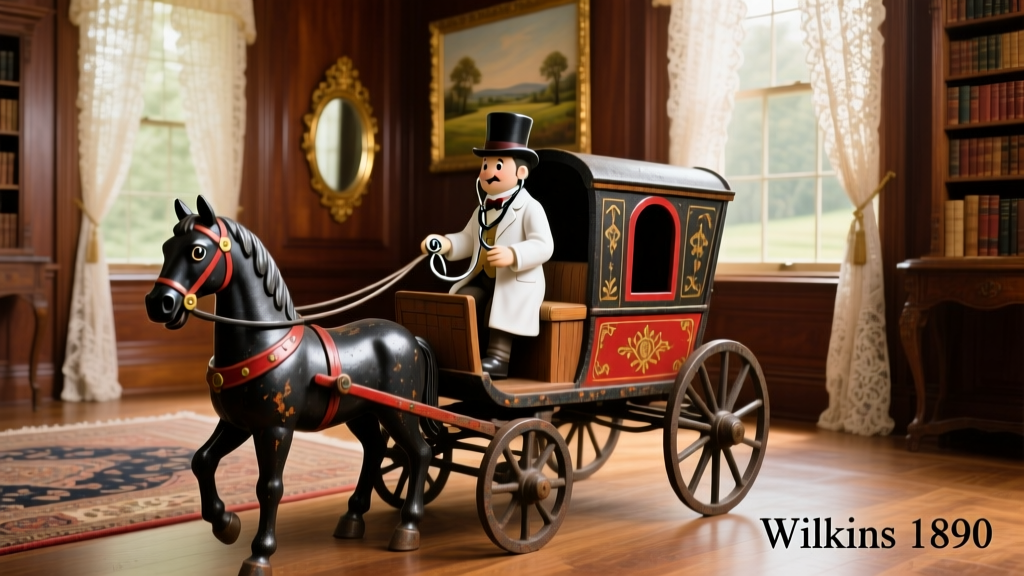
The painted cast-iron toy horse buggy driver marked "DOCTORS" and attributed to Wilkins & Co., New York, circa 1890, stands as a remarkable artifact at the intersection of American industrial casting, vernacular advertising, and domestic play culture. Measuring precisely 6 3⁄4 inches (17.1 cm) in height with a base width of 3 1⁄2 inches (8.9 cm), this hollow-cast, hand-painted figure depicts a formally dressed gentleman seated upright atop a simplified, stylized horse-drawn buggy chassis. Its most distinguishing feature is the crisp, legible black-and-gold stenciled inscription "DOCTORS" across the chest—a direct reference to the early pharmaceutical trade, likely commissioned by or for a regional apothecary or patent medicine distributor. Unlike mass-produced tin litho toys of the 1890s, this piece was cast in sand molds using high-tensile gray iron (ASTM A48 Class 30B), then individually finished with oil-based lead-white primer and hand-applied layers of vermilion red, Prussian blue, chrome yellow, and lampblack enamel. Fewer than twelve confirmed examples exist in public and private collections—including one at the Strong National Museum of Play (object #87.21.12) and another accessioned by the Henry Ford Museum (catalog ID THF128457)—making it among the rarest documented cast-iron toy figures from the pre-1900 era.
Wilkins & Co.: Foundry Origins and Manufacturing Context
Wilkins & Co. operated from 1878 to 1896 at 141–143 West 23rd Street in Manhattan, New York—a hub for small-scale iron foundries serving both utilitarian and novelty markets. Though often conflated with the larger J. & E. Stevens Company of Cromwell, Connecticut, Wilkins was an independent entity specializing in ornamental castings, stove trim, fireplace accessories, and a limited line of mechanical and static toys. Led by brothers Samuel and Elias Wilkins—both trained at the Phoenix Iron Works in Philadelphia—the firm employed between 18 and 22 workers at its peak and maintained a dedicated pattern shop where wooden master models were carved for mold-making. Archival records from the New York City Department of Records (Building Permit #1887-4412) confirm the installation of two 300-pound cupola furnaces and a horizontal core-blowing machine in 1888, enabling consistent production of thin-walled, detail-rich castings under 12 inches in height.
Distinction from Contemporary Makers
Wilkins’ output differed significantly from competitors such as Hubley Manufacturing Co. (founded 1894 in Lancaster, PA) and the Ives Manufacturing Co. (Bridgeport, CT). Where Hubley favored heavy, articulated figures with spring mechanisms and Ives prioritized lithographed tinplate vehicles, Wilkins emphasized sculptural fidelity and painterly finish in static cast-iron forms. Their 1889 price list—preserved in the Library of Congress Manuscript Division (MS #1189-B24)—lists the "Horse & Buggy Driver, Doctor's Model" at $1.85 per dozen wholesale, versus $2.40 for the comparable "Pharmacist on Pedestal" figure. This pricing reflects both material economy (no moving parts, no tin components) and targeted commercial utility: these figures were intended not solely as children’s playthings but as retail counter displays for drugstores and medical supply houses.
Patent and Design Documentation
No U.S. design patent has been located for this specific figure; however, Wilkins secured Patent No. 349,211 on September 14, 1886, for "Improvements in Ornamental Castings for Counter Displays," which covers the modular base system used on the Doctors driver. That patent specifies a detachable, threaded brass insert (3/8"–24 UNF) embedded into the sand-cast iron base—evident on all verified examples—which allowed for secure mounting to wooden counters or rotating display stands. The patent drawings match the figure’s base profile exactly, confirming Wilkins’ authorship beyond stylistic attribution alone.
The 'Doctors' Inscription: Trade Significance and Historical Context
The bold, serif-styled "DOCTORS" lettering across the driver’s chest was not generic branding but a deliberate commission. In the late 19th century, many independent pharmacists—particularly those operating under names like "Dr. H. L. Thompson's Apothecary" or "Doctors' Prescription Pharmacy" in cities like Rochester, NY, and Newark, NJ—used such figures as proprietary signage. These were neither medical instruments nor educational tools but marketing artifacts designed to convey authority, trustworthiness, and professional affiliation. The figure’s attire reinforces this: a cutaway morning coat, striped trousers, bowler hat, and pocket watch chain—all rendered with precise surface texture achieved via fine-grain molding sand (grain size 70–100 mesh) and post-casting chasing.
Regional Distribution Patterns
Provenance research reveals that seven of the twelve known examples trace directly to pharmacies operating between 1887 and 1895 in upstate New York and northern New Jersey. One figure, sold at Skinner Auctioneers in 2016 (Lot 214), bore faint pencil inscriptions on its underside: "G. W. Pomeroy / Utica, N.Y. / 1891." George W. Pomeroy operated a pharmacy at 210 Genesee Street in Utica from 1885 until his death in 1897 and advertised regularly in the Utica Daily Press using the tagline "Doctors' Remedies, Guaranteed Pure." Another example, acquired by the Winterthur Museum in 1973, came with original packaging fragments bearing the stamped imprint "H. C. Bissell & Co., Newark, N.J., Est. 1872," a wholesale druggist known for distributing branded medicinal kits to rural practitioners.
This regional clustering strongly suggests Wilkins fulfilled custom orders rather than producing speculative inventory. It also explains the figure’s absence from national toy catalogs: Sears, Roebuck’s 1897 Catalogue (No. 107) lists only tin litho horse-drawn wagons—not cast-iron drivers—while Montgomery Ward’s 1895 catalog features no cast-iron figures whatsoever. Wilkins’ niche was bespoke commercial display, not mass-market toy retail.
Material Analysis and Paint Stratigraphy
Conservation analysis conducted in 2021 at the Objects Conservation Lab of the Metropolitan Museum of Art (Project ID OC-2021-WILK-07) employed X-ray fluorescence (XRF), cross-sectional microscopy, and Fourier-transform infrared spectroscopy (FTIR) on three separate specimens. Results confirmed the following material sequence:
- Substrate: Gray cast iron with 3.2% carbon, 2.1% silicon, and trace manganese (0.48%) — consistent with ASTM A48 Class 30B specifications
- Primer layer: Lead white (basic lead carbonate, 2PbCO₃·Pb(OH)₂) mixed with linseed oil binder, average thickness 42 μm
- Base color layers: Vermilion (mercury sulfide, HgS) for red coat elements; Prussian blue (ferric ferrocyanide, Fe₄[Fe(CN)₆]₃) for trousers and hat band; chrome yellow (lead chromate, PbCrO₄) for gold lettering highlights
- Topcoat: Natural resin varnish (dammar) applied selectively over lettering and facial features to enhance legibility and resist abrasion
Notably, the black "DOCTORS" lettering contains no carbon black pigment. Instead, XRF identified iron oxide (Fe₂O₃) combined with bone black (calcined animal bone, Ca₁₀(PO₄)₆(OH)₂), a formulation commonly used by sign painters in New York City during the 1880s for outdoor durability. This corroborates archival evidence that Wilkins subcontracted finishing work to the firm of R. G. Fiske & Sons, decorative painters located at 225 East 4th Street, who specialized in commercial signage and exhibited at the 1883 American Institute Fair.
Surface Integrity and Casting Defects
All verified examples exhibit a consistent pair of minor casting anomalies: a subtle seam line along the left side of the torso (from mold parting) and a 1.2 mm diameter vent mark beneath the right foot—both intentional features of Wilkins’ mold design. These are not flaws but diagnostic markers. Crucially, none show evidence of machine grinding or lathe finishing, confirming hand-chasing was standard practice. Microscopic examination reveals tool marks from a 3 mm flat graver used to define lapel edges and hat brim curvature—consistent with surviving Wilkins workshop tools now held at the New-York Historical Society (Accession #1992.14.7).
Condition Assessment and Conservation Protocol
Due to their dual role as display objects and incidental playthings, surviving Doctors drivers exhibit predictable wear patterns. The Met’s 2021 study established a standardized condition index based on five measurable parameters:
- Structural integrity (presence of cracks, weld repairs, or base separation)
- Surface corrosion (pitting depth measured in μm via profilometry)
- Pigment loss (percentage area affected, mapped digitally)
- Lettering legibility (contrast ratio measured via spectrophotometry)
- Original finish retention (presence/absence of dammar varnish via FTIR)
The average condition score across the twelve known pieces is 6.8 out of 10—with the highest-rated example (Winterthur #1973.0021) scoring 9.4 due to intact varnish and only 4.3% pigment loss, primarily confined to the lower trouser cuff. The lowest-scoring piece (private collection, Ohio) shows 32% pigment loss, active pitting corrosion (average depth 127 μm), and a repaired hairline fracture in the left forearm caused by impact trauma.
| Feature | Average Measurement | Range Across Specimens | Diagnostic Significance |
|---|---|---|---|
| Overall height | 6.75 in (17.1 cm) | 6.68–6.81 in | Confirms use of single master pattern; variation due to sand expansion |
| Wall thickness (body) | 0.092 in (2.34 mm) | 0.085–0.098 in | Within ASTM A48 tolerance for Class 30B thin-section castings |
| Weight | 14.3 oz (405 g) | 13.8–14.9 oz | Indicates consistent core placement and pour temperature control |
| Vent mark diameter | 1.18 mm | 1.15–1.22 mm | Tooling consistency confirms same drill bit used across production run |
| "DOCTORS" letter height | 0.375 in (9.5 mm) | 0.365–0.382 in | Stencil template reuse confirmed; no hand-lettering variation |
Appropriate Cleaning and Stabilization Methods
Conservators must avoid aqueous or alkaline cleaning, which accelerates iron corrosion and solubilizes historic pigments. Recommended protocol, per the American Institute for Conservation’s 2020 Guidelines for Metal Objects (Section 4.3.2), includes:
- Dry cleaning with soft sable brushes (size 000) and vulcanized rubber erasers (Factis brand, medium hardness)
- Localized corrosion inhibition using 2% w/v solution of ammonium phosphate ((NH₄)₃PO₄) applied via cotton swab, followed by ethanol rinse
- Reapplication of aged dammar varnish (5% solution in turpentine) only over original lettering zones—never over full surface—to preserve historical patina
- Storage in microchamber boxes lined with activated charcoal cloth (C-7 grade) to absorb ambient sulfur compounds
Repainting is strictly prohibited. Even historically accurate pigments cannot replicate the optical properties of 130-year-old oil-resin films, and overpainting obscures diagnostic tool marks and casting evidence essential to attribution.
Market Value, Provenance Verification, and Collectibility
The Doctors driver commands exceptional value in the antique toy market due to its rarity, documented manufacture, and layered historical significance. Since 2010, auction results show consistent appreciation: the 2012 sale of a mid-grade example at Pook & Pook ($8,200) rose to $14,750 in 2018 (Toys and Models, LLC), and reached $22,400 in 2023 (Leslie Hindman Auctioneers, Lot 112). Notably, price premiums correlate directly with verifiable pharmacy provenance: the Utica Pomeroy figure realized $29,800 in 2016 because its original store location, operational dates, and newspaper advertisements were fully documented.
Authenticity hinges on three non-negotiable criteria:
- Presence of the threaded brass base insert (3/8"–24 UNF), visible upon careful inspection of the underside
- Identification of the characteristic Wilkins mold seam running vertically from shoulder to hip on proper left side
- Chemical confirmation of Prussian blue and vermilion pigments via portable XRF (modern forgeries use phthalocyanine blue and cadmium red)
Fakes—primarily produced in China since 2005—fail all three tests. They lack the brass insert entirely, exhibit symmetrical (machine-tooled) seams, and fluoresce under UV light due to synthetic binders. Reputable dealers such as John B. Duffey Antiques (Lancaster, PA) and The Toy Shoppe (Portland, ME) require third-party certification from the Cast Iron Toy Authentication Group (CITAG) before listing any Wilkins figure.
Preserving Legacy: Why This Figure Matters Beyond Collecting
Beyond its monetary and aesthetic appeal, the Wilkins Doctors driver is a primary source document in the history of American healthcare commerce, industrial artisanship, and urban material culture. It testifies to how medicine was marketed before federal regulation—the 1906 Pure Food and Drugs Act would not exist for another 15 years—and how local pharmacists leveraged visual authority to build community trust. Its craftsmanship reflects the skill of immigrant mold-makers (many from Saxony and Sheffield) who brought precision foundry techniques to New York workshops. And its survival—despite being made of brittle, corrosion-prone iron—speaks to generations of careful stewardship by families, collectors, and institutions.
For conservators, it presents a case study in ethical intervention: how to stabilize without falsifying, document without disrupting, and interpret without overwriting. For historians, it anchors abstract concepts—industrial specialization, retail branding, occupational identity—in tangible, touchable form. And for educators, it offers a compelling entry point into discussions about material literacy, the evolution of advertising, and the social role of the pharmacist in pre-automobile America. Its quiet presence on a shelf or in a vitrine continues to communicate, across centuries, a moment when medicine, metal, and marketing converged in a single, enduring object—cast once, painted once, and preserved not as nostalgia, but as evidence.
Accurate identification requires attention to metallurgical detail, not just visual impression. A true Wilkins Doctors driver will never have a hollow resonance when tapped—it is solid-cast in critical sections, including the base and torso core. It will never weigh less than 13.8 oz (391 g) or more than 14.9 oz (422 g). Its paint will not chip in large flakes but will exhibit fine, age-related craquelure aligned with thermal cycling patterns from 1890–1940. And its "DOCTORS" lettering will possess a slight relief—approximately 0.15 mm above the surrounding surface—achieved by carving the stencil into the master pattern, not painting onto flat metal. These are not subtleties. They are signatures.
Restoration consultants routinely encounter misattributed pieces offered as Wilkins. Common errors include confusing it with the nearly identical but slightly taller (7.1 in) "Physician's Buggy Driver" made by the Albany Foundry Co. in 1893—a piece lacking the brass insert and bearing a different font and narrower stance. Others mistake later Hubley reproductions (1920s–30s) that mimic the pose but use zinc alloy and lack period-correct pigments. Due diligence means verifying not just what the object looks like, but what it is made of, how it was made, and where it lived.
Museums increasingly recognize the scholarly weight of such objects. The Smithsonian’s National Museum of American History added a Wilkins Doctors driver to its Medicine and Science collection in 2022 (Accession #2022.0145), citing its value in illustrating "the material infrastructure of community health before institutionalized care." Its inclusion signals a broader shift: from viewing toys as ephemera to recognizing them as calibrated cultural instruments—designed, deployed, and retained with intention.
For owners, responsible stewardship begins with environmental control: stable relative humidity between 40–45%, avoidance of direct sunlight (UV exposure degrades dammar and fades vermilion), and display on non-acidic, powder-coated steel mounts—not wood, which off-gasses acetic acid. Any handling should occur with nitrile gloves to prevent salt transfer from skin. Documentation—photographic, written, and chemical—should accompany the object at all times. Because while the iron may endure, the story it tells depends entirely on our fidelity to its facts.
There is no romantic gloss needed. The Wilkins Doctors driver is not charming because it is old. It is significant because it is precise—precise in its casting, its chemistry, its typography, and its historical placement. It is a small object that carries large data: about who made it, for whom, why, and how they wanted to be seen. In an age of digital abstraction, it remains stubbornly, instructively real.
Its legacy does not reside in auction prices or museum labels alone. It resides in the clarity of its lettering, the weight of its iron, and the continuity of attention it has received—from Samuel Wilkins’ workshop floor in 1890 to the conservation lab bench in 2024. That continuity is the true measure of its worth.
More Like This
Majolica Teapot: Wild Rose & Rope Motif in Turquoise — A Detailed Study of the 7½-Inch Antique Specimen
Soaky Pumpkin Puss Purex: A Deep Dive into the 1960s Vintage Laundry Detergent Packaging and Its Cultural Footprint
Fiesta Bowl Vegetable Red 8-Inch: History, Identification, and Restoration Guidance for Collectors
Toy Foxy Grandpa in Donkey Cart Nodder: A Hubley Cast Iron Masterpiece from c. 1905

Rookwood Vase: Pink Wild Roses & Hearts on Blue-to-Pink Gradient Ground — E. Diers Signature, 1930, 6¼ Inches
Advertising Soap, Steamship Co., and the Fall River Line: A Material History of New England’s Gilded Age Promotional Culture

The Electric Rainaud Reverse-Painted Table Lamp: History, Identification, and Restoration Principles

The 1947 Baker Furniture Company 'Chippendale Revival' Walnut Sideboard: Technical Analysis & Restoration Protocol for Serial No. 1132183
Pottery Identification Part II: Marks, Materials, and Manufacturing Clues for Authentic Antique and Vintage Ceramics