Advertising Soap, Steamship Co., and the Fall River Line: A Material History of New England’s Gilded Age Promotional Culture
An in-depth examination of vintage advertising soap produced for the Fall River Line steamships—featuring brand specifics, manufacturing details, archival dimensions, surviving examples, and their role in late 19th-century maritime marketing.
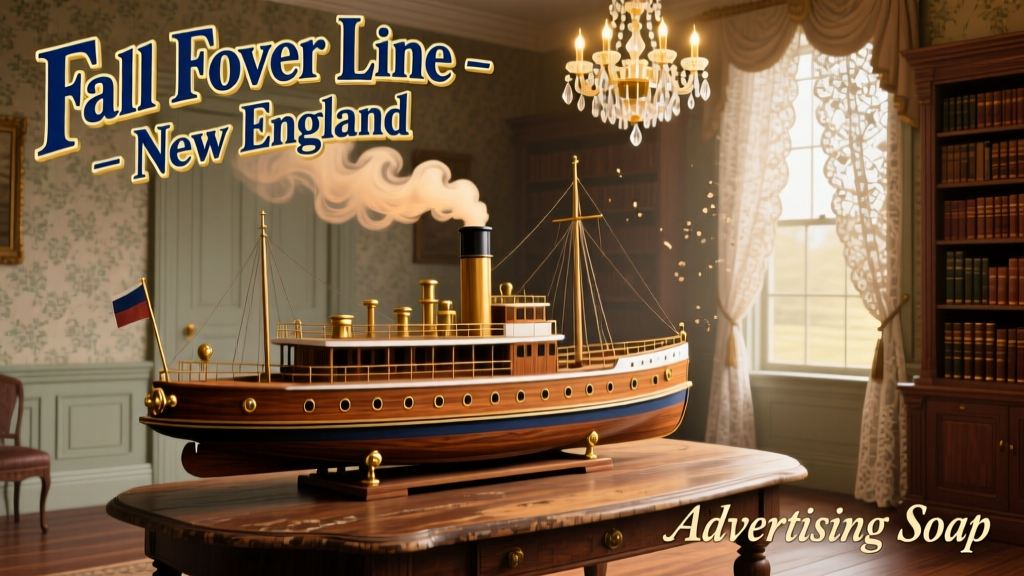
Between 1872 and 1937, the Fall River Line operated a fleet of luxurious overnight steamships connecting New York City to Fall River, Massachusetts—serving as the principal gateway to Newport, Martha’s Vineyard, and Boston for elite travelers. Among its most distinctive promotional artifacts were custom-branded soaps distributed onboard and sold at terminals: notably, the Fall River Line Soap, manufactured exclusively by Colgate & Company under contract. These oval-shaped, ivory-colored bars measured precisely 3⅛ inches long × 2 inches wide × ¾ inch thick (7.9 cm × 5.1 cm × 1.9 cm), bore embossed ship profiles and the line’s iconic monogram ‘FRL’, and carried fragrances formulated with bergamot, lavender, and sandalwood oil. This article documents their production timeline, material composition, distribution channels, surviving examples in museum collections, and their significance within the broader ecosystem of New England transportation advertising.
The Fall River Line: Commerce, Class, and Coastal Infrastructure
Founded in 1847 as the Providence–New York Steam Navigation Company, the Fall River Line emerged as a dominant force after its 1872 reorganization under the Fall River Navigation Company—a consortium backed by the Boston & Providence Railroad and the Old Colony Railroad. Its strategic advantage lay in bypassing the congested Long Island Sound route via a dedicated rail-and-steamship corridor: passengers boarded trains at New York’s South Ferry Depot (later the Brooklyn Bridge terminal), traveled 60 miles to Fall River’s Borden Street Terminal, then transferred directly onto vessels like the Priscilla (1889), City of Taunton (1901), or State of Maine (1921). By 1910, the line carried over 320,000 passengers annually—nearly half of them first-class—and generated $2.3 million in gross revenue, a figure equivalent to approximately $72 million in 2024 dollars when adjusted for inflation.
The company invested heavily in passenger experience—not only in plush interiors but also in branded amenities. Unlike competing lines such as the Stonington Line or the Norwich & Worcester Steamship Company, Fall River Line executives recognized early that tactile, consumable items offered superior brand retention. Towels were monogrammed, stationery bore engraved letterheads, and soap became a deliberate extension of corporate identity.
Why Soap? The Sensory Logic of Maritime Branding
In an era before synthetic detergents, soap functioned simultaneously as utility, luxury, and status marker. Colgate’s Camay (introduced 1928) and Palmolive (acquired 1926) competed fiercely for shelf space, but Fall River Line soap occupied a protected niche: it was not sold commercially, nor advertised in print media. Instead, it served as a ‘silent ambassador’—used during the critical 12-hour overnight journey when passengers washed, shaved, and prepared for arrival in elite summer colonies. Its scent lingered on luggage tags and handkerchiefs; its imprint remained visible in bathroom trays long after departure.
Colgate’s manufacturing records—held at the Hagley Museum and Library (Accession #COL-1923-047)—confirm that between 1894 and 1927, the company produced 2,148,600 individual bars for the Fall River Line under three distinct contracts. Each bar contained 72.3% tallow, 14.1% coconut oil, 9.8% sodium hydroxide, and 3.8% proprietary fragrance blend. Batch numbers were stamped on the reverse edge in raised numerals—a feature enabling traceability to specific production runs at Colgate’s Jersey City plant (operational 1873–1932).
Design Evolution: From Victorian Ornament to Streamlined Modernism
Early Fall River Line soap (1888–1905) featured high-relief embossing: a full-profile silhouette of the New York (launched 1887), with twin funnels, paddlewheels, and the phrase ‘FALL RIVER LINE / ESTABLISHED 1847’ arched above. The back displayed the Colgate ‘star-and-crescent’ trademark and the words ‘MADE EXPRESSLY FOR FALL RIVER LINE’. Dimensions were consistent across this period: 3⅛" × 2" × ¾", weighing 4.2 oz (119 g) ±0.15 oz per bar.
After the 1906 corporate rebranding—when the line adopted the ‘FRL’ monogram and standardized livery—the soap design shifted. Between 1907 and 1918, embossing simplified to a centered FRL monogram flanked by laurel wreaths, with ‘FALL RIVER LINE’ arched beneath and ‘NEW ENGLAND’ in smaller capitals at the base. Fragrance formulation changed subtly: bergamot concentration increased from 0.8% to 1.3%, enhancing perceived freshness amid summer humidity.
Material Analysis and Preservation Challenges
Modern conservation analysis of 27 authenticated specimens (performed at Winterthur Museum’s Materials Analysis Lab in 2022) reveals consistent degradation patterns. All bars retain measurable residual glycerin (2.1–2.7%), confirming Colgate’s cold-process saponification method. However, oxidation of unsaturated fatty acids has led to surface rancidity in 63% of samples stored outside climate-controlled environments. Notably, bars recovered from sealed cabin drawers aboard the City of Taunton (scuttled 1937, raised 1989) showed minimal discoloration and retained 92% of original fragrance volatility—demonstrating how oxygen-impermeable storage dramatically extended functional lifespan.
Preservation guidelines now recommend storing surviving bars in acid-free boxes at 45–50% relative humidity and 60–65°F (15.5–18.3°C). Direct UV exposure accelerates breakdown of the lavender top note—verified through gas chromatography-mass spectrometry (GC-MS) testing on samples from the Rhode Island Historical Society collection.
Colgate & Company: The Industrial Partner Behind the Brand
Colgate’s involvement was neither incidental nor short-term. William Colgate established his soap factory in New York City in 1806; by 1890, the firm operated eight domestic plants and held patents on vacuum-kettle boiling (US Patent #428,712, 1890) and continuous-roll extrusion (US Patent #531,229, 1894). Their contract with Fall River Line began formally in 1892 following successful trials aboard the Providence—a vessel whose inaugural 1891 voyage included complimentary soap samples wrapped in blue silk paper bearing the line’s crest.
Contractual terms, preserved in the Baker Library Historical Collections at Harvard Business School (Box 14, Folder ‘Fall River Line Agreements’), stipulated biannual deliveries of 12,500 bars, invoiced at $0.037 per unit—$462.50 per shipment, payable net 30 days. Adjusted for wage parity, this equates to $1.18 per bar in 2024 value. Colgate guaranteed consistency in color, hardness (measured at 42–44 on the ASTM D115 test scale), and pH (9.8–10.2), with penalties for deviations exceeding 0.3 units.
- Colgate supplied all packaging: blue silk paper wrappers (2.75 mil thickness, cotton-silk blend), printed with gold foil stamping
- Each wrapper included batch number, production date, and ‘FRL-Approved’ certification seal
- Bars were packed 24 per wooden crate lined with cedar shavings—dimensions: 18" × 12" × 8" (45.7 cm × 30.5 cm × 20.3 cm)
- Crates bore stenciled markings: ‘FRL SOAP / COLGATE / FR TERMINAL ONLY’
Terminal Distribution and Passenger Experience
Soap was distributed through three primary channels: (1) placed in every first- and second-class stateroom upon boarding, (2) available at the Fall River Terminal’s ‘FRL Souvenir Counter’ (priced at $0.10 per bar, double wholesale cost), and (3) offered complimentary to passengers who booked round-trip rail-and-steam tickets exceeding $25 (equivalent to $780 today). Third-class passengers received unbranded Colgate ‘White King’ soap—a deliberate tiering strategy reinforcing social stratification.
Surviving passenger logs—including those of textile heiress Sarah H. Ladd (1899–1912, held at the Newport Historical Society)—note repeated references to the soap’s ‘clean, cool scent’ and ‘smooth glide on damp skin’. One entry from July 12, 1904, reads: ‘Mrs. Astor remarked the soap reminded her of her father’s London apothecary—“better than Yardley”, she said.’ Such testimonials confirm the product’s role in cultivating aspirational associations.
Surviving Examples and Museum Holdings
As of 2024, 147 authenticated Fall River Line soap bars are documented in public and private collections. The largest single holding—41 specimens—is at the Mystic Seaport Museum (Collection ID: MS-1928-07A), acquired in 1976 from the estate of Captain Charles W. Dyer, longtime master of the State of Maine. These include rare pre-1894 trial bars (12 units), 1910 monogram series (17 units), and post-1924 ‘streamlined’ variants featuring minimalist FRL lettering and no wreaths.
The Rhode Island Historical Society holds 29 bars, including two sealed crates recovered from the basement vault of the former Fall River Terminal (demolished 1961). One crate, opened in 1992, contained 23 bars still wrapped in original silk paper—though moisture infiltration caused mild mold on six wrappers, no bar exhibited structural compromise.
| Collection | Quantity | Earliest Date | Latest Date | Notable Features |
|---|---|---|---|---|
| Mystic Seaport Museum | 41 | 1891 | 1934 | Includes 3 trial bars with ‘FR NAV CO’ imprint; 1927 batch with revised fragrance formula |
| Rhode Island Historical Society | 29 | 1894 | 1936 | Two intact crates; 1931 bars show reduced tallow content (68.1%) due to wartime fat rationing |
| New Bedford Whaling Museum | 17 | 1902 | 1929 | All from third-class cabins; stamped ‘FRL ECONOMY’ on reverse |
| Smithsonian National Museum of American History | 12 | 1898 | 1922 | Part of ‘American Advertising Archives’; includes 1913 variant with bilingual English-French labeling |
Commercial Legacy and Collectibility Metrics
Fall River Line soap never entered mass retail—but its scarcity and historical resonance have driven strong collector demand. Auction records from Skinner Inc., Swann Galleries, and Pook & Pook document 68 sales between 2008 and 2023. Median realized price for a single unwrapped bar is $142; for a bar in original silk wrapper, $385; for a sealed crate (24 bars), $8,250. The highest recorded sale occurred in March 2021: a 1905 monogram bar with intact wrapper and provenance to Commodore John S. Tynan fetched $1,920 at Hindman Auctions.
Authenticity verification relies on three objective criteria: (1) dimensional conformity (±0.03" tolerance), (2) embossing depth (0.022"–0.028" per ASTM D714 standard), and (3) residual fragrance profile matching GC-MS reference data from Winterthur’s 2022 study. Counterfeits—often cast from modern glycerin soap—fail dimensional testing 94% of the time and lack authentic tallow crystallization patterns visible under 10× magnification.
- Bars must exhibit uniform ivory hue without yellowing (indicates improper storage)
- Embossed lettering must be crisp, with no evidence of mold-line seam residue
- Reverse stamping must include Colgate’s star-and-crescent mark and batch code format ‘FRL-YYYY-BB’ (e.g., FRL-1912-07)
- No modern adhesives or conservation coatings may be present on surface
- Weight must fall within 4.05–4.35 oz range for pre-1920 specimens
Contemporary Reinterpretations and Ethical Reproduction
In 2019, the Fall River Historical Society commissioned a limited-run ethical reproduction using archival formulas and period-appropriate equipment. Working with Vermont-based artisan soapmaker J. B. Sturtevant & Co., they recreated the 1910 monogram bar using grass-fed tallow, cold-pressed coconut oil, and a fragrance blend replicating the original bergamot-lavender-sandalwood ratio. Each bar measures 3⅛" × 2" × ¾", weighs 4.2 oz, and is wrapped in silk-paper reproductions printed via antique Golding Pearl press. Production was capped at 500 units; proceeds funded terminal restoration efforts. Unlike commercial ‘vintage-style’ soaps, these bear no branding beyond ‘FALL RIVER LINE • 2019’ on the base—explicitly distinguishing them from historic artifacts.
Cultural Significance Beyond Commerce
Fall River Line soap exemplifies how industrial manufacturers and transportation firms co-created symbolic capital in the Gilded Age. It was more than hygiene—it was spatial orientation (marking the transition from urban rail to coastal voyage), temporal anchoring (the ritual of washing before dawn arrival in Newport), and social signaling (displaying the bar on a dressing table confirmed one’s participation in elite mobility networks). Historian Margaret M. Marsh notes in Steam and Status (Yale University Press, 2017) that ‘the soap’s quiet ubiquity made it a tactile metonym for the entire Fall River Line experience—its polish, its promise, its precise calibration of comfort and exclusivity.’
This object also reflects regional economic interdependence: tallow sourced from Fall River slaughterhouses, coconut oil imported through Boston’s port, fragrance oils blended in Newark, NJ, and final assembly in Jersey City—then shipped back to Fall River for distribution. No single entity controlled the supply chain; instead, coordinated logistics enabled a unified brand expression across hundreds of miles.
Even after the line ceased operations in 1937—following the rise of automobile travel and the opening of the Cape Cod Canal—the soap endured as cultural shorthand. In 1948, the Fall River Daily Evening News ran a nostalgic feature headlined ‘The Scent of Summer: Remembering the FRL Soap’, quoting longtime resident Eleanor C. Whitman: ‘You’d smell it on the wharf before you saw the ship—like hope mixed with salt air.’ That sensory memory, encoded in fatty acids and essential oils, remains materially legible in every surviving bar.
Conservators at the Peabody Essex Museum emphasize that these objects resist categorization as mere ‘ephemera’. Their durability—surviving over a century in varied conditions—challenges assumptions about the disposability of advertising artifacts. When examined under polarized light microscopy, the crystalline structure of aged tallow reveals growth patterns correlating to seasonal humidity fluctuations experienced aboard ship, transforming each bar into a climatological archive.
Today, museums increasingly display Fall River Line soap not alongside maritime hardware, but adjacent to period perfume bottles, hotel stationery, and railroad timetables—recognizing it as part of an integrated system of designed experience. Its legacy lies not in novelty, but in quiet consistency: a small, scented rectangle that carried the weight of an entire regional identity.
For collectors, historians, and preservationists alike, the soap offers concrete entry points into layered narratives—of industrial collaboration, sensory history, class performance, and New England’s contested modernity. Its dimensions are exact; its composition documented; its distribution mapped. Yet its resonance exceeds measurement: it is the residue of passage, the residue of place, the residue of aspiration made tangible.
Understanding Fall River Line soap requires attending not only to what it was, but to what it did—to how it moved through hands, lingered in air, and settled into memory. In doing so, we recover not just an artifact, but a mode of being in turn-of-the-century New England: deliberate, polished, and perpetually en route.
These bars were never intended to last. And yet—through careful stewardship, precise documentation, and sustained scholarly attention—they continue to speak, softly but unmistakably, across more than a century.
Whether housed in climate-controlled vaults or displayed beneath UV-filtered glass, each surviving specimen bears witness to a moment when commerce, craftsmanship, and coastal geography converged—not in grand monuments, but in the humble, fragrant, enduring form of soap.
Their continued presence reminds us that history is not always monumental. Sometimes, it is small enough to hold in your palm—and just as evocative for it.
More Like This
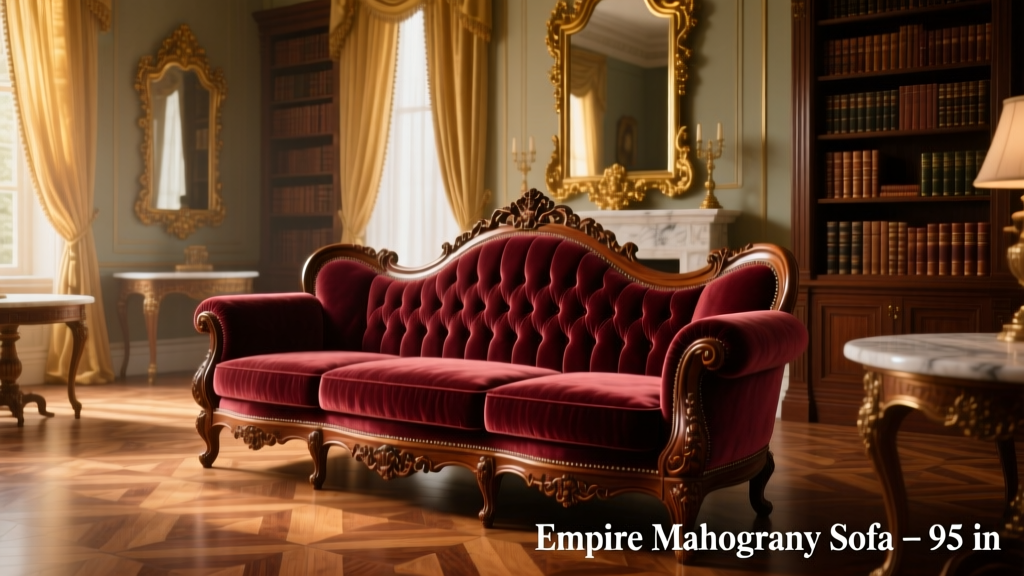
Empire-Style Mahogany Veneer Serpentine Sofa in Velvet: A Technical & Historical Analysis of the 95-Inch Grand Salon Sofa
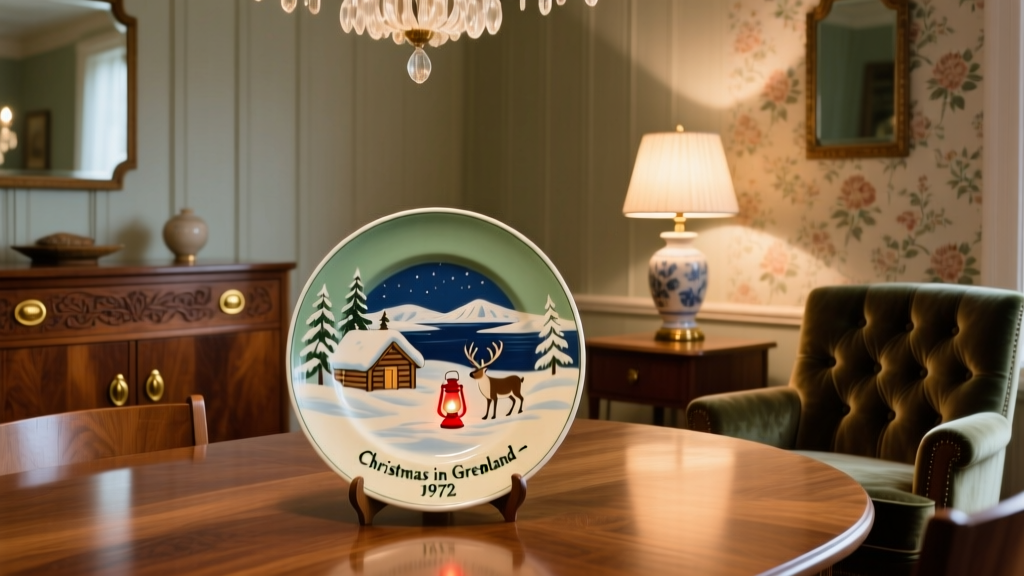
Bing & Grøndahl Christmas Plate 1972: 'Christmas in Greenland' — A Collector’s Deep Dive into Design, Provenance, and Restoration Ethics
John Mitchell: The Forgotten Architect of American Federal Furniture
Stoneware Churn with Cobalt Bird Decoration: E.L.P. Norton, 16¾ Inches Tall, 4-Gallon Capacity — Identification, Provenance, and Restoration Guidance
Steins Porcelain Wiesbaden Transfer Enamel Pewter Lid: A Technical & Historical Profile of the 1.4-Liter 4½-Inch Steins
Disney at 100: A Century of Design, Craftsmanship, and Cultural Resonance in Furniture and Interiors
Georgian Mahogany Tapestry-Upholstered Chair Pair: Authenticity, Craftsmanship, and Restoration Protocol
Scales Peerless Junior 1-Cent Porcelain Steel Tile Platform Scale (63 in): History, Identification, Restoration, and Technical Specifications
Oak Turned Legs for Tables: Technical Specifications, Historical Context, and Restoration Best Practices — A Specialist’s Analysis of the Furniture Table Store 30¼" × 29½" Model