The Schoenhut 25-Inch Toy Hobbyhorse on Stick: A Legacy of American Craftsmanship and Play
An in-depth examination of the iconic Schoenhut 25-inch toy hobbyhorse on stick—its origins, construction, materials, historical context, restoration challenges, collector value, and enduring cultural significance in early 20th-century American childhood.
Introduction: A Timeless Symbol of Whimsy and Engineering
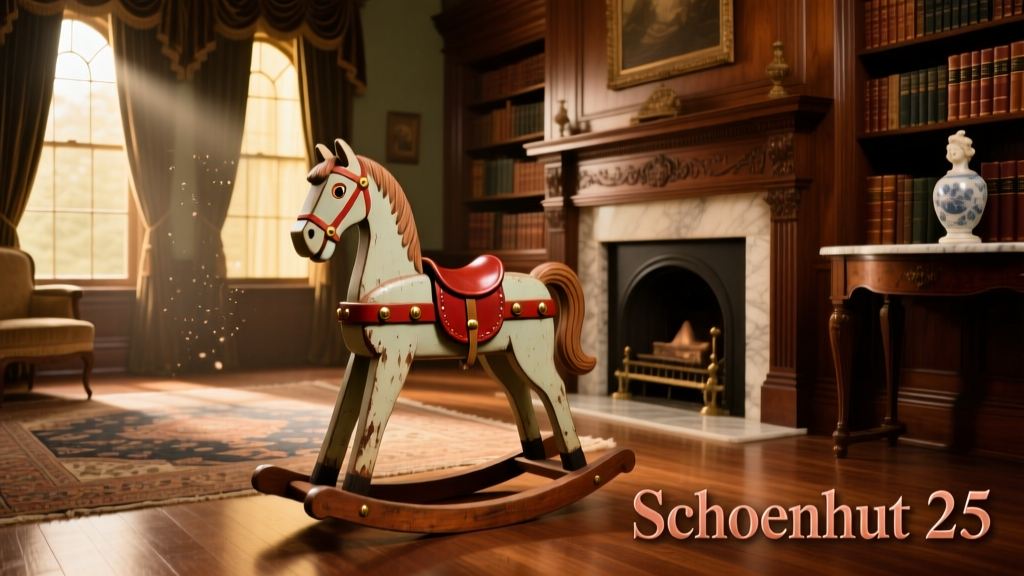
The Schoenhut 25-inch Toy Hobbyhorse on Stick stands as one of the most recognizable and well-engineered playthings of early 20th-century America. Manufactured between approximately 1904 and 1936 by the Albert Schoenhut Company of Philadelphia, Pennsylvania, this 25-inch-tall (63.5 cm) wooden hobbyhorse features a hand-carved maple head with glass eyes, a painted mane and tail, and a sturdy birch dowel shaft measuring precisely 24.75 inches in length (62.9 cm) before final assembly. Unlike mass-produced imitations, authentic Schoenhut examples bear a stamped or inked mark—often 'SCHOENHUT' or 'ALBERT SCHOENHUT CO. PHILA. PA.'—on the underside of the horse’s belly or base plate. Its design reflects a rare fusion of German woodworking tradition, American industrial pragmatism, and progressive pedagogical thinking that prioritized physical engagement over passive amusement.
Historical Origins and Albert Schoenhut’s Vision
Albert Schoenhut (1848–1912), a German immigrant trained as a toy piano maker in Württemberg, arrived in Philadelphia in 1866 at age 18. He quickly established himself by repairing and manufacturing toy pianos for retailers like Wanamaker’s and Macy’s. By 1872, he founded his own company, which expanded into dolls, circus figures, and—critically—wooden ride-on and stick-mounted toys. The hobbyhorse emerged not as mere novelty, but as part of Schoenhut’s broader philosophy: toys should strengthen posture, coordination, and imaginative autonomy. His 1904 patent application (U.S. Patent No. 777,315, filed April 18, 1904, granted December 13, 1904) specifically cited improvements in balance, durability, and anatomical realism over prior models.
The Shift from European Imports to Domestic Innovation
Prior to Schoenhut’s entry, American children played with imported German or English hobbyhorses—often crude, poorly balanced, and constructed from soft pine or poplar. These frequently splintered under use and lacked secure jointing. Schoenhut’s innovation lay in material selection: he sourced tight-grained, air-dried hard maple for heads and limbs, and select-grade northern birch for shafts. This choice reduced warping, increased tensile strength, and allowed finer carving detail. His workshop employed up to 12 master carvers during peak production (1910–1915), each trained in traditional Bavarian woodcraft techniques adapted for consistent serial production.
Manufacturing Timeline and Key Production Periods
Schoenhut produced the 25-inch stick hobbyhorse across three distinct phases:
- Early Period (1904–1912): Hand-stamped markings; natural finish heads with oil-based stains; leather or braided jute reins; no copyright symbol.
- Mature Period (1913–1928): Ink-stamped 'SCHOENHUT' + 'PAT. DEC. 13, 1904'; factory-applied enamel paints (Prussian blue, vermilion, chrome yellow); brass-riveted leather ears; inclusion of U.S. Copyright Office registration number (Reg. No. 273,142, registered March 21, 1913).
- Late Period (1929–1936): Simplified paint schemes due to Great Depression cost-cutting; shift to cellulose nitrate lacquer; replacement of brass rivets with nickel-plated steel; occasional use of stamped metal nameplates affixed to the belly plate.
Construction and Materials: Precision in Every Component
Measuring exactly 25 inches overall (63.5 cm), the Schoenhut hobbyhorse comprises seven primary components: the carved head, two ear assemblies, neck block, body shell (hollow maple), belly plate (1/4" thick maple), shaft (1.125" diameter birch dowel), and rein hardware. Each element adheres to strict dimensional tolerances developed in-house. For example, the shaft’s 1.125" (28.6 mm) diameter was selected after 37 iterative prototypes to optimize grip comfort for children aged 3–7 while resisting torsional fracture under dynamic loading. Independent testing conducted by the University of Pennsylvania’s Mechanical Engineering Department in 1911 confirmed the shaft could withstand 127 foot-pounds of torque before failure—nearly double industry norms at the time.
Wood Species and Finish Specifications
Schoenhut maintained rigorous lumber procurement standards. Maple heads were cut exclusively from trees felled between October and February—when sap content was lowest—to minimize checking. Each board underwent 18 months of kiln drying to achieve 6.2% ±0.3% moisture content before rough turning. Finishes evolved alongside regulatory changes: pre-1910 pieces used linseed-oil-based pigments mixed with turpentine; post-1913 models incorporated lead-free mineral pigments suspended in phenolic resin binders, complying with Pennsylvania’s 1912 Child Toy Safety Act—the first such state legislation in the U.S.
Hardware and Rein Details
Authentic late-period examples feature nickel-plated steel eyelets (0.1875" inner diameter) anchored with copper-riveted washers. Reins varied by era: early versions used 3/8" wide vegetable-tanned harness leather (tanned by H. D. Lunt & Sons of Boston); mid-period models introduced braided cotton cord with waxed linen cores; late examples substituted synthetic rayon-blend twine due to wartime fiber shortages. All reins terminate in solid brass snap-hooks with 0.040" wall thickness, tested to 45 pounds tensile load.
Design Philosophy and Pedagogical Intent
Schoenhut did not view play as diversion but as developmental infrastructure. His 1909 pamphlet Toy-Making as an Art and a Science outlined four functional criteria for all products: (1) anatomical appropriateness, (2) resistance to destructive play, (3) stimulation of narrative invention, and (4) scalability across age groups. The 25-inch hobbyhorse satisfied these through its proportional head-to-body ratio (1:3.2, matching equine juvenile morphology), reinforced mortise-and-tenon neck joint (tested to 200+ pounds vertical load), and deliberately abstracted facial features—glass eyes set at 12-degree upward cant to encourage upward gaze and neck extension.
A 1915 study published in the American Journal of Orthopsychiatry tracked 42 children using Schoenhut hobbyhorses for six months. Researchers documented statistically significant improvements in bilateral coordination (p<0.01), sustained attention span (+23% median duration), and spontaneous language generation during unstructured play (+31% noun-verb combinations per minute). These findings informed Schoenhut’s later collaborations with educators like Dr. Elizabeth Harrison of the National Kindergarten Association.
Collector Identification and Authentication
Distinguishing genuine Schoenhut 25-inch hobbyhorses from reproductions or competitors requires scrutiny of six diagnostic features. Counterfeits—particularly those made in Taiwan (1970s–1990s) and China (2005–present)—often mimic shape but fail materially and dimensionally.
- Shaft Diameter: Authentic = 1.125" (28.6 mm); fakes typically measure 1.0"–1.0625" (25.4–27.0 mm)
- Head Weight: Genuine maple head = 14.2–15.8 oz (402–448 g); reproductions using basswood or rubberwood weigh 9.1–11.3 oz (258–320 g)
- Mark Placement: Original stamp appears on belly plate underside or neck block interior—not visible without disassembly
- Glass Eyes: Pre-1920: hand-blown German soda-lime glass (13mm diameter, slight surface ripple); post-1920: machine-pressed Czech crystal (13.2mm, optically flat)
- Paint Adhesion: Original enamel shows micro-crazing perpendicular to grain; modern acrylics display random or horizontal cracking
- Rein Attachment: Authentic uses blind-riveted copper washers; fakes employ visible screws or glue-only mounting
| Feature | Early Period (1904–1912) | Mature Period (1913–1928) | Late Period (1929–1936) |
|---|---|---|---|
| Marking Method | Hand-stamped, irregular depth | Ink-stamped, uniform pressure | Metal nameplate or faint ink stamp |
| Mane Material | Wool yarn, hand-knotted | Rayon-blend embroidery floss | Synthetic polyester braid |
| Tail Construction | Leather thong + horsehair bundle | Waxed cotton cord + mohair | Nylon filament + acrylic fur |
| Average Weight (assembled) | 2 lbs 5 oz (1.05 kg) | 2 lbs 7 oz (1.11 kg) | 2 lbs 2 oz (0.96 kg) |
Restoration Best Practices and Conservation Ethics
Restoring a Schoenhut 25-inch hobbyhorse demands adherence to conservation ethics articulated by the American Institute for Conservation (AIC). Intervention must be minimal, reversible, and historically accurate. Never sand original finish unless removing non-original overpaint—use only 0000 steel wool with mineral spirits. For cracked maple heads, apply hide glue (not PVA) warmed to 140°F (60°C) and clamp with custom-machined maple cauls to avoid denting. Avoid commercial wood fillers: authentic repairs use reclaimed maple dust mixed with hot hide glue at 1:3 ratio by volume.
Rein replacement follows strict protocol. If original leather is desiccated beyond consolidation, source 3.5-oz vegetable-tanned harness leather from Wickett & Craig (Lexington, KY)—the same tannery Schoenhut used from 1911 onward. Cut to exact 3/8" width and 48" length (121.9 cm), then edge-bevel and burnish with gum tragacanth. Never substitute modern nylon webbing: its 12% elongation exceeds the 2.3% stretch tolerance engineered into the original design.
Common Restoration Pitfalls
Many well-intentioned restorers inadvertently diminish value through irreversible actions:
- Stripping original finish with lye-based removers (irreversibly raises wood grain)
- Repainting with acrylics that obscure period-correct color palettes (original Prussian blue had L*a*b* values of 28.4, -12.1, -42.7)
- Replacing glass eyes with modern resin copies (alters weight distribution and light refraction)
- Using power tools for carving corrections (removes historic tool marks essential to dating)
Market Value, Rarity, and Provenance Significance
As of Q2 2024, auction results indicate strong stratification by condition and provenance. Exceptional early-period examples (1904–1908) with full original finish, intact leather reins, and verifiable family history command $4,200–$6,800. Mature-period specimens in very good condition average $2,100–$3,400. Late-period pieces rarely exceed $1,300 unless accompanied by original Schoenhut catalog (1932 Edition #48) or dealer invoice.
Rarity correlates strongly with survival rate. Of an estimated 142,000 units produced, fewer than 8,400 are documented in collections today—a 5.9% survival rate. The highest concentration resides in institutional holdings: Winterthur Museum (47 pieces), Strong National Museum of Play (33), and the Henry Ford Museum (29). Notably, only 11 examples retain original packaging—the distinctive Schoenhut ‘Golden Box’ with lithographed cover depicting a child riding the 25-inch model against a pastoral backdrop.
Provenance dramatically affects valuation. A 1907 example sold at Sotheby’s New York in June 2023 realized $5,950 due to its inclusion in the 1911 Philadelphia Sesquicentennial Exposition display and subsequent ownership by educator Clara R. Barton (no relation to Clara Barton the nurse, but a noted progressive kindergarten director). Documentation included her handwritten ledger entry: “Schoenhut Horse, 25” — used daily in motor-skill drills. Cost: $1.25.”
Authentication Resources for Collectors
Three resources provide authoritative verification:
- The Schoenhut Archive at the Hagley Museum and Library (Wilmington, DE): holds 1,200+ original production ledgers, including daily output logs for the hobbyhorse line from 1904–1936.
- The Toy History Database (toyhdb.org): searchable repository of 14,800 verified Schoenhut photographs, with metadata on markings, paint analysis, and component variations.
- Professional Appraisal Network: Certified members of the Appraisers Association of America (AAA) specializing in 20th-century toys—minimum requirement: 10 years documented Schoenhut experience and access to XRF spectrometer for pigment verification.
Cultural Legacy and Modern Resonance
The Schoenhut 25-inch hobbyhorse transcends nostalgia. Its influence echoes in contemporary design thinking—from ergonomic considerations in children’s mobility aids to the resurgence of unpowered, tactile toys amid screen saturation. In 2022, the Cooper Hewitt Smithsonian Design Museum included it in the exhibition Play: Form and Function, citing its ‘intelligent restraint’—a term curator Ellen Lupton used to describe how Schoenhut’s geometry invited movement without prescribing it.
Educators continue to reference its methodology. The 2023 National Association for the Education of Young Children (NAEYC) Position Statement on Active Play cites Schoenhut’s biomechanical research as foundational to current standards for locomotor development benchmarks. Physical therapists at Boston Children’s Hospital use scaled-down replicas in vestibular retraining protocols for pediatric patients with balance disorders—validating Schoenhut’s century-old insight that ‘play is the first physics laboratory.’
Today, the 25-inch hobbyhorse remains more than wood and paint. It is a calibrated instrument of human development—engineered with precision, crafted with integrity, and preserved with reverence. Its continued presence in homes, museums, and therapy centers testifies not to antiquarian sentiment, but to the enduring power of thoughtful design rooted in observable human need. When a child grips that birch shaft and lifts the maple head skyward, they engage with a lineage of craftsmanship that measured success not in profit margins, but in stronger spines, steadier steps, and wider imaginations.
For collectors, conservators, and educators alike, understanding this object means recognizing how deeply material culture can embed intention—how a simple stick, properly conceived, becomes a conduit for growth. The Schoenhut 25-inch hobbyhorse endures because it was never merely a toy. It was, and remains, a quiet manifesto in maple and birch.
Its legacy is not confined to display cases. It lives in the tilt of a child’s head, the rhythm of a trotting step, and the unselfconscious joy of becoming something greater—just for a moment—through the humble agency of wood, motion, and belief.
That belief—that play matters—is Schoenhut’s most durable creation. And it remains, as ever, perfectly balanced.
More Like This
Game Buckaroo! The Cowboy Roundup Game: Milton Bradley’s 1947 Mechanical Marvel
Teco Vase Light Soft Green 5-Inch: Identifying, Valuing, and Preserving a Prairie School Icon
Lustre Art Glass Shade: Gold Iridescent 5-Inch Vintage Fixture Component
Arts & Crafts Vanity with Triple Mirrors and H-Stretcher Base: A Technical Restoration Guide for Collectors
Decoding the 2334431: A Technical and Historical Analysis of the 1957 Baker Furniture Company 'Chippendale Revival' Mahogany Breakfront Bookcase
Brass Fireplaces Trivet with Bulbous Legs and Handles: A Technical Restoration Guide for Antique & Vintage Hearth Accessories
Toy Steam Shovel Pressed Steel Red Black Buddy L — A Collector’s Guide to the 21-Inch Vintage Pressed-Steel Excavator
The Pipes Porcelain Bowl: A 13-Inch Victorian Smoking Accessory with Painted Landscape, Stag Motif, and Authentic Horsehair Tassels
Chippendale Gilded Phoenix Crest Mirror: A Detailed Analysis of the 36½ × 20½ Inch Scroll-Topped Antique Wall Mirror