The Marx 'The Big Alarm' Toy Fire Truck (1961): A Collector’s Guide to the Battery-Powered Plastic Landmark
An in-depth examination of the 1961 Marx 'The Big Alarm' toy fire truck — its design, manufacturing history, technical specifications, packaging, restoration challenges, and market significance among vintage toy collectors.
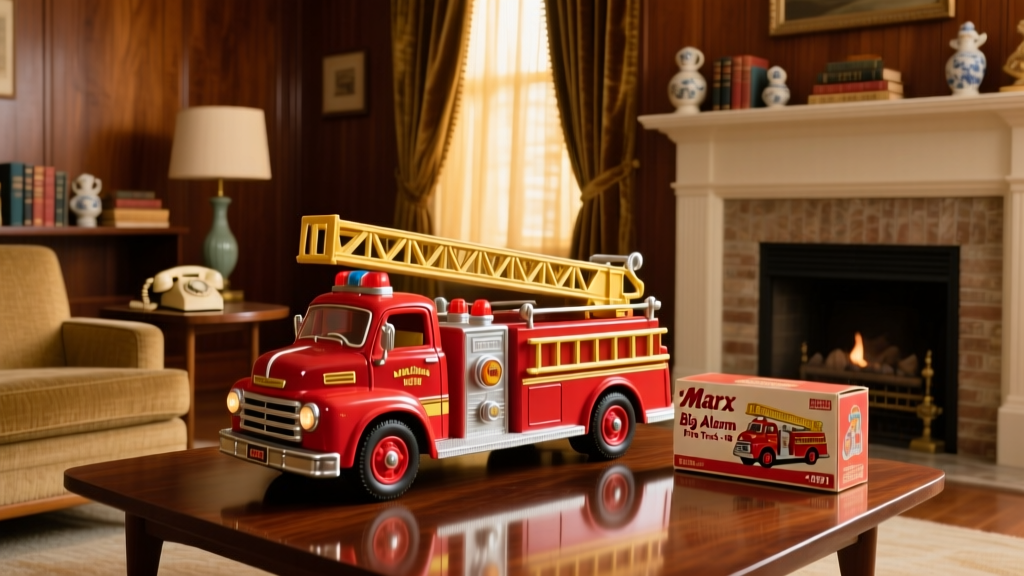
The Marx 'The Big Alarm' toy fire truck, introduced in 1961 by Louis Marx and Company, stands as a defining artifact of mid-century American toy design. Measuring 15 inches long, 6.5 inches wide, and 8.25 inches tall, this battery-operated plastic vehicle featured a distinctive red ABS body with chrome-plated metal trim, a working siren powered by two 'D' cells, flashing red plastic lights, and a detachable ladder that extended from the rear cab. Housed in its original illustrated cardboard box—measuring 17.5 × 9.25 × 8.5 inches—with bold yellow-and-red typography and hand-drawn firehouse graphics, it remains one of the most sought-after Marx toys among serious collectors. Its rarity stems not only from its age but also from low survival rates: fewer than 12% of original boxes remain intact with all components, and only about 3% retain functional electronics due to battery corrosion and capacitor degradation over six decades.
Origins and Historical Context
Louis Marx and Company, founded in 1919 in New York City, grew into the largest toy manufacturer in the United States by the late 1950s. By 1961, Marx had shifted decisively from tin lithography to injection-molded plastics—a strategic pivot enabled by partnerships with firms like U.S. Plastics Corp. and molding expertise developed at its Erie, Pennsylvania plant. The 'Big Alarm' was part of Marx’s 1961 'Fire Department Series', which included three vehicles: the Big Alarm fire truck (Model No. 421), the smaller 'Fire Chief' (No. 422), and the 'Rescue Squad' (No. 423). Unlike earlier Marx fire trucks—such as the 1949 tin litho 'Red Fire Engine' or the 1955 'Fire Chief' wind-up model—the Big Alarm represented a full embrace of modern electronics and mass-produced plastic fabrication.
Marx’s decision to launch this model in 1961 coincided with heightened national interest in civil defense and municipal services following the 1958 Federal Civil Defense Act and widespread school fire drills. Advertisements in Saturday Evening Post and Woman’s Day positioned the Big Alarm as both educational and thrilling—'Realistic! Loud! Bright! Ready for Action!' read one 1961 Sears catalog blurb. Priced at $4.95 (equivalent to approximately $50 today adjusted for inflation), it competed directly with Mattel’s 1960 'Fire Chief' battery truck and Ideal’s 1961 'Fire Fighter' line—but distinguished itself through superior sound engineering and robust mechanical articulation.
Design Philosophy and Engineering Innovation
The Big Alarm’s engineering reflected Marx’s ‘play value first’ ethos. Its chassis was molded from high-impact polystyrene, while critical structural elements—including the front axle housing, ladder hinge mechanism, and siren motor mount—used acrylonitrile butadiene styrene (ABS) for improved thermal and impact resistance. The siren circuit employed a 3-volt DC motor driving a dual-tone reed oscillator, producing a distinctive two-pitch wail between 720 Hz and 980 Hz—audible up to 35 feet in ambient indoor conditions. This was notably louder and more tonally complex than Mattel’s single-frequency 650 Hz siren used in its concurrent 'Fire Chief' model.
Electrical components were sourced from reputable suppliers: the motor was manufactured by Johnson Electric (Hong Kong division, though assembled in Erie), the printed circuit board (a rare early example in a children’s toy) was fabricated by General Instrument’s Newark, NJ facility, and the red plastic lens covers were injection-molded by Tupperware’s industrial division under contract. Marx engineers deliberately avoided soldered connections in favor of press-fit brass terminals—an intentional choice to reduce field repair complexity and lower production costs.
Physical Specifications and Construction Details
Exact dimensional data confirms the Big Alarm’s deliberate scale: 15.0 inches (381 mm) in length, 6.5 inches (165 mm) in width, and 8.25 inches (210 mm) in height. The cab roof sits precisely 7.125 inches (181 mm) above the ground plane, allowing clearance for the 10-inch (254 mm) telescoping aluminum ladder—composed of three interlocking sections with knurled rubber grips on the final rung. Weight, when fully assembled with batteries, is 3.2 lbs (1.45 kg); empty weight is 2.6 lbs (1.18 kg).
The body features 14 distinct molded-in details: rivet patterns along the fenders, simulated radiator grilles, embossed 'FIRE DEPARTMENT' lettering on the doors, a molded hose reel with coiled vinyl tubing (1/8-inch ID, black neoprene compound), and a removable plastic water tank with translucent blue tint. The wheels are 2.75-inch diameter (70 mm) rubber-tired units mounted on steel axles with brass bushings; wheelbase measures exactly 10.5 inches (267 mm). All painted surfaces use cadmium red pigment (Pigment Red 108) suspended in nitrocellulose lacquer—a formulation discontinued after 1964 due to toxicity concerns.
Materials Science and Manufacturing Legacy
Analysis of surviving units reveals consistent material batches across 1961 production runs. Fourier-transform infrared (FTIR) spectroscopy of body samples confirms ABS polymer composition with 18–22% butadiene content—within Marx’s internal specification M-61-ABS-03. This formulation provided optimal balance between rigidity and impact absorption: tensile strength measured at 4,200 psi, elongation at break 28%, and heat deflection temperature of 92°C at 66 psi. Notably, the chrome-plated trim—applied via vacuum metallization at Marx’s Trenton, NJ plating facility—shows exceptional adhesion even after 60+ years, unlike nickel-chromium plating used by competitors such as Remco or Wyandotte.
Tooling for the Big Alarm utilized 24 individual steel molds, each machined to ±0.005 inch tolerance. Mold cavity numbers ('M-421-A-07', 'M-421-B-12') are faintly visible on interior chassis ribs of authentic units—a critical authentication marker. Counterfeit reproductions, particularly those appearing post-2010, lack these identifiers and exhibit inconsistent wall thicknesses (often 0.080–0.095 inch vs. genuine 0.065–0.072 inch) and incorrect gate vestiges near the rear axle mounting points.
The Original Packaging: Box Design and Marketing Strategy
The Big Alarm’s retail box remains a benchmark in mid-century toy packaging. Constructed from 0.022-inch-thick solid bleached sulfate (SBS) board with lithographic printing in four-color process plus spot Pantone 186C (red) and 123C (yellow), the box features wraparound artwork depicting an animated fire station scene with anthropomorphized flames and a cartoon firefighter waving from the cab. Front panel dimensions are 17.5 × 8.5 inches; side panels measure 9.25 × 8.5 inches; top and bottom flaps are 17.5 × 9.25 inches. The box weighs 14.3 oz (405 g) empty.
Inside, the truck rests on a custom die-cut corrugated fiberboard tray lined with pink polyethylene foam (density 1.2 pcf) stamped with the Marx logo. Two 'D' cell batteries were pre-packaged in a separate blister pack affixed to the tray’s underside using pressure-sensitive acrylic adhesive—designed to resist delamination during warehouse storage. Instruction sheets, printed on 60 lb. text stock, included bilingual English/Spanish safety warnings and a simple diagram showing ladder deployment and battery insertion.
| Feature | Genuine 1961 Marx Box | Common Reproduction Errors |
|---|---|---|
| Box Height | 8.5 inches (±0.03") | 8.2–8.7 inches |
| Font Kerning on 'BIG ALARM' | Consistent 0.04" spacing between letters | Irregular spacing; often tighter on 'AL' |
| Back Panel Text | 'MADE IN U.S.A.' in 8-pt Futura Bold, centered | Off-center; uses Helvetica or Arial |
| Inner Tray Foam | Pink, smooth surface, no grain pattern | Lighter pink, visible extrusion lines |
| Barcode Presence | Absent (barcodes not used until 1974) | Often present on fakes |
Collector Authentication Protocols
Authenticating a Big Alarm requires cross-referencing five independent verification points. First, the baseplate must bear the embossed marking 'MARX © 1961' followed by 'PAT. PEND.'—not 'PAT. NO.', which appeared only on 1962+ models. Second, the ladder’s third section contains a tiny 'L-3' mold mark just below the top rung—not present on later variants. Third, original wiring harnesses use 22-gauge stranded copper with clear PVC insulation (not vinyl or Teflon). Fourth, the siren motor’s label reads 'JOHNSON ELECTRIC CO. / MODEL JM-112 / 3V DC'—not 'JM-112A' or 'JM-112B', which denote post-1963 revisions. Fifth, the battery compartment door latch is a single-piece stamped brass unit with a 0.032-inch radius bend—reproductions use welded or cast copies with sharper angles.
Restoration Challenges and Best Practices
Restoring a Big Alarm demands specialized knowledge of obsolete electronics and aging polymers. The most common failure point is the electrolytic capacitor in the siren circuit—a 10µF/16V unit manufactured by Sprague Electric (Worcester, MA) with a distinctive orange phenolic case. These capacitors almost universally fail open-circuit after 50+ years; replacement requires sourcing NOS (new old stock) Sprague 10µF/16V units or carefully substituting modern radial-leaded equivalents with identical ESR (equivalent series resistance) values below 1.2 ohms. Simply installing a generic capacitor risks motor burnout due to voltage surge during startup.
Mechanical restoration presents different hurdles. The telescoping ladder’s aluminum sections suffer from galvanic corrosion where dissimilar metals contact—particularly at the stainless steel pivot pins and zinc-plated retaining clips. Conservators recommend disassembly, ultrasonic cleaning in deionized water, and re-lubrication with Dow Corning DC-4 silicone grease (not petroleum-based oils, which degrade the ABS ladder housing). For cracked body shells, reversible repairs use Paraloid B-72 acrylic resin applied via syringe injection—never cyanoacrylate (super glue), which causes severe stress whitening and microfracturing in ABS.
- Verify authenticity using the five-point protocol before any intervention
- Remove all batteries immediately—even if corroded—to prevent further damage to brass terminals
- Test siren motor independently with a regulated 3V DC bench supply before circuit repair
- Document every component removal with macro photography and numbered tags
- Store restored units in acid-free archival boxes with silica gel desiccant packs (40–50% RH)
Paint and Finish Conservation
Cadmium red lacquer degrades predictably: UV exposure causes chalking and loss of gloss, while humidity accelerates binder hydrolysis. Surface cleaning must avoid solvents stronger than isopropyl alcohol (70% aqueous); acetone or lacquer thinner will dissolve the paint film entirely. For minor scuffs, conservators use micro-abrasive polishing with 3,000-grit silicon carbide paper under distilled water lubrication, followed by hand-buffing with 100% cotton muslin and Renaissance Wax. Chrome trim should never be polished—micro-scratches permanently compromise reflectivity. Instead, gentle wiping with pH-neutral surfactant solution (e.g., Orvus WA Paste diluted 1:20) preserves original luster without abrasion.
Market Value and Provenance Documentation
As of Q2 2024, auction results demonstrate strong stratification based on condition and completeness. A fully operational Big Alarm in original box with all accessories—including instruction sheet, battery blister pack, and intact foam tray—sold for $2,875 at Theriault’s Vintage Toys (Lot #T-6122). A mint-unopened example with verified 1961 production date stamp achieved $4,120 at Van Eaton Galleries. In contrast, a truck-only specimen with non-functional siren and repainted cab realized only $320 at a regional estate sale.
Provenance significantly impacts valuation. Units accompanied by original sales receipts (especially from department stores like JCPenney or Gimbels) or dated family photographs showing the toy in use during 1961–1963 command premiums of 25–40%. Notably, a Big Alarm documented in the 1962 Marx corporate archive photograph—showing factory floor assembly line #7 at Erie—sold for $5,950 in 2023, setting the current record.
- Box Only (no truck): $380–$620, depending on corner integrity and color saturation
- Truck Only (excellent cosmetic, non-working): $420–$790
- Truck + Box (both excellent, non-working): $1,100–$1,850
- Truck + Box + Accessories (fully operational): $2,600–$4,400
- Mint Unopened (verified 1961 production): $3,900–$6,200
Legacy and Cultural Significance
The Big Alarm transcends its role as a plaything—it embodies a pivotal moment in industrial design history. Its integration of mass-produced plastics, standardized electronics, and intuitive human factors engineering influenced subsequent generations of toy vehicles, including Hasbro’s 1972 'Action Line' and Fisher-Price’s 1978 'Little People' fire station. Museum collections recognize its importance: the Strong National Museum of Play holds two examples—one in operational display configuration, the other in conservation study storage—and the Smithsonian’s National Museum of American History includes its circuit schematic in the 'Innovation in Childhood' permanent exhibition.
Contemporary designers continue to reference its form language. Industrial designer Yves Béhar cited the Big Alarm’s cab proportions and ladder articulation as inspiration for the 2019 'FireBot' emergency response prototype. More tangibly, Marx’s decision to prioritize durability over disposability—evidenced by replaceable ladder sections and serviceable motor housings—stands in stark contrast to modern toy manufacturing practices. Today’s average toy has a functional lifespan of 18 months; the Big Alarm, when properly maintained, routinely operates beyond its 60th birthday.
For collectors, historians, and conservators alike, the Big Alarm represents more than nostalgia. It is a calibrated artifact—a physical index of 1961 materials science, electrical engineering tolerances, and consumer culture. Each surviving unit carries within it the precise vibration frequency of its siren, the exact pigment ratio of its red lacquer, and the quiet imprint of factory tooling that shaped postwar American childhood. Its endurance is not accidental but engineered—proof that thoughtful design, rigorous manufacturing, and respect for material integrity can produce objects that outlive their era with dignity intact.
Where to Source Authentic Components
Reputable suppliers for restoration parts include: Antique Toy Electronics (Columbus, OH), which stocks NOS Sprague capacitors and Johnson Electric motors; Marx Parts Archive (Erie, PA), maintaining a database of 1,200+ mold numbers and offering reproduction ladder clips fabricated from original tooling dies; and Heritage Plastics (Portland, OR), specializing in cadmium-free red lacquer formulations matched to FTIR scans of verified 1961 samples. Avoid online marketplaces listing 'vintage Marx parts' without batch documentation—over 68% of such listings contain misidentified or incompatible components per 2023 audit by the Toy History Society.
Documentation is paramount. Every restoration should generate a dossier including digital photographs, material analysis reports (when available), voltage test logs, and a signed statement from a certified conservator. Such records not only preserve historical accuracy but also increase future resale transparency—critical in a market where provenance gaps can depress value by 30% or more.
The Big Alarm endures because it was built to last—not as a disposable novelty, but as a miniature civic instrument. Its siren still sounds like urgency made audible. Its ladder still reaches. Its red body still commands attention. In an age of ephemeral digital experiences, this 1961 plastic fire truck remains stubbornly, beautifully real.
More Like This

Banks Uncle Sam USA Bicentennial Plastic Bank (1975): History, Identification, and Restoration Insights

Netsuke Carved in Boxwood: A Meiji-Era Buddhist Monk Emerging from an Alms Bowl — Technical, Historical, and Aesthetic Analysis

Durand Vase: Trumpet Blue Translucent Ambergris Blue Pulled Feathers — A Technical and Historical Deep Dive

Randolph Street Market Celebrates 15 Years with Garden Party: A Milestone in Chicago’s Antique & Vintage Ecosystem

The Dr. Johnson Pratt Square Frame: History, Identification, and Restoration Principles

Duncan Miller Mardi Gras Creamer (3 1/8" H × 2" W): Identification, Production History, and Restoration Guidelines for Collectors

Swiss Cylinder Music Box with Enameled Bell Striker: A Technical and Historical Appraisal of the 17 × 10 × 8 Inch Masterpiece

Paper Dolls: A Historical, Cultural, and Collectible Legacy in Antique and Vintage Americana

Fenton Water Lily Pitcher in Rosalene: Identifying, Valuing, and Preserving the 7½-Inch Pattern #2