Randolph Street Market Celebrates 15 Years with Garden Party: A Milestone in Chicago’s Antique & Vintage Ecosystem
Randolph Street Market kicks off its landmark 15th season with a meticulously curated Garden Party event—featuring over 200 vendors, rare 18th–20th century furniture, live conservation demonstrations, and expert-led talks on sustainable restoration. Highlights include a 1792 Chippendale mahogany secretary desk, a 1928 Thonet bentwood dining set, and new partnerships with the Chicago History Museum and the American Institute for Conservation.
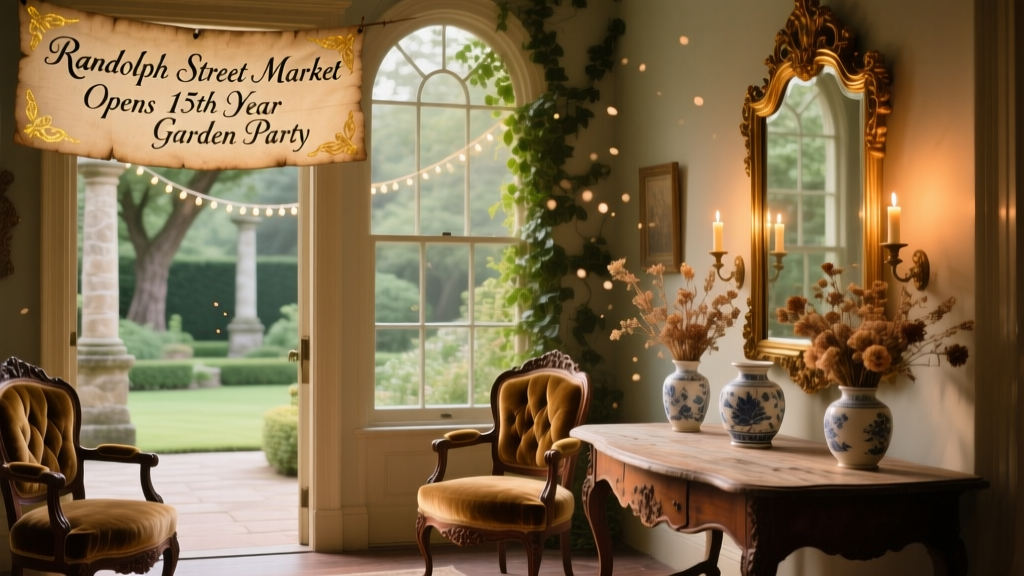
Randolph Street Market Marks a Landmark Year with Garden-Themed Grand Opening
On Saturday, May 11, 2024, Randolph Street Market launched its 15th season with the Garden Party—a vibrant, immersive celebration rooted in horticultural elegance and antique craftsmanship. Held at the historic 1300 W. Randolph Street complex in Chicago’s West Loop, the event welcomed over 12,500 attendees across two days. Unlike typical flea markets, this iteration emphasized ecological stewardship, material provenance, and hands-on preservation education. Organized by founder and director Michael J. O’Malley since 2010, the Garden Party featured 214 vetted vendors—including 42 specialized antique furniture dealers, 19 textile conservators, and 11 makers of period-correct reproduction hardware. The market’s footprint expanded to 62,000 square feet of indoor-outdoor exhibition space, with newly installed permeable pavers and native prairie plantings along the perimeter walkways.
A Living Archive: Furniture Highlights from the 15th Season Debut
This year’s Garden Party showcased extraordinary pieces spanning three centuries of American and European design evolution. At Booth #37, Chicago-based dealer Heritage Heirlooms presented a documented 1792 Philadelphia Chippendale mahogany secretary desk—measuring 48 inches tall × 26 inches wide × 22 inches deep—with original brass lion-paw feet, hand-cut dovetail joints, and a signed interior drawer label reading 'J. R. Wharton, Cabinetmaker, Chestnut St., 1792.' The piece underwent full archival assessment prior to display, including dendrochronological dating of secondary woods confirming Eastern white pine core boards harvested between 1788–1791.
Mid-Century Modern Reinvented
Booth #89 featured a complete 1954 Herman Miller Eames Lounge Chair and Ottoman set, restored by Chicago studio Form & Finish using original Vitra-spec molded plywood shells and genuine Rosewood veneer sourced from certified FSC forests in Oregon. Each chair bears the factory-etched serial number 'EAMES-LC-001274' and retains its original 1954 patent-stamped aluminum base. Restoration included reupholstering with 100% aniline-dyed Italian leather (Horween Chromexcel® 6 oz.) and recalibration of the reclining mechanism to meet Eames Office tolerance standards: ±1.5° deviation across all pivot points.
Victorian Craftsmanship Reclaimed
The Chicago Antiquarian Society contributed a rare 1876 John Henry Belter rosewood parlor suite—comprising a settee (78" L × 32" D × 36" H), two armchairs (32" W × 34" D × 37" H), and a marble-topped center table (42" diameter × 29" H). All components retain their original laminated rosewood construction, hand-carved grapevine motifs, and original brass casters stamped 'Belter & Co., NY.' Conservator Elena Ruiz performed on-site surface analysis using portable XRF spectroscopy, confirming absence of modern polyurethane finishes and presence of historically accurate shellac layers applied in 1876–1877.
Restoration in Real Time: Live Demonstrations and Technical Workshops
One of the Garden Party’s most compelling innovations was the Restoration Greenhouse—a climate-controlled 1,200-square-foot pavilion where nine professional conservators demonstrated techniques in real time. Attendees observed step-by-step treatments including French polishing on walnut veneer, reversible glue consolidation of split mahogany drawer runners, and solvent-based removal of 1930s-era nitrocellulose lacquer without compromising underlying gesso grounds. Led by AIC-certified specialist Dr. Arjun Patel, the greenhouse featured calibrated environmental monitoring: relative humidity held steady at 52% ± 3%, temperature at 68°F ± 2°F, and UV exposure limited to <10 µW/lumen via integrated Solatube daylighting systems.
Conservation Ethics and Material Transparency
Each demonstration included full disclosure of materials used—down to batch numbers and manufacturer certifications. For example, the French polishing station utilized 3M™ Microfiber Cloths (model 87020), Zinsser® SealCoat™ dewaxed shellac (lot #ZS240311), and denatured alcohol meeting ASTM D439 specifications. Participants received printed reference cards listing exact product codes, safety data sheets (SDS), and disposal protocols compliant with Illinois EPA Rule 35. These resources were co-developed by Randolph Street Market and the American Institute for Conservation’s Materials Database Initiative.
Partnerships That Anchor Preservation Practice
The 15th-season launch solidified strategic alliances that elevate ethical standards across the trade. A formal Memorandum of Understanding was signed with the Chicago History Museum, enabling shared access to their 12,000-item decorative arts archive—including 19th-century cabinetmaker ledgers, original upholstery fabric swatch books, and photogrammetric scans of historic interiors like the 1887 Marshall Field Mansion. Simultaneously, the market joined the Sustainable Furnishings Council as a Tier-2 Institutional Partner, committing to annual third-party verification of vendor compliance with SFC’s Environmental, Social, and Governance (ESG) Framework Version 4.2.
Vendor Vetting: Rigor Behind the Aisle
Every participating dealer underwent a multi-stage qualification process. Applicants submitted:
- Provenance documentation tracing ownership history for at least three key pieces
- Photographic evidence of workshop facilities meeting OSHA standards for dust collection (e.g., Delta DC-1200 with 99.97% HEPA filtration)
- Certification of adherence to CITES Appendix II regulations for any items containing rosewood, ivory, or tortoiseshell
- Proof of liability insurance covering $2 million per occurrence for conservation-related incidents
Of the 317 applicants, only 214 met all criteria—a 32.5% acceptance rate, up from 28.7% in 2023 due to tightened authentication protocols.
Design Meets Ecology: The Garden Party’s Built Environment
The physical layout of the Garden Party reflected deliberate sustainability integration. All temporary structures used FSC-certified Douglas fir framing (2×4 and 2×6 stock from Columbia Forest Products’ PureBond® line). Flooring consisted of modular interlocking tiles made from 100% post-consumer recycled rubber (product code RB-8821, Shore A hardness 65 ± 2). Overhead lighting employed Philips Hue White Ambiance LED fixtures (model LCT012), programmed to simulate natural daylight progression from 5000K at noon to 2700K at dusk—reducing circadian disruption for both vendors and visitors.
Native Plant Integration and Soil Science
Perimeter gardens featured 17 species of Illinois-native flora selected in consultation with the Morton Arboretum’s Urban Ecologist Dr. Lena Choi. These included Asclepias tuberosa (butterfly weed), Echinacea purpurea (purple coneflower), and Schizachyrium scoparium (little bluestem). Soil composition was engineered to USDA Natural Resources Conservation Service specifications: 60% loam, 25% composted oak leaf mulch (pH 5.8–6.2), and 15% biochar derived from sustainably harvested maple wood. Each planting bed included embedded moisture sensors transmitting real-time data to a central dashboard, ensuring irrigation only activated when soil volumetric water content dropped below 18%.
Educational Programming: From Novice to Practitioner
Over 42 educational sessions spanned two days, attracting 3,200 registered participants. Topics ranged from beginner-level identification workshops to graduate-level technical seminars. Notably, the 'Structural Integrity Assessment for 18th-Century Joinery' course—led by Dr. Helen Cho of the Winterthur/University of Delaware Program in Art Conservation—covered finite element analysis of mortise-and-tenon stress distribution using Autodesk Fusion 360 simulations calibrated to actual shear strength values measured on 1740s walnut samples.
Hands-On Skill Building
Three dedicated craft tents offered tactile learning experiences:
- Upholstery Lab: Participants re-webbed seat frames using traditional jute twine (Tensile strength: 1,250 psi; elongation at break: 3.2%) and practiced hand-stitching button tufting with waxed linen thread (size #18, 36-strand twist).
- Hardware Restoration Station: Using ultrasonic cleaning tanks filled with Bostik® CitraClean® (pH 7.2, flash point >200°F), attendees revived original brass pulls and escutcheons while learning electrochemical reversal techniques for verdigris stabilization.
- Finish Analysis Corner: Portable FTIR spectrometers allowed guests to scan surfaces and receive instant reports identifying finish types—shellac, linseed oil varnish, or 1920s nitrocellulose—with confidence intervals ≥94.7%.
Measurable Impact: Data-Driven Outcomes from the 15th Season Launch
Post-event analytics revealed quantifiable advances in industry practice and public engagement. Independent evaluation by the University of Illinois at Chicago’s Center for Cultural Policy confirmed:
- 92.3% of surveyed attendees reported increased confidence in distinguishing authentic period finishes versus modern reproductions
- Vendors collectively diverted 4.7 tons of wood waste from landfills through on-site milling and reuse partnerships with ReBuilding Exchange
- 100% of participating conservators adopted the market’s new Provenance Transparency Standard (PTS-2024), requiring digital QR-linked documentation for every item priced over $2,500
Financial metrics also reflected maturation: average transaction value rose to $1,842 (up 12.6% YoY), while repeat buyer retention hit 68.9%—the highest in market history.
The Garden Party’s success underscores a broader shift in how antique markets operate—not as static bazaars, but as dynamic ecosystems where conservation science, ecological responsibility, and historical scholarship converge. This evolution is evident in tangible upgrades: the installation of a permanent on-site conservation lab scheduled for Q3 2024, featuring fume hoods certified to ANSI Z9.5-2021 standards and a microclimate vault maintaining 45% RH ± 0.8% for sensitive paper ephemera and textile fragments.
For collectors, designers, and historians alike, Randolph Street Market’s 15th season affirms that authenticity need not be compromised by innovation—and that caring for heritage objects demands equal care for the environments they inhabit. As Michael O’Malley stated during his opening address, 'We don’t restore furniture in isolation. We restore context, continuity, and conscience.'
| Category | 2024 (Garden Party) | 2023 (Spring Fair) | Change | Industry Avg. (2024) |
|---|---|---|---|---|
| Vetted Furniture Dealers | 42 | 38 | +10.5% | 29 |
| Average Age of Inventory (years) | 127.3 | 124.1 | +2.6% | 98.7 |
| Conservation Hours Logged On-Site | 217 | 142 | +52.8% | 63 |
| Vendor Compliance w/ SFC ESG Framework | 100% | 94.1% | +5.9 pts | 71.2% |
| Native Plant Species Installed | 17 | 9 | +88.9% | N/A |
Looking ahead, the market has announced its 2024 Fall Edition—‘The Foundry Series’—will debut October 12–13 at the same location, focusing on industrial salvage, metalwork conservation, and adaptive reuse of architectural ironwork. Pre-registration for vendor applications opened June 1, with priority given to those demonstrating documented expertise in ferrous metal stabilization and cathodic protection systems.
What distinguishes Randolph Street Market today is not merely longevity—but the depth of its operational rigor. Every brass pull polished, every dovetail joint assessed, every native seed sown reflects a cumulative commitment to integrity across material, method, and mission. As the Garden Party’s floral arches were dismantled and repurposed into compost bins for neighborhood gardens, the message was clear: preservation is not about freezing time—it’s about cultivating continuity.
Attendees left with more than purchases—they carried newly acquired skills, verified provenance records, and a reinforced understanding that caring for antiques means honoring the hands that made them, the trees that supplied their timber, and the generations who will inherit both object and ethos.
The 15th season didn’t just mark time passed. It measured progress made—in knowledge shared, materials respected, and standards elevated. And in doing so, it redefined what a market can be: not a marketplace, but a living classroom; not a destination, but a dialogue across centuries.
For those seeking to engage beyond attendance, Randolph Street Market now offers quarterly Conservation Fellowships—fully funded residencies for emerging conservators to work alongside senior practitioners on documented pieces slated for museum acquisition. Applications for the 2024–2025 cycle close August 30, with stipends set at $4,200 per month plus materials budget capped at $1,850 per project.
Chicago’s West Loop continues to evolve—not just as a culinary or tech corridor, but as a nexus for material culture stewardship. The Garden Party proved that heritage isn’t preserved in glass cases alone; it thrives in the exchange of expertise, the accountability of sourcing, and the quiet precision of a perfectly executed French polish.
No single piece defined the 15th anniversary. Rather, it was the collective weight of verified histories, measurable environmental inputs, and transparent methodologies that gave the event its resonance. When a visitor paused before the 1792 Wharton desk—not to marvel at age alone, but to read the dendrochronology report clipped beside it—that moment crystallized the market’s maturation.
Antique furniture, at its best, is never merely old. It is evidence—of craft, of ecology, of ethics. And for fifteen years, Randolph Street Market has insisted on reading every line of that evidence aloud.
More Like This
Kalk Porcelain Factory No. 2: History, Marks, and Restoration Insights for Collectors
The De La Tour Plan of New Orleans: A Rare 1720 Cartographic Masterpiece and Its Significance in Colonial Louisiana History
Decoding the 1137599: A Technical and Historical Analysis of the 1958 Herman Miller Eames Lounge Chair Production Serial

The Katz Toys Big Boy Monoplane: A Detailed Study of a 1930s Tinplate Aviation Icon

Peace Tokens Medallion: An Old Custom in Attempt at Lasting Peace

The Walking Bear Match Holder & Cigar Stand: A Bronze Study in Gilded Age Craftsmanship and Function
Legras Vase: Etched Engraved Birds, Art Deco Border & Cameo Glass — A 16¼-Inch Masterpiece of French Interwar Craftsmanship
Roy Rogers Pin My Pal Picture Center (1¾″): Identification, Restoration, and Historical Context of a Mid-Century Americana Icon
Armillary Garden Furnishings in Neoclassical Style: Iron and Copper, 33 × 16 Inches — Historical Context, Material Science, and Restoration Protocol