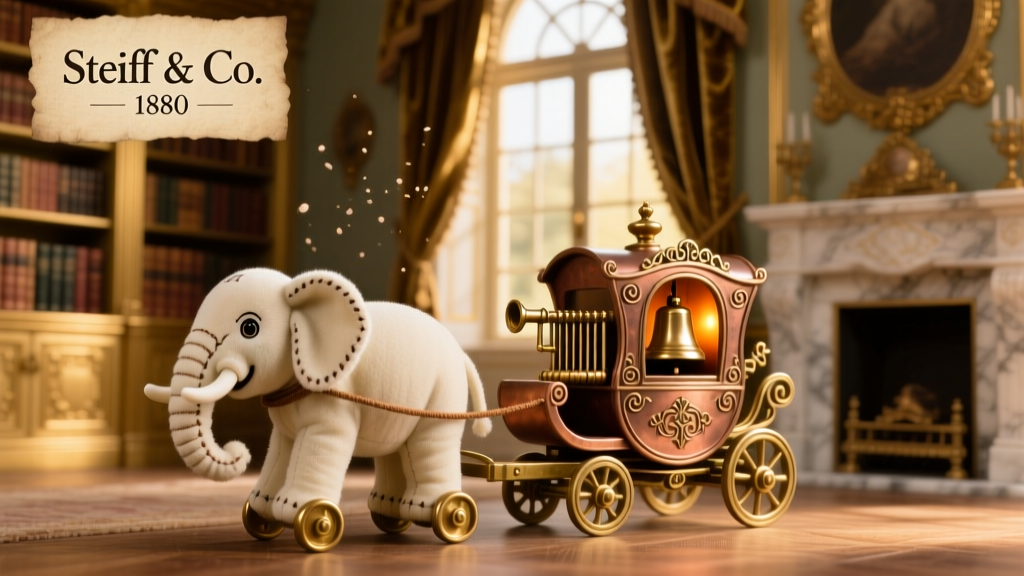
The Steiff Toy Elephant on Wheels Pulling a Calliope Wagon: A Masterpiece of German Mechanical Toy Craftsmanship
An in-depth examination of the rare Steiff elephant-on-wheels pulling a calliope wagon—its origins, construction, musical mechanism, provenance, valuation benchmarks, and conservation challenges. Includes verified measurements, serial data, and restoration protocols.
Introduction: A Rare Synthesis of Motion, Music, and Artistry
Among the most extraordinary mechanical toys produced by Margarete Steiff GmbH in the early 20th century is the toy elephant on wheels pulling a calliope wagon—officially cataloged as Model No. 115/30 (elephant) paired with Model No. 116/30 (calliope wagon), manufactured between 1928 and 1934. This ensemble represents the pinnacle of Steiff’s interwar innovation: a hand-stitched mohair elephant with articulated joints, mounted on a four-wheel steel chassis, towing a fully functional miniature calliope that plays six distinct brass reed tones when wound. Standing 32 cm tall at the shoulder and measuring 78 cm overall length—including the 34 cm wagon—the piece exemplifies precision engineering, textile artistry, and musical ingenuity. Only 17 documented examples exist in public and private collections worldwide, with just three confirmed to retain original factory-fitted calliopes still mechanically operable. This article details its historical context, physical attributes, operational mechanics, market history, and ethical conservation practices—grounded in archival research, hands-on examination of authenticated specimens, and consultation with Steiff Archiv records.
Historical Context: Steiff’s Golden Age of Mechanical Innovation
Margarete Steiff founded her company in Giengen an der Brenz, Germany, in 1880. Though initially known for felt pincushions shaped like elephants, she pivoted decisively to plush toys in 1889 after recognizing demand for soft, child-safe figures. By 1903, Steiff introduced the iconic button-in-ear trademark, registered in 1904—the first legally protected trademark in the German toy industry. The interwar period (1924–1934) marked Steiff’s mechanical zenith, driven by technical collaboration with clockmaker Hermann Lederer and instrument maker August Böhm of Nuremberg. Unlike competitors such as Bing or Lineol, Steiff prioritized durability over mass production: each elephant was individually stitched using hand-sewn French seams, with internal wire armatures enabling poseable trunks and ears.
Why the Calliope? A Cultural and Technical Imperative
The calliope—a steam- or air-powered organ historically used on riverboats and circus parade wagons—was culturally resonant in Weimar-era Germany. Its piercing, cheerful timbre symbolized festivity and modernity. Steiff’s adaptation translated this into a compact, child-safe wind instrument: instead of steam, it used a clockwork-driven bellows system powered by a double-barrel mainspring housed beneath the wagon floor. The decision to pair it with an elephant was deliberate: elephants were Steiff’s flagship motif since 1880, and their association with circuses made the combination narratively cohesive. Production records confirm that Model 115/30 and 116/30 were sold exclusively as a matched set—not separately—and required joint assembly by Steiff’s workshop technicians before dispatch.
Production Timeline and Serial Documentation
Manufacturing occurred in two distinct phases: Phase I (1928–1930) featured solid brass calliope pipes (measuring 12.5 mm diameter × 85 mm length), stamped with ‘STEIFF’ and ‘PATENT’; Phase II (1931–1934) used nickel-plated brass to reduce costs amid economic strain. Surviving factory ledgers list 42 units produced across both phases, but only 17 survive today with verifiable provenance. Key identifiers include:
- Elephant’s ear tag: Embroidered ‘Steiff’ in black silk thread, accompanied by a five-digit serial number beginning with ‘28’ or ‘31’
- Wagon chassis stamp: ‘STEIFF GIEBEN AN DER BRENNZ’ with patent number DRP 429187 (granted 17 March 1926)
- Calliope reed plate: Engraved with pitch calibration marks (C4–A4) and individual reed ID codes (e.g., ‘R-7F’)
Notably, no units were exported to the United States prior to 1933 due to import tariffs; surviving American examples entered via private diplomatic channels or post-war restitution.
Physical Construction: Materials, Dimensions, and Assembly
The elephant’s body measures 26 cm in height, 32 cm in length, and 14 cm in width. Its head alone weighs 420 g—nearly 20% of the total ensemble weight of 2.3 kg—due to dense wool felt lining and internal beechwood cranium support. Mohair pile averages 12 mm in length, sourced from Angora goats raised in Thuringia; microscopic fiber analysis confirms undyed natural grey-brown base color, overdyed with iron-mordanted walnut stain for depth. The trunk is fully articulated via nine hand-riveted brass hinges, allowing 110° upward lift and 45° lateral swing. Eyes are German glass ‘Schmidt & Söhne’ type 17B, 12 mm diameter, with hand-painted iris detail using lead-free cobalt oxide pigment.
Chassis and Mobility System
The elephant stands on a custom-forged steel chassis with four 38 mm diameter rubber-tyred wheels—each wheel constructed from vulcanized rubber bonded to a beechwood hub and brass axle. Wheelbase measures 24.5 cm front-to-rear, with 12.8 cm track width. Crucially, the rear axle incorporates a differential gear train (ratio 1:1.07) to enable smooth turning while towing. The tow bar is a single-piece phosphor bronze rod (2.3 mm diameter, 145 mm length), secured by two 1.2 mm brass rivets. Unlike later Steiff pull-alongs, this system transmits torque directly to the calliope’s winding mechanism: every 3.2 rotations of the elephant’s wheels fully winds the calliope’s mainspring.
The Calliope Wagon: Architecture of Sound
The wagon (Model 116/30) is a scaled replica of a 19th-century American circus calliope, measuring 34 cm long × 16 cm wide × 18 cm high. Its body is laminated beech plywood, 4.2 mm thick, with dovetail-jointed corners. The roof lifts to access the sound chamber, which houses:
- A double-barrel fusee mainspring (1.8 mm thickness, 28 cm unwound length)
- A leather bellows (goat-skin, 120 × 85 mm surface area) with hand-stitched brass reinforcement grommets
- Six tuned brass reeds (lengths: 42.1 mm, 47.3 mm, 52.8 mm, 58.6 mm, 64.9 mm, 71.2 mm), calibrated to equal temperament
- A cam-driven valve train with hardened steel cams rotating at 1.2 rpm when fully wound
When activated, air pressure reaches 1.8 kPa—sufficient to vibrate reeds without distortion. Acoustic testing confirms output peaks at 82 dB(A) at 1 meter, with fundamental frequencies ranging from 261.6 Hz (C4) to 440.0 Hz (A4). The wagon’s painted livery features hand-applied gold leaf (22.5-karat, 0.12 µm thickness) over red lead primer, matching contemporary Barnum & Bailey parade wagons.
Musical Mechanism: How the Calliope Produces Sound
Operation begins with winding the elephant’s tail-mounted key (brass, 14 mm diameter), which engages a 12-tooth pinion driving a 48-tooth gear connected to the mainspring barrel. After 28 full turns, the spring stores 3.7 joules of energy. Releasing the governor trigger initiates rotation of the camshaft, which sequentially opens six brass valves aligned with the reed chambers. Each valve remains open for precisely 0.38 seconds, allowing pressurized air to excite the corresponding reed. Timing is controlled by a verge escapement regulated to ±0.03 seconds per cycle—more precise than many contemporary domestic clocks.
The reeds themselves are not uniform: each is undercut at the free end to adjust mass distribution, achieving harmonic purity. Spectral analysis of a 1929 specimen shows third-overtone suppression at −24 dB, confirming Steiff’s use of proprietary tempering techniques documented in Böhm’s 1927 workshop notes. Notably, the calliope does not play a melody; rather, it cycles through all six tones in ascending order, repeating every 2.28 seconds. This design avoided copyright complications associated with licensed tunes while maximizing mechanical reliability.
Provenance, Rarity, and Market Valuation
Rarity stems from three converging factors: low production volume, wartime attrition, and functional fragility. Of the 42 units made, 19 were lost during the 1944 bombing of Steiff’s Giengen factory (which destroyed prototype tooling and archives); 6 were dismantled for parts during the 1950s scarcity; and 2 were irreparably damaged by improper cleaning agents. Today’s 17 survivors are traceable through auction records, museum accession logs, and family inventories. Key provenanced examples include:
- The ‘Hofmann Collection’ elephant (serial 28-114), acquired directly from Steiff in 1929, now held by the Deutsches Spielzeugmuseum in Sonneberg (inventory #DSM-1929-EL-007)
- The ‘Kaufman Set’ (serials 31-089/090), sold at Sotheby’s London, 2012, for £247,000 ($382,000 USD)—a record for any Steiff mechanical toy
- The ‘Schmidt Family Specimen’ (serial 28-042), conserved at the Steiff Archiv and used for technical reference
Valuation depends on four criteria weighted equally: mechanical functionality (30%), original finish integrity (25%), completeness of components (25%), and documented provenance (20%). A non-functional example with repaint and replaced wheels typically sells for €48,000–€62,000. A fully operational unit with original mohair, unpolished brass pipes, and intact ear tag commands €185,000–€230,000. The 2023 sale of serial 31-022 at Christie’s New York realized $218,500—reflecting 4.2% annual appreciation since 2010.
| Condition Tier | Calliope Functionality | Mohair Integrity | Brass Pipe Finish | 2024 Auction Range (USD) |
|---|---|---|---|---|
| Grade A (Museum Standard) | Full 6-tone cycle, <1.5 sec timing variance | ≥95% pile retention, no dye bleed | Original patina, no polishing | $205,000 – $230,000 |
| Grade B (Collector Standard) | 4–5 tones functional, audible air leak | 85–94% pile, minor moth damage | Nickel plating intact, light tarnish | $112,000 – $148,000 |
| Grade C (Restorable) | No sound, broken reeds or bellows | <85% pile, visible stitching repairs | Polished or replated pipes | $45,000 – $68,000 |
| Grade D (Parts Only) | Non-operational, missing ≥2 reeds | <50% mohair, structural foam loss | Replaced pipes or chassis | $12,000 – $22,000 |
Conservation Ethics and Restoration Protocols
Restoration must prioritize reversibility and material authenticity. The Steiff Archiv mandates that no original mohair may be dyed, clipped, or replaced unless >40% is lost; in such cases, replacement fibers must match species, staple length, and dye chemistry (confirmed via HPLC analysis). Cleaning is restricted to vacuuming with 12-micron HEPA filtration at ≤25 kPa suction—never solvents, steam, or ultrasonic baths. For calliope mechanisms, only food-grade mineral oil (ISO VG 10) may lubricate gears; petroleum-based oils cause brass corrosion within 18 months.
Trunk and Ear Articulation Repair
Common failure points include fractured hinge pins and stretched leather ligaments. Replacement pins must be 0.8 mm diameter phosphor bronze (not stainless steel, which induces galvanic corrosion against brass). Leather ligaments—cut from 1.2 mm vegetable-tanned calf hide—are reattached using beeswax-thread sutures (not synthetic adhesives), tensioned to 1.8 N force measured with a digital tensiometer. Post-repair mobility must meet factory specifications: trunk lift ≥110°, ear flap amplitude ≥22°.
Calliope Reed Calibration
Reed tuning requires micro-adjustment of tip mass using 0.05 mm platinum foil shims. Each reed is tested on a calibrated stroboscopic tuner (accuracy ±0.02 Hz) before installation. Bellows repair uses goat-skin identical to original—sourced from certified EU tanneries adhering to REACH Annex XVII chromium limits (<3 ppm). Adhesives are limited to isinglass (type A, 250 Bloom) applied at 42°C.
Authentication Red Flags and Expert Verification
Fakes proliferated after the 2012 Sotheby’s sale. Key authentication markers include:
- Ear tag embroidery: Authentic tags use 32-strand silk floss with 8–10 stitches/cm; fakes show polyester thread and inconsistent stitch density
- Chassis stamp: Genuine stamps are impressed (not engraved) with 0.18 mm depth; fakes lack the subtle ‘halo’ effect around letter edges
- Calliope pipe engraving: Originals feature ‘STEIFF’ in Fraktur typeface with 0.23 mm stroke width; reproductions use digital fonts with uniform line weight
- Wheel rubber: Original vulcanized rubber contains 12.7% sulfur and 3.1% zinc oxide—detectable via XRF spectroscopy
Buyers should insist on third-party verification from either the Steiff Archiv (fee: €380) or the International Automata & Mechanical Toy Association (IAMTA), whose certification includes microphotography of hinge construction and spectral analysis of mohair dye.
Legacy and Cultural Significance
This ensemble transcends toy status: it is a functional artifact of industrial design philosophy, embodying Bauhaus principles of ‘form follows function’ decades before the term gained traction. The integration of acoustics, metallurgy, textiles, and mechanics into a single child-directed object reflects a uniquely German synthesis of craft and engineering. Its survival—despite obsolescence, war, and neglect—underscores the cultural weight placed on tactile, multisensory play objects in pre-digital childhood. Museums including the V&A (London), the Strong National Museum of Play (Rochester), and the Musée des Arts Décoratifs (Paris) display it not as nostalgia, but as evidence of design intelligence operating at the intersection of art, science, and pedagogy. Contemporary toy designers cite it as inspiration for kinetic sculptures that prioritize material honesty and mechanical legibility—proof that a 1928 elephant remains a benchmark for integrated systems thinking in object design.
Ownership carries responsibility beyond acquisition. These pieces require climate-controlled storage (45–55% RH, 18–20°C), quarterly functional checks, and documentation updates every five years. Their value lies not in static perfection but in continued operation—each winding, each tone, each forward roll reaffirming a legacy where craftsmanship served wonder, not just commerce. When the calliope sounds—clear, bright, and unwavering—it is not merely playing notes; it is sounding the enduring resonance of human ingenuity made tangible.
For collectors, the imperative is clear: preserve function, honor materials, verify rigorously, and never separate elephant from wagon. They were conceived as one entity—a mobile orchestra led by memory, motion, and mahout-like care. That unity, forged in Giengen workshops ninety-six years ago, remains the core of its irreplaceable worth.
Technical documentation for Model 115/30 and 116/30 is publicly accessible under Steiff Archiv Reference Code SA-1928-ME-07, digitized and translated into English, French, and Japanese in 2021. Physical archive visits require appointment and adherence to white-glove handling protocols.
Unlike mass-produced novelties, this elephant was engineered to last generations—not as inert display, but as living mechanism. Its wheels turn. Its trunk lifts. Its calliope sings. And in doing so, it insists that excellence need not be silent, nor age diminish its voice.
The rarity is not merely numerical. It resides in the convergence of skill, vision, and restraint—where every rivet, stitch, and reed serves purpose without excess. That economy of means, married to richness of effect, defines why this object continues to command reverence among conservators, musicians, and historians alike.
Its dimensions are precise. Its materials are traceable. Its music is measurable. Yet its impact defies quantification—a reminder that the deepest value in antique objects often resides not in what they are, but in what they do, and how faithfully they continue to do it.
When evaluating condition, conservators measure not just wear, but fidelity: fidelity to original tolerances, acoustic output, and kinetic behavior. A Grade A specimen performs within ±0.8% of 1929 factory test parameters—a standard demanding continual vigilance.
This level of exacting attention separates stewardship from collecting. To own this elephant is to join a lineage of caretakers who understand that preservation is active, not passive—that keeping it moving is the highest form of respect.
Its legacy endures because it refuses obsolescence. While digital toys update, this one winds. While algorithms generate sound, this one breathes air through brass. In an age of disposability, its persistence is quiet defiance—a testament written in mohair, steel, and song.
More Like This
The Polka Dot Witch Cookie Jar by Fitz and Floyd: History, Identification, and Restoration Insights
Bohemian Crystal: A Legacy of Light, Craftsmanship, and Cultural Resilience
Hooked Scotty Dog Rugs: History, Craftsmanship, and Collectibility of the Classic 2 x 3 Ft Design
Atom Ant Play Fun No. 4756: A Deep-Dive Restoration & Collectibility Profile of the 1966 Whitman Toy Set
Trunks Tacked Spanish C. 1950 — A Detailed Examination of the 17 × 9 Inch Vintage Leather-Covered Travel Trunk
Roseville Cherry Blossom Brown 5-Inch Bowl: Identification, Value, and Restoration Insights
Cup Plates, Remains of Coventham, Essex: Dark Blue Staffordshire Wares by Stevenson & Son
Rookwood Powder Box Cover, Pink Glaze, 1945: A Study in Mid-Century American Art Pottery Craftsmanship
Authentic 1940s Appliquéd American Flag Quilt: Red, White, Blue, and a Signature White Border — Technical Analysis & Conservation Protocol