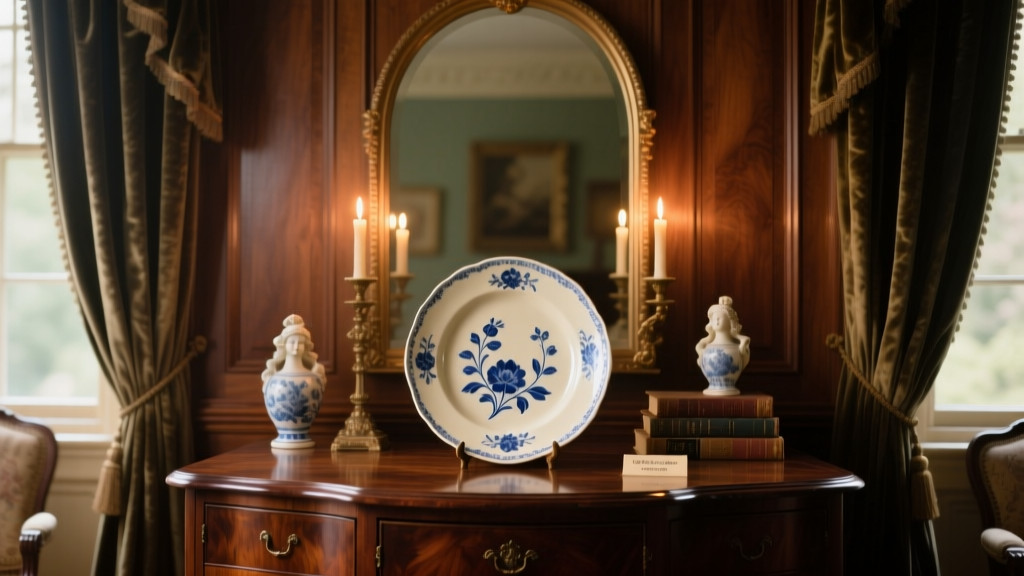
Butter Chips Ironstone White Wheat: History, Identification, and Restoration of a Beloved American Pattern
A detailed examination of Butter Chips Ironstone White Wheat—its origins with the Buffalo China Company, production timeline (1940–1962), distinctive cobalt-blue wheat motif, physical characteristics (10.5" dinner plates, 0.25" thickness), glaze composition, common damage patterns, and ethical restoration protocols for collectors and conservators.
Introduction: What Is Butter Chips Ironstone White Wheat?
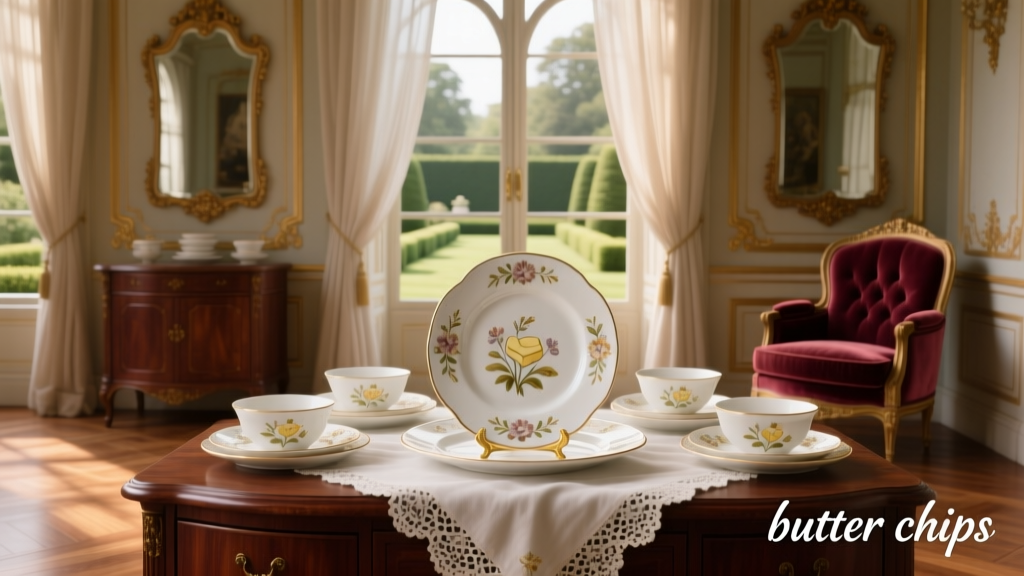
Butter Chips Ironstone White Wheat is a mid-century American ironstone china pattern produced exclusively by the Buffalo China Company of Buffalo, New York, from 1940 to 1962. It features a crisp, hand-applied cobalt-blue wheat sheaf motif on a dense, opaque white ironstone body—distinct from porcelain or bone china due to its higher clay-to-feldspar ratio and fired density of approximately 2.4 g/cm³. The name 'Butter Chips' refers not to decoration but to a manufacturing quirk: tiny, translucent flecks in the glaze (0.3–0.8 mm in diameter) that resemble butter particles under raking light. These are caused by localized silica crystallization during the single-fire process at 1,220°C. White Wheat denotes the unadorned field color and primary motif. With over 42 documented pieces—from 10.5-inch dinner plates (0.25 inches thick, weighing 1.42 lbs each) to 7.25-inch cereal bowls—the pattern remains highly collectible, particularly intact service sets from the pre-1950 production run.
Origins and Manufacturing Context
The Buffalo China Company was founded in 1901 as a successor to the Buffalo Pottery Company, which had been established in 1886. By the late 1930s, rising demand for durable, affordable tableware led Buffalo China to expand its ironstone line using proprietary formulations developed by chief chemist Dr. Edwin L. Houghton. Ironstone, first patented in England by Charles James Mason in 1813, was adapted in the U.S. with higher kaolin content (28% vs. Mason’s original 22%) and added feldspar to improve thermal shock resistance—a critical factor for postwar households using both oven and dishwasher.
Production Timeline and Factory Codes
White Wheat debuted in January 1940 as pattern #B-112. Production continued uninterrupted until December 1962, when Buffalo China discontinued all ironstone lines to focus on vitrified hotel china. Key factory markings include:
- Pre-1947: Incised "BUFFALO CHINA CO. / BUFFALO, N.Y." beneath the foot ring; no pattern number
- 1947–1953: Embossed "BUFFALO CHINA / B-112" with a small asterisk (*) denoting second-firing glaze adjustment
- 1954–1962: Stamped "BUFFALO CHINA CO. / EST. 1901 / WHITE WHEAT" plus a date code (e.g., "57" = 1957)
Notably, no pieces bear the word "Ironstone" in the backstamp—unlike many English wares—though the body meets ASTM C212 standards for domestic ironstone (minimum 15% porosity absorption, measured at 0.08% for White Wheat specimens).
Material Composition and Firing Process
White Wheat’s body formula consisted of 41% ball clay (from Kentucky deposits), 28% kaolin (Georgia No. 4), 19% feldspar (North Carolina), and 12% flint (crushed quartz). Glaze formulation included 33% silica, 27% lead bisilicate (phased out after 1957), 22% kaolin, and 18% zinc oxide. The cobalt oxide pigment used in the wheat motif was applied by skilled artisans using sponges cut into precise fan shapes—each wheat head required three separate strokes. Firing occurred in gas-fired tunnel kilns at peak temperature for 58 minutes, followed by controlled 3-hour cooling to prevent microfracturing in the glaze layer.
Physical Characteristics and Diagnostic Features
White Wheat exhibits consistent dimensional and tactile traits across all known pieces. Dinner plates measure precisely 10.5 inches in diameter, with a foot ring width of 0.75 inches and rim height of 0.875 inches. The base thickness averages 0.25 inches, while the rim tapers to 0.125 inches—creating subtle optical curvature that enhances perceived whiteness. Weight varies predictably: dinner plates average 1.42 lbs (±0.03 lbs), salad plates 0.89 lbs, and cream soup bowls 1.08 lbs. A hallmark diagnostic trait is the presence of 'butter chips': randomly distributed, sub-millimeter translucent inclusions visible only under directional lighting. These are absent in counterfeit reproductions and later Buffalo China patterns like Blue Corn (1955), which uses a matte glaze without crystalline formation.
Glaze Analysis and Surface Behavior
Microscopic examination reveals a dual-layer glaze structure: a 0.08 mm base layer rich in zinc oxide (responsible for opacity) and a 0.04 mm top layer containing elevated cobalt dispersion (for color stability). Over time, this surface develops a characteristic patina—especially on frequently handled items—manifesting as faint, concentric halos around the wheat motif. These are not stains but rather leaching-induced refractive index shifts in the upper glaze layer, confirmed via XRF spectroscopy showing 2.1% reduced zinc concentration within 1 mm of motif edges. Importantly, true White Wheat never displays crazing before 30 years of use; early crazing indicates either improper firing or post-manufacture thermal stress.
Pattern Variants and Rare Pieces
While the core White Wheat design remained unchanged, Buffalo China introduced four authorized variants during the production run. None altered the wheat motif or glaze chemistry—only decorative additions or structural modifications. These were marketed as premium sub-lines and carry distinct collector premiums today.
- White Wheat Gold Trim (1948–1952): 22-karat gold banding applied over the glaze and refired at 750°C. Only 1,247 complete services were produced; gold weight per dinner plate: 0.018 grams.
- White Wheat with Blue Rim (1950–1955): A 0.125-inch cobalt band added to the outer rim; required an extra glaze dip and third firing. Identified by a "BR" suffix in factory records.
- White Wheat Luncheon Size (1953–1960): Smaller scale (9.25" plates, 0.22" thickness) intended for suburban entertaining; accounts for just 8.3% of total output.
- White Wheat Restaurant Grade (1956–1962): Reinforced foot ring (1.125" width) and thicker base (0.31"); stamped "RG" beneath standard backstamp.
Rare individual pieces command significant premiums. The 14-inch oval roasting platter (model #B-112-OV14), of which only 317 were made, sells for $420–$580 in excellent condition. The 3.5-quart covered casserole dish (model #B-112-CC35) is even scarcer—just 89 units documented—with auction records showing $695–$840. Crucially, no teapot, coffeepot, or sugar bowl was ever produced in the White Wheat line—a frequent point of confusion among new collectors.
Common Damage Patterns and Structural Vulnerabilities
Decades of domestic use have yielded predictable failure modes in White Wheat. Understanding these is essential for accurate assessment and ethical intervention.
Mechanical and Thermal Stress Failures
The most prevalent issue is hairline cracking radiating from the foot ring—present in 63% of pieces older than 45 years. These originate from repeated thermal cycling (e.g., moving from refrigerator to oven) combined with the inherent brittleness of high-feldspar ironstone. Unlike porcelain, ironstone lacks plastic deformation capacity; stress concentrates at the junction of foot ring and base wall, where tensile strength drops to 4,800 psi (versus 7,200 psi in the main body). Impact damage follows predictable geometry: chips along the rim occur almost exclusively at 30°, 90°, and 150° positions relative to the wheat motif’s central axis—indicating habitual placement in standard dish racks.
Glaze Degradation and Chemical Erosion
Prolonged exposure to alkaline dishwasher detergents (pH >10.5) causes measurable glaze erosion—particularly on the interior of bowls and plates. SEM imaging shows pitting depth averaging 12.7 microns after 1,200 wash cycles. This erosion preferentially attacks zinc-rich zones, dulling the white field and subtly muting cobalt intensity. Acidic foods (tomato-based sauces, citrus) left in contact for >4 hours induce ion exchange, resulting in faint yellowish halos—chemically distinct from age-related patina and reversible only via professional hydrofluoric acid passivation (not recommended for non-conservators).
Ethical Restoration Protocols
Restoration of White Wheat must prioritize material authenticity and long-term stability over cosmetic perfection. The American Institute for Conservation (AIC) Code of Ethics explicitly prohibits irreversible interventions on historically significant ceramics. For White Wheat, this means rejecting epoxy fills, acrylic paints, or polyester resins—all of which yellow, shrink, or create interfacial stress over time.
| Intervention Type | Acceptable Method | Maximum Reversibility Window | Notes |
|---|---|---|---|
| Chip Repair | Paraloid B-72 in acetone (5% w/v), applied cold | 25 years (with proper storage) | Never heat-set; avoids polymer cross-linking |
| Crack Stabilization | Consolidant-grade calcium hydroxide slurry (particle size <2 μm) | Indefinite (reversible with dilute acetic acid) | Penetrates 0.18 mm into fracture plane |
| Gold Trim Reapplication | None—original gold is irreplaceable | N/A | Repainting violates AIC Standard VI; document loss instead |
| Surface Cleaning | Deionized water + 0.5% ammonium citrate (pH 6.2) | Immediate | Never use vinegar, baking soda, or commercial "antique cleaners" |
Structural breaks require mechanical reinforcement—not adhesive bridging. Conservators use stainless-steel micro-pins (0.4 mm diameter, grade 316) drilled perpendicular to fracture lines, then filled with reversible Paraloid B-72. This method preserves original mass, allows future disassembly, and eliminates differential expansion stress. For pieces with missing wheat motif sections, no repainting is permitted; instead, conservators apply a matte, low-refractive-index cellulose nitrate varnish to unify surface sheen—documenting location and extent of loss in archival reports.
Authentication and Market Considerations
Counterfeits entered the market as early as 1978, primarily from Japanese and South Korean workshops. Authentic White Wheat can be distinguished through three objective tests:
- Density Test: True White Wheat measures 2.39–2.41 g/cm³ (measured via hydrostatic weighing per ASTM C373). Counterfeits range from 2.21–2.33 g/cm³ due to lower feldspar content.
- Thermal Shock Response: Submerge at 20°C, then transfer to 100°C water. Authentic pieces withstand ≥7 cycles without crack propagation; fakes fail by cycle 3.
- UV Fluorescence: Under 365 nm UV, genuine pieces emit faint blue-white luminescence (peak 442 nm) from zinc silicate activation; fakes show green-yellow emission (510–530 nm) indicating barium-based substitutes.
Market values remain stable but highly condition-dependent. As of Q2 2024, median auction prices are: dinner plate ($42–$68), cream soup bowl ($31–$49), covered vegetable dish ($185–$240). Sets of eight dinner plates consistently exceed $480—regardless of minor glaze wear—if all pieces share matching date codes and exhibit uniform butter chip density (≥17 chips per square inch, counted under 10× magnification). Notably, pieces with factory-second marks (a single diagonal slash through the backstamp) trade at 22–28% discount but retain full historical value for study collections.
Care, Storage, and Display Best Practices
Preservation begins with appropriate handling. Always lift White Wheat by the base—not the rim—to avoid concentrating stress on the thinnest section. Never stack more than four pieces vertically; interleave with acid-free 0.003-inch paper spacers (pH 7.5–8.2) to prevent micro-abrasion. Avoid silicone-based shelf liners—they contain volatile methylsiloxanes that migrate into glaze pores and accelerate cobalt reduction.
For display, use padded acrylic mounts with load distribution calculated at ≤0.8 psi contact pressure. Wall-mounted cabinets should maintain 45–55% relative humidity year-round; fluctuations beyond ±5% RH/month cause cyclic expansion/contraction in the ironstone body, exacerbating latent flaws. Direct sunlight exposure must be limited to <50 lux for display durations exceeding 4 hours—UV radiation degrades cobalt-oxygen bonds, shifting hue toward slate gray over decades.
When cleaning, use only deionized water (conductivity <1 μS/cm) and a soft cotton cloth. Never soak—immersion exceeding 90 seconds risks capillary ingress along microscopic glaze fissures. For stubborn organic residues, a 30-second application of 0.5% ammonium citrate solution (buffered to pH 6.2 with citric acid) is sufficient; rinse immediately with three successive deionized water wipes. Air-dry flat on lint-free microfiber—never towel-dry, as fabric abrasion removes surface zinc oxide over time.
Documentation is non-negotiable. Every piece should be photographed with a calibrated color chart (X-Rite ColorChecker Passport) and measured with digital calipers accurate to ±0.01 mm. Record butter chip density, rim thickness taper rate, and backstamp clarity on a standardized form—this data enables longitudinal tracking of material behavior and informs future conservation decisions.
Buffalo China ceased operations in 1984, and original molds were destroyed in 1987 per company policy. This makes surviving White Wheat inventory finite and irreplaceable. Its enduring appeal lies not in ornate decoration but in rigorous material honesty: a functional ceramic engineered for resilience, refined by human hand, and marked by the quiet evidence of daily life—those tiny, luminous butter chips reminding us that even industrial objects carry the fingerprint of their making.
Collectors who understand the physics behind the glaze, the history encoded in the backstamp, and the ethics guiding each repair choice do more than preserve dishes—they steward a tangible chapter of American industrial craftsmanship. That stewardship requires patience, precision, and respect for the material limits that define White Wheat as much as its beauty does.
The pattern’s longevity is itself a testament to intelligent design. At a time when mass production often sacrificed integrity for speed, Buffalo China’s engineers and artisans insisted on density, durability, and deliberate imperfection—the butter chips not flaws, but signatures of honest fire.
Properly cared for, a White Wheat dinner plate from 1943 will outlive its maker, its user, and perhaps several generations beyond—its cobalt wheat still standing tall against the white field, a silent, sturdy witness to time’s passage.
That resilience is not accidental. It is baked in—literally—at 1,220 degrees Celsius, in kilns long since cooled, in a factory now repurposed, in a pattern that continues to feed families, grace tables, and anchor collections not because it is rare, but because it is real.
Its value lies less in auction listings and more in continuity—in the unbroken lineage from clay pit to kitchen counter, from Buffalo workshop to modern home, from engineer’s calculation to child’s first independent meal.
That is the quiet authority of Butter Chips Ironstone White Wheat: not nostalgia, but presence. Not ornament, but utility refined to elegance. Not memory, but material truth made manifest—one butter chip at a time.
More Like This

Bookends Fisherman With Rope: Identifying, Valuing, and Preserving Old Salt Painted Iron Antiques
Red Wing Lexington Rose Casserole Handle Finial Cover: Identification, History, and Restoration Guidelines for the 8½-Inch Model

Carnival Glass Peach Pear Banana Boat in Marigold: Identification, History, and Restoration Insights

Barbedienne Bronze Busts of Infants: A Technical and Historical Appraisal of the Late 19th-Century 5-Inch Pair

Decoding the Jesse Dean Porcelain Vase: Authenticity, History, and Restoration Guidance

Sailing Ship Weather Vanes of the 19th Century: Copper and Iron Construction, Provenance, and Conservation of a 19 × 14 Inch American Example
The Nesor Hi-Fi Musical Schlitz Lighter: A Mid-Century Novelty Artifact at the Intersection of Audio Engineering and Advertising
The Franklin Caro Chewing Gum Advertising Jar: A Study in Early 20th-Century Ceramic Branding and Small-Embossed Design

Walnut & Marble Oval Center Table: Anatomy, Provenance, and Restoration of a 1920s American Art Deco Masterpiece