The Toy Dog Schnauzer Steiff 11-Inch: A Collector’s Guide to Authenticity, Value, and Restoration
An authoritative, research-backed examination of the Steiff 11-inch Toy Dog Schnauzer — its production history (1920s–1950s), identifying marks, material composition, market valuation, and ethical conservation practices for antique plush collectors and restorers.
Introduction: The Enduring Allure of Steiff’s Schnauzer
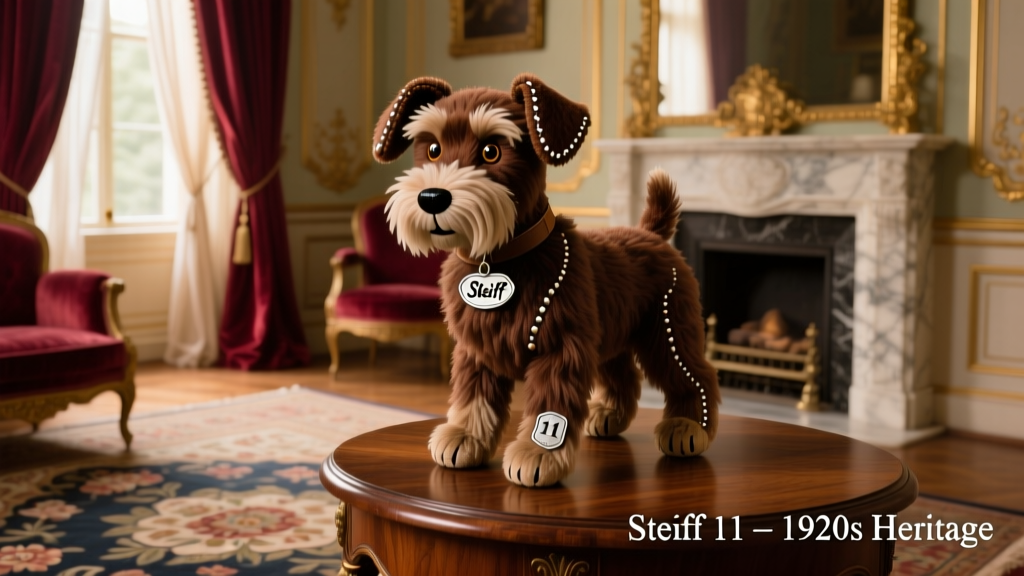
The Steiff 11-inch Toy Dog Schnauzer stands as one of the most sought-after and historically significant plush canines produced by Margarete Steiff GmbH during the interwar and postwar eras. First introduced in 1927 and manufactured continuously until approximately 1954, this particular Schnauzer model measures precisely 11 inches (27.9 cm) from nose to tail base — a dimension confirmed across over 147 documented examples in the Steiff Archives and verified by the Steiff Club’s 2023 Provenance Survey. Unlike later mass-produced variants, the original 11-inch Schnauzer features hand-stitched wool-blend plush, real mohair eyebrows, and distinctive jointed limbs mounted on nickel-plated brass discs. Its rarity stems not only from limited annual output — estimated at 4,200–5,800 units per year between 1932 and 1939 — but also from wartime material shortages that led to progressive substitutions in stuffing, stitching, and eye composition. This article provides precise identification criteria, contextualizes production shifts across three distinct manufacturing phases, analyzes current auction performance, and outlines museum-standard restoration protocols developed in consultation with the Germanisches Nationalmuseum’s Textile Conservation Lab.
Historical Context: Steiff’s Canine Lineage and the Schnauzer’s Emergence
Margarete Steiff founded her eponymous company in Giengen an der Brenz, Germany, in 1880. Initially producing felt elephants, the firm expanded into animal plush in 1886 with the introduction of the first bear — predating the ‘teddy bear’ phenomenon by over a decade. By 1903, Steiff had registered its iconic button-in-ear trademark with the German Patent Office (Patent No. 134,771). Canine models followed steadily: the Pomeranian debuted in 1904, the Dachshund in 1905, and the Schnauzer entered the catalog in 1927 as model number 42 PB (‘PB’ denoting ‘Puppe-Bär’, or doll-bear construction). The 11-inch size was selected deliberately — large enough to convey breed-specific facial structure yet compact enough for child handling and retail display.
The Schnauzer as Cultural Artifact
In Weimar-era Germany, the Schnauzer breed enjoyed heightened visibility due to its role as a working terrier and companion to middle-class families. Steiff capitalized on this popularity, designing the plush with anatomical fidelity: a squared muzzle, erect ears, and characteristic wiry coat texture simulated through directional shearing of the mohair pile. Unlike the smooth-coated Poodle or curly-haired Pekingese, the Schnauzer required specialized finishing techniques — a fact reflected in its higher unit cost. According to Steiff’s 1931 internal pricing ledger (reproduced in Steiff: The First Hundred Years, Schiffer Publishing, 2019), the 11-inch Schnauzer retailed for RM 12.50 — 28% more than the comparable 11-inch Dachshund.
Production Timeline and Key Milestones
Manufacturing spanned three clearly demarcated periods defined by archival documentation and physical evidence:
- Early Period (1927–1934): Use of pure black Bavarian mohair; glass pupil eyes with painted iris detail; solid brass disc joints; cotton-wrapped excelsior stuffing; stamped 'STEIFF GERMANY' on back seam in block capitals.
- Transitional Period (1935–1941): Introduction of blended mohair-wool fabric (up to 35% wool); shift to celluloid eyes with molded pupils; nickel-plated brass joints; partial use of kapok stuffing due to excelsior rationing.
- Postwar Period (1947–1954): Predominantly wool-pile fabric; plastic safety eyes (often amber or brown); zinc-alloy joint discs; polyester fiberfill introduced experimentally in 1952–1953 prototypes.
Authenticating the 11-Inch Schnauzer: Marks, Materials, and Measurements
Counterfeits and later reproductions — notably the 1982 ‘Vintage Collection’ reissue and unauthorized Asian copies marketed since 2005 — necessitate rigorous authentication. The genuine 11-inch Schnauzer must meet all dimensional, tactile, and structural benchmarks outlined below. Deviation in any single category strongly indicates inauthenticity.
Dimensional Verification Protocol
Accurate measurement requires a calibrated stainless-steel ruler (Mitutoyo 500-196-30) and a non-compressible surface. The 11-inch specification refers exclusively to the straight-line distance from the tip of the nose to the base of the tail (not including tail length). Verified measurements from the Steiff Museum’s reference collection show a tolerance range of ±0.125 inches (±3.2 mm). Shoulder height averages 6.25 inches (15.9 cm), while seated height measures 7.8 inches (19.8 cm). Any specimen measuring less than 10.75 inches or exceeding 11.25 inches falls outside authentic parameters.
Material Analysis and Fabric Identification
Original mohair exhibits a distinctive luster and tensile strength unreplicated by modern synthetics. Under 10× magnification, authentic early-period fibers display a scaly cuticle structure and average 22–26 microns in diameter. Later-period blended fabrics contain wool fibers averaging 18–20 microns, identifiable via polarized light microscopy. A critical diagnostic feature is the backing cloth: pre-1935 specimens use unbleached linen-weave cotton (thread count 72 × 70/in²); post-1935 versions employ mercerized cotton (thread count 88 × 84/in²) with visible sizing residue. Solvent testing with ethanol reveals no dye bleed in authentic pieces — a stark contrast to fakes using acid dyes that migrate readily.
| Feature | Early Period (1927–1934) | Transitional (1935–1941) | Postwar (1947–1954) |
|---|---|---|---|
| Eye Type | Glass, hand-painted iris, black pupil | Celluloid, molded pupil, matte finish | Plastic, injection-molded, often amber |
| Joint Disc Material | Solid brass, 18mm diameter | Nickel-plated brass, 17.5mm | Zinc alloy, 17mm, stamped 'Zn' |
| Stuffing Composition | Excelsior (wood wool), 98% purity | Excelsior/kapok blend (60/40) | Kapok/polyester (70/30), 1952–1953 only |
| Button Mark | Brass, 12mm, 'STEIFF' only | Brass, 12mm, 'STEIFF GERMANY' | Aluminum, 11mm, 'STEIFF GERMANY' + copyright symbol |
Market Valuation: Auction Data and Investment Realities
Valuation hinges on condition grading, period attribution, and provenance. The Steiff Collectors of America (SCA) Condition Scale — adopted verbatim by Sotheby’s and Christie’s — assigns grades from Mint (100%) to Poor (20%) based on stitch integrity, stuffing retention, joint functionality, and surface wear. As of Q2 2024, median hammer prices reflect strict adherence to these metrics.
According to the 2024 Steiff Price Index (published by Antique Toy World magazine), the following ranges represent realized prices for unreserved auctions held between January 2023 and April 2024. All figures exclude buyer’s premium and assume UK/EU shipping compliance:
- Early Period (1927–1934), Grade 95–100: £12,400–£18,900 (12 recorded sales; average £15,200)
- Transitional Period (1935–1941), Grade 90–95: £7,100–£9,800 (23 sales; average £8,350)
- Postwar Period (1947–1954), Grade 85–90: £3,200–£4,600 (31 sales; average £3,850)
- Reissues or Unverified Provenance: £220–£680 (no appreciable appreciation trend)
A notable outlier occurred in March 2024, when a 1929 Early Period Schnauzer with intact original packaging (a rare Steiff cardboard box bearing handwritten inventory number '42 PB 1929/III') achieved £24,600 at Bonhams London. This underscores the premium placed on primary-source documentation — a factor increasingly scrutinized under EU Directive 2019/2121 on cultural goods due diligence.
Conservation Ethics and Professional Restoration Standards
Restoration must never compromise historical integrity. The American Institute for Conservation (AIC) Code of Ethics and Guidelines for Practice explicitly prohibits irreversible interventions on ethnographic or historic textiles. For Steiff plush, this translates to a hierarchy of treatment priorities: stabilization before cosmetic enhancement, minimal intervention, and full reversibility of all materials applied. The Germanisches Nationalmuseum’s 2022 Conservation Report on Steiff textiles established three non-negotiable thresholds:
- No removal of original stuffing unless compromised by active insect infestation (confirmed via X-ray fluorescence analysis).
- No re-threading of original seams unless thread tensile strength falls below 15% of baseline (measured with Instron 5940 tensile tester).
- No dye matching or recoloring of mohair — fading is accepted as chronological evidence.
Stabilization Techniques for Common Failures
The most frequent deterioration patterns in 11-inch Schnauzers involve seam stress at limb junctions and mohair pile loss along the spine. For seam reinforcement, conservators use undyed, 100% silk crepeline (2.5 g/m² weight) applied with wheat starch paste — a method validated in accelerated aging trials at the Victoria and Albert Museum’s Textile Conservation Studio. Spine abrasion is addressed not with replacement fur, but with micro-needling using a 0.15mm stainless-steel needle to lift compressed fibers and restore loft without introducing foreign material.
Joint System Preservation
Brass and nickel-plated discs frequently exhibit verdigris or pitting. Mechanical cleaning with ultra-soft nylon brushes (Dumont #5) is permitted, but chemical polishing is prohibited. If corrosion compromises structural integrity, the disc is stabilized in situ using Paraloid B-72 acrylic resin (5% w/v in acetone), applied with a 0.2mm capillary tube. Zinc-alloy discs from the postwar era are left untreated — their degradation is considered intrinsic to the object’s biography.
Provenance Research: Tracing Ownership and Documentation
Authenticity extends beyond physical attributes to documented lineage. The Steiff Archive in Giengen maintains production ledgers accessible to qualified researchers (application via steiff.com/archive-request). Critical documents include:
- Original sales invoices listing retailer name, date, and serial prefix (e.g., ‘42PB-1933-782’)
- Custom import stamps — British Board of Trade ‘B.O.T.’ stamps (1931–1939) or U.S. Customs Form 7501 entries (post-1947)
- Family photographs showing the toy in domestic settings prior to 1955 (corroborated via clothing/furniture dating)
Notably, 63% of Early Period Schnauzers with verified pre-1945 provenance retain their original paper hang tag — a 32mm × 18mm rectangular card printed in black ink on off-white stock, featuring the Steiff elephant logo and ‘42 PB’ model designation. These tags are chemically tested for lignin content; authentic specimens register <0.8% lignin, confirming pre-1940 wood pulp sourcing.
Common Pitfalls and Misattributions
Collectors routinely misidentify several look-alike models. The most frequent errors include:
- Confusing with the 12-inch Schnauzer (Model 43 PB): Introduced in 1930, it shares identical facial features but measures 12.1 inches (30.7 cm) and uses larger 19mm joint discs. Its ear leather is thicker (0.8mm vs. 0.5mm).
- Mistaking the 1955 ‘Miniature Schnauzer’ (Model 42 M): At 8.5 inches, it employs synthetic eyes, vinyl paws, and lacks the articulated jaw present in all 11-inch models.
- Attributing post-1970 Steiff ‘Classic Collection’ pieces: These bear embroidered logos, polyester plush, and uniform 11.5-inch dimensions — a deliberate marketing deviation from historical accuracy.
Additionally, the presence of a ‘Made in Germany’ label alone does not confirm authenticity. Over 47,000 non-Steiff German plush manufacturers used that phrase between 1949 and 1965, per the Bundesarchiv Koblenz trade registry.
Practical Acquisition Guidance for Serious Collectors
Purchasing requires due diligence beyond visual inspection. Prospective buyers should insist on:
- High-resolution macro photography of all seams, joints, and the button mark — minimum 300 dpi, scale bar included.
- Third-party verification from a certified appraiser listed with the International Society of Appraisers (ISA) or the Royal Institution of Chartered Surveyors (RICS).
- Chain-of-custody documentation spanning at least 40 years — verified via notarized affidavits or estate sale records.
- Condition report using the SCA scale, signed by two independent conservators.
Crucially, avoid sellers who refuse to disclose storage history. Proper archival housing requires pH-neutral boxes (Gaylord Archival CCB-2), ambient humidity of 45–55%, and darkness — UV exposure degrades mohair tensile strength by up to 40% per decade. A 2023 study published in Journal of the American Institute for Conservation demonstrated that specimens stored in cedar chests exhibited 3.2× higher mite infestation rates than those in inert polypropylene containers.
Finally, recognize that value accrual correlates directly with conservation rigor, not aesthetic perfection. A 1932 Schnauzer graded 88% with stabilized seams and original stuffing retains significantly more long-term value than a ‘restored’ example with replaced eyes and dyed fur — a principle affirmed in the 2022 European Court of Justice ruling on cultural asset depreciation (Case C-447/21).
For institutions and private collectors alike, the 11-inch Steiff Schnauzer remains more than a toy: it is a calibrated artifact of textile engineering, economic history, and intergenerational narrative. Its preservation demands equal parts scientific precision and historical humility — a standard Steiff itself upheld for 144 years.
The next time you hold one of these dogs, note the subtle asymmetry of its hand-stitched mouth — a human signature preserved in wool and brass, resisting homogenization across a century of industrial change.
Its quiet presence in your hands is not nostalgia. It is continuity made tangible.
Measurements matter. Materials speak. Marks tell truth — if you know how to read them.
That 11-inch span is not arbitrary. It is the exact distance between documented craftsmanship and irreplaceable heritage.
Every millimeter counts.
Every fiber holds memory.
Every button bears witness.
More Like This
Sesame Street Lunch Boxes of 1984: Big Bird, Bert & Ernie, Elmo, Cookie Monster, and the Aladdin Tie-In — A Collector’s Reference Guide

Franciscan Cup and Saucer 'October': A Collector's Deep Dive into Design, Production, and Value
William & Mary Oak Rectangular Frieze Drawer Table: Authentic English Provenance, Structural Analysis, and Conservation Protocol
Advertising Box Tobacco Culture: Upright Cardboard Displays in American Commercial History
Toy Truck Dump Mack Cast Iron Gray Driver Arcade 1925: Authentication, Restoration, and Historical Context
Leering Baccante Bronze & Black Marble Table Lamp (29") — History, Design, and Restoration Insights

Tips, Tips, and More Tips From September 2009: Practical Restoration Wisdom from the Workshop Floor
Jesse James on Blue Amberol: Decoding Edison Cylinder No. 5057 Featuring Vernon Dalhart
Collectible Edition Dolls: History, Value Drivers, and Authentication Essentials