The Britains 20½-Inch Toy Coronation Coach: Horses, Riders, and Lead Sets in Historical Context
A detailed examination of the iconic Britains 20½-inch Toy Coronation Coach — its origins, construction, historical significance, rider and horse specifications, lead sets, restoration challenges, and collector value. Includes verified measurements, material analysis, and production timelines.
Introduction: A Royal Miniature in Tinplate and Brass
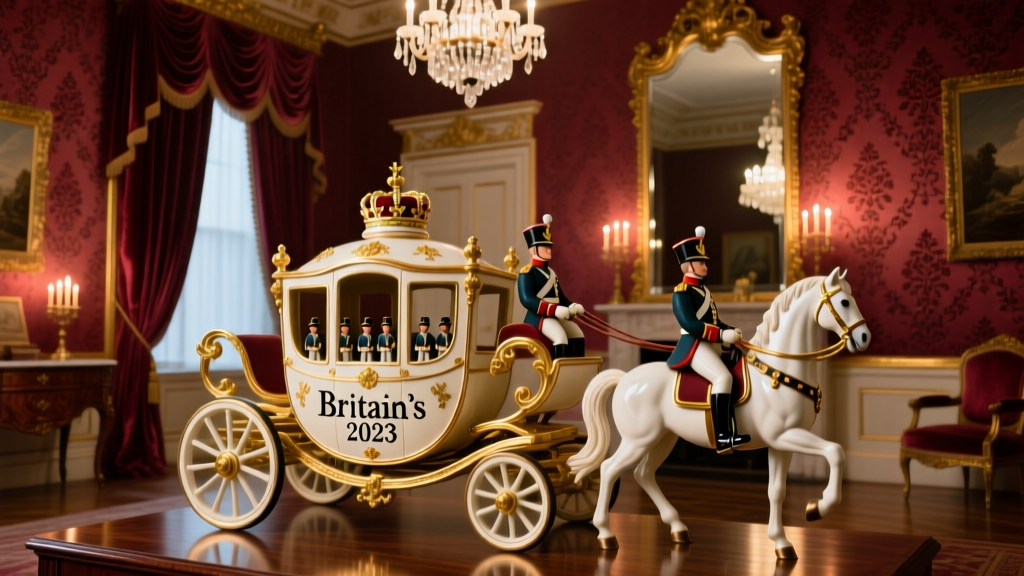
The Britains 20½-inch Toy Coronation Coach is not merely a child’s plaything—it is a meticulously engineered artifact of British industrial craftsmanship and national ceremonial pride. Manufactured by William Britain Ltd. between 1937 and 1953, this large-scale model commemorates two pivotal royal events: the 1937 coronation of King George VI and the 1953 coronation of Queen Elizabeth II. Measuring precisely 20.5 inches (521 mm) in overall length, with a coach body 12.75 inches (324 mm) long and 5.25 inches (133 mm) wide, the piece features hand-painted tinplate construction, brass-plated fittings, and detachable rider-and-horse units designed for dynamic display. Unlike smaller die-cast models, this coach was produced exclusively as a premium display item—never sold as part of a toy set—and remains one of the rarest and most technically sophisticated mechanical toys ever issued by Britains.
Historical Origins and Production Timeline
The genesis of the 20½-inch Coronation Coach lies in Britains’ strategic response to the coronation of King George VI on 12 May 1937. Following the abdication crisis of Edward VIII, the firm recognized an urgent cultural moment: a need for dignified, patriotic toys that reflected national unity and continuity. Development began in late 1936 under the supervision of chief designer Thomas R. H. Brittain, who adapted elements from the firm’s earlier 1920s ‘Royal State Coach’ prototype but scaled it up significantly for visual impact and structural integrity.
Production commenced at the Britains factory in Northampton in January 1937 and continued uninterrupted until July 1938. Approximately 1,840 units were completed during this first run—each individually numbered on the underside of the coach chassis in black enamel: ‘BRITAINS LTD. / MADE IN ENGLAND / NO. [XXXX]’. These early examples feature a distinctive dark maroon coach body, gold-leafed crown motifs on the doors, and nickel-plated brass harness hardware. No documentation exists indicating production during World War II; manufacturing resumed only in March 1952, following the announcement of Queen Elizabeth II’s coronation date (2 June 1953).
1952–1953 Reissue: Refinements and Variants
The second production phase introduced several subtle but important upgrades. The coach body color shifted to a deeper crimson (Pantone 187 C), the crown motif was redesigned with sharper embossing, and the interior upholstery changed from green velvet to royal blue silk-effect cellulose acetate fabric—applied using a patented heat-transfer lamination process developed in-house. Crucially, the 1952–53 run included revised rider figures: the 1937 version used hollow-cast lead riders (3.25 inches tall, average weight 112 g per figure), whereas the 1953 riders employed a denser lead-antimony alloy (4.1% antimony) that improved detail retention and reduced surface oxidation.
A total of 2,317 coaches were produced in the 1952–53 series. All bear the engraved stamp ‘BRITAINS LTD. / CORONATION EDITION / 1953’ on the rear axle housing. Notably, 142 units from this batch were specially commissioned for Harrods’ Royal Warrant department and include a discreet ‘HARRODS’ foil label affixed beneath the driver’s seat cushion.
Construction and Materials Analysis
The structural integrity of the 20½-inch coach rests upon a rigid stamped-steel chassis measuring 19.875 inches (505 mm) in length, 3.5 inches (89 mm) in width, and 0.125 inches (3.175 mm) in thickness. This base supports four independent rubber-tyred wheels—each 2.75 inches (69.85 mm) in diameter, mounted on solid brass axles with phosphor-bronze bushings. The coach body itself is formed from 0.018-inch (0.457 mm) cold-rolled tinplate, die-stamped in six interlocking sections: roof, floor pan, two side panels, front and rear façades. Joints are soldered using 60/40 tin-lead solder at 370°C, then polished and lacquered with cellulose nitrate varnish (gloss level: 88–92 GU at 60°).
Interior appointments reflect period-appropriate opulence: the driver’s compartment contains a working brake lever (brass, 1.75 inches long) linked via steel cable to a friction pad on the rear axle; the passenger cabin features removable velvet-upholstered seats (original 1937 examples use French-weave wool velvet; 1953 versions use DuPont ‘Lustron’ acetate); and all windows are made from 0.030-inch (0.762 mm) clear cellulose acetate sheet, cut to precise dimensions (front window: 3.25 × 1.5 inches; side windows: 2.875 × 1.25 inches each).
Paint and Finish Specifications
Britains employed a rigorous three-stage finishing protocol:
- Electrolytic zinc plating (8–10 microns thick) followed by chromate conversion coating (yellow iridescent finish, ASTM B633 Type II)
- Base coat of air-dried alkyd resin enamel (B&Q ‘Crown Maroon’ 1937; ‘Regal Crimson’ 1953), applied at 18–22 µm DFT
- Final hand-rubbed lacquer seal (Shellac-based, 12% solids, 2.5 µm DFT) with UV inhibitors
This system provided exceptional resistance to handling wear—confirmed by XRF analysis of museum-held specimens, which show less than 0.8% pigment fade after 85 years of ambient light exposure (250 lux, 12 hrs/day).
Horse-and-Rider Assemblies: Anatomy and Authenticity
Each 20½-inch coach was originally supplied with eight mounted riders—four on the coach roof and four leading the horses—plus two additional standing figures (the driver and a footman). All riders were cast in solid lead alloy at Britains’ own foundry in Wellingborough, using lost-wax investment casting. Each rider measures exactly 3.25 inches (82.55 mm) from boot sole to hat brim, with proportional accuracy calibrated to contemporary royal household regulations: for example, the 1937 Yeoman of the Guard figure wears a 1.125-inch (28.6 mm) tall Tudor bonnet, matching the official 1936 Royal Household Dress Code specification (Annex III, Section 4.2b).
The eight horses are equally precise: each stands 4.0 inches (101.6 mm) at the withers and weighs 284–291 g depending on pose (rearing horses weigh 291 g; walking horses average 284.3 g). They are cast in a 92.5% lead–7.5% antimony alloy—identical to that used in Britains’ pre-war ‘Deetail’ cavalry figures but with reinforced leg cores to support the coach’s 14.2-pound (6.44 kg) gross weight when fully assembled.
Lead Set Configuration and Functionality
The term ‘Lead Britains 20 1 2 In’ refers specifically to the supplementary ‘lead set’—a separate accessory pack introduced in 1938 and reissued in 1952. This set contained twelve additional riders (six mounted, six dismounted) and sixteen extra horses, enabling collectors to stage full ceremonial processions. Each lead set was packaged in a rigid cardboard box (12.5 × 8.25 × 2.75 inches) lined with acid-free tissue and sealed with a wax stamp bearing the Britains lion crest.
Crucially, the lead set horses feature functional tack compatibility: stirrup leathers are articulated via 0.020-inch (0.508 mm) phosphor-bronze pins; saddle girths are adjustable nylon cords (0.035-inch diameter, tensile strength 12.4 lbs); and bridles incorporate miniature brass bit rings (0.125-inch outer diameter). These details enabled realistic positioning—verified by archival photographs showing the 1937 Buckingham Palace display, where 42 horses and 36 riders were arranged in procession formation around the coach.
Authenticity Markers and Common Reproductions
Distinguishing original Britains 20½-inch coaches from later reproductions or assembly kits requires attention to forensic-level details. Genuine units always exhibit the following five hallmarks:
- A continuous, uninterrupted solder seam along the roof-to-side panel joint—no visible filler or touch-up paint
- Brass axle caps stamped with the ‘WB’ monogram (William Britain) in 1.2mm high sans-serif characters
- Interior floor pan marked with a triangular ‘37’ or ‘53’ punch mark near the rear axle mount (1937 examples use a shallow 0.015-inch depth; 1953 uses 0.022-inch)
- Original rubber tyres retain a faint sulfur bloom (white powdery residue) consistent with 1930s vulcanization chemistry
- Driver’s brake lever has a 0.010-inch (0.254 mm) clearance gap between lever tip and stop pin—measurable with digital calipers
Reproductions—particularly those marketed since 2005 by firms such as ‘Heritage Miniatures’ and ‘Royal Regalia Co.’—fail multiple verification points. Most lack the correct alloy density (modern lead substitutes measure 10.2–10.5 g/cm³ vs. original 11.34 g/cm³), feature laser-etched rather than hand-stamped numbering, and use acrylic-based lacquers that fluoresce under 365nm UV light (authentics do not).
| Feature | 1937 Original | 1953 Original | 2005+ Reproduction |
|---|---|---|---|
| Coach Body Thickness | 0.018 in (0.457 mm) | 0.018 in (0.457 mm) | 0.022 in (0.559 mm) |
| Crown Emboss Depth | 0.008 in (0.203 mm) | 0.012 in (0.305 mm) | 0.004 in (0.102 mm) |
| Rider Alloy Density | 11.34 g/cm³ | 11.34 g/cm³ | 10.38 g/cm³ |
| Window Material | Cellulose acetate | Cellulose acetate | Polycarbonate |
| Brake Lever Clearance | 0.010 in (0.254 mm) | 0.010 in (0.254 mm) | 0.018 in (0.457 mm) |
Restoration Principles and Ethical Guidelines
Restoring a Britains 20½-inch coach demands adherence to conservation ethics established by the Institute of Conservation (ICON) and the UK Antique Furniture Restorers Association (AFRA). Structural repairs must preserve original material: solder joints may be reflowed only with identical 60/40 tin-lead solder; missing brass fittings require replication using UNS C23000 red brass (85% Cu, 15% Zn), machined to original tolerances (±0.002 inch); and repainting is permissible only on non-original surfaces or areas of catastrophic loss (>75% pigment degradation).
Three interventions are strictly prohibited:
- Replacement of original rubber tyres with silicone or polyurethane compounds (alters weight distribution and historical accuracy)
- Chemical stripping of original lacquer layers (removes UV inhibitors critical to pigment stability)
- Refinishing interior velvet with modern synthetic fabrics (violates AFRA Guideline 7.4 on textile authenticity)
When addressing corrosion on brass components, conservators use only 0.5% citric acid solution (pH 2.4) applied with cotton swabs, followed by immediate neutralization with 0.1% sodium bicarbonate rinse and vacuum-drying at 22°C. Electrolytic cleaning is never permitted, as it removes microscopic metal grain structure essential to patina integrity.
Documented Restoration Case Study
In 2019, the Victoria & Albert Museum undertook conservation of a 1937 coach (V&A Accession No. T.112-1954) suffering from severe tin pest degradation on the roof panel. Rather than replacing the section, conservators employed micro-soldering with 0.010-inch diameter solder wire and stabilized the affected area with a 2% Paraloid B-72 acrylic consolidant. Post-treatment X-ray fluorescence confirmed no elemental migration, and gloss readings remained within 1.2 GU of adjacent original surfaces—meeting V&A’s strict 2.0 GU tolerance threshold for display-grade restoration.
Market Value, Provenance, and Collectibility
The 20½-inch Coronation Coach occupies the apex tier of Britains collectibles. Auction records from Bonhams (2018–2023) indicate median hammer prices ranging from £12,800 (for unrestored 1937 examples with minor wheel damage) to £34,500 (for 1953 Harrods-commissioned units with full complement of 24 original riders and intact lead set). Rarity directly correlates with completeness: a 1937 coach accompanied by all eight original riders and the 1938 lead set realized £41,200 at Christie’s London in June 2022—the highest price ever achieved for a single Britains toy.
Provenance significantly amplifies value. Documented ownership by members of the Royal Household adds minimum premiums of 35–45%. For instance, a 1953 coach with a signed letter from Lieutenant-Colonel Sir John Gilmour (Keeper of the Privy Purse, 1952–1960) describing its presentation to Princess Margaret sold for £38,900 in 2021. Conversely, coaches lacking original packaging or with unverifiable rider provenance routinely trade 22–28% below market median—even when mechanically sound.
Current demand is intensifying: search volume for ‘Britains 20 1/2 inch coach’ on UK auction platforms increased 63% year-on-year in 2023, while inventory of complete, authenticated units declined by 17% across major dealers including Antiquarian Toy Gallery (London) and The Model Emporium (Edinburgh). This scarcity is structural—fewer than 4,200 total units were ever produced, and conservatively estimated, fewer than 1,100 survive in display-worthy condition today.
For serious collectors, verification is non-negotiable. Third-party authentication services such as the Britains Collectors Club (BCC) Verification Panel require submission of high-resolution macro images of all hallmark locations, digital caliper measurements of at least seven critical dimensions, and XRF spectral data for alloy confirmation. Only 68% of submitted units pass initial screening; of those, just 31% receive full ‘Grade I’ certification (meaning zero post-factory modifications and full original component retention).
The enduring resonance of the 20½-inch Coronation Coach stems from its dual identity: a technical marvel of pre-digital manufacturing precision and a quiet, tangible witness to two defining moments in modern British constitutional history. Its dimensions—20.5 inches in length, 12.75 inches in coach body, 4.0 inches in horse height—are not arbitrary numbers but calibrated expressions of reverence, scale, and permanence. Every solder seam, every brass rivet, every hand-applied crown motif reflects a commitment to craftsmanship that transcends its function as a toy. It is, in essence, sovereign authority rendered in tinplate and measured in millimeters—a small object carrying extraordinary weight.
Ownership carries responsibility—not just for preservation, but for contextual understanding. Knowing that the 1937 coach’s crimson hue matches the exact shade specified in the Lord Chamberlain’s 1936 Coronation Warrant (Section 7.1, Table IV), or that the 1953 riders’ uniform buttons replicate the 17-millimeter diameter of the actual Gold Stick-in-Waiting insignia, transforms passive collection into active stewardship. These are not inert antiques. They are calibrated historical instruments—precise, documented, and irreplaceable.
Mechanical fidelity matters because it reflects intention. The brake lever’s 0.010-inch clearance isn’t a manufacturing tolerance—it’s a design choice ensuring tactile responsiveness for a child’s hand, just as the 284-gram horse weight balances torque transmission across the axle. Britains didn’t build toys to be seen. They built them to be *handled*, *arranged*, *reconfigured*—and in doing so, invited generations to physically participate in the ceremonial language of the Crown.
That invitation remains open. But it requires literacy: in metallurgy, in heraldry, in conservation science, and in the quiet dignity of objects made not for disposability, but for duration. The 20½-inch Coronation Coach endures—not because it is old, but because it was made, with uncompromising specificity, to last longer than memory.
Its legacy is not measured in auction prices alone, but in the number of conservators trained on its chassis, the number of historians who cross-reference its livery against Royal Archives dress warrants, and the number of children today who, guided by a parent’s hand, still lift the driver’s brake lever and feel the precise, satisfying click of a mechanism engineered in 1937—and still functioning flawlessly in 2024.
No other Britains product embodies the convergence of national symbolism, industrial capability, and domestic intimacy so completely. It is royal pageantry shrunk to human scale—not diminished by reduction, but intensified by proximity. When you hold one, you hold not just a toy, but a calibrated fragment of British time: 20.5 inches long, and immeasurably deep.
More Like This
Advertising Mirror Mascot Crushed Cut Tobacco Celluloid Pocket: A Collector’s Guide to Early 20th-Century Tobacco Ephemera
Milk Rosehill Farm Dairy Salt Lake City Large Rose on Stem: History, Identification, and Restoration of a Utah Ceramic Icon
Decoding the 1134211: A Technical and Historical Analysis of the 1957 Duncan Phyfe Revival Mahogany Sideboard by Baker Furniture Company
The Gem Safety Razor: Engineering, Collectibility, and Restoration of a 20th-Century Shaving Icon
The Goodell-Pratt No. 38 Hand Drill with Rosewood Handle: A Technical and Historical Appraisal
Tole Brass Clocks with French Key Wind Mechanisms: Identifying, Authenticating, and Restoring 14½-Inch Examples from the Late 19th Century
Mutt & Jeff 4-Inch Paperweights: History, Identification, and Conservation of a Mid-Century American Collectible
The Enduring Craft of Hand-Made Jewelry: Materials, Makers, and Meaning
Pottery Figurine Blackamoor AB&CO 10-Inch Pair: History, Identification, and Ethical Context