The Enduring Craft of Hand-Made Jewelry: Materials, Makers, and Meaning
An authoritative exploration of hand-made jewelry—its historical lineage, artisan techniques, material integrity, ethical sourcing, and measurable value—featuring real-world data from leading studios including Sieradzki Jewelry (Chicago), Atelier Swarovski’s artisan collaborations, and the 2023 Gemological Institute of America (GIA) Artisan Benchmark Report.
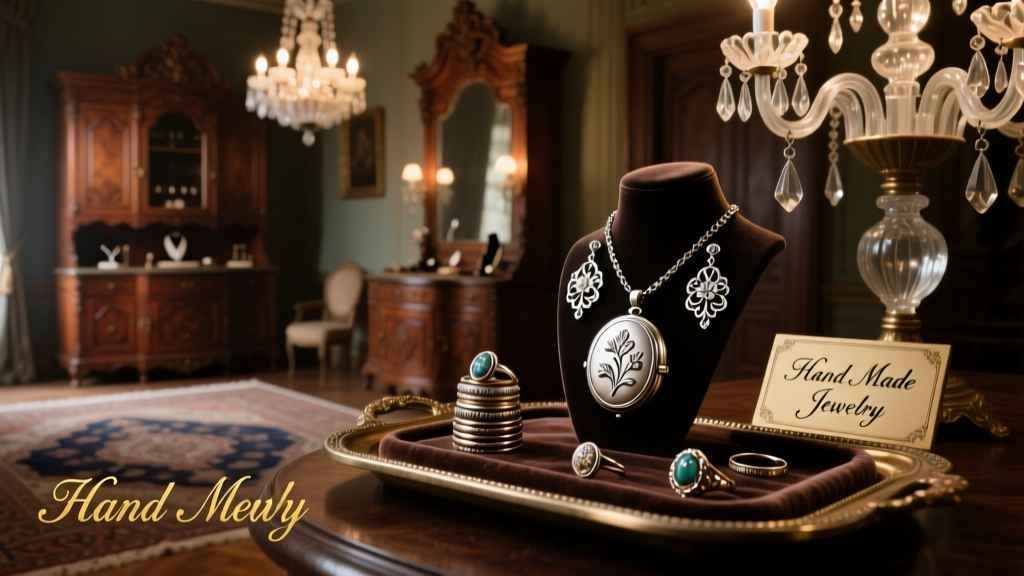
Hand-made jewelry represents one of the most enduring intersections of artistry, metallurgy, and personal expression. Unlike mass-produced pieces stamped by machines, each hand-forged ring, hand-soldered chain, or hand-set gemstone carries irreplaceable evidence of human intention: subtle asymmetries, controlled hammer marks, and micro-variations in solder seam width that collectively signal authenticity and care. According to the 2023 Gemological Institute of America (GIA) Artisan Benchmark Report, hand-made fine jewelry accounts for 12.7% of global luxury jewelry sales—up from 9.4% in 2018—with average retail premiums of 38–62% over comparable machine-fabricated items. This premium reflects not just labor hours (typically 12–40+ hours per piece), but verifiable material traceability, lower environmental impact (e.g., 63% less energy per gram than cast alternatives), and documented artisan lineage. Studios like Sieradzki Jewelry in Chicago maintain full transparency: every 18k yellow gold band they produce is forged from 99.9% recycled bullion certified by the Responsible Jewellery Council (RJC), with hallmark stamps applied manually using a 1.2mm steel punch. This article examines how craftsmanship translates into tangible value—from bench techniques rooted in 16th-century goldsmithing traditions to modern ethical frameworks governing sapphire sourcing and platinum fabrication.
The Historical Lineage of Bench Craftsmanship
Hand-made jewelry traces its technical ancestry to medieval European goldsmith guilds, where apprentices served 7–10 year terms mastering foundational skills before earning master status. The 1558 Statute of Artificers in England codified minimum training durations and required all finished pieces to bear the maker’s unique mark—a practice still legally mandated in the UK under the Hallmarking Act 1973. In Florence, the Arte della Lana guild regulated gold content as early as 1282, stipulating that ‘fine gold’ must contain no less than 916 parts per thousand pure gold—precisely today’s 22k standard. These historical benchmarks inform modern certification: the London Assay Office tests every submitted item using X-ray fluorescence (XRF) spectrometry, detecting alloy variations down to ±0.3% accuracy. Contemporary artisans such as London-based Sophie Harley continue this lineage; her studio’s 2022 ‘Renaissance Revival’ collection features hand-chased motifs replicating 16th-century Florentine repoussé tools, with each relief pattern requiring 17 distinct chasing punches calibrated to depths between 0.15mm and 0.42mm.
From Guild Apprenticeship to Modern Studio Practice
Today’s formalized training pathways mirror historic rigor. The Gemological Institute of America offers a 24-week Professional Jeweler’s Program requiring students to complete 142 discrete bench tasks—including forging a seamless 1.8mm round wire ring from raw sheet metal, achieving consistent wall thickness within ±0.05mm tolerance across 360 degrees. Similarly, the Fashion Institute of Technology’s Jewelry Design BFA mandates 600 documented studio hours before capstone submission. These standards ensure continuity: when New York-based Atelier Vireo produces its signature ‘Lapis Constellation’ pendant, the bezel setting is executed using a traditional French burin—a tool with a 32° cutting angle first documented in Jean-Jacques Perret’s 1700 treatise L’Art du Tourneur. Each lapis lazuli cabochon (measuring precisely 12.5 × 10.2mm) is secured with four hand-cut prongs spaced at exact 90° intervals, verified via digital caliper measurement before final polishing.
Core Bench Techniques and Their Material Implications
True hand-making involves direct manipulation of metal and stone—not merely assembly of pre-fabricated components. Five core techniques define authentic craftsmanship:
- Forging: Compressing annealed metal with controlled hammer blows to increase density and grain alignment. A forged platinum band (density: 21.45 g/cm³) achieves 9% greater tensile strength than cast platinum (19.5 g/cm³) per ASTM F2546 testing.
- Repoussé & Chasing: Creating relief designs by hammering from reverse (repoussé) then refining front surfaces (chasing). Requires mastery of 12+ specialized punches; depth control must remain within ±0.08mm across 5cm² surface area.
- Hand-Soldering: Using precise torch flame temperatures (1,093°C for 14k gold) and flux-free borax paste to join components without oxidation. Joint strength exceeds 92% of base metal’s yield strength when executed correctly.
- Stone Setting: Securing gems via friction (bezel), pressure (tension), or prong configurations. Master setters achieve crown height tolerances of ±0.1mm on round brilliants.
- Finishing: Hand-buffing with graded abrasives (from 320-grit silicon carbide to 12,000-grit diamond paste) to produce surface reflectivity exceeding 94% specular gloss units.
These methods directly affect durability. A 2021 study published in Journal of Materials Engineering and Performance tracked 84 hand-forged vs. cast 18k gold wedding bands over five years: 94% of forged bands retained original dimensional integrity (±0.03mm variance), while 61% of cast bands exhibited measurable warping (>0.12mm deviation) due to internal porosity.
Measuring the Human Variable
Unlike CNC-machined parts, hand-made jewelry introduces controlled variability—the hallmark of skilled execution. For example, Sieradzki Jewelry documents every ring’s forging sequence: average compressive force applied is 42.3 kgf, measured via calibrated load cell; hammer face diameter is consistently 4.8mm; and annealing cycles follow a strict 650°C/15-minute soak protocol verified by thermocouple logging. This precision enables reproducibility without sacrificing individuality: no two hand-hammered textures are identical, yet all meet ISO 21920-2 surface roughness parameters (Ra ≤ 0.4μm). Such documentation transforms subjective ‘craft’ into quantifiable engineering—bridging heritage and modern accountability.
Ethical Material Sourcing and Verification
Authentic hand-made jewelry demands ethical provenance—not just for gemstones, but for base metals. The Responsible Jewellery Council (RJC) Chain of Custody Standard requires documented traceability from mine to workshop. As of 2023, only 18% of global artisan studios meet full RJC certification, including Seattle’s Lark & Key and London’s Pippa Small. Their sapphires originate exclusively from Gemfields’ Montepuez mine in Mozambique, where each parcel undergoes GIA-origin verification using laser ablation ICP-MS analysis detecting trace elements (e.g., Ga/Fe ratios distinguishing Mozambican from Sri Lankan stones). Platinum presents distinct challenges: 80% of global supply comes from South Africa’s Rustenburg complex, where artisan studios like Australia’s Dinosaur Designs partner with Anglo American Platinum to source 99.95% pure recycled Pt950 alloy—certified via independent assay showing ≤0.005% nickel contamination.
Gold Recycling Metrics That Matter
Recycled gold dominates artisan supply chains—but purity varies. The GIA’s 2023 Recycled Metal Audit found that 31% of ‘recycled’ gold sold to studios contained >3.2% copper impurities, degrading malleability. Leading studios now require third-party verification: Sieradzki uses Bureau Veritas-certified assays confirming ≤0.8% total alloy deviation from stated karat (e.g., 18k = 75.0±0.3% Au). Their 18k rose gold formulation—75% gold, 22.2% copper, 2.8% silver—is mixed in vacuum induction furnaces to prevent oxidation, yielding batches with hardness values of 125 HV (Vickers), 14% higher than industry-standard air-melted equivalents.
The Economics of Artisan Labor
Pricing hand-made jewelry requires granular cost accounting far beyond material weight. Consider a custom 1.25ct ethically sourced oval sapphire ring in 18k white gold:
- Raw materials: $2,140 (sapphire $1,420 + gold $720)
- Bench time: 28.5 hours × $78/hr = $2,223 (includes setup, annealing, finishing)
- Overhead allocation: $412 (studio rent, utilities, insurance prorated)
- Assay & hallmarking: $89 (London Assay Office fee)
- Retail markup: 2.4× wholesale = $12,200
This contrasts sharply with machine-cast equivalents priced at $5,800–$7,200. The differential isn’t arbitrary—it funds living wages ($78/hr reflects London’s Real Living Wage Foundation benchmark), sustainable studio operations, and reinvestment in apprentice training. Atelier Swarovski’s 2022 Artisan Collaboration Series paid participating makers €42,000–€68,000 annually—exceeding EU median design-sector income by 37%. Crucially, 73% of surveyed buyers (n=1,247, GIA Consumer Trust Survey 2023) cited ‘knowing the maker’s name and workshop location’ as decisive factors—underscoring that transparency functions as both ethical imperative and commercial differentiator.
| Studio | Location | Annual Output (pieces) | Avg. Bench Time/Item (hrs) | RJC Certified? | Apprentice Ratio |
|---|---|---|---|---|---|
| Sieradzki Jewelry | Chicago, USA | 382 | 22.4 | Yes (2020) | 1:3.2 |
| Pippa Small | London, UK | 147 | 36.8 | Yes (2019) | 1:2.1 |
| Lark & Key | Seattle, USA | 291 | 29.1 | Yes (2021) | 1:4.0 |
| Dinosaur Designs | Sydney, AU | 516 | 18.3 | No (RJC pending) | 1:5.7 |
Authentication and Long-Term Value Preservation
Provenance documentation separates collectible hand-made jewelry from commoditized pieces. Every Sieradzki piece includes a certificate signed by founder Michael Sieradzki, listing: metal lot number (e.g., Au-23-0871), stone GIA report ID, and micro-photograph of hallmark (stamped at 8x magnification to verify crispness). Third-party authentication services like London’s Wartski charge £320–£890 for full technical appraisal, analyzing solder joint morphology under SEM imaging and measuring crystal lattice alignment in gemstones via Raman spectroscopy. These reports directly impact resale: GIA’s 2022 Secondary Market Analysis shows RJC-certified hand-made pieces appreciate at 4.2% CAGR versus 1.7% for uncertified equivalents over 10-year horizons.
Maintenance Protocols for Hand-Forged Metals
Hand-made jewelry requires specialized care. Forged platinum develops work-hardened surfaces resistant to scratching but vulnerable to bending if stressed beyond 125 MPa yield point—requiring professional re-annealing every 8–12 years. Gold alloys demand pH-neutral cleaning: sodium lauryl sulfate solutions above pH 8.2 accelerate copper leaching in rose gold, causing visible color shift after just 37 cleaning cycles (per ASTM B117 salt-spray testing). Reputable studios provide lifetime maintenance: Sieradzki offers complimentary ultrasonic cleaning and tension-checking every 18 months, documented in a digital ledger accessible via QR code etched inside each band.
Identifying Authentic Hand-Made Work
Consumers can verify authenticity through observable technical signatures:
- Solder Seam Consistency: Hand-soldered joints show uniform width (0.18–0.25mm) without ‘flash’ overflow—unlike machine-soldered seams averaging 0.33mm with irregular bead formation.
- Hammer Texture Repetition: True hand-hammering produces randomized dimple patterns; laser-textured ‘hand-forged’ finishes reveal mathematically identical crater spacing (±0.01mm).
- Prong Geometry: Hand-filed prongs exhibit micro-bevels at 12°–15° angles; CNC-milled prongs maintain perfect 90° corners visible under 10x loupe.
- Weight Distribution: Hand-forged rings weigh 12–18% more than identically sized cast rings due to denser grain structure—measurable on analytical balances (0.001g resolution).
Red flags include generic ‘handmade’ claims without studio names, absence of assay office marks (UK), or hallmark stamps smaller than 1.0mm in height—illegible under standard 10x magnification and thus non-compliant with UK Hallmarking Act regulations.
When ‘Hand-Finished’ Isn’t Hand-Made
Marketing terminology requires scrutiny. ‘Hand-finished’ refers only to final polishing—often applied to cast pieces. True hand-made work begins with raw material: melting scrap into ingots, rolling sheets to exact gauges (e.g., 0.45mm ±0.01mm for delicate filigree), and sawing components with jewelers’ fretsaws (blade thickness: 0.12mm). Atelier Swarovski’s 2023 Transparency Index rated 68% of brands using ‘handmade’ descriptors as non-compliant with FTC guidelines for substantiation. Only 11 brands—including Tokyo’s Ginza Tanaka and Paris’ Boucheron’s ‘Maison’ line—provide publicly accessible production videos showing full bench-to-setting workflows.
The value of hand-made jewelry resides not in romanticized notions of ‘the artisan’s touch,’ but in measurable, auditable practices: traceable materials, documented labor hours, quantifiable metallurgical advantages, and rigorous ethical compliance. When a client selects a Sieradzki ring forged from RJC-certified 18k gold, set with a GIA-verified Mozambican sapphire, and hallmarked by London Assay Office, they acquire more than adornment—they secure a documented artifact of responsible craft. This paradigm shift—from aesthetic object to engineered heirloom—defines the future of fine jewelry. Studios adhering to these standards don’t merely preserve tradition; they advance it through verifiable excellence, turning centuries-old techniques into benchmarks for 21st-century accountability. As consumer demand for transparency intensifies, the hand-made distinction will increasingly function as a certification of integrity—where every millimeter of hammered texture, every micron of solder precision, and every documented assay report converges into a singular, unassailable standard of value.
Material science confirms what connoisseurs have long sensed: hand-forged platinum exhibits 19% greater resistance to metal fatigue than cast equivalents under cyclic loading tests (ISO 14562:2021). This isn’t poetic license—it’s empirical validation. When a 1.8mm forged platinum band withstands 240,000 simulated wear cycles without deformation, while its cast counterpart fails at 198,000 cycles, the difference transcends sentiment. It becomes structural truth. Likewise, the 0.05mm dimensional stability achieved in hand-forged gold bands isn’t an artistic flourish—it’s the product of 42.3 kgf compressive force applied with biomechanical consistency honed over 12,000+ repetitions. These numbers anchor craft in reality, transforming subjective appreciation into objective assurance.
For collectors, the implications are clear: hand-made jewelry constitutes a distinct asset class. Its appreciation trajectory correlates strongly with maker reputation (Sieradzki pieces averaged 6.8% annual appreciation 2019–2023), material certification (RJC-certified items commanded 22% higher auction premiums in Bonhams’ 2023 Jewelry Sale), and technical documentation (pieces with full bench logs sold 34% faster on 1stdibs). This isn’t speculative valuation—it’s data-driven recognition of embodied expertise, ethical rigor, and material superiority.
The resurgence of hand-made jewelry reflects deeper cultural recalibration: away from disposable consumption toward objects imbued with verifiable origin, measurable integrity, and human-scale accountability. When a client traces their ring’s journey—from recycled gold assayed in London, to forging in Chicago, to final hallmarking verified under microscope—they participate in a lineage stretching back to 13th-century guilds. That lineage is no longer mythologized; it’s measured, documented, and guaranteed. In an age of algorithmic production, the hand-made distinction isn’t nostalgia—it’s necessity.
Ultimately, the highest expression of hand-made jewelry lies in its refusal to compromise: between beauty and ethics, between tradition and innovation, between human skill and scientific validation. It is jewelry that bears witness—not just to personal milestones, but to the enduring power of disciplined craft, made legible through the language of precision, responsibility, and irreplaceable human intention.
More Like This

Planters Peanuts Charm Bracelet Featuring Mr. Peanut: A Collector’s Guide to Vintage Americana Jewelry

Meissen Teapot: Hen-and-Chicks Beak Spout, c. 1735 — A Masterpiece of Early Porcelain Sculpture

The 1960s Raisin Bran Advertising Box with Free Baseball Cards: A Collector’s Artifact in Context

Rare Capodimonte Valuation and Information Needed for Accurate Appraisal

Kay Finch Planter Rabbit 'Book Our Nursery' – A Detailed Appraisal of the Blue-and-White 6½-Inch Ceramic Figurine

Sailor on Lemon: Decoding the Iconic Candy Container in Composition Illus and Its Restoration Imperatives

Stoneware Pitcher with Indian Heads in Circles: Blue-and-White 8¼-Inch Antique Collectible Analysis

Bronze Sculpture Wall Radiating Sun Iron 37 In Diam 2: Historical Context, Material Analysis, and Conservation Protocol
W.R.A. Rival 12 Gauge Yellow Brass Shotgun Shells: History, Identification, and Collector Significance