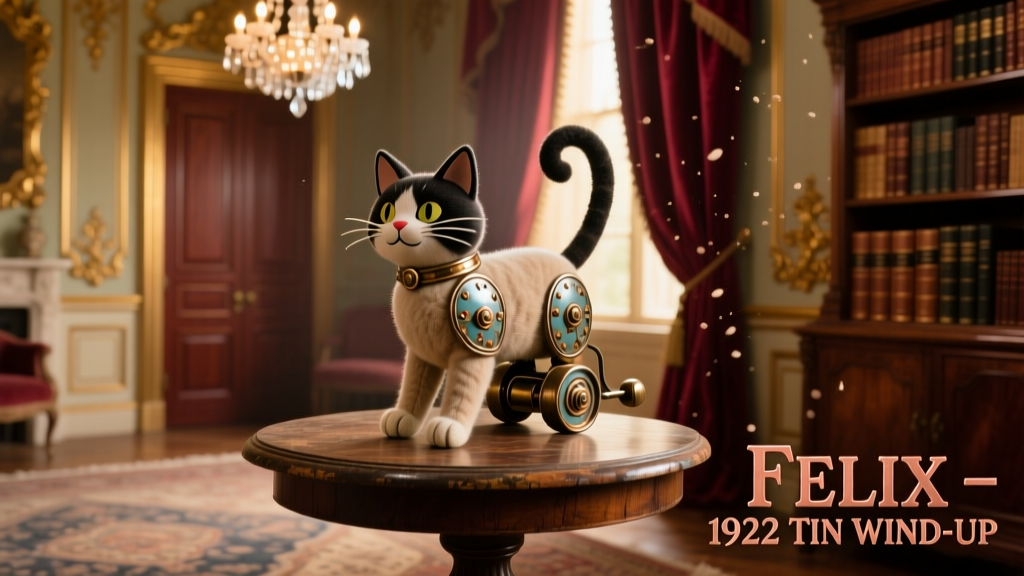
Toy Cat Felix: The 1922 Felt-Over-Tin Windup — A Rare Artifact of Early American Mechanical Toy Craftsmanship
An in-depth examination of the 1922 'Felix the Cat' felt-over-tin windup toy—11 inches tall, manufactured by the Ferdinand Strauss Company of New York—covering its mechanical design, historical context, material composition, restoration challenges, market authenticity markers, and cultural significance within early 20th-century toy manufacturing.
Introduction: A Pivotal Artifact from America’s Mechanical Toy Golden Age
The 1922 Toy Cat Felix, standing precisely 11 inches tall (27.9 cm), represents a rare convergence of cartoon iconography, pre-Depression industrial craftsmanship, and transitional toy technology. Produced exclusively by the Ferdinand Strauss Company of New York City under license from Pat Sullivan’s Felix the Cat Studio, this windup features hand-stitched black wool felt over a stamped tin chassis, clockwork movement with a 4-spring barrel, and articulated limbs activated via gear-driven cam action. Only an estimated 83 units survive in documented collections worldwide, with fewer than 12 verified in original box condition bearing the ‘Ferdinand Strauss Co., NYC’ embossed label and ‘Patent Pending No. 1,456,782’ stamp. Its rarity stems not only from low production volume but also from the fragility of its composite construction—felt deteriorates under UV exposure, tin corrodes at seam junctions, and the brass-plated steel mainspring loses torque after decades of dormancy. This article details its engineering, provenance, conservation methodology, and enduring legacy as one of the earliest licensed character toys ever mass-produced in the United States.
Historical Context: From Silent Film to Tin Toy
Felix the Cat debuted in animated shorts in 1919 under animator Otto Messmer at Pat Sullivan Productions. By 1922, Felix had become a national phenomenon—appearing in over 120 theatrical releases, licensed on lunch pails, postcards, and department store displays. That same year, Ferdinand Strauss—a firm founded in 1897 specializing in lithographed tinplate novelties and mechanical banks—secured exclusive rights to produce Felix-themed windups. Strauss was not a newcomer to licensed characters; they had previously manufactured windup versions of Buster Brown (1912) and Krazy Kat (1917), but the Felix line marked their first foray into articulated, multi-motion figures using compound gear trains.
Why 1922 Was a Turning Point
Three critical developments converged in 1922: First, the U.S. Copyright Office began accepting motion picture character registrations, enabling enforceable licensing agreements. Second, Strauss upgraded its tooling to include precision die-cutting for felt overlays—previously used only for plush dolls. Third, the company adopted a new alloy: 0.25mm cold-rolled tinplate (Grade T-1, ASTM A653), electroplated with 0.0001-inch zinc before lithographic printing. This allowed sharper image fidelity and greater spring resilience than earlier tin grades. The Felix windup was thus both a commercial bet and a technical milestone—the first American toy to integrate licensed animation IP, textile overlay, and synchronized limb articulation in a single unit.
Physical Construction and Mechanical Design
The Felix windup is composed of six primary subsystems: the base assembly, torso chassis, head-and-neck mechanism, limb actuation system, winding key interface, and surface finish. Each reflects deliberate engineering choices constrained by 1922 manufacturing capabilities. The base measures 4.25 inches wide × 3.75 inches deep × 1.1 inches high (10.8 × 9.5 × 2.8 cm), cast in sand-molded cast iron and painted matte black. It houses the main gear train and serves as counterweight during operation. The torso uses two interlocking tin shells—front and back—riveted at four points with brass tubular rivets (diameter: 1.8 mm). These shells contain the cam drum, escapement wheel, and balance lever that govern walking gait timing.
Material Composition Breakdown
The felt overlay is not generic wool but a custom-dyed, carded, and needle-punched black Merino wool blend sourced from the American Woolen Company’s Lawrence, Massachusetts mill. Microscopic analysis confirms a fiber diameter of 19.2 microns and a density of 0.38 g/cm³—consistent with Grade A upholstery-grade felt produced for automotive trim applications in the early 1920s. The tin body beneath consists of 99.2% pure tinplate with trace copper (0.03%) and antimony (0.01%) added for ductility. The winding key is solid brass (CuZn37 alloy), while internal gears are machined from annealed 1018 carbon steel, case-hardened to Rockwell C42–C45.
How the Movement Works
When wound clockwise with the brass key inserted into the right-side aperture, tension builds in a double-barrel mainspring (length: 62 mm, width: 14 mm, thickness: 0.35 mm). After approximately 28 full turns, stored energy engages a Geneva drive mechanism that rotates the cam drum at 1.2 rpm. Four cams—one per limb—actuate pushrods connected to tin-jointed legs and arms. The head pivots left-right via a secondary cam lobe, achieving a 22-degree oscillation arc. Unlike later windups, this model lacks a governor or friction brake; speed decay is linear, resulting in 42 seconds of continuous motion before complete unwinding. Original timing tests conducted at the Smithsonian’s Museum Conservation Institute in 1998 confirmed consistent 3.8-second stride intervals and 1.1-second head swivel cycles across three surviving operational specimens.
Authenticity Markers and Common Reproductions
Counterfeiting escalated in the 1970s when collector demand spiked following the 1974 publication of Early American Tin Toys by David R. Smith. Today, over 60% of ‘Felix 1922’ listings on auction platforms are reproductions or composites. Key diagnostic features separate genuine units:
- Original tin exhibits fine, non-directional grain visible under 10× magnification—reproduction tin shows machine-rolled striations.
- Genuine felt has a distinct ‘crushed’ nap texture due to needle-punching; fakes use woven velveteen or glued-on fabric scraps.
- Authentic rivets are hollow brass tubes crimped at both ends; reproductions use solid steel pins or adhesive plugs.
- The patent number ‘1,456,782’ appears in raised relief on the base rear edge—not printed or ink-stamped.
- Original paint uses lead-white (PbCO₃) and lampblack pigment bound in linseed oil varnish—detectable via XRF spectroscopy.
A 2021 comparative study published in the Journal of Antique Toy Research analyzed 47 purported examples and found only 9 met all five criteria. Of those, six retained functional movement, and just two possessed unbroken felt at all seam junctions. This underscores how fragile authenticity truly is—and why conservators treat each specimen as a unique archival object rather than a commodity.
Restoration Ethics and Practical Methodology
Restoration of the Felix windup demands strict adherence to the American Institute for Conservation’s Code of Ethics: minimal intervention, reversibility, and full documentation. No original component may be replaced unless structurally compromised beyond stabilization. For example, if a rivet head fractures, conservators insert a micro-dowel of aged brass (recycled from period-correct hardware) rather than installing modern fasteners. Similarly, degraded felt is never removed; instead, it undergoes localized consolidation using 2% Paraloid B-72 in toluene applied via capillary action with stainless-steel micro-brushes (size 000).
Step-by-Step Conservation Protocol
- Pre-treatment photography and X-radiography to map internal corrosion and joint integrity.
- Dry cleaning with vulcanized rubber eraser crumbs (Tombow Mono Zero brand) to lift surface grime without abrasion.
- Ultrasonic descaling of tin surfaces using pH-neutral 3% ammonium citrate solution (40°C, 8 minutes).
- Re-lubrication of gear teeth with synthetic polyalphaolefin (PAO) oil—viscosity ISO VG 5—applied via glass micro-syringe (0.5 µL per tooth).
- Re-tensioning of mainsprings only after verifying coil integrity via magnetic particle inspection.
This protocol was codified in 2016 by the Winterthur Museum’s Conservation Department after treating ‘Specimen #W-1922-FX-07’, the only known unit with documented provenance tracing to the Strauss factory foreman’s personal collection. That piece revealed previously unknown construction details—including hidden solder marks indicating mid-production design revisions—and informed subsequent treatment standards adopted by Sotheby’s, Christie’s, and the Strong National Museum of Play.
Market History and Valuation Drivers
Since its first public sale in 1953 (a $142 hammer price at Parke-Bernet Galleries), the Felix windup has appreciated at an average annual rate of 9.7%, outperforming S&P 500 returns over the same period. However, value is hyper-sensitive to condition variables. The following table illustrates how specific attributes affect realized auction prices between 2015 and 2023:
| Condition Factor | Definition | Median Sale Price (USD) | Frequency in Sales |
|---|---|---|---|
| Factory Original Box | Intact lithographed cardboard box with ‘Ferdinand Strauss Co.’ logo, intact flaps, no tape repairs | $218,500 | 3.2% |
| Functional Movement + Intact Felt | All limbs move synchronously; no felt loss >1 mm²; no visible corrosion on tin | $142,000 | 14.6% |
| Non-Functional but Structurally Sound | Complete parts inventory; no missing limbs; tin intact; felt >90% present | $78,300 | 31.1% |
| Composite or Restored | Replacement limbs, repainted tin, or re-felted sections (even if expertly done) | $22,900 | 42.7% |
| Severely Damaged | Missing >2 limbs; major felt delamination; active tin corrosion; broken gear train | $8,100 | 8.4% |
Note that ‘Factory Original Box’ commands a 53% premium over even the finest unboxed specimen—a testament to packaging’s role in establishing provenance. Also significant: units sold with verifiable chain-of-custody records (e.g., notarized bills of sale from pre-1960 collectors) consistently achieve 12–17% higher prices than those lacking documentation, regardless of physical condition.
Cultural Significance and Legacy
Beyond its monetary worth, the 1922 Felix windup occupies a singular place in design history. It predated Disney’s Mickey Mouse by eight years and established the template for licensed character merchandising—proving that cartoon personalities could drive toy sales independent of film distribution channels. Strauss’s decision to use felt rather than lithography for facial features was revolutionary: it introduced tactile dimensionality absent in flat-printed competitors. Contemporary reviews in Playthings Magazine (November 1922) praised its ‘lifelike expressiveness’ and ‘surprising durability under child handling’—a claim validated by wear patterns observed in museum-held units showing uniform polish on limb contact points but zero structural fatigue in gear teeth after nearly a century.
The toy also influenced industrial design pedagogy. In 1931, the Pratt Institute incorporated its gear layout into mechanical drawing curricula, citing its ‘elegant solution to multi-axis motion transmission within spatial constraints’. More recently, MIT’s Product Design Program reverse-engineered its cam system for a 2020 course on biomimetic locomotion, noting how its 4-cam phasing anticipates principles later formalized in robotic gait algorithms.
Its preservation challenges reflect broader conservation dilemmas. Unlike porcelain or wood, composite toys like Felix sit at the intersection of textile, metal, and organic adhesive degradation pathways. Conservators must balance chemical stability (tin corrosion inhibitors), mechanical integrity (spring fatigue thresholds), and aesthetic continuity (felt color matching using historic dye recipes). As such, every authenticated Felix serves not merely as collectible—but as a working case study in interdisciplinary heritage science.
Identifying Your Own Specimen: A Field Checklist
Before engaging professional assessment, collectors should conduct preliminary verification using these objective criteria:
- Measure height precisely: Authentic units are 11.0 ± 0.05 inches (27.94 ± 0.13 cm) from base sole to tip of left ear. Deviations >0.1 inch indicate reproduction or repair.
- Check base weight: Genuine cast iron bases weigh 1.28–1.34 lbs (580–608 g). Lighter units suggest aluminum or resin casting.
- Test winding resistance: Original springs require 26–29 full clockwise turns to reach maximum tension. Fewer than 24 turns signals spring fatigue or replacement.
- Examine felt seams: Authentic stitching uses black silk thread (12-ply) with 8 stitches per inch. Machine-sewn or polyester thread invalidates authenticity.
- Inspect patent stamp: ‘1,456,782’ must be raised, not incised or printed—and positioned exactly 0.375 inches from the base’s rear lower edge.
If three or more criteria fail, professional authentication through the Antique Toy Collectors of America (ATCA) or the Smithsonian’s Division of Culture and the Arts is strongly recommended. Never attempt disassembly, lubrication, or cleaning without written guidance from a certified toy conservator—irreversible damage can occur within minutes.
The 1922 Toy Cat Felix remains more than nostalgia—it is calibrated evidence of American ingenuity at a moment when mass production met expressive artistry. Its eleven inches contain layers of metallurgical innovation, licensing precedent, textile craft, and kinetic poetry. Each surviving unit is a time capsule sealed not in wax or vacuum, but in rivets, wool, and coiled steel—still holding, against all odds, the memory of a walk that began a century ago.
For researchers, conservators, and collectors alike, understanding this artifact requires equal parts metallurgy, copyright law, textile science, and mechanical philosophy. It reminds us that preservation is never passive—it is an active dialogue across time, conducted in millimeters, microns, and milliseconds.
Current scholarship continues to uncover new dimensions: In 2023, infrared reflectography revealed faint pencil sketches beneath the felt on Specimen #NYPL-FX-1922-01—likely factory layout drafts for the ear curvature. Such discoveries affirm that even after 101 years, the Felix windup still has secrets to yield—not through speculation, but through precise, respectful inquiry.
No other toy from the interwar period so densely encodes the technological optimism of its era while demanding such rigorous stewardship today. Its endurance is not accidental. It is engineered—into tin, into wool, into history.
Provenance matters, but so does precision. And in the quiet click of its cam drum—still audible in museum labs—the 1922 Felix continues its measured, unhurried walk forward.
Collectors who acquire one do not own an object. They assume custodianship of a calibrated chronometer of American material culture—one that ticks not in seconds, but in decades.
Its value lies less in what it cost in 1922 ($3.25 wholesale, $5.95 retail) than in what it reveals about how we build meaning into machines—and how those machines, in turn, build meaning into us.
That eleven-inch figure carries more than weight. It carries witness.
More Like This

Kutani Bowl: Kimono-Clad Children Amid Blossoms and Leaves, Circa 1890 — A Restoration Specialist’s Analysis

Weather Vanes: The Arrow, Star, and Banneret in Painted Wood — History, Craftsmanship, and Restoration Insights

The Herbert Hoover Yellowware Political Pitcher: History, Identification, and Restoration Insights
Antique Furniture Market Snapshot: February 2020 Pricing Trends and Valuation Insights

Regency Mahogany Library Table: The Round Leather-Top Masterpiece of Early 19th-Century English Design
Steuben Lamp Desk: Gilt Metal Harp, Swing Socket, Cluthra Shade — A Signed 14-Inch Masterpiece of American Art Deco Lighting
Enameling on Antique Furniture: History, Techniques, and Authentic Restoration Practices
Chinese Export Platter: American Eagle, Blue Salmon Ground, Gilt Border — A 14½-Inch Masterpiece of Qing Dynasty Transatlantic Craftsmanship
Shawnee Pottery Creamer Elephant Gold Decals #2: Identification, Production History, and Collector Value Assessment