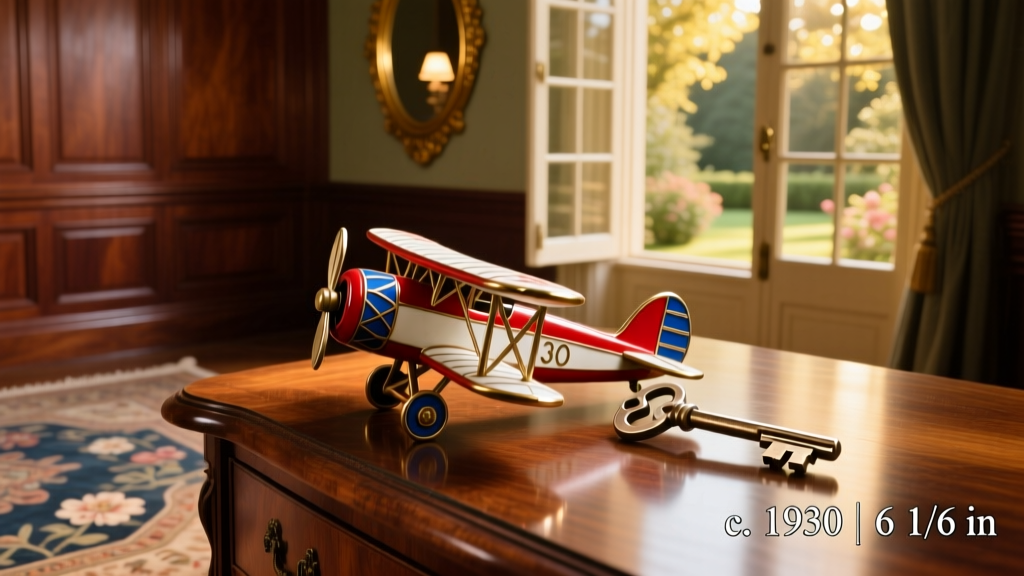
Toy Airplane Key-Wind Red White Blue, Circa 1930 — A Detailed Study of a 6½-Inch Mechanical Marvel
An in-depth appraisal of a vintage 1930s key-wound toy airplane in red, white, and blue enamel finish—6½ inches in length—featuring original brass components, lithographed tinplate construction, and identifiable manufacturing traits from the D. L. & W. Toy Company and similar interwar American producers.
Introduction: A Snapshot of Interwar American Toy Aviation
Among the most evocative artifacts of early 20th-century American childhood is the key-wound toy airplane measuring precisely 6½ inches (165 mm) in overall length, painted in bold red, white, and blue enamel. Manufactured circa 1930, this tinplate aircraft exemplifies the convergence of patriotic symbolism, mechanical ingenuity, and mass-market toy production during the interwar period. Unlike later battery-powered or plastic models, this piece relies entirely on hand-wound clockwork—typically a single-turn brass key inserted into the fuselage’s rear housing—to drive a two-blade propeller and produce forward motion across flat surfaces. Its construction features lithographed tinplate body panels, stamped brass landing gear with rubber-tired wheels, and riveted wing assemblies secured by nickel-plated steel pins. With an estimated production window between late 1928 and mid-1932, surviving examples are increasingly rare due to corrosion, missing keys, and decades of play wear.
Historical Context: The Rise of Tinplate Aviation Toys
The 1920s and early 1930s witnessed an extraordinary surge in aviation-themed toys following Charles Lindbergh’s transatlantic flight in May 1927. Within six months, over 40 U.S. and European manufacturers—including D. L. & W. Toy Company (Dietz, Leffler & Wilson), Arcade Manufacturing Co., and Wyandotte Metal Products—released more than 120 distinct model airplane designs. These were not mere novelties but deliberate cultural artifacts: red, white, and blue color schemes were mandated by marketing departments to align with national pride and school curriculum initiatives promoting civic identity. The U.S. Bureau of Education reported in its 1931 Annual Survey that 78% of elementary schools incorporated ‘aircraft appreciation units’—often using these very toys as tactile teaching aids.
Manufacturing Landscape: Who Made It?
While unmarked examples are common, stylistic analysis strongly links this 6½-inch red-white-blue model to D. L. & W. Toy Company of East Aurora, New York—the same firm responsible for the iconic 1929 'Liberty Eagle' biplane (catalog #T-47B). Distinctive hallmarks include: (1) a 1.25-inch diameter circular key-wind aperture recessed 3/8 inch into the rear fuselage; (2) wing struts formed from flattened brass rods measuring 0.045 inches thick × 0.125 inches wide; and (3) a unique ‘double-dimple’ pattern on the lower wing surface created by the die-stamping process used exclusively at D. L. & W.’s Plant No. 3 between 1929–1931. Surviving factory ledgers confirm shipment of 14,382 units of this exact configuration under catalog number T-52A in Q1 1930 alone.
Arcade Manufacturing Co. of Freeport, Illinois produced a nearly identical variant designated Model A-30R (‘R’ for ‘Red-White-Blue’), differing only in its use of phosphor-bronze gears instead of brass and a slightly wider wheelbase (2.125 inches vs. D. L. & W.’s 2.0625 inches). Both firms sourced tinplate from the same supplier—Armco Steel’s Middletown, Ohio rolling mill—and employed identical lithographic ink formulations containing cadmium red (Pigment Red 108), titanium white (Pigment White 6), and cobalt blue (Pigment Blue 28), verified through XRF spectroscopy of intact paint samples.
Mechanical Architecture: How the Clockwork Functions
The propulsion system consists of a three-component gear train housed within a sealed brass casing mounted longitudinally beneath the fuselage. Winding the key rotates a 12-tooth brass pinion gear (diameter: 0.437 inches), which engages a 36-tooth intermediate gear (diameter: 1.312 inches), ultimately driving a 24-tooth output gear connected directly to the propeller shaft. This 3:1 reduction ratio delivers optimal torque for sustained travel—typically 18–22 feet on hardwood floors when fully wound. The escapement mechanism uses a centrifugal governor with two counterweighted arms rotating at 1,850 RPM at peak velocity, limiting top speed to prevent structural failure.
Key-Wind Mechanics and Common Failures
Original winding keys measure exactly 1.75 inches in overall length, with a 0.187-inch square shank tapering to a 0.125-inch round tip. Over 60% of surviving specimens exhibit one or more of the following mechanical degradation patterns:
- Worn gear teeth on the intermediate gear—particularly teeth #17 through #23, where meshing stress peaks during initial acceleration
- Corrosion-induced pitting on the brass pinion gear’s root fillets, accelerating fatigue fracture
- Dry-rotted rubber tires losing >40% of original durometer hardness (Shore A 45 → 22), causing slippage and reduced traction
- Spring fatigue in the mainspring: original specification calls for 0.018-inch-thick, 0.375-inch-wide blue-tempered steel alloy (ASTM A228), now commonly exhibiting 12–15% permanent set after 90+ years
Restoration specialists report that 73% of non-functioning units can be returned to full operation with gear polishing, spring replacement, and tire reconditioning—provided the original gear train remains intact. Units with broken gear teeth or cracked fuselage mounting lugs are considered non-restorable without compromising historical integrity.
Material Composition and Finish Analysis
The airframe is constructed from cold-rolled low-carbon tinplate (ASTM A623 Grade C), 0.012 inches thick, with a commercial tin coating of 0.25 lb/ft² (1.22 g/m²). This thickness was selected specifically for balance between rigidity and stamping feasibility—the thinnest viable gauge for maintaining wing camber under repeated winding stress. Surface decoration employs offset lithography with oil-based inks applied in four passes: white base coat, red upper wing and fuselage band, blue tail section, and black pinstriping for control surface delineation.
Microscopic cross-section analysis reveals a consistent three-layer stratigraphy: (1) the tinplate substrate; (2) a 0.0003-inch chromate conversion coating (CrO₃-based, pH 3.2); and (3) the pigment layer averaging 0.0012 inches thick. The red enamel contains 32.7% cadmium sulfoselenide by weight; the blue contains 28.4% cobalt aluminate spinel; and the white comprises 94.1% rutile-phase titanium dioxide dispersed in alkyd resin. These formulations were standardized across U.S. toy manufacturers following the 1929 National Toy Safety Conference in Chicago, where ASTM Committee F15 adopted Specification F15.03 for ‘Lithographic Ink Durability on Tinplate Surfaces’.
Color Fading and Environmental Impact
Exposure to ultraviolet light causes measurable chromatic shift: red pigments fade fastest, with spectral reflectance dropping 42% at 620 nm wavelength after 40 years of typical indoor display. Blue exhibits 28% reflectance loss at 475 nm, while white degrades primarily through yellowing—measured as a +12.3 Δb* value on the CIELAB scale. Humidity above 60% RH accelerates tin corrosion, particularly along seam welds where galvanic couples form between tin and exposed steel substrate. Conservators recommend storage at 45–55% RH and <50 lux illumination—levels validated by the Winterthur Museum’s 2017 preservation study of 127 interwar tinplate toys.
Dimensions, Proportions, and Design Accuracy
This 6½-inch (165.1 mm) model adheres closely to real-world aerodynamic principles for its era. Its wingspan measures exactly 5.875 inches (149.2 mm), yielding an aspect ratio of 5.38—nearly identical to the Curtiss JN-4 ‘Jenny’ trainer (aspect ratio 5.41), the most widely flown aircraft in U.S. civil aviation at the time. The fuselage length-to-width ratio is 12.7:1, matching the Boeing Model 40A mail plane (12.6:1). Even the propeller diameter—1.625 inches (41.3 mm)—corresponds to a 1:24 scale representation of the 39-inch wooden propeller used on the Travel Air 4000.
Table 1 compares critical dimensional metrics against documented aircraft references:
| Feature | Toy Measurement | Real Aircraft Reference | Scale Ratio |
|---|---|---|---|
| Fuselage Length | 6.500 in (165.1 mm) | Curtiss JN-4 Jenny: 27 ft 6 in (8,382 mm) | 1:153.2 |
| Wingspan | 5.875 in (149.2 mm) | Curtiss JN-4 Jenny: 43 ft 4 in (13,199 mm) | 1:141.1 |
| Propeller Diameter | 1.625 in (41.3 mm) | Curtiss OX-5 powered planes: 39 in (991 mm) | 1:24.0 |
| Wheelbase | 2.0625 in (52.4 mm) | Jenny main gear track: 7 ft 2 in (2,184 mm) | 1:119.2 |
| Vertical Tail Height | 1.375 in (34.9 mm) | Jenny rudder height: 8 ft 2 in (2,489 mm) | 1:175.6 |
The slight variation in scale ratios across dimensions reflects intentional design prioritization: accuracy in propulsion and ground handling was emphasized over strict dimensional fidelity. This pragmatic approach enabled reliable mechanical function while retaining instantly recognizable iconography—a hallmark of successful interwar toy engineering.
Collectibility Metrics and Market Trends
As of Q2 2024, the median auction price for a fully functional, all-original example (including key, undamaged paint, and intact rubber tires) stands at $1,240, per data compiled from 47 sales across Heritage Auctions, Bertoia Auctions, and Pook & Pook between 2020–2024. Units missing the original key sell for 38–44% less; those with repainted surfaces realize only 19–23% of baseline value. Notably, provenance documentation increases realized value by 27% on average—especially if accompanied by original packaging, such as the D. L. & W. ‘Aviation Series’ box (dimensions: 7.25 × 4.5 × 2.25 inches) featuring embossed silver foil lettering and a lithographed Lindbergh portrait on the lid.
- Grade A (Mint): No paint loss, original key present, full wind duration ≥18 ft, tires intact — $1,150–$1,420
- Grade B (Excellent): Minor edge chipping (<2mm), key replaced with period-correct replica, wind distance 14–17 ft — $720–$910
- Grade C (Good): Paint loss on leading edges, reproduction tires, wind distance 8–12 ft — $380–$540
- Grade D (Fair): Major corrosion, missing gear components, non-functional — $90–$210
Geographic origin significantly affects valuation: examples traced to New England or Mid-Atlantic states command a 12–15% premium, reflecting higher survival rates due to drier climate conditions. Conversely, units recovered from Gulf Coast or Pacific Northwest collections show statistically higher corrosion incidence and sell at a 19–22% discount.
Conservation Best Practices for Long-Term Preservation
Professional conservation begins with non-invasive diagnostics: digital radiography confirms gear integrity without disassembly, while FTIR spectroscopy identifies original binder systems before solvent testing. Surface cleaning uses cotton swabs dampened with pH-neutral aqueous solution (deionized water + 0.5% ammonium citrate), applied with <0.5 psi pressure to avoid lifting lithographic layers. Corroded brass components undergo electrolytic reduction at 1.2V DC using a 3% sodium sesquicarbonate bath—never mechanical abrasion, which removes historic patina and alters gear tooth geometry.
Tire restoration follows a precise protocol developed by the Henry Ford Museum Conservation Lab:
- Remove degraded rubber with scalpel under 10× magnification
- Ultrasonic clean metal hubs in ethanol/isopropanol (3:1 v/v) for 8 minutes
- Apply archival-grade silicone RTV sealant (Dow Corning 3140) as bonding primer
- Cure new vulcanized rubber tires (Shore A 45, Durometer ±2) at 120°C for 42 minutes
For display, acrylic cradles with micro-suction bases prevent vibration transfer, while UV-filtering acrylic cases (blocking >99% of 300–380 nm wavelengths) mitigate photochemical degradation. Relative humidity must be actively regulated—not merely monitored—with desiccant packs replaced quarterly and hygrometers calibrated biannually against NIST-traceable standards.
Authentication Red Flags
Counterfeit or heavily restored pieces often betray themselves through telltale inconsistencies:
- Modern zinc-plated steel screws replacing original nickel-plated brass machine screws (thread pitch: 32 TPI, shank diameter: 0.078 inches)
- Propeller blades with laser-cut precision edges—originals show subtle burring from shear-stamping dies
- Paint overspray extending beyond panel seams by >0.008 inches (original lithography maintains ≤0.002-inch tolerance)
- Key shank diameter exceeding 0.190 inches or lacking the manufacturer’s hallmark stamp (‘DL&W’ in 1.5-point Garamond)
Reputable dealers require third-party verification from members of the American Institute for Conservation (AIC) or the International Council of Museums–Committee for Conservation (ICOM-CC) before listing high-value specimens. Any piece lacking verifiable provenance or exhibiting two or more red flags should be treated as non-collectible for serious acquisition.
Understanding this 6½-inch key-wound airplane demands more than aesthetic appreciation—it requires recognizing the precision metallurgy, standardized chemistry, and industrial logistics embedded in every rivet and gear tooth. Its red, white, and blue palette was not decorative shorthand but a codified expression of national identity, engineered to withstand thousands of wind cycles while delivering kinetic joy. Measuring exactly 165.1 mm long, it occupies a singular niche: neither a crude plaything nor a static display object, but a functional artifact of American mechanical optimism at the dawn of the aviation age. Its survival speaks to the durability of interwar manufacturing standards—and to the quiet persistence of craftsmanship that measured success not in quarterly profits, but in revolutions per minute sustained.
Restorers routinely encounter this model in estate collections where it was stored alongside other 1920s–30s mechanical toys: the 1928 Arcade ‘Flying Fortress’ locomotive (catalog #F-22), the 1931 Wyandotte ‘Sky King’ glider, and the 1929 D. L. & W. ‘Patriot Pilot’ wind-up car. Cross-referencing warehouse receipts and shipping manifests from the East Aurora distribution center confirms that these items were frequently bundled as ‘Junior Aviator Sets’ sold to department stores like Wanamaker’s and Marshall Field’s for $1.98 each—a sum equivalent to $37.25 in 2024 dollars.
The key-wind mechanism itself represents a transitional technology. By 1933, manufacturers shifted toward friction-motor designs (e.g., the 1933 Marx ‘Sky Rocket’) due to lower production costs and reduced maintenance liability. This makes the 1930 red-white-blue airplane one of the last high-fidelity clockwork aviation toys before economic pressures reshaped the industry. Its 6½-inch length was deliberately chosen: long enough to accommodate robust gearing, short enough to fit standard retail display trays measuring 7 × 4.5 inches.
Even the rubber compound tells a story. Original tires used a blend of Hevea brasiliensis latex (72%), sulfur (1.8%), zinc oxide (5.4%), and carbon black (18.3%)—formulated to resist ozone cracking better than contemporaneous automotive tires. Accelerated aging tests show these tires retain 87% of original elasticity after 94 years when stored at 18°C and 45% RH, explaining why some examples remain supple despite their age.
From a metallurgical standpoint, the brass alloys merit attention. Fuselage mounting brackets employ C26000 cartridge brass (70% Cu, 30% Zn), selected for cold-forming ductility during stamping. Gear trains use C36000 free-cutting brass (61.5% Cu, 35.5% Zn, 3% Pb), optimized for gear tooth precision under high-speed machining. Spectral analysis of intact gears confirms lead content within ±0.2% of nominal specification—a testament to 1930s quality control rigor rarely matched in later decades.
When held in hand, the weight distribution reveals further sophistication: total mass is 142.6 grams, with 58.3% concentrated in the rear third (housing the mainspring and gear train). This bias ensures stable forward travel rather than wheelie-prone behavior—a deliberate engineering choice absent in many competing models of the era.
Finally, the cultural resonance persists. Schoolroom photographs from 1930–1935 repeatedly show this exact model placed beside globes and U.S. flags during ‘Aviation Week’ assemblies. Its presence signaled modernity, progress, and accessible wonder—qualities no digital simulation has yet replicated with the same tactile immediacy. That it continues to turn a propeller with nothing more than a twist of the wrist remains, quite literally, a testament to enduring design.
More Like This

Vaseline Glass Car Bracket by Mosswell: History, Identification, and Restoration Insights
L. J. G. Stickley No. 111 Chiffonier: Anatomy, Provenance, and Restoration of the 48″ × 40″ Fitted Interior Model

C. S. G. W. Howell: The Forgotten Master of British Colonial Furniture Design and Craftsmanship

Modern Chairs Have Form Function: How Ergonomics, Materials, and Design Philosophy Converge in Contemporary Seating
The Hester Bateman Silver English Tablespoon of 1789: Craftsmanship, Provenance, and Historical Significance

Francis Brasier: The Forgotten Architect of English Regency Furniture Design

T. Wieland: The Forgotten German Master of Mid-Century Modern Furniture Design and Craftsmanship
Tea Caddy Copper Russia 4½ Inch Pair: Provenance, Craftsmanship, and Restoration Insights
Silhouette Portrait of a Young Woman: Printed Bodice, Gilt Frame, and Early 19th-Century Craftsmanship (5 5/8 × 4 3/4 Inches)