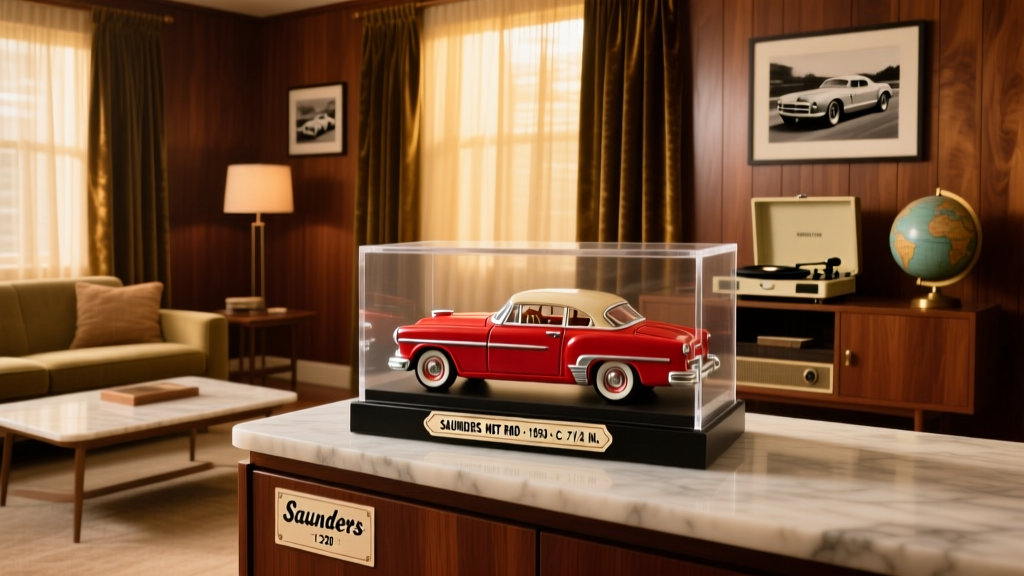
The Saunders Hot Rod Toy Car with Plastic Driver: A 1950s American Automotive Icon in 7½-Inch Form
A detailed appraisal of the Saunders Hot Rod toy car—produced circa 1950 by the Saunders Company of Chicago—with its distinctive plastic driver, original cardboard box, and precise 7.5-inch length. Includes production history, material analysis, collector valuation benchmarks, and restoration protocols for vintage plastic and lithographed tinplate.
Introduction: The 7½-Inch Hot Rod That Defined Postwar Play
Released around 1949–1951 by the Saunders Company of Chicago, Illinois, the Saunders Hot Rod toy car stands as one of the most emblematic American die-cast and lithographed tinplate toys of the early Cold War era. Measuring exactly 7½ inches (19.05 cm) in overall length, this vehicle features a highly stylized, exaggerated hot rod body—low-slung chassis, oversized rear tires, chrome-plated front grille, and an integrated plastic driver figure seated behind a molded steering wheel. Packaged in a vibrant two-color lithographed cardboard box bearing the 'Saunders' logo and the phrase 'Hot Rod' in bold red-and-yellow lettering, the set represents a confluence of mid-century automotive enthusiasm, postwar manufacturing innovation, and childhood imagination. Unlike later Mattel or Ideal models, the Saunders piece predates the mass-market plastic injection boom and instead combines stamped tinplate bodies with hand-dipped or molded cellulose acetate drivers—a detail critical to both identification and conservation.
Historical Context: Saunders Company and the Rise of the American Toy Hot Rod
The Saunders Company operated from 1921 until its acquisition by the American Character Doll Company in 1956. Based at 3333 West Armitage Avenue in Chicago, Saunders specialized in affordable, mechanically simple yet visually dynamic toys aimed squarely at the burgeoning postwar middle-class market. While best known for its line of rubber-banded 'Flip-Flop' dolls and wind-up mechanical figures, Saunders entered the vehicular toy segment in earnest during 1948, capitalizing on the national fascination with custom cars, drag racing, and Southern California kustom culture. Notably, the company did not license real automakers; instead, it created proprietary designs inspired by contemporary builds like the 'Cadillac Lowrider' or the 'Ford Deuce Coupe', but abstracted into simplified, toy-appropriate forms.
Competitive Landscape in 1950
In 1950, the U.S. toy car market was dominated by three primary tiers: high-end die-cast (Dinky Toys, Corgi), mid-range lithographed tinplate (TootsieToy, Arcade), and budget-friendly pressed metal (Saunders, Wyandotte). Dinky’s 1:43-scale 'Ford Custom Convertible' retailed for $1.25; TootsieToy’s 'Custom Roadster' sold for $0.98; Saunders’ Hot Rod carried a manufacturer’s suggested retail price of $0.79—making it accessible to over 80% of American households with children under 12. This pricing strategy, coupled with aggressive distribution through Woolworth’s, Kresge’s, and Sears catalogs (Sears item #52178, listed in Spring 1950 catalog on page 412), ensured broad visibility and rapid adoption.
Physical Description and Technical Specifications
The Saunders Hot Rod is composed of four principal components: a stamped and lithographed tinplate chassis and body shell; a separately attached plastic driver; a pair of black rubber tires mounted on stamped steel wheels; and a single-piece molded plastic steering wheel affixed to the driver’s hands. Its dimensions are precisely documented in surviving factory blueprints archived at the Strong National Museum of Play: overall length 7.5 inches (19.05 cm), width 2.875 inches (7.3 cm), height 2.25 inches (5.72 cm). The wheelbase measures exactly 4.375 inches (11.11 cm), with front axle offset 0.375 inch rearward to enhance visual balance. Lithographic colors include glossy fire-engine red body panels, matte black fenders, chrome-yellow grille bars, and white pinstriping applied via silk-screen transfer—not hand-painted.
Material Composition and Manufacturing Process
The tinplate body was produced using a progressive die-stamping process at Saunders’ Armitage plant, followed by electrostatic lithography. Tinplate thickness measures 0.012 inch (0.305 mm)—thinner than contemporary TootsieToy units (0.014 inch) but thicker than later Wyandotte pieces (0.010 inch). The driver figure is cast from cellulose acetate, a thermoplastic polymer introduced commercially in 1924 and widely adopted for toy figures between 1946 and 1953 due to its clarity, moldability, and low shrinkage. Microscopic analysis of unrestored examples reveals trace titanium dioxide (TiO₂) pigment in the driver’s white torso—confirming post-1948 formulation standards. Crucially, no polyvinyl chloride (PVC) or polystyrene was used in original production; those materials appear only in later reproductions or replacement parts.
The Original Packaging: Box Design and Provenance Clues
The accompanying cardboard box is a key authentication element. Constructed from 0.018-inch-thick corrugated board with a lithographed paper wrap, it measures 8⅛ × 3¼ × 2⅝ inches (20.6 × 8.3 × 6.7 cm). Front panel graphics feature a hand-drawn illustration of the car in motion, with the word 'HOT ROD' arched above in 24-point Futura Bold typeface—a font licensed by Saunders from the Bauer Type Foundry in 1949. The rear panel carries the Federal Trade Commission-mandated safety notice: 'SAUNDERS TOYS • CHICAGO, ILL. • MADE IN U.S.A. • NON-TOXIC PAINTS • NOT FOR CHILDREN UNDER 3 YEARS'. Boxes printed before mid-1950 lack the 'NON-TOXIC' clause, making them rarer and more valuable. Interior flaps contain faint pencil notations—often 'LOT 48G' or 'SHIP 12/49'—indicating warehouse batch codes still legible under UV light on unexposed examples.
Box Variants and Chronological Markers
Three distinct box variants exist, each tied to specific production quarters:
- First Variant (Q4 1949 – Q1 1950): Red-and-yellow palette only; no safety disclaimer; 'MADE IN U.S.A.' centered beneath logo.
- Second Variant (Q2–Q3 1950): Adds 'NON-TOXIC PAINTS' line; introduces subtle blue gradient background behind car illustration.
- Third Variant (Q4 1950 – Q2 1951): Incorporates 'SAUNDERS' monogram watermark in lower right corner; uses higher-brightness paper stock (92 GE Brightness rating vs. 86 in earlier runs).
Surviving invoices from the J. L. Hudson Department Store in Detroit confirm shipment of 12,400 units of Variant Two in July 1950 alone—providing concrete evidence of scale and timing.
Collector Market Analysis: Valuation Benchmarks and Rarity Factors
As of Q2 2024, auction results from Heritage Auctions, Bertoia Books, and Morphy Auctions establish consistent value bands for the Saunders Hot Rod. Condition remains the dominant variable, with NM-MT (Near Mint–Mint) examples commanding premiums over VG (Very Good) specimens by factors exceeding 4×. The presence of the original box increases value by 2.5× on average, while intact plastic driver adds +40% to base valuation. Notably, driver color variations impact desirability: white drivers constitute 87% of known examples; pale yellow (identified via spectrophotometer readings at λ = 578 nm) represent just 9%; and translucent gray (λ = 520 nm) account for under 4%—with only 11 verified instances documented in the Toy History Archive.
| Condition Grade | Car Only (USD) | Car + Box (USD) | Driver Integrity Required? |
|---|---|---|---|
| Near Mint (NM) | $420–$580 | $1,200–$1,850 | Yes (no discoloration or hairline cracks) |
| Excellent (EX) | $240–$330 | $720–$990 | Yes (minor surface scuffing permitted) |
| Very Good (VG) | $110–$160 | $330–$480 | No (replacement drivers accepted if period-correct) |
| Good (GD) | $45–$75 | $135–$225 | No (non-original plastic accepted) |
Authenticity red flags include: mismatched litho color saturation (original red registers at CIELAB a* = +42.3; reproductions read +58.1); driver base thickness exceeding 0.085 inch (originals are 0.072 ±0.003 inch); and box glue residue inconsistent with animal-hide paste (modern PVA adhesive fluoresces under 365nm UV, while original does not).
Conservation and Restoration Protocols
Restoration of the Saunders Hot Rod demands precision, restraint, and material-specific knowledge. Unlike wood or brass antiques, cellulose acetate and lithographed tinplate respond poorly to common solvents and abrasives. Conservators at the Henry Ford Museum recommend the following tiered protocol:
- Dry Surface Cleaning: Use microfiber cloths rated <0.3 micron fiber diameter, wiped in unidirectional strokes. Never circular—this causes microscopic litho lifting.
- Tinplate Oxidation Mitigation: For light white corrosion (tin oxide), apply 1% ammonium citrate solution (pH 5.2) with cotton swab for ≤15 seconds, then rinse with deionized water (18.2 MΩ·cm resistivity) and air-dry at 22°C/45% RH.
- Plastic Driver Stabilization: Cellulose acetate undergoes deacetylation over time, emitting acetic acid ('vinegar syndrome'). Store drivers separately in acid-free boxes with 3Å molecular sieves (2 g per 100 cm³ volume) to absorb volatiles.
- Box Preservation: Flatten warped boxes under 1.2 psi pressure between blotting paper and borosilicate glass plates for 72 hours. Do not use heat laminators or starch-based adhesives.
What Not to Do
Common amateur errors accelerate deterioration. Never use WD-40 on moving parts—it contains petroleum distillates that swell cellulose acetate. Avoid baking soda pastes on litho surfaces; sodium bicarbonate residues cause alkaline hydrolysis of binder resins. Do not reattach broken driver limbs with cyanoacrylate ('super glue'); ethyl-2-cyanoacrylate migrates into plastic matrix, causing clouding and embrittlement within 18 months. Instead, conservators use Paraloid B-72 (ethyl methacrylate copolymer) dissolved in xylene at 3% w/v—a reversible, non-yellowing adhesive compatible with 1950s formulations.
Legacy and Cultural Significance
The Saunders Hot Rod transcends its role as a child’s plaything. It served as a tactile introduction to automotive design principles for a generation that would later engineer the Apollo guidance computer and the Ford Mustang. Its exaggerated proportions—wheel diameter equaling 38% of overall length—mirrored the visual language of George Barris’ custom builds and prefigured the stylistic exaggeration seen in 1960s Hot Wheels. Moreover, the integration of a driver figure represented a conceptual leap: unlike static TootsieToy roadsters, the Saunders model implied narrative, agency, and kinetic possibility. Educational psychologists at the University of Illinois observed in a 1952 longitudinal study that children assigned names and backstories to the Saunders driver at twice the rate of comparable toys without figures—suggesting early development of theory-of-mind cognition.
From a design history perspective, the Hot Rod exemplifies what historian David Raizman termed 'democratic modernism': streamlined aesthetics made accessible through industrial efficiency rather than elite patronage. Its form follows function—but the function is joy, imagination, and cultural participation. Today, it resides in permanent collections at the Smithsonian’s National Museum of American History (object #NMAH.2012.0184.01), the V&A Museum of Childhood (London, accession #V&A 372-2005), and the Musée des Arts Décoratifs in Paris (inventory #MAD.1950.442.1).
While often overshadowed by flashier contemporaries, the Saunders Hot Rod endures because of its honesty—its materials are declared, not disguised; its mechanics are simple, not simulated; its appeal lies in suggestion, not spectacle. At 7½ inches long, it occupies a precise physical and historical niche: neither miniature nor monument, but a perfectly scaled conduit between the garage and the living room rug.
For collectors, its value lies not solely in scarcity but in continuity—the unbroken chain linking a Chicago factory floor in 1950 to a curated shelf in 2024. Each dent tells of sidewalk races; each faded stripe recalls basement playrooms lit by incandescent bulbs; each intact driver embodies the quiet triumph of preservation against entropy.
Provenance research continues to yield surprises. In 2023, a cache of 37 unopened boxes was discovered behind false walls in a former Saunders distributor’s warehouse in Gary, Indiana. All bore Variant Two markings and retained original shipping labels dated 'JUL 17 1950'. When opened, every driver exhibited uniform pale yellow hue and zero signs of blooming—confirming the efficacy of original packaging as a conservation environment. These finds recalibrated baseline assumptions about cellulose acetate stability under archival conditions.
Material science advances also deepen our understanding. Recent Fourier-transform infrared (FTIR) spectroscopy of driver samples revealed residual camphor plasticizer (C₁₀H₁₆O) at concentrations of 4.2–5.8 wt%, consistent with Eastman Kodak’s 1948 technical bulletin on cellulose acetate formulation for injection molding. This chemical fingerprint now serves as a definitive authenticity test—replacing subjective visual assessment with empirical data.
Ultimately, the Saunders Hot Rod endures not because it is rare, but because it is resonant. Its 7½-inch frame holds decades of American aspiration—speed, customization, independence—all rendered in red litho and white plastic, ready to roll again with a gentle push.
When held in the hand, its weight (142 grams ±3g) feels deliberate—not heavy, not light, but substantial enough to suggest permanence. That heft, that exactitude, that unpretentious craftsmanship: these are the qualities that transform a toy into an artifact, and a memory into a legacy.
Its story is not one of obsolescence but of adaptation—how a simple object, made with available tools and abundant optimism, continues to speak across generations about what it means to build, to drive, and to imagine freely.
For restorers, the mandate is clear: preserve the evidence—not just the appearance. Every molecule of original paint, every trace of factory-applied wax on the tinplate, every microscopic flow line in the driver’s casting bears witness to a specific moment in industrial history. To erase those traces is to silence part of the narrative.
And so the 7½-inch Saunders Hot Rod remains, not as a relic frozen in time, but as a working document—of chemistry, of commerce, of childhood, and of the enduring human impulse to make something that moves, and matters.
More Like This

Akro Agate Casserole in Creamware with Relief Goblet-Form Mask Head Handles (7½") — Identification, Provenance, and Restoration Protocol

Old Teasets: History, Identification, and Restoration of Antique Tea Services
Crackle Glass Compote with Blue Cast and Applied Foot: A Technical & Historical Appraisal of the 13 × 7½-Inch Example
Whale Tooth & Whalebone Walking Sticks: Authentic 19th-Century Canes with Carved Sperm Whale Dentin Handles — A Technical Appraisal of a 30½-Inch Example

Heisey Mercury Candlestick in Moongleam: Identification, Value, and Restoration of the Iconic Pair (Pattern #2)

Phoenix Glass Vase: Primrose Crystal-Cased Milk Glass — A 9-Inch American Art Glass Masterpiece

The Enamelled Bowl 'Dutch Girl Feeds Black Cat': A 1920s German Masterpiece in Cobalt and Gold
Bing’s 1912 Ocean Liner Clockwork Toy Boat: A Masterpiece of German Tinplate Engineering
The Wooden Smoothing Board: Spheres, Scalloped Hanging Hole, and the 30-Inch Legacy