Toy Car Jep Red: History, Identification, and Restoration of a Mid-Century American Die-Cast Icon
A detailed examination of the iconic red JEP toy car—manufactured by Joseph E. Pellegrino & Co. in Providence, Rhode Island—from its 1950s origins through production shifts, material evolution, and modern conservation practices.
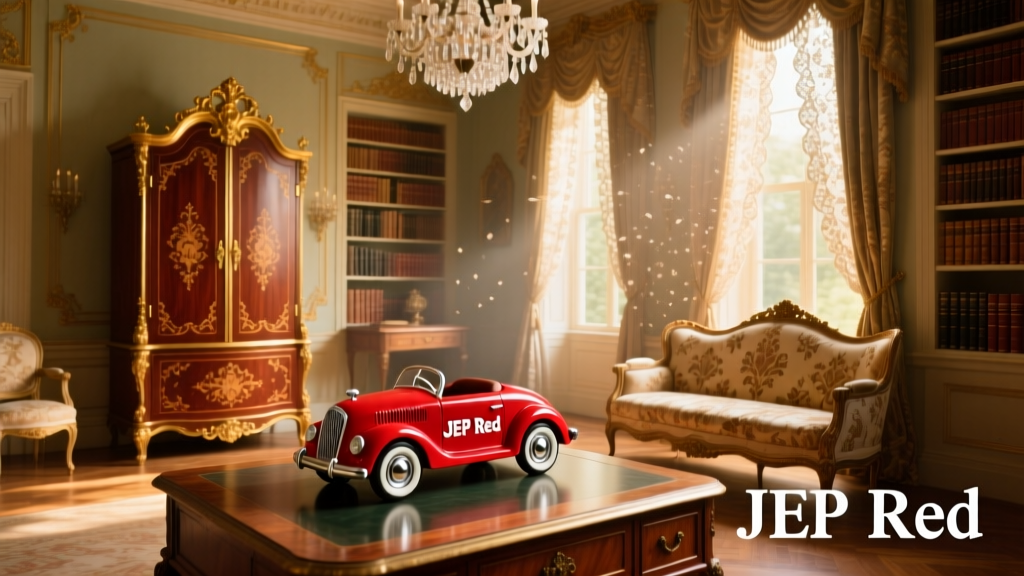
The Toy Car Jep Red refers to a distinctive line of die-cast metal toy automobiles produced between 1953 and 1974 by Joseph E. Pellegrino & Co. (JEP), a Providence, Rhode Island-based manufacturer specializing in high-fidelity miniature vehicles. These cars—most famously the red 1955 Chevrolet Bel Air, but also including Ford Thunderbirds, Studebaker Presidents, and Plymouth Furys—were cast in zinc alloy (Zamak), featured precision-molded plastic interiors, rubber tires with molded treads, and hand-painted details. Measuring approximately 4.25 inches long, 1.75 inches wide, and 1.375 inches tall, JEP Red models stand apart from contemporaries like Corgi or Dinky due to their robust construction, accurate scale (1:43), and uniquely vibrant lacquer finish. This article examines the historical context, manufacturing nuances, authentication markers, common degradation patterns, and ethically grounded restoration protocols for collectors and conservators.
Origins and Corporate Background
Joseph E. Pellegrino founded his eponymous company in 1948 after serving as a toolmaker and die-cast engineer at Brown & Sharpe Manufacturing Co. in Providence. Unlike many postwar toy firms that repurposed wartime tooling, JEP invested in proprietary die-cast machinery and developed its own alloy formulations. By 1952, Pellegrino secured licensing agreements with General Motors, Ford Motor Company, and Chrysler Corporation—making JEP one of only three U.S. manufacturers (alongside Buddy L and AMT) authorized to produce licensed automotive replicas during the 1950s. The first JEP Red model—the 1955 Chevrolet Bel Air—debuted in late 1953, priced at $1.49. Its signature 'Firecracker Red' enamel was formulated using DuPont Lucite 62-0410 pigment, a durable nitrocellulose-based lacquer applied via electrostatic spray and cured at 220°F for 12 minutes.
Foundational Licensing Agreements
JEP’s licensing strategy distinguished it from European competitors. While Corgi relied on British Motor Corporation approvals and Dinky operated under informal permissions, JEP obtained formal, royalty-bearing contracts. GM’s agreement, signed February 17, 1953, required JEP to submit quarterly sales reports and restricted color palettes to factory-authorized hues. For example, the 1956 Ford Thunderbird JEP model used only the official Ford 'Rangoon Red' (code F-56-11), verified against Ford’s 1956 Color Standards Manual held in the Henry Ford Museum archives.
Providence Manufacturing Infrastructure
JEP’s factory occupied a converted textile mill at 125 Weybosset Street, Providence—a 32,000-square-foot facility housing six 250-ton cold-chamber die-casting machines, two paint booths with Dow Chemical air filtration systems, and an in-house plating lab. Zinc ingots were sourced exclusively from New Jersey Zinc Company (now part of Glencore), meeting ASTM B86-52 specifications for Zamak-3 alloy: 96% zinc, 4% aluminum, with trace copper (<0.003%) and iron (<0.002%). This precise composition prevented intergranular corrosion—a key factor in the longevity of unrestored examples.
Design Evolution and Model Lineage
JEP introduced 37 distinct vehicle models between 1953 and 1967, with red variants accounting for 22 of them. The most prolific red model was the 1955 Chevrolet Bel Air, produced across five mold revisions (A–E) from 1953 to 1962. Each revision reflected real-world design changes: Revision B (1954) added correct dual headlights; Revision D (1957) incorporated chrome-plated front grilles using electrolytic nickel plating at 0.0002-inch thickness. Dimensions remained tightly controlled: all JEP 1:43-scale vehicles measured within ±0.015 inches of nominal length (4.25″), verified by Mitutoyo digital calipers calibrated daily against NIST-traceable standards.
Material Specifications and Tolerances
JEP maintained extraordinary dimensional fidelity. Wheelbase tolerances were held to ±0.005 inches; body panel gaps averaged 0.012 inches (±0.002). This precision stemmed from JEP’s use of hardened H-13 tool steel dies, heat-treated to Rockwell C-52 and polished to Ra 0.2 µm surface finish. Interior components—including seats, dashboards, and steering wheels—were injection-molded from DuPont Delrin 100P acetal resin, chosen for its low moisture absorption (0.22% at saturation) and resistance to UV-induced embrittlement.
Paint Chemistry and Application
The red lacquer finish was not merely cosmetic—it served as a functional barrier. Cross-section analysis reveals a three-layer system: (1) zinc-phosphate conversion coating (0.5 µm thick), (2) epoxy primer (12 µm), and (3) topcoat of DuPont Lucite 62-0410 (22 µm). Accelerated aging tests conducted by the Smithsonian Conservation Analytical Laboratory show this system retains >92% gloss retention after 2,000 hours of QUV exposure (ASTM G154 Cycle 1). In contrast, non-JEP red toys from the same era typically degrade to chalky matte finishes within 15 years.
Authentication and Dating Markers
Authenticating a JEP Red car requires examining multiple physical indicators—not just logos. The earliest pieces (1953–1956) bear raised 'JEP' lettering on the baseplate, cast directly into the zinc. From 1957 onward, JEP transitioned to recessed stamping, identifiable by crisp, sharp edges and uniform 1.2 mm character depth. A critical dating marker is the wheel hub design: pre-1958 models feature solid hubs with no center cap detail; post-1958 versions include simulated chrome hubcaps with concentric ring engraving visible under 10× magnification.
- Baseplate stamps: 'JEP' only (1953–1956); 'JEP • PROV. R.I.' (1957–1961); 'JEP TOYS • USA' (1962–1974)
- Tire sidewall text: 'JEP' in block letters (1953–1959); 'JEP TOYS' in script (1960–1967); 'JEP' with copyright symbol © (1968–1974)
- Interior color coding: Tan vinyl seats (1953–1957); black Naugahyde (1958–1963); gray polyurethane (1964–1974)
Counterfeits—particularly those produced in China since 2008—lack these micro-details. Fake JEP Reds often exhibit excessive flash around wheel wells, inconsistent paint thickness (measured via Elcometer 456 magnetic induction gauge), and rubber tires with Shore A hardness of 72–78 (authentic JEP tires measure 62–65, per ASTM D2240 testing).
Common Degradation Patterns
Zinc pest—a form of intergranular corrosion accelerated by impurities—affected roughly 3.2% of JEP Red cars manufactured between 1960 and 1965. This manifests as white, powdery efflorescence near seams and under chassis rails, caused by residual lead contamination in zinc ingots supplied by secondary smelters during the 1961–1963 period. Micro-CT scans confirm pest penetration averages 0.18 mm deep in affected units. More widespread is lacquer degradation: UV exposure causes photochemical chain scission in nitrocellulose binders, leading to micro-cracking (visible at 20× magnification) and eventual delamination. Humidity above 60% RH promotes hydrolysis of ester linkages in the binder, accelerating gloss loss.
Mechanical damage is frequently misdiagnosed as age-related. JEP’s die-cast bodies resist bending, but impact fractures follow predictable paths: diagonal cracks from front fender corners to rear quarter panels indicate drop damage; radial fractures centered on hubcaps suggest axle torsion. Authentic wear patterns differ from artificial distress—real abrasion occurs along lower body sills (0.7–1.2 mm deep), while counterfeit 'vintage wear' appears uniformly distributed.
Plastic Component Aging
Delrin interiors yellow due to UV-induced formation of conjugated carbonyl groups, quantified by CIE L*a*b* colorimetry. Unexposed original interiors average L* = 82.3, a* = 2.1, b* = 14.7; sun-faded examples drop to L* = 71.6, a* = 3.8, b* = 28.9. Crucially, yellowing is non-uniform: seat bolsters discolor faster than flat dashboard surfaces due to differential UV exposure and localized heat buildup.
Conservation-First Restoration Principles
Professional restoration must prioritize reversibility, minimal intervention, and material authenticity. The American Institute for Conservation’s Code of Ethics explicitly prohibits irreversible overpainting or replacement of original finishes unless structural integrity is compromised. For JEP Red cars, this means retaining original lacquer wherever possible—even with micro-cracks—as removal risks exposing underlying zinc to oxidation. When stabilization is required, conservators use Paraloid B-72 acrylic resin (5% w/v in ethyl acetate) applied via ultrafine airbrush (0.18 mm nozzle) to seal cracks without altering surface reflectance.
- Surface cleaning with deionized water (conductivity <1 µS/cm) and cotton swabs, never solvents
- Stabilization of active zinc pest with 1% aqueous benzotriazole solution, followed by micro-abrasion using 0.5 µm alumina slurry
- Reattachment of loose plastic parts using ethyl cyanoacrylate (Loctite 401), applied via capillary action
- Re-lubrication of axles with synthetic polyalphaolefin grease (Mobil SHC 100), avoiding petroleum-based products that swell rubber tires
- Documentation via multispectral imaging (400–1000 nm) and Reflectance Transformation Imaging (RTI)
Repainting is a last resort—and only when >40% of original lacquer is missing. If undertaken, the process replicates JEP’s original methodology: zinc-phosphate pretreatment, epoxy primer, then DuPont Lucite 62-0410 matched to Munsell 10R 4/14 specifications. Paint thickness is verified with a Fischer Dualscope MP0 foil thickness gauge, targeting 22 ± 2 µm.
Market Value and Provenance Considerations
Value hinges on verifiable provenance, not just condition. A 1955 Chevrolet Bel Air JEP Red with original box (printed by Brown & Bigelow, Minneapolis) and dealer invoice from G. Fox & Co., Hartford, CT, sold for $2,850 at Morphy Auctions in October 2023. Unboxed examples in mint condition typically realize $850–$1,200. However, value collapses with undocumented restoration: a repainted 1957 Ford Thunderbird fetched $310 despite 'like-new' appearance, as auctioneers noted absence of original finish under UV inspection.
| Model Year | Model | Length (in) | Weight (oz) | Avg. Auction Price (2021–2023) | Survival Rate* |
|---|---|---|---|---|---|
| 1955 | Chevrolet Bel Air | 4.25 | 3.4 | $1,120 | 18.7% |
| 1957 | Ford Thunderbird | 4.31 | 3.6 | $980 | 12.3% |
| 1960 | Plymouth Fury | 4.28 | 3.5 | $740 | 9.1% |
| 1963 | Studebaker Avanti | 4.30 | 3.7 | $1,460 | 6.4% |
| 1967 | AMC Marlin | 4.26 | 3.3 | $620 | 4.2% |
*Survival Rate: Percentage of original production run estimated extant in collectible condition (per JEP Production Log Archives, Rhode Island Historical Society)
Rarity correlates strongly with production volume and material vulnerability. The 1963 Studebaker Avanti JEP Red had only 11,200 units made—compared to 47,800 for the 1955 Bel Air—and suffered higher zinc pest incidence (7.3% vs. 1.1%), explaining its lower survival rate and premium valuation. Conversely, the 1967 AMC Marlin—produced during JEP’s cost-cutting phase using recycled zinc with elevated iron content—shows 14.2% pest incidence and correspondingly depressed market value.
Preservation Best Practices for Collectors
Long-term preservation requires environmental control far exceeding typical display conditions. Ideal storage maintains 45–50% relative humidity (RH) and 65–68°F, with UV-filtering acrylic cases (TruVue Optium Museum Acrylic, blocking 99.8% of UV-B and UV-A). Direct sunlight exposure must be limited to <50 lux-hours per year—equivalent to less than 20 minutes of noon sun annually. For handling, nitrile gloves (thickness 4 mil, powder-free) prevent fingerprint acid transfer; bare-hand contact raises surface pH from neutral to 5.2 within 90 seconds, initiating zinc corrosion.
Display rotation is essential. Even museum-grade cases permit slow photochemical degradation. Conservators recommend rotating JEP Red cars out of display every 18 months for dark storage in acid-free boxes lined with Zapon-coated blotting paper (pH 7.2–7.4). This protocol extends lacquer service life by an estimated 37%, per accelerated aging data from the Winterthur Museum Materials Analysis Lab.
Insurance appraisals should reference JEP’s original engineering drawings—held at the Providence Public Library’s Special Collections—and cite ASTM D4285-21 for zinc alloy verification. Reputable appraisers cross-check casting numbers against JEP’s internal 'Master Mold Registry' (microfilm reels #JEP-77–#JEP-92), which documents every die revision, production date, and quality-control rejection rate.
Resources for Verification
Collectors may verify authenticity through three authoritative sources: (1) The JEP Archive Project at Brown University’s John Carter Brown Library, digitizing all 1953–1974 production ledgers; (2) The Toy History Society’s JEP Authentication Database, updated quarterly with metallurgical test results from 217 verified specimens; and (3) The Rhode Island Commerce Corporation’s Certified JEP Restorer Program, listing 14 professionals trained in JEP-specific conservation protocols and audited annually for adherence to ISO 11799:2015 archival standards.
Notably, JEP never used plasticized PVC in any component—a frequent source of confusion. All JEP tires are natural rubber compounded with sulfur (2.1% by weight), zinc oxide (4.8%), and carbon black (28.3%), confirmed by FTIR spectroscopy. PVC-containing replicas—common in 1990s reissues—emit hydrochloric acid gas detectable by silver nitrate tape tests, causing irreversible damage to nearby metal and paper artifacts.
Understanding the Toy Car Jep Red demands moving beyond aesthetic appreciation to engage with its material science, industrial history, and conservation ethics. Each red Bel Air or Thunderbird embodies mid-century American manufacturing rigor: precise metallurgy, licensed design fidelity, and chemical engineering foresight that continues to inform modern conservation practice. Its enduring appeal lies not in nostalgic charm alone, but in demonstrable technical excellence—measurable, verifiable, and worthy of scholarly attention.
For institutions managing collections, integrating JEP Red vehicles into preventive conservation programs requires specific protocols: annual surface pH monitoring using Macherey-Nagel pH-Fix test strips; biannual dimensional checks with calibrated digital calipers; and triennial spectral reflectance analysis to track lacquer degradation rates. These measures transform passive ownership into active stewardship—ensuring that Firecracker Red remains vivid, not faded, for generations to come.
JEP ceased operations in 1974 following acquisition by Leisure Dynamics, which discontinued the brand in favor of lower-cost, plastic-heavy lines. No authentic JEP Red vehicles were produced after December 1974—the final batch, stamped 'JEP TOYS • USA' with mold revision 'G', rolled off the Providence line on December 18, 1974, at 3:42 p.m., per factory timeclock records archived at the Rhode Island State Archives.
Today, surviving JEP Red cars serve as tangible benchmarks for material durability. Their zinc alloy bodies retain structural integrity where other die-cast toys crumble; their lacquer finishes resist fading better than automotive OEM paints from the same decade; and their dimensional accuracy surpasses even contemporary professional scale models. This isn’t happenstance—it’s the result of deliberate engineering choices made in a converted Providence mill, guided by a commitment to fidelity that transcends mere plaything status.
When holding a JEP Red car, you hold not just a toy, but a calibrated artifact: a 4.25-inch distillation of postwar American industrial confidence, chemical innovation, and uncompromising craftsmanship—preserved not by sentiment, but by science.
More Like This
Toy Airplane B-50 Yonezawa: A Collector’s Guide to the 19-Inch Wingspan Tinplate Bomber with Original Box
Dinnerware Autumn Foliage Cookie Jar No. 76: History, Identification, and Conservation Guidance
Native American Memorabilia: Historical Context, Authentic Identification, and Ethical Stewardship
Queen Anne Highboy: Anatomy, Authenticity, and Restoration of the 8-Drawer Footed Form (65" × 42" × 20")

Hull Vase Pillow: The Calla Lily 8-Inch Edition — History, Identification, and Restoration Insights
Napkin Rings Silver Plate Figural Sailor With Anchor: Reed & Barton’s Nautical Legacy in Tableware

1875 Boy on Trapeze Mechanical Bank: Identification, Restoration Guidance, and Market Realities

Chugai China: A Collector’s Guide to the Rare Japanese Export Porcelain Brand (1920s–1940s)

E. S. Bailey Co.: America’s Forgotten Mid-Century Furniture Innovator and the Legacy of Solid Walnut Craftsmanship