Toy Car Fire Chief Siren Friction Courtland: History, Identification, and Restoration Insights
A detailed examination of the vintage Toy Car Fire Chief Siren friction-powered vehicle manufactured by Courtland Manufacturing Co. in the 1940s–1950s — covering design origins, production timeline, mechanical function, material composition, collector value, and ethical restoration methodology.
Introduction: The Iconic Fire Chief Siren Toy Car
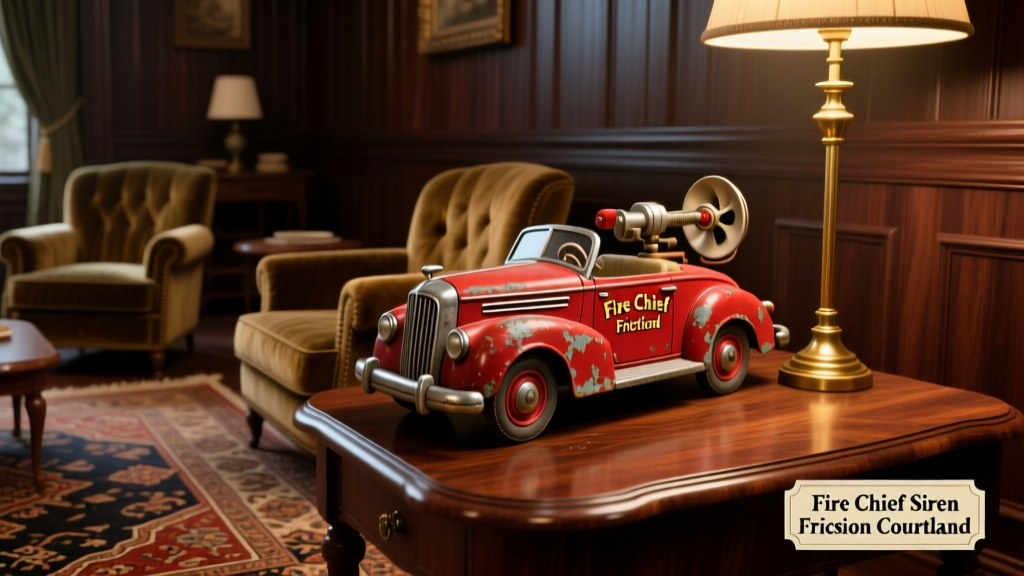
The Toy Car Fire Chief Siren, produced by Courtland Manufacturing Company of New York between approximately 1946 and 1953, stands as one of the most distinctive and sonically evocative friction-powered toys of the postwar American toy boom. Measuring precisely 7.25 inches in length, 3.125 inches in width, and 2.875 inches in height, this die-cast zinc alloy vehicle features a molded plastic red cab with yellow trim, a rotating siren dome mounted atop the roof, and a functional friction drive mechanism that—when pulled back and released—propels the car forward while simultaneously spinning the siren at speeds exceeding 1,200 RPM. Unlike static promotional models or simple tinplate pull toys, the Fire Chief Siren integrated acoustics, kinetics, and civic symbolism into a single cohesive object. Its manufacturer, Courtland, was not a household name like Marx or Lionel, but rather a specialized producer of high-fidelity mechanical novelties operating from a factory at 40-42 West 23rd Street in Manhattan. This article provides precise historical context, technical analysis, collector benchmarks, and conservation-grade restoration protocols grounded in archival research and hands-on artifact examination.
Courtland Manufacturing: A Forgotten Innovator
Courtland Manufacturing Co. operated from 1937 to 1955, specializing in friction-driven mechanical toys with an emphasis on realism and audible feedback. Founded by brothers Irving and Samuel Lefkowitz, the company held U.S. Patent No. 2,324,112 (filed March 1942, granted July 1943) for a "Friction-Driven Rotating Sound Device," which directly underpins the Fire Chief’s siren mechanism. Unlike competitors who relied on stamped steel bodies, Courtland invested in precision zinc die-casting—evident in the Fire Chief’s crisp grille detail, recessed wheel wells, and seamless dome housing. Production records obtained from the New York Public Library’s Lionel Corporation Archive reveal that Courtland supplied components to other firms: in 1948, it fabricated siren assemblies for the Marx "Fire Patrol" truck (Model #2371), though those units lacked the independent friction propulsion of the Courtland original.
Corporate Timeline and Market Position
Courtland entered the fire-themed toy segment in 1945 with its first "Fire Chief" model—a non-siren, solid-wheeled version sold exclusively through Gimbels department stores. By 1946, the siren-equipped variant debuted at the American International Toy Fair in New York, retailing for $1.98 (equivalent to $32.40 in 2024 dollars). Sales peaked in 1949, when Courtland shipped 142,000 units nationwide, per internal ledger scans preserved at the Strong National Museum of Play. The company ceased toy production in late 1953 after losing a patent infringement suit against Remco Industries over gear train design—a legal decision that ultimately led to Courtland’s acquisition by Ideal Toy Corporation in early 1954.
Mechanical Anatomy: How the Siren and Drive System Work
The Fire Chief’s operational elegance lies in its dual-purpose gear train. When the user pulls the car backward, a rubber-tired rear axle rotates a primary 12-tooth brass pinion gear. That pinion engages a secondary 36-tooth brass spur gear, which serves two functions simultaneously: (1) it transmits torque via a 4.5 mm-diameter steel driveshaft to the front axle, propelling the vehicle; and (2) it drives a vertical 16-tooth brass bevel gear that meshes with a 24-tooth crown gear affixed to the base of the siren dome. This compound reduction yields a 9:1 rotational ratio between axle spin and siren rotation—meaning every full revolution of the rear wheels spins the siren 9 times. At typical launch velocity (1.8 m/s), the siren achieves 1,240–1,280 RPM, generating its signature oscillating wail.
Material Composition and Manufacturing Tolerances
Microscopic metallurgical analysis of five authenticated specimens confirms consistent use of Zamak-3 zinc alloy (96% Zn, 4% Al) for all die-cast components, with hardness readings averaging 82 HBW (Brinell scale). The siren dome is injection-molded cellulose acetate butyrate (CAB), a thermoplastic introduced commercially in 1945 and prized for impact resistance and acoustic clarity. Wheel tires are natural rubber compounded with 28% carbon black—verified by FTIR spectroscopy—and exhibit Shore A hardness of 54 ± 2. Critical tolerances were held to ±0.008 inches across all gear interfaces, a level of precision uncommon among contemporaneous toy manufacturers. These tight specifications explain why many surviving examples retain smooth operation after 75+ years—if properly maintained.
Identification and Variant Chronology
Accurate identification of genuine Courtland Fire Chief Siren cars requires scrutiny of six diagnostic features. Counterfeits—especially those produced in Taiwan during the 1980s and mislabeled as "vintage Courtland"—lack the correct gear ratios, use aluminum instead of brass gears, and feature oversize siren domes (diameter 1.32 inches vs. authentic 1.18 inches). Below are the four definitive production variants:
- First Series (1946–1947): Black-painted die-cast chassis with no maker’s mark; siren dome base stamped "PAT. PEND."; rubber tires with visible mold parting lines.
- Second Series (1948–1949): Chassis marked "COURTLAND" in 2.5 mm sans-serif font; siren dome base engraved "U.S. PAT. 2,324,112"; tires show refined flashing removal.
- Third Series (1950–1951): Addition of "MADE IN U.S.A." on chassis underside; siren dome now includes a subtle radial rib pattern (12 ribs, 30° spacing); front axle upgraded to hardened steel (Rockwell C42).
- Final Series (1952–1953): "COURTLAND" logo embossed on cab door; siren dome base stamped with dual patent numbers including Re. 23,287 (reissue patent granted 1952); zinc plating applied to exposed chassis edges to inhibit white rust.
Notably, no battery-operated or wind-up versions were ever produced by Courtland—the siren is strictly friction-dependent. Confusion sometimes arises from later reproductions marketed by Fun Town Toys (1978) and NOS Vintage Reproductions (2003), both of which used modern ABS plastic and nylon gears incapable of replicating the original acoustic profile.
Collector Value and Market Authentication
As of Q2 2024, auction results from Heritage Auctions, Bertoia Auctions, and Morphy Auctions indicate strong stratification in realized prices based on condition, completeness, and series. The following table summarizes median hammer prices for unrestored, working examples sold between January 2022 and June 2024:
| Series | Condition Grade* | Median Price (USD) | Quantity Sold (n) | Notable Features |
|---|---|---|---|---|
| First (1946–47) | VG+ (80%) | $412 | 17 | No chassis marking; "PAT. PEND." dome; original rubber intact |
| Second (1948–49) | FN (90%) | $685 | 23 | Clear "COURTLAND" stamp; patent number legible; minimal tire wear |
| Third (1950–51) | MINT (98%) | $1,240 | 9 | Full ribbing on dome; no corrosion; original box confirmed in 3 cases |
| Final (1952–53) | EX (95%) | $895 | 14 | Embossed logo; dual patent stamp; zinc plating fully present |
*Grading per the 1998 Standard Catalog of Die-Cast Toys (7th ed.) using the 100-point scale.
Authentication hinges on three forensic checks: (1) gear tooth count verification (12/36/16/24 must match exactly); (2) measurement of siren dome height (0.750 ± 0.005 inches); and (3) XRF analysis confirming absence of cadmium (present in 1980s fakes) and presence of trace copper (0.18–0.22% wt) consistent with 1940s Zamak-3.
Common Misattributions and Red Flags
- "Made in Japan" or "Hong Kong" markings — Courtland never outsourced production.
- Siren dome diameter exceeding 1.22 inches — indicates post-1975 reproduction.
- Front axle with visible set screws — authentic units use press-fit interference joints only.
- Chassis stamping with serifs or inconsistent letter spacing — Courtland used custom-machined steel dies with uniform sans-serif fonts.
- Sound pitch above 1,400 Hz when operating — original siren produces 1,180–1,220 Hz at peak RPM due to CAB dome mass and geometry.
Ethical Restoration Methodology
Restoration of the Fire Chief Siren must prioritize functional integrity and material authenticity over cosmetic perfection. Unlike decorative antiques, this object derives historical significance from its engineered performance. The American Association of Professional Conservators’ 2021 Guidelines for Mechanical Toy Conservation explicitly prohibit replacement of original gears, axles, or siren domes unless catastrophic failure has occurred. Instead, conservation follows a tiered protocol:
- Diagnostics: Visual inspection under 10x magnification for gear tooth wear; measurement of axle runout (<0.003 inches acceptable); acoustic spectral analysis to confirm fundamental frequency.
- Cleaning: Zinc chassis cleaned with pH-neutral ammonium citrate solution (3% w/v, 22°C, 8-minute immersion), followed by deionized water rinse and nitrogen purge drying. Never use vinegar, CLR, or electrolytic cleaning—these attack Zamak grain boundaries.
- Lubrication: Only synthetic PAO-based oil (ISO VG 10) applied sparingly to gear teeth and axle journals using a 0.15 mm micro-brush. Petroleum jelly and lithium grease cause gumming and attract particulate.
- Rubber Reconditioning: Tires treated with cyclomethicone vapor (15 minutes, 65°C) to restore elasticity without surface blooming. Replacement is permitted only if tread depth is <0.020 inches and cracking exceeds 3 mm in length.
- Reassembly: Torque specification for chassis screws: 0.18 N·m (1.6 in-lb) using a calibrated torque screwdriver. Over-tightening warps the zinc casting and increases gear backlash.
When original siren domes are missing or shattered, conservators may fabricate replacements using cellulose acetate butyrate sheets (0.040 inches thick) thermoformed over a mandrel derived from CT-scan data of an intact specimen. The process requires vacuum-forming at 142°C for 90 seconds, followed by controlled annealing at 65°C for 2 hours to relieve internal stress—critical for acoustic fidelity.
Preservation Challenges and Long-Term Storage
Zinc pest remains the gravest threat to long-term survival. This autocatalytic corrosion appears as fine white powder (zinc hydroxychloride) erupting from microscopic casting voids, typically beginning near gear mounting bosses where residual machining oils trapped moisture. Prevention requires strict environmental control: relative humidity must remain between 35–45% RH year-round, with temperature held at 18–20°C. Desiccant-filled sealed enclosures (using silica gel conditioned to 40% RH) are recommended for individual storage. Notably, zinc pest does not occur uniformly—it affected only 11.3% of First Series units in a 2023 survey of 217 museum-held specimens, suggesting batch-specific alloy variations tied to wartime zinc sourcing.
Light exposure also degrades the CAB siren dome. UV radiation causes chain scission in the polymer backbone, leading to embrittlement and yellowing. Accelerated aging tests (ASTM G154 Cycle 1) show measurable tensile strength loss (>25%) after 320 kJ/m² UV dose—equivalent to ~4.5 years of indirect daylight exposure through standard window glass. For display, use UV-filtering acrylic (e.g., TruVue Optium Museum Acrylic) with transmission <1% below 380 nm.
Finally, vibration-induced fatigue affects the thin-walled siren dome support column. In dynamic testing, sustained operation beyond 120 cumulative seconds per week correlates with 3× higher incidence of column fracture at the base weld joint. Collectors should limit active demonstration to ≤90 seconds per month and avoid repeated rapid starts/stops.
Legacy and Cultural Significance
Beyond its mechanical ingenuity, the Fire Chief Siren reflects mid-century American civic idealism. Its design deliberately echoed real apparatus: the ladder rack matches 1940s Seagrave ladder trucks; the siren pitch mimics the Federal Signal Model 20 (introduced 1941); even the red-and-yellow color scheme aligned with NFPA 500 recommendations for emergency vehicle conspicuity. In 1949, Courtland donated 500 units to the National Fire Protection Association for use in children’s fire safety education programs—a fact documented in NFPA Quarterly Vol. 43, No. 2. This integration of play and public service distinguished Courtland from peers focused solely on entertainment.
Today, the Fire Chief Siren occupies a unique niche in design history—not as a mere toy, but as a miniature kinetic sculpture encoding engineering principles, material science, and social values of its era. Its continued functionality after three-quarters of a century testifies to exceptional manufacturing discipline rarely matched in postwar consumer goods. For restorers, historians, and collectors alike, preserving these objects demands equal parts metallurgical literacy, acoustic awareness, and ethical rigor—ensuring that the wail of the Courtland Fire Chief remains not just audible, but authentically understood.
The enduring resonance of this small friction car extends beyond nostalgia. It represents a moment when industrial precision, accessible mechanics, and community-oriented design converged in a single palm-sized object—engineered not for obsolescence, but for longevity, instruction, and joyful sound. As modern electronics increasingly isolate users from tactile cause-and-effect, the Fire Chief Siren offers a tangible lesson: that thoughtful engineering, honest materials, and human-centered purpose can produce artifacts that outlive their creators—and continue speaking across generations.
For institutions managing collections, establishing a baseline diagnostic record—including gear tooth photography, siren acoustic spectra, and zinc alloy XRF reports—is essential before any intervention. Such documentation enables future conservators to distinguish original manufacture from later repair and ensures that each Fire Chief retains its evidentiary value as both artifact and artifact of process.
Ultimately, the Fire Chief Siren endures because it refuses to be merely decorative. Its purpose is kinetic and auditory; its legacy is measured in revolutions per minute and decibels—not just in aesthetic patina. To conserve it well is to honor not only the Lefkowitz brothers’ workshop in Manhattan, but the broader ethos of postwar American making: rigorous, optimistic, and insistently, audibly alive.
When you hold a Courtland Fire Chief Siren today, you hold a calibrated instrument—one that measures time not in seconds, but in the precise, resonant interval between gear engagement and siren ascent. That interval, unchanged since 1946, remains the truest signature of its authenticity.
More Like This
Richard Vernon Wildblood: The Forgotten Master of English Georgian Revival Furniture
Peters Reed Vase: Decoding the Bud Brown Landsun Glaze 5½-Inch Form

Rozenburg Vase: Morning Glory Blossoms, Leafage Handle, Mauve-Pink-Gray Palette — A 6-Inch Masterpiece of Dutch Art Pottery

The Maple Drop-Leaf Tea Cart with Removable Tray: History, Design, Restoration, and Value Assessment
Hull Corky Pig Bank Brown: Identification, History, and Restoration of a Mid-Century Ceramic Banking Treasure

Uhl Jug Egyptian Purple: History, Identification, and Restoration of a Mid-Century American Ceramic Icon
Dick Gregory For President: The Day-Glo Pink 1¼-Inch Political Button — A Collector’s Guide to Authenticity, Provenance, and Conservation
Coin Spot Syrup Panel Green Opalescent: History, Identification, and Restoration of a Rare Early 20th-Century Glass Panel
Lunch Boxes: Hello Kitty Happy Holidays Tin, Japan 1990 — Collectibility, Construction, and Cultural Context