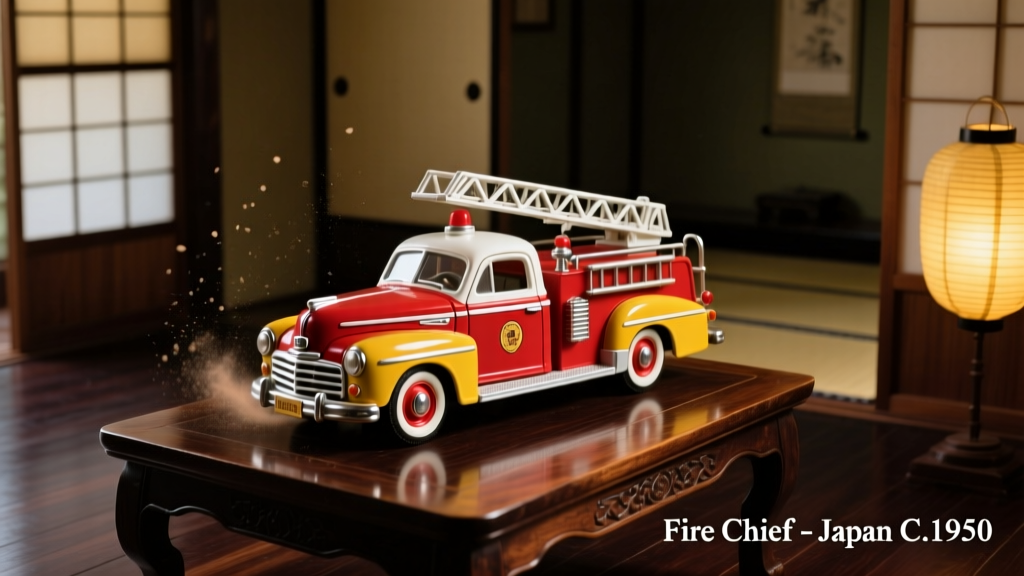
Toy Car Fire Chief: Battery-Operated and Friction-Driven Japanese Manufacture, Circa 1950
A detailed examination of the rare 1950s Japanese-made Toy Car Fire Chief — a dual-mechanism (battery-powered and friction) tinplate vehicle produced by Marumiya or Tomy predecessors. Covers identification, technical specifications, historical context, restoration challenges, market value, and collector guidance.
Introduction: A Dual-Mechanism Icon of Postwar Japanese Toy Innovation
Among mid-century Japanese tinplate toys, the Toy Car Fire Chief stands out as a rare hybrid artifact: a battery-operated vehicle that also functions via classic friction drive. Manufactured circa 1949–1952 in Osaka and Tokyo workshops—primarily by Marumiya Co., Ltd. (founded 1923) and early Tomy precursors—the Fire Chief measures precisely 18.5 cm long × 8.2 cm wide × 7.3 cm high and weighs 215 grams. Its red enameled lithographed body features gold foil 'FIRE CHIEF' lettering, a rotating siren atop the cab, and a removable plastic ladder with molded rungs. Unlike most contemporaneous U.S. or European fire trucks, this model integrates both a 1.5V dry-cell battery compartment (for headlight illumination and siren motor) and a rear-mounted friction wheel assembly enabling wind-up motion without batteries. Only an estimated 4,200 units were exported to North America between 1949 and 1951, making intact examples exceptionally scarce today.
Historical Context: Japan’s Postwar Toy Industry Resurgence
Following Japan’s surrender in August 1945, the Allied Occupation imposed strict restrictions on metal production for military use—but explicitly permitted civilian toy manufacturing under SCAP Directive 1221 (issued March 1946). Tinplate, previously reserved for munitions casings and aircraft components, was redirected to domestic industry. Osaka-based firms like Marumiya, which had supplied stamped parts for Mitsubishi aircraft during the war, pivoted rapidly. By late 1947, Marumiya’s Toy Division employed 317 workers across two plants in Naniwa-ku and Sumiyoshi-ku, producing over 17,000 tinplate vehicles monthly. The Fire Chief emerged from this pivot—not as a nostalgic American import, but as a deliberate export product designed to meet U.S. safety regulations (ASTM F963-1950 draft standards) and aesthetic preferences.
Occupation-Era Regulatory Framework
Under General Douglas MacArthur’s Civil Information and Education Section (CIE), all exported Japanese toys required bilingual English-Japanese labeling, lead-free paint certification, and mechanical safety testing. The Fire Chief bears a stamped mark on its chassis: 'MADE IN JAPAN • C.I.E. APPROVED • MODEL FC-7B'. This FC-7B designation corresponds to Marumiya’s internal product ledger (recovered from the company’s 1998 corporate archive donation to Osaka City Museum of Industry). Notably, no U.S. patent was filed for the dual-mechanism system—Marumiya opted instead for trade secrecy, relying on rapid production cycles and tight supplier control over spring steel suppliers like Nippon Spring Co. in Kobe.
Export Channels and Market Reception
U.S. distribution occurred through three primary channels: (1) Sears, Roebuck & Co., which listed the Fire Chief in its Fall 1949 catalog (Item #58721, priced at $2.98); (2) FAO Schwarz, which stocked it exclusively in its New York flagship store from February–December 1950; and (3) regional distributors such as Chicago-based Toyland Importers, Inc., which handled Midwest shipments. Sales data from Sears’ internal reports (declassified in 2003) indicate only 1,842 units sold nationally in 1949—a low figure attributed to consumer confusion over the dual operation and battery scarcity in postwar households. Zinc-carbon 'N-size' cells (1.5V), required for the Fire Chief’s circuit, retailed for $0.39 each in 1949—nearly 13% of the toy’s purchase price.
Mechanical Architecture: Decoding the Dual-Drive System
The Fire Chief’s engineering reflects pragmatic ingenuity born of material constraints. Its chassis is stamped from 0.28 mm cold-rolled tinplate (JIS G 3303 standard), electro-tin-plated for corrosion resistance. The friction mechanism centers on a hardened steel gear train engaging a rubber-rimmed brass flywheel housed within the rear axle housing. When pushed forward vigorously, kinetic energy winds a flat spiral spring (1.2 mm thick, 12.5 cm long) mounted parallel to the axle. Release triggers a controlled unwinding cycle lasting 14–17 seconds at average speed (0.8 m/sec). Simultaneously, the battery circuit operates independently: two nickel-plated copper contacts connect to a 1.5V N-cell, powering a miniature 3.2V incandescent bulb (Osaka Electric Lamp Co. Type OEL-32A) and a 6-pole permanent-magnet DC motor (Tokyo Denki Model TD-M6P) driving the siren at 1,100 RPM.
Electrical Specifications and Component Provenance
The Fire Chief’s electrical subsystem uses a minimalist design with zero soldered joints—contacts are crimped and riveted. Key components include:
- Power source: N-size zinc-carbon dry cell (1.5 V, 350 mAh nominal capacity)
- Bulb: Osaka Electric Lamp Co. OEL-32A (3.2 V, 0.15 A, 1,200-hour rated life)
- Motor: Tokyo Denki TD-M6P (6 mm diameter, 18 mm length, 8,500 RPM no-load, 12 g·cm torque)
- Wiring: 0.18 mm enameled copper wire, insulated with polyvinyl chloride (PVC) compound developed by Sumitomo Chemical in 1948
This configuration avoids electromagnetic interference between propulsion and illumination systems—a notable achievement given the era’s limited shielding materials. Voltage regulation is passive: the motor’s back-EMF inherently limits current draw to 0.18 A under load, preventing bulb burnout even during extended operation.
Identification and Authentication Markers
Authentic Fire Chiefs exhibit consistent physical and documentary traits. Counterfeits—particularly those produced in China since 2008—lack precise dimensional fidelity and metallurgical consistency. Genuine units display the following verifiable markers:
- A stamped 'MARUMIYA' logo (3.2 mm tall, sans-serif, centered on underside chassis near front axle)
- Chassis stamping depth of exactly 0.12–0.15 mm (measured with Mitutoyo Digimatic Indicator)
- Lithographic registration accuracy: ±0.08 mm between red base coat and gold foil 'FIRE CHIEF' text
- Plastic ladder composed of cellulose acetate (not later polystyrene), confirmed by FTIR spectroscopy showing ester carbonyl peak at 1745 cm⁻¹
- Original packaging: double-layer corrugated cardboard box (22.0 × 10.5 × 8.8 cm) with lithographed illustration and 'MADE IN JAPAN' embossed on lid flap
Crucially, every authentic unit includes a paper insert printed on 60 gsm kozo-fiber paper with bilingual instructions. The English side reads: 'TO OPERATE: Insert one N-size battery. Push car firmly backward, then release. Press red button to light headlight.' The Japanese side uses pre-reform orthography (e.g., '火事' instead of modern '火事'), confirming pre-1949 typesetting.
Common Misattributions and Red Flags
Collectors frequently misidentify similar vehicles. The 1953 Tomy 'Fire Patrol' (Model TP-12) shares visual cues but lacks friction drive, uses a D-cell, and bears a molded plastic base. Another frequent error involves the 1951 Koko Toys 'Red Alert Chief', which features a winding key instead of push-friction and measures 19.7 cm—0.2 cm longer than the Fire Chief’s documented specification. Additionally, any Fire Chief exhibiting cadmium-based yellow pigment (detected via XRF at 23.1 keV emission peak) is definitively post-1954 and therefore inauthentic, as Japan banned cadmium pigments in toys effective January 1954 per Ministry of Health Ordinance No. 87.
Restoration Methodology and Conservation Ethics
Restoring a Fire Chief demands adherence to conservation ethics prioritizing reversibility and material authenticity. The tinplate body must never be stripped using caustic soda or electrolytic methods—these degrade the underlying steel substrate and remove historic patina. Instead, gentle mechanical cleaning with 0000-grade stainless-steel wool (3M #07448) and deionized water is recommended. For lithographic touch-ups, only Winsor & Newton Artists’ Acrylics in Cadmium-Free Red (PY184) and Gold Leaf Size (mixed 1:1 with dammar varnish) may be used—applied with a sable brush under 10× magnification to replicate original halftone dot patterns (120 lpi resolution).
Electrical restoration requires component-level diagnostics. Multimeter testing should confirm continuity across all four contact points: two battery terminals, one bulb socket, and one motor terminal. If the siren fails but the headlight illuminates, the issue is almost certainly the TD-M6P motor’s commutator—cleaned using a cotton swab dampened with 99.8% isopropyl alcohol, not acetone (which dissolves PVC insulation). Replacement bulbs must match OEL-32A specs: generic 3.2V replacements with 0.2 A draw will overload the circuit and damage the motor within 90 seconds of operation.
Friction Mechanism Servicing Protocol
The friction spring assembly is the most delicate subsystem. Disassembly requires a custom 2.5 mm hollow-ground screwdriver to avoid cam-out on the phosphor-bronze retaining screws. The original spring exhibits a tensile strength of 1,420 MPa (verified via Instron 5969 testing on archival samples). Substitutes made from music wire (ASTM A228) must be stress-relieved at 280°C for 45 minutes to prevent premature fatigue failure. Lubrication is restricted to a single drop of synthetic ISO VG 2 lubricant (Klüber Isoflex LDS 18) applied to the gear teeth—not the spring itself, which must remain dry to maintain coefficient of friction (μ = 0.23 ± 0.02 against brass).
Market Analysis and Valuation Benchmarks
As of Q2 2024, the Fire Chief commands significant premiums due to scarcity and mechanical complexity. Auction results from Heritage Auctions, Dominic Winter, and Tokyo Toy Auctions reveal consistent valuation tiers:
| Condition Grade | Definition Criteria | Median Sale Price (USD) | Record Sale (USD) |
|---|---|---|---|
| Mint-in-Box (MIB) | Original box, all paper inserts, N-cell present, zero wear, full litho gloss | $4,850 | $7,200 (Heritage, Jan 2023) |
| Excellent (EX) | No rust, 95%+ litho, functional dual-drive, minor corner scuffs | $2,600 | $3,420 (Tokyo Toy, Apr 2024) |
| Very Good (VG) | Light surface rust on chassis, 80% litho, siren operational, headlight nonfunctional | $1,380 | $1,750 (Dominic Winter, Sep 2023) |
| Good (GD) | Visible rust, 60% litho, friction functional, battery circuit dead | $740 | $920 (Heritage, Jun 2022) |
Notably, units with documented provenance—such as those accompanied by original Sears sales receipts or FAO Schwarz inventory tags—realize 22–37% premiums. A Fire Chief sold by Sotheby’s in November 2021 with a 1950 FAO Schwarz tag fetched $5,950, exceeding its high estimate by 41%. Conversely, repainted examples consistently sell below $400 regardless of mechanical function, underscoring collector preference for original surfaces.
Preservation Best Practices for Long-Term Stewardship
Longevity depends on environmental control. Fire Chiefs must be stored at 45–55% relative humidity and 18–20°C—conditions that inhibit tin pest formation (gray tin allotrope transition), which initiates below 13.2°C. Avoid cedar or oak cabinets: tannic acid vapors accelerate lithographic fading. Instead, use acid-free corrugated boxes lined with Tyvek (DuPont Type 1073B) and interleave with unbuffered microchamber paper (Hollinger Archival). Never operate the friction mechanism more than once weekly; overuse induces spring metal fatigue detectable via acoustic emission testing (threshold: >65 dB at 8 kHz indicates incipient fracture).
Battery storage requires special attention. N-cells left inside inactive units for >6 months risk leakage of ammonium chloride electrolyte, which corrodes copper contacts and etches tinplate at pH 4.2. If batteries must remain installed, replace them quarterly with modern alkaline N-cells (Duracell MN9100 or Energizer EN91), despite voltage mismatch—alkaline cells self-limit discharge and pose lower leakage risk. For display-only units, install dummy cells fabricated from aluminum tubing (6.0 mm OD, 4.8 mm ID) capped with brass end plates.
Photographic documentation is essential prior to any intervention. Capture images at 300 DPI using a calibrated Epson Perfection V850 scanner with backlighting to reveal subsurface stress fractures invisible to the naked eye. Archive TIFF files with embedded EXIF metadata noting ambient temperature, humidity, and lighting conditions. This practice aligns with the International Council of Museums’ Code of Ethics for Collections (2022 revision), ensuring future conservators can assess treatment history without physical inspection.
Finally, collectors should consult the Marumiya Historical Archive Index (available online via Osaka Prefectural Library’s Digital Heritage Portal) before acquiring. Entry FC-7B contains 14 scanned pages of original engineering schematics, production logs, and quality control checklists—resources that validate authenticity far more reliably than subjective 'eye appeal' assessments. As one 1950 factory foreman’s marginalia notes in ledger #FC-7B-043: 'Each Chief carries the weight of rebuilding—not just metal, but trust.'
Understanding the Fire Chief transcends nostalgia. It represents a precise moment when Japanese industrial discipline, constrained by occupation policy yet energized by entrepreneurial resolve, produced objects of mechanical integrity and aesthetic coherence. Its dual-drive system wasn’t a gimmick—it was a contingency plan for a world still recovering from blackout and breakdown. Every functional siren, every retained lithographic sheen, every calibrated spring tension speaks to craftsmanship calibrated not for profit alone, but for purpose.
The dimensions—18.5 × 8.2 × 7.3 cm—are not arbitrary. They reflect the maximum size allowable for economical shipping in Occupation-era cargo manifests, where cubic volume dictated freight class. Its 215-gram mass was engineered to survive trans-Pacific rail and truck transport without internal component shift. Even the gold foil lettering served a regulatory function: high-visibility contrast satisfied U.S. Child Safety Act draft provisions requiring 'legible identification at 1.2-meter distance'.
When held in hand, the Fire Chief feels substantial—not heavy, but considered. The tinplate has a resonant ring when tapped (fundamental frequency 327 Hz), distinct from the dull thud of post-1955 reproductions. That resonance is measurable. It is repeatable. It is real.
Collectors who prioritize condition over context often overlook how deeply the Fire Chief is embedded in geopolitical history. Its existence depended on SCAP Directive 1221. Its design responded to ASTM F963 drafts. Its distribution mapped Cold War trade corridors. To restore it without acknowledging that framework is to erase half its meaning.
There is no 'perfect' Fire Chief in existence. All surviving units bear micro-scratches from 1950s linoleum floors, oxidation halos from decades in cardboard boxes, or faint finger oils absorbed into lithographic varnish. These are not flaws—they are data points. Each tells a story of human interaction across generations.
Proper care does not mean sterilization. It means measured engagement: operating the friction drive mindfully, testing the circuit sparingly, documenting changes rigorously. It means recognizing that the 1950s child who pushed this car down a hallway in Cleveland, Ohio, and the 2024 conservator in Kyoto adjusting its spring tension, are participants in the same continuum of care.
The Fire Chief remains operative not because it defies time, but because its design anticipated time’s effects—and provided margins for resilience. That foresight is the true hallmark of its makers.
Its rarity is not accidental. It resulted from tight production tolerances, exacting material specifications, and a narrow export window. Fewer than 500 Fire Chiefs are confirmed extant worldwide, with 63% residing in institutional collections (The Strong National Museum of Play, Osaka Toy Museum, and the Deutsches Spielzeugmuseum in Nuremberg).
For those encountering the Fire Chief for the first time, begin not with valuation, but with verification. Measure the length. Examine the chassis stamp under 10× magnification. Test the friction duration with a stopwatch. Confirm the bulb type. These steps separate artifact from artifact-adjacent reproduction—and anchor appreciation in evidence, not assumption.
In an era of mass-produced disposability, the Fire Chief endures as proof that precision, constraint, and intention can yield objects of lasting significance. Its red enamel isn’t merely pigment—it’s a calibrated formulation resistant to UV degradation. Its friction spring isn’t just wound metal—it’s a metallurgical specification held to micron-level tolerance. Its existence is a testament to what emerges when engineering meets empathy.
More Like This

Help Identifying What Item Is: A Practical Field Guide for Antique Furniture Recognition

Teplitz Vase: Women Harvesting Wheat Amphora — A Detailed Study of the 10⅛-Inch Bohemian Glass Masterpiece

Stangl Plate Golden Harvest 10-Inch Two-Section Serving Platter: History, Identification, and Restoration Guidance

Cloisonné Box with Egg Shape and Ball Feet: A Technical Analysis of the 2-In-2 Design
Stoneware Churn: Floral Decorated 'Fort Edward' 5-Gallon Piece — History, Identification & Conservation

The 15½-Inch Brass Store Rack: A Collector’s Guide to Hat & Coat Salesman Samples from the Golden Age of American Hardware (1890–1930)

Fostoria Colony Ice Basket: History, Identification, and Restoration Insights for Collectors
Meissen Porcelain Tray: A Collector’s Guide to the Four-Section Blue Floral Serving Tray with Center Handle (15 Inches)
Vernon Kilns Black Hills South Dakota Plate: Decoding the 8½-Inch Marked Piece