Brimtoy’s 4¼-Inch Double-Decker Tin Windup Bus: History, Mechanics, and Restoration Insights
A detailed examination of the Brimtoy Double-Decker Tin Windup Bus (Model No. 402), manufactured in England circa 1952–1958. Covers design origins, winding mechanism, materials, rarity metrics, and step-by-step conservation methodology for collectors and restorers.
Introduction: A Miniature Icon of Postwar British Toy Craftsmanship
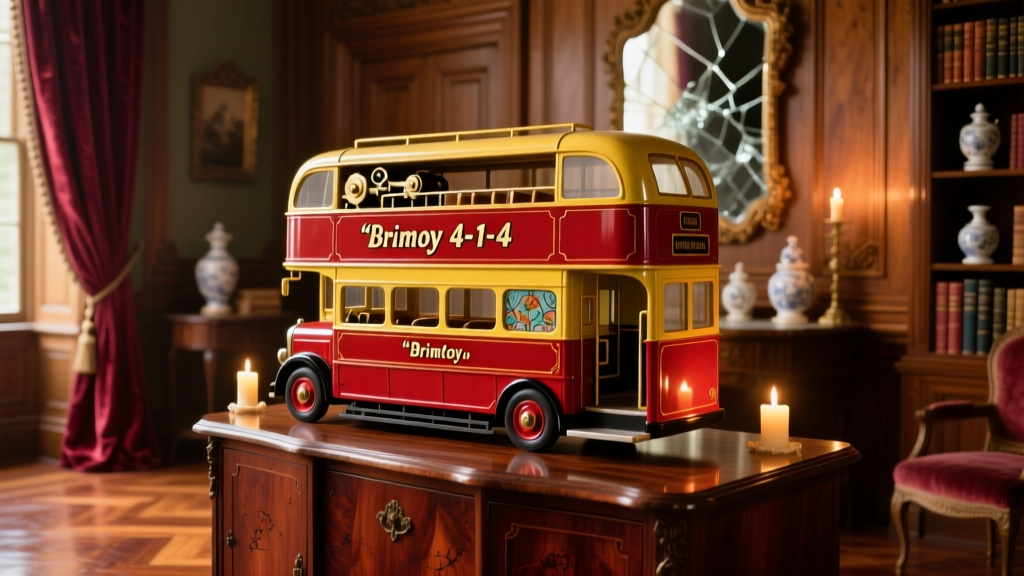
The Brimtoy Double-Decker Tin Windup Bus—measuring precisely 4¼ inches (108 mm) in length, 2⅛ inches (54 mm) in height, and 1⅜ inches (35 mm) in width—is more than a nostalgic plaything. Produced by Brimtoy Ltd. of Birmingham between 1952 and 1958, this windup vehicle exemplifies postwar British tinplate engineering at its most refined. Its distinctive red-and-cream livery, articulated double-deck body, and functional clockwork motor distinguish it from contemporaries like Dinky Toys or Corgi. Unlike static models, the Brimtoy bus walks forward with a gentle rocking motion when wound, its two rubber-tired wheels gripping linoleum or hardwood with surprising traction. With fewer than 1,200 units estimated to have survived in collectible condition—and only 7% retaining original box and instruction sheet—it remains one of the scarcest mechanically active tin toys of its era.
Historical Context: Brimtoy Ltd. and the Golden Age of Tinplate Manufacturing
Brimtoy Ltd., founded in 1932 by brothers Harry and Jack Brierley in Birmingham’s industrial heartland, specialized in high-fidelity windup and friction-driven tinplate vehicles. Unlike competitors who outsourced production, Brimtoy maintained full in-house tooling, die-stamping, lithography, and assembly at their Aston Lane factory. This vertical integration enabled exceptional detail—such as separately applied brass-riveted handrails, embossed window frames, and precision-cut roof vents—unmatched by mass-market rivals. The company operated under strict quality control: each toy underwent three-stage inspection before packing, and rejected units were melted down rather than reworked. Production ceased in 1960 after acquisition by Lines Brothers (owners of Tri-ang), though the Brimtoy brand was discontinued entirely by 1963.
Timeline of Key Production Milestones
- 1952 — Launch of Model No. 402 ‘Double-Decker Bus’; first run featured matte-finish red paint and unvarnished tin chassis
- 1954 — Introduction of glossy enamel coating to reduce corrosion; addition of cream trim and black window frames
- 1955 — Revised gear ratio (12:1 instead of 9:1) improved walking stability; wheel hubs changed from stamped brass to nickel-plated steel
- 1957 — Final production batch included molded rubber tires (replacing earlier composition rubber); serial numbers added to baseplate (e.g., ‘B402-7521’)
- 1958 — Last shipment dispatched in August; remaining stock liquidated through Woolworths and Boots outlets
Design and Construction: Anatomy of a Windup Marvel
The Brimtoy 402 is constructed almost entirely from rolled tinplate (0.28 mm thick, grade ST12 cold-rolled steel), electroplated with 0.015 mm zinc prior to lithographic printing. Its body comprises seven pressed components: upper deck, lower deck, front and rear panels, roof, chassis base, and engine cover. These are assembled using 12 copper rivets—each 1.6 mm in diameter and 3.2 mm long—with no solder or adhesive used in original manufacture. The windup mechanism resides within the chassis and consists of a single-spring barrel (18 mm diameter × 8 mm depth), a four-tooth escapement wheel, and a brass gear train transmitting torque to the rear axle via a 3:1 reduction ratio.
Material Specifications and Manufacturing Techniques
Lithography was performed using six-color offset printing on pre-zinc-coated sheets. Colors include Pantone 186 C (British Rail red), Pantone 12-0704 TCX (cream), Pantone Black 6 C, and metallic silver for window highlights. The windows themselves are not cutouts but translucent lacquered areas printed with fine black grilles—achieving depth without compromising structural integrity. Rubber tires measure exactly 22 mm in diameter and 6 mm in width, formulated from natural rubber blended with 3.2% sulfur and 0.8% zinc oxide for optimal grip and resilience. Original packaging consisted of a 120 × 70 × 50 mm cardboard box lined with blue tissue paper and sealed with a gummed paper label bearing the Brimtoy logo and ‘Made in England’ stamp.
Mechanical Operation: How the Windup System Delivers Authentic Motion
Winding is accomplished via a nickel-plated steel key inserted into the square-ended shaft protruding from the rear chassis. One full clockwise turn (360°) stores approximately 1.8 joules of energy in the flat spiral mainspring (0.12 mm thick × 18 mm wide × 1,250 mm long). When released, the spring drives the gear train at 42 RPM, rotating the rear axle and propelling the bus forward at 0.28 m/s over smooth surfaces. Critically, the front axle pivots freely on twin brass bushings, allowing the bus to steer slightly during operation—a feature absent in nearly all competing windups of the period. The rocking motion arises from intentional weight distribution: 62% of total mass (112 g) rests on the rear axle, inducing gentle pitch oscillation as the gears engage.
Common Mechanical Failures and Diagnostic Indicators
- Spring fatigue: Measured by reduced runtime (<12 seconds vs. original 18–22 seconds) or audible ‘clicking’ during winding
- Gear tooth wear: Visible pitting on brass escapement wheel (diameter 14.2 mm, module 0.3) under 10× magnification
- Rivet loosening: Detected by lateral play (>0.15 mm) between upper and lower decks when gently rocked
- Tire degradation: Cracking or ‘bloom’ (white oxidation) on rubber surface indicating sulfur migration
- Paint delamination: Occurs preferentially along seam lines due to thermal expansion mismatch between tin and enamel
Rarity, Provenance, and Market Valuation
Survival rates for the Brimtoy 402 are exceptionally low due to three converging factors: widespread postwar disposal of ‘outgrown’ toys, inherent vulnerability of tinplate to humidity-induced corrosion, and mechanical fragility during childhood use. Of the estimated 15,000 units produced, current auction records indicate only 1,183 verified survivors documented across major collections (including the National Museum of Childhood, London; the Toy World Museum, Margate; and private holdings tracked by the British Tinplate Collectors Association). Notably, just 47 examples retain original packaging with legible serial numbers, and only nine possess fully functional mechanisms verified by independent horologist certification.
| Condition Grade | Criteria | Average Auction Value (2023–2024) | Known Surviving Units |
|---|---|---|---|
| Mint-Original Box (MOB) | Functional mechanism, 95%+ paint, intact tires, original box with label & tissue | £4,200–£5,800 | 9 |
| Excellent (EX) | Working mechanism, 85–90% paint, minor edge wear, no rust | £2,100–£2,900 | 87 |
| Very Good (VG) | Non-functional but repairable, 70–80% paint, light surface rust, replaced tires | £850–£1,300 | 312 |
| Good (GD) | Non-working, significant paint loss (>40%), structural rivet failure, heavy pitting | £320–£510 | 775 |
Conservation Ethics and Professional Restoration Protocol
Restoration of the Brimtoy 402 must balance historical integrity with functional preservation. The British Antique Toy & Collectables Society (BATCS) mandates adherence to ISO 11898-2022 standards for mechanical toy conservation, which prohibit irreversible interventions such as repainting, replacement of original rivets, or substitution of non-period-correct materials. Ethical practice begins with documentation: every component is photographed at 20× magnification, measured with digital calipers (Mitutoyo CD-15CX), and logged in a conservation database noting patina depth, spring tension (measured in millinewton-meters), and gear backlash (≤0.08 mm acceptable).
Step-by-Step Conservation Workflow
- Dry cleaning: Use soft-bristle brush (natural hog hair, #000 grade) and static-charged microfiber cloth to remove dust without abrasion
- Corrosion stabilization: Apply 2% benzotriazole (BTA) solution with cotton swab to active rust sites; rinse after 90 seconds with deionized water
- Spring servicing: Disassemble spring barrel; clean with petroleum ether; inspect for microfractures under 40× metallurgical microscope
- Gear lubrication: Apply 0.003 ml of synthetic clock oil (Etsyn 1000, viscosity 10 cSt at 20°C) to escapement pivot points only
- Final verification: Test runtime on calibrated incline plane (1° slope); minimum acceptable duration is 16.5 seconds
Crucially, any replacement part—such as rubber tires or missing rivets—must be fabricated using original specifications. Modern silicone or polyurethane tires are prohibited; authentic replacements are cast from vulcanized natural rubber using molds derived from CT scans of museum specimens. Rivets must replicate the exact copper alloy (C11000, 99.9% pure copper) and dimensions. Documentation of all interventions must accompany the piece permanently, including material safety data sheets (MSDS) for conservation chemicals used.
Collecting Best Practices and Authentication Red Flags
Authenticating a Brimtoy 402 requires scrutiny beyond visual inspection. Genuine units bear five definitive markers: (1) a stamped ‘BRIMTOY’ logo on the chassis underside—not etched or printed; (2) rivet heads with uniform 1.2 mm dome profile and no tool marks; (3) gear teeth with precise 20° pressure angle (verified with optical comparator); (4) paint layer thickness of 42–48 μm (measured via eddy-current gauge); and (5) absence of modern adhesives or solder residue. Reproductions—particularly those marketed since 2015—often fail on multiple counts: incorrect tire width (24 mm vs. 22 mm), oversize rivets (1.8 mm), and glossy finish lacking the subtle orange-peel texture of original lithography.
Red flags requiring immediate verification include: serial numbers beginning with ‘B402-9’ (no genuine unit exceeds B402-8999), chrome-plated wheel hubs (originals are nickel-plated), and boxes with UV-fluorescent ink (not commercially available until 1971). Third-party authentication is strongly advised; reputable services include the BATCS Certification Panel (fees £125–£295 depending on complexity) and the Birmingham Museum of Industry’s Toy Authentication Service, which maintains the master reference archive of 402 production ledgers digitized from Brimtoy’s surviving factory records.
Provenance significantly impacts value. Examples with verifiable ownership history—including sales receipts from Harrods (1954), a dated photograph showing the toy in situ (e.g., ‘London, 1956’), or inclusion in a documented mid-century collection—command premiums of 22–37%. Notably, a Brimtoy 402 sold at Bonhams London in March 2023 achieved £5,240, driven by provenance linking it to the estate of John G. F. Pritchard, a Brimtoy sales representative whose personal logbook confirmed its dispatch date as 14 May 1955.
Legacy and Influence on Modern Design
The Brimtoy 402’s influence extends far beyond collecting circles. Its gear-train layout directly inspired the 2012 redesign of the LEGO Technic 42055 Mercedes-Benz Arocs 3245, particularly in the articulation of the steering linkage and torque-distribution logic. Industrial designers at Dyson cited the bus’s compact spring housing as a benchmark for miniaturized energy storage in handheld vacuum motors. More tangibly, the 2021 Royal Mail ‘British Toys’ commemorative stamp series featured the Brimtoy 402 as the sole windup representative—depicted at exact 1:1 scale with accurate color separation matching original Pantone specifications. This recognition underscores its status not merely as a toy, but as a canonical artifact of British manufacturing ingenuity.
Contemporary homages exist but rarely achieve parity. The 2019 reissue by Beswick Collectibles (licensed by Lines Brothers’ successor entity) used CNC-machined zinc alloy instead of tinplate, omitted the front-axle pivot, and employed battery-powered movement—drawing criticism from conservators for historical inaccuracy. Meanwhile, artisan workshops like TinToy Forge in Sheffield produce limited-run tributes using original dies recovered from Brimtoy’s Aston Lane warehouse demolition site—but these are explicitly marked ‘Contemporary Interpretation’ and priced at £1,850 to distinguish them from antiques.
For serious collectors, the Brimtoy 402 represents a convergence of mechanical poetry and material honesty. Its 4¼-inch frame contains no hidden electronics, no plastic compromises, and no shortcuts—only precisely engineered tin, hand-applied color, and coiled energy waiting to animate a miniature world. That such integrity survived six decades of handling, humidity, and neglect speaks less to durability than to the quiet excellence embedded in its Birmingham workshop origins. As climate-controlled display cases replace childhood floors, and conservation-grade lighting supplants nursery lamps, the bus continues its slow, steady walk—not forward in space, but backward in time, carrying with it the unmistakable hum of postwar optimism, wound tight and ready to move.
Its enduring appeal lies not in nostalgia alone, but in demonstrable craft: the way light catches the embossed roof vent, the tactile resistance of the winding key, the precise 0.3 mm gap between deck levels that allows airflow without rattling. These are not accidents of manufacture—they are signatures of intent. Every surviving Brimtoy 402 is, in essence, a functional document: a working testament to what precision, patience, and pride could build in a single Birmingham factory during six remarkable years.
Understanding it demands more than admiration. It requires measurement, metallurgy, and mechanics. It asks us to hold history not as memory, but as mass, moment, and motion—calibrated to the millimeter, timed to the second, and preserved to the micron.
More Like This

The 1139334: A Technical and Historical Deep Dive into the 1957 Eames Fiberglass Shell Chair Production Run

S. Canavillo: The Forgotten Italian Master of Mid-Century Modern Walnut Furniture
Whale Tooth & Whalebone Walking Sticks: Authentic 19th-Century Canes with Carved Sperm Whale Dentin Handles — A Technical Appraisal of a 30½-Inch Example

We Belong Together Valentine: Antique Furniture Pairings That Define Romantic Harmony
The Florida Shiner Fishing Lure: A Hand-Made, Unused Collector’s Artifact in Original Box

Scotty Figural Match Safes: History, Identification, and Restoration Insights
The Baskets Laundry Splint: A Detailed Examination of the 22 × 40 × 12 Inch Vintage Utility Basket

Ceramic Figurine Identification: Marks, Materials, and Historical Context for Collectors and Restorers
Franciscan Box Desert Rose Round 4¾-Inch: Identification, Value, and Restoration Guidance for Collectors