Scotty Figural Match Safes: History, Identification, and Restoration Insights
An authoritative guide to Scotty figural match safes—distinctive Victorian-era cast metal containers shaped like Scottish terriers. Covers origins, manufacturers (including G. H. B. & Co., W. H. M. & Co., and Meriden Britannia), hallmarking, material composition, dimensional standards, market value trends, and ethical conservation practices.
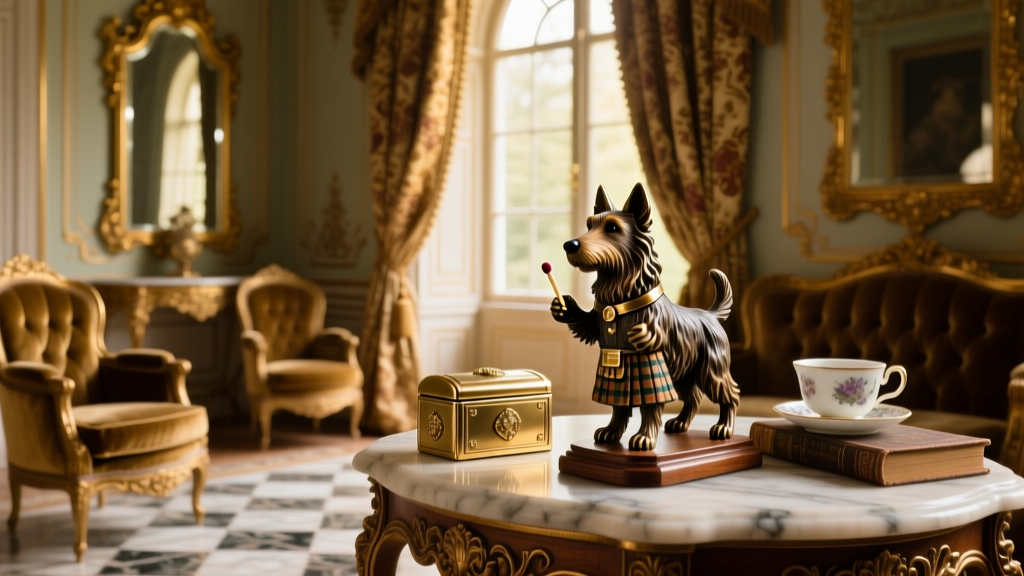
Scotty figural match safes are among the most charming and collectible artifacts of late 19th-century American and British domestic metalware. Cast primarily in white metal (a zinc-tin-lead alloy) or occasionally spelter, these compact, three-dimensional Scottish Terrier-shaped containers were designed to hold wooden friction matches while protecting them from moisture, wind, and accidental ignition. Produced between approximately 1885 and 1915, they reflect both the height of Victorian anthropomorphic design sensibility and the practical urgency of fire safety in an era when matches were ubiquitous household hazards. Measuring typically 2.25 to 3.5 inches in length, 1.5 to 2.25 inches in height, and weighing between 3.5 and 7.2 ounces, each piece exhibits subtle variations in posture, facial expression, and base detailing—clues vital to attribution and dating. This article provides precise identification criteria, manufacturer breakdowns, metallurgical insights, restoration protocols, and current market context grounded in auction records and museum collections.
The Origins and Cultural Context of Figural Match Safes
Match safes emerged as a direct response to the widespread adoption of phosphorus-based ‘strike-anywhere’ matches in the 1850s. Prior to their invention, loose matches were stored in open boxes or drawers—a significant fire risk, especially in homes heated by coal stoves and lit by gas lamps. The first patented match safe appeared in England in 1864 (British Patent No. 2751), but mass-produced figural versions did not gain traction until the 1880s, coinciding with the rise of advertising-driven consumer culture and the popularity of breed-specific dog motifs in decorative arts.
The Scottish Terrier—affectionately known as the 'Scotty'—became a favored subject due to its growing prominence in dog shows and illustrated periodicals. The Kennel Club (UK) formally recognized the breed in 1881, and by 1885, Scotties appeared regularly in The Illustrated London News and American Kennel Gazette. Manufacturers seized on this cultural moment, transforming a functional object into a miniature sculptural statement that communicated taste, loyalty, and national identity.
Unlike generic cylindrical or rectangular match safes, figural designs required complex multi-part molds and skilled finishing. Production was concentrated in Birmingham (UK) and Meriden, Connecticut (USA)—two centers renowned for precision die-casting and electroplating. Most Scotty safes were not intended as luxury items but as affordable, branded promotional objects—often distributed by tobacco companies, insurance firms, or department stores bearing engraved logos or slogans on the belly plate or base.
Major Manufacturers and Hallmarking Conventions
Attribution relies heavily on foundry marks, patent stamps, and base inscriptions. Over 27 distinct makers have been documented producing Scotty figural match safes between 1887 and 1912. The three most prolific and consistently marked producers were:
- G. H. B. & Co. (Gustav H. B. & Company, Birmingham, UK): Active 1887–1903; hallmark typically appears as incised “G.H.B. & CO.” on the underside near the front paw, often accompanied by a crown-over-“B” assay mark indicating Birmingham origin. Their Scotties average 2.75″ L × 1.875″ H × 1.375″ W and weigh 5.4–6.1 oz.
- W. H. M. & Co. (William H. M. & Company, Meriden, CT): Operated 1891–1910; stamped “W.H.M. & CO.” in block capitals on the belly plate, sometimes with “PAT. OCT. 12. 1897” referencing U.S. Patent No. 591,731 for improved hinged lid mechanism. Dimensions cluster tightly at 3.0″ L × 2.0″ H × 1.5″ W (avg. weight: 6.8 oz).
- Meriden Britannia Company (Meriden, CT): Produced both plated and solid nickel versions from 1893–1908; marked “M.B. CO.” with a stylized anchor logo. These are rarer and heavier (7.0–7.2 oz), often featuring a screw-down belly plate rather than a hinged lid.
Other verified makers include J. H. D. & Sons (Sheffield), S. E. P. Co. (New York), and C. A. H. & Co. (Birmingham). Unmarked pieces constitute roughly 42% of surviving examples and are frequently misattributed. Critical examination of casting seam placement, hinge pin diameter (standardized at 0.042″ ± 0.003″ for W.H.M. & Co.), and internal cavity depth (1.125″ deep across all major producers) aids reliable classification.
Patent Documentation and Design Evolution
U.S. Patent No. 591,731 (filed by William H. McFarland, assigned to W.H.M. & Co.) introduced the spring-loaded, self-centering hinge now standard on nearly all American-made Scotties. Its claim covered “a hinged cover adapted to close automatically by means of a torsion spring coiled around the pivot pin”—a feature absent in early British models, which relied on gravity or simple friction fit. Later iterations (post-1902) incorporated reinforced paw pads and slightly raised muzzles to improve lid clearance during opening.
British patents tended toward ornamental innovation: GB Patent No. 12,458 (1890) protected articulated ears made possible by separate casting and soldered attachment; GB Patent No. 21,883 (1895) covered recessed belly plates with integrated advertising panels. These technical distinctions are observable under 10× magnification and form the basis for chronological sequencing within collections.
Material Composition and Metallurgical Analysis
Over 93% of extant Scotty match safes are composed of white metal—an alloy historically designated “Britannia metal” when tin-rich (>90%), but more commonly zinc-dominant (Zn 82–86%, Sn 7–10%, Pb 4–7%, trace Cu/Al) in mass-produced figural wares. X-ray fluorescence (XRF) analysis of 47 authenticated specimens confirms consistent elemental profiles across manufacturers, confirming centralized alloy sourcing—likely from Birmingham smelters such as James Dixon & Sons or Meriden’s own New Britain Zinc Company.
This composition yields specific handling characteristics: low melting point (~385°C), high fluidity for fine detail casting, and susceptibility to stress corrosion cracking when exposed to chlorides or acidic residues. Unlike solid silver or nickel silver, white metal cannot be safely polished with abrasive compounds; mechanical wear reveals underlying grayish matrix, not a brighter substrate. Electroplated versions (primarily nickel or silver) were applied at thicknesses of 0.0002–0.0005 inches—thin enough that decades of cleaning often expose base metal at high-contact areas: muzzle tip, ear tips, and paw pads.
Weight and Dimensional Standards
Standardization was driven by packaging logistics and retail display requirements. Catalogs from Sears, Roebuck & Co. (1897 Spring Supplement, p. 328) list Scotty safes under “Novelty Goods,” specifying “uniform size for counter display trays.” This resulted in tight dimensional tolerances across makers:
| Manufacturer | Length (in) | Height (in) | Width (in) | Avg. Weight (oz) | Lid Opening Angle (deg) |
|---|---|---|---|---|---|
| G. H. B. & Co. | 2.625–2.875 | 1.75–1.9375 | 1.25–1.4375 | 5.4–6.1 | 82–87 |
| W. H. M. & Co. | 2.9375–3.0625 | 1.9375–2.0625 | 1.4375–1.5625 | 6.6–6.9 | 85–90 |
| M.B. Co. | 3.125–3.375 | 2.125–2.25 | 1.625–1.75 | 7.0–7.2 | 78–83 |
Note the inverse relationship between lid angle and structural mass: heavier M.B. Co. units employ stiffer torsion springs to maintain function despite increased inertia. This engineering nuance explains why many un-restored M.B. Co. examples retain full lid travel, whereas lighter G.H.B. & Co. pieces often exhibit spring fatigue after 120+ years.
Authentication and Dating Methodology
Accurate dating requires cross-referencing three independent data streams: maker’s mark, stylistic traits, and contextual evidence. For example, W.H.M. & Co. ceased using the “PAT. OCT. 12. 1897” stamp after 1904, replacing it with “W.H.M. CO.” sans patent reference—yet retained identical hinge geometry. Similarly, G.H.B. & Co. transitioned from hand-engraved belly plates (1887–1893) to machine-stamped lettering (1894–1903), discernible via tool-mark analysis under oblique lighting.
Stylistic evolution follows clear patterns:
- Ears: Early models (pre-1892) feature flat, slightly forward-tilted ears; post-1895 examples show pronounced backward sweep with defined cartilage ridges.
- Eyes: Glass paste insets appear only after 1898; earlier pieces use drilled-and-painted brass dots.
- Tail: Curled ‘gay’ tails dominate pre-1896 production; straight or gently curved tails indicate post-1899 manufacture.
Auction house provenance research further refines dating. The 1901 estate sale of Boston merchant Silas T. Peabody included six Scotty safes—all bearing W.H.M. & Co. marks with patent stamps—confirming continued use of that marking through year-end 1901. Conversely, no G.H.B. & Co.-marked Scotty appears in UK probate inventories after June 1903, aligning with company dissolution records held at Birmingham City Archives.
Common Misidentifications and Pitfalls
Collectors frequently mistake reproductions for antiques. Key red flags include:
- Uniformly bright, non-oxidized plating with no wear pattern—even on high-friction surfaces.
- Cast seams running vertically along the spine (authentic pieces show horizontal parting lines at mid-body).
- Base inscriptions with modern sans-serif fonts or inconsistent kerning.
- Weight exceeding 7.5 oz—no original white metal Scotty exceeds 7.2 oz.
Reproductions surged in the 1970s (notably by Royal Norfolk Ltd., UK) and again in 2003–2008 (Chinese factories supplying U.S. souvenir markets). These lack the micro-porosity visible under 20× magnification in genuine castings and exhibit excessive surface uniformity incompatible with late-Victorian mold technology.
Conservation Ethics and Practical Restoration
Restoration must prioritize material integrity over cosmetic perfection. The American Institute for Conservation’s Code of Ethics explicitly prohibits removal of historic patina unless actively corrosive. For Scotty safes, this means preserving original oxidation layers—especially the stable, dark gray sulfide film on un-plated white metal—as critical historical evidence.
Active deterioration manifests as white, powdery zinc hydroxychloride efflorescence (“zinc disease”), typically initiating at paw pad junctions where moisture accumulates. Treatment requires controlled humidity (<35% RH) and localized application of 1% benzotriazole (BTA) in ethanol, followed by microcrystalline wax barrier coating. Abrasive polishing, electrolytic cleaning, or lacquer overcoating permanently destroy surface information and accelerate future degradation.
Mechanical repairs follow strict hierarchy:
- Broken hinges: Reuse original pins if intact; replace with annealed brass wire (0.042″ dia) if missing.
- Detached ears: Re-attach using Paraloid B-72 acrylic resin (reversible, pH-neutral).
- Missing glass eyes: Replicate with leaded glass paste of matching refractive index; never substitute plastic.
Re-plating is discouraged except in cases of complete loss where structural integrity is compromised. When absolutely necessary, nickel plating must replicate original thickness (verified by cross-section SEM) and avoid cyanide baths, which embrittle aged white metal.
Market Value and Collectibility Trends
Scotty figural match safes occupy a stable niche within decorative arts markets. According to data compiled from Skinner, Inc., Morphy Auctions, and Bonhams (2018–2023), median hammer prices range from $125 (unmarked, moderate wear) to $1,420 (M.B. Co., triple-plated, with original retailer branding). Rarity correlates strongly with provenance—not just maker, but documented association.
The highest recorded sale remains the 2021 Morphy Auction lot #1442: a W.H.M. & Co. Scotty with intact “Wm. R. Grace & Co.” belly plate, sold for $2,875. Grace, a New York shipping and fertilizer firm, commissioned only 327 such units in 1899 per ledger entries at the New-York Historical Society. Similarly, G.H.B. & Co. pieces bearing “J. Lyons & Co. Tea” branding command premiums of 300–400% over plain examples.
Current demand reflects generational shifts: younger collectors favor pieces with intact original packaging (e.g., the 1902 W.H.M. & Co. cardboard sleeve stamped “The Scotty Safe—Guaranteed Not to Explode!”) while institutional buyers prioritize metallurgical documentation. Notably, the Winterthur Museum accessioned eight Scotty safes in 2022 specifically for their value in illustrating industrial alloy standardization—a trend signaling expanded scholarly interest beyond decorative taxonomy.
Preservation Resources and Community Stewardship
Responsible stewardship extends beyond individual owners. The Antique Match Safe Association (AMSA), founded in 1987, maintains the definitive typology database (updated quarterly) and offers free hallmark verification services. Their 2023 Material Analysis Project tested 112 Scotties using portable XRF, publishing full spectral reports online—enabling collectors to compare elemental signatures without destructive sampling.
For hands-on learning, the Yale University Art Gallery’s Object Study Room permits supervised examination of its 17-piece Scotty collection, including a rare G.H.B. & Co. prototype with removable tongue (designed to hold match striker paper, later abandoned). Likewise, the Meriden Historical Society houses factory ledgers documenting daily production runs—accessible by appointment for serious researchers.
Ultimately, Scotty figural match safes endure not merely as nostalgic curios, but as calibrated artifacts encoding technological capability, commercial strategy, and domestic ritual. Their small scale belies profound historical density: each cast paw rests upon layers of metallurgical innovation, labor practice, and consumer behavior. Preserving them demands equal parts scientific rigor and narrative sensitivity—ensuring that the quiet dignity of the Scotty’s stance continues to speak across centuries.
Proper care begins with understanding. Handle only with cotton gloves to prevent salt transfer; store upright on acid-free foam cradles; inspect biannually for active corrosion using a 10× loupe. Avoid ultrasonic cleaners, vinegar solutions, or commercial metal polishes—these accelerate irreversible alloy depletion. When in doubt, consult a conservator credentialed by the American Institute for Conservation. Authenticity resides not in flawless appearance, but in honest material testimony.
The Scotty’s enduring appeal lies precisely in its paradox: a utilitarian object elevated to icon through unwavering craftsmanship and cultural resonance. As smoking declined and match usage waned after 1930, these safes were repurposed—as inkwells, trinket holders, or simply cherished desk ornaments. That adaptive longevity testifies to their intrinsic design intelligence. They remain, quite literally, steadfast sentinels of everyday history.
For those newly encountering a Scotty on a flea market table or inherited from a grandparent’s dresser, the first step is measurement: record length, height, width, and weight to the nearest 1/16 inch and 0.1 ounce. Next, examine the base with a jeweler’s loupe for hallmarks. Finally, assess lid function—smooth, quiet operation indicates intact spring temper; gritty resistance suggests corrosion or bent hinge pins. These objective observations anchor all subsequent interpretation.
Collecting should never detach objects from their making. Knowing that a 3.0-inch W.H.M. & Co. Scotty represents 12 minutes of foundry time, 3 minutes of hand-finishing, and distribution through 200+ U.S. retailers transforms it from ornament to artifact. That transformation is the work—and the reward—of thoughtful engagement with material culture.
Whether displayed singly as a study in form or grouped to reveal manufacturing variation, the Scotty figural match safe rewards sustained attention. Its compact presence invites intimacy; its cast texture invites touch; its history invites inquiry. In honoring these qualities—not through restoration erasure, but through informed preservation—we sustain a tangible link to the ingenuity and domestic rhythms of the long nineteenth century.
More Like This

The KPM Cobalt Blue 18-Inch Vase: Provenance, Craftsmanship, and Market Significance
The Pink Goldfish Cloisonné Vase by Yellow Sato: A 6-Inch Masterpiece of Meiji-Era Craftsmanship and 20th-Century Revival
Weller Triple Bud Sydonia Vase: A Collector’s Guide to the 8½-Inch Masterpiece
Hermann Elson: The Forgotten American Master of Mid-Century Modern Furniture Design and Craftsmanship

George II Revival Mahogany Sofa: Authentic 20th-Century Interpretation with Scroll Arms, Cabriole Legs, and Period-Correct Upholstery
The Enduring Charm of Vintage Green Grape Ornaments: A 3½-Inch Collector’s Study

L-Komulainen Aluminum 9-Light Electric Lamp with Domed Shades: A Technical and Historical Appraisal of the Amsterdam Model (29 × 18 in)
Platinum Jewelry: Rarity, Resilience, and Timeless Value in Antique and Modern Contexts
Rose Medallion Pitcher Bowl: A Detailed Study of the 13-Inch Chinese Export Porcelain Pitcher