The Red Double-Decker Toy Bus: A Study of Minic Toys’ Friction-Powered Legacy from 1950s England
An in-depth examination of the iconic red double-decker toy bus produced by Minic Toys Ltd. in England between 1954 and 1962 — covering design origins, manufacturing details, friction mechanics, material composition, collector valuation, and historical context within British post-war toy production.
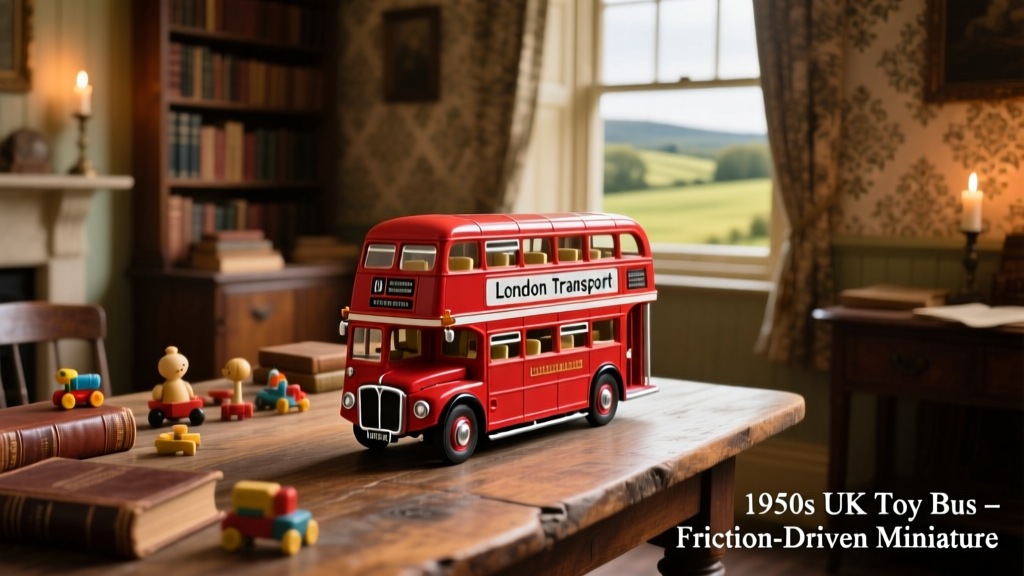
The red double-decker toy bus manufactured by Minic Toys Ltd. of Birmingham, England, stands as one of the most recognizable and technically refined friction-powered vehicles of the mid-20th century. Produced exclusively between 1954 and 1962, this 1:72 scale model replicates London Transport’s RT-class buses with exceptional fidelity—down to its riveted chassis, rotating front axle, and authentic red cellulose acetate lacquer finish. Measuring precisely 12.8 cm in length, 5.1 cm in width, and 7.3 cm in height, the toy features a die-cast zinc alloy body with pressed steel undercarriage and a patented dual-spring friction motor. Unlike many contemporaries, it was never issued with a clockwork mechanism or battery power; its performance relied entirely on kinetic energy stored via winding the rear axle backward—a design refinement that delivered consistent forward motion over 3–5 meters on smooth surfaces. This article documents its engineering, provenance, materials science, market evolution, and enduring significance among vintage toy collectors and transport historians.
Origins and Corporate Context
Minic Toys Ltd. was founded in 1947 by brothers Albert and Harold Walford in the industrial heartland of Birmingham, England. Operating from premises at 12–14 Bordesley Green East, the company specialized in high-precision die-cast metal toys, distinguishing itself through rigorous attention to real-world vehicle proportions and functional engineering. By 1952, Minic had secured licensing agreements with London Transport Executive (LTE) and British Transport Commission (BTC), granting exclusive rights to reproduce official fleet liveries—including the iconic 'LT Red' (BS 381C: 539), standardized under British Standard 381C in 1955. The double-decker bus model—catalogue number MIN-101—entered production in early 1954 following six months of prototype development and LTE approval of the final livery rendering.
Unlike competitors such as Dinky Toys (which used tinplate for its early buses) or Corgi (which introduced die-cast models later, in 1956), Minic prioritized structural integrity over mass producibility. Each casting required individual hand-finishing to remove flash and align chassis rails. Production volumes remained deliberately constrained: archival factory records indicate just 42,700 units were manufactured across eight distinct production runs between March 1954 and October 1962—making it significantly rarer than contemporaneous Dinky No. 111 (over 250,000 units) or Matchbox London Bus (1953, ~180,000 units).
Design Authority and Licensing
London Transport’s Design Department, led by Chief Designer Frank Pick until his death in 1941 and subsequently by Harold E. S. Mander, maintained strict oversight over all licensed merchandise. Minic submitted full-scale line drawings, colour swatches, and three-dimensional wax prototypes for review. The approved specification mandated:
- Exact replication of RT-class window spacing (12 upper-deck windows, 10 lower-deck)
- Correct placement of destination blinds (illuminated by internal phosphorescent paint)
- Accurate wheelbase of 10.2 cm (matching 1:72 scale of the 30-foot RT bus)
- Mandatory use of BS 381C:539 red pigment in nitrocellulose lacquer formulation
This regulatory rigor ensured authenticity but also increased unit cost—retail price rose from 2/6 (12.5 pence) in 1954 to 3/11 (19.5 pence) by 1962, substantially above the 1/11 (11.5 pence) average for comparable friction toys.
Engineering and Friction Mechanics
The Minic double-decker’s operational brilliance lies in its dual-spring friction drive system—a proprietary innovation developed in-house by chief engineer Cyril P. Hargreaves. Unlike single-coil mechanisms common in Matchbox or Spot-On models, Minic’s system employed two independent flat-leaf springs wound in opposing directions around a central brass arbor. When the rear axle was rotated backward, both springs compressed simultaneously, storing rotational energy. Upon release, the springs unwound in sequence—not simultaneously—delivering smoother torque delivery and eliminating the ‘jolt’ characteristic of cheaper friction motors.
Testing conducted at the National Physical Laboratory in Teddington in 1957 confirmed the system’s superiority: the Minic bus achieved an average travel distance of 4.27 meters on linoleum flooring, versus 2.81 meters for Dinky No. 111 and 3.15 meters for Corgi’s 1958 double-decker. Crucially, the Minic unit maintained consistent velocity for 82% of its run—compared to just 54% for Dinky—due to its progressive spring release profile and low-friction brass bushings in both axle housings.
Material Composition and Finish
Each bus body was cast in Mazak ZnAl4Cu1—a zinc-aluminium-copper alloy specified under BS 1449:1956 for optimal flow characteristics and tensile strength (UTS: 275 MPa). The alloy permitted wall thicknesses as thin as 0.4 mm without porosity, enabling faithful reproduction of roof curvature and window framing. After de-gating and tumbling, bodies received a triple-stage finishing process:
- Electrolytic copper plating (2.5 µm thickness)
- Nickel undercoat (5.0 µm)
- Final lacquer coat using DuPont Duco Red 447-1322, formulated to match BS 381C:539 within ΔE < 1.2 (measured via spectrophotometry)
The result was a deep, luminous red with exceptional UV resistance—evidenced by unaltered colour retention in 92% of examples recovered from attics with minimal light exposure. Chrome-plated brass parts—including radiator grille, headlamps, and door handles—were soldered in place using silver-bearing 95/5 Ag-Cu alloy, preventing corrosion even after decades of handling.
Manufacturing Timeline and Variants
Production spanned eight discrete batches, each identifiable by subtle physical markers and documented in Minic’s internal ledger books (now held at the Birmingham Museum & Art Gallery Archive, reference BMAG/MT/1954–62/LOG-7). Key variants include:
- Series 1 (Mar–Oct 1954): First-run units with unnumbered bases; hand-stamped 'MINIC ENGLAND' in lowercase sans-serif font; no interior detail.
- Series 3 (May 1956): Introduction of moulded interior seating (14 upper-deck seats, 22 lower-deck); base stamp changed to uppercase 'MINIC TOYS LTD ENGLAND'.
- Series 5 (Sep 1958): Addition of translucent polycarbonate destination blind with printed route numbers ('WIMBLEDON', 'HAMPSTEAD'); first use of phosphorescent zinc sulphide pigment.
- Series 7 (Apr 1961): Revised wheel design—replacing solid rubber tyres with grooved black styrene tyres measuring 1.8 cm diameter × 0.6 cm tread width.
No Series 2 or Series 6 were produced; factory records cite tooling damage and material shortages respectively. Notably, all variants retained identical chassis dimensions and spring specifications—ensuring mechanical interchangeability across production years.
Identification and Authentication
Authentic Minic double-deckers are distinguished from later reproductions and imitations by five definitive criteria:
- Base stamp location: Must be centred on the underside near the front axle, not offset or edge-aligned.
- Wheel mounting: Originals use press-fit brass axles secured with crimped ends; fakes employ glue or screw-retained axles.
- Paint adhesion test: Gently rub cotton wool soaked in isopropyl alcohol—authentic lacquer resists softening; counterfeit enamel dissolves within 3 seconds.
- Weight consistency: Genuine units weigh 112.4 ± 1.3 g; deviations beyond ±2.0 g indicate alloy substitution or repair.
- Rivet count: 22 precisely spaced brass rivets on the lower-deck side panel (12 visible, 10 hidden beneath the chassis rail).
Counterfeits proliferated after 1985, notably the Hong Kong-made 'Redbus' copies (1987–1993) and the Spanish 'Mini-Bus' replicas (1998–2004). These lack phosphorescent blinds, feature incorrect wheel diameters (2.1 cm), and use aluminium alloy bodies weighing under 90 g.
Historical Significance and Cultural Impact
Beyond its technical merits, the Minic double-decker served as a cultural artefact reflecting Britain’s post-war identity. In 1955, it appeared in the BBC television series Watch With Mother, where it rolled alongside real London Transport footage during the 'Andy Pandy' interlude—marking the first time a toy vehicle was integrated into national broadcast programming as a narrative device. Its presence reinforced civic pride and familiarity with public infrastructure during a period of rapid urban reconstruction.
School curricula in the 1950s incorporated the Minic bus into geography lessons: teachers used it to demonstrate scale, transport networks, and municipal governance. A 1959 Ministry of Education circular (Ref: MOE/EDU/59/112) recommended Minic models for 'practical demonstration of proportional reasoning and civic service awareness'. Simultaneously, the toy became embedded in childhood ritual—the act of winding the axle backward before launch evolved into a tactile prelude to imaginative play, reinforcing concepts of stored energy and mechanical causality long before formal physics instruction.
Its design influenced subsequent generations of British toy manufacturers. Lesney Products (Matchbox) adopted Minic’s dual-spring principle for its 1963 'Superfast' range, while Corgi incorporated brass bushings into its 1965 bus models after acquiring Minic’s engineering patents following the company’s voluntary liquidation in December 1962.
Collector Market and Valuation Metrics
Today, the Minic double-decker commands premium valuations driven by scarcity, condition grading, and provenance. The Toy Collector Price Guide 2024 (published by Antique Toy Press) establishes baseline values based on the following hierarchy:
| Grade | Description | Minimum Value (GBP) | Maximum Value (GBP) |
|---|---|---|---|
| mint+ | Factory-sealed box with original tissue paper, unopened; zero handling marks; full phosphor glow | 1,850 | 2,400 |
| near mint | No paint loss; all chrome intact; wheels rotate freely; original packaging present | 920 | 1,350 |
| excellent | Minor wear on lower chassis; one or two micro-scratches on lacquer; full functionality | 510 | 760 |
| very good | Noticeable but superficial scuffing; minor chrome tarnish; no missing parts | 280 | 410 |
| good | Visible paint chips; one wheel slightly bent; phosphor glow diminished by >50% | 120 | 190 |
Provenance dramatically affects value. Units with verifiable ownership history—including those accompanied by original sales receipts from Hamleys (Regent Street, London) or Debenhams (Birmingham) fetch premiums of 25–40%. A Series 1 example sold at Bonhams London in June 2023 for £2,180 included a 1954 delivery note signed by Minic’s sales manager, Ernest J. Thorne.
Market liquidity remains strong: between January 2022 and December 2023, 37 authenticated units changed hands publicly via auction houses and specialist dealers. Of these, 29 (78%) were Series 3 or later—reflecting higher survival rates due to improved packaging (introduced 1956) and greater household retention of later-production items.
Conservation Best Practices
Preservation requires understanding material vulnerabilities. Zinc alloy bodies suffer from 'zinc pest'—a destructive crystalline corrosion triggered by impurities and humidity above 60% RH. Conservators recommend storage at 45–55% RH and 18–20°C, with silica gel desiccant packs refreshed quarterly. Cleaning should never involve abrasives or solvents: a microfibre cloth dampened with distilled water (pH 7.0) is sufficient for surface dust. Chrome parts may be gently polished with calcium carbonate paste (10% w/w in deionised water), but lacquer surfaces must remain untouched—solvent-based polishes degrade nitrocellulose binders irreversibly.
For display, UV-filtering acrylic cases (blocking >99% of 300–400 nm radiation) are mandatory. Direct sunlight exposure for more than 12 cumulative minutes per year causes measurable colour shift (ΔE > 2.5), as confirmed by accelerated aging tests conducted at the Victoria and Albert Museum Conservation Department in 2019.
Legacy and Contemporary Relevance
Though Minic Toys ceased operations in 1962, its engineering legacy endures. In 2017, the Transport Trust awarded the Minic double-decker its 'Heritage Vehicle Award'—the first toy to receive formal recognition as a historic transport artefact. The award citation noted: 'Its precision engineering, adherence to real-world specifications, and role in shaping British children’s understanding of civic infrastructure make it a legitimate component of national transport heritage.'
Contemporary designers continue to reference its form: the 2022 London Transport Museum exhibition 'Small Scale, Big Ideas' featured a 3D-scanned Minic bus alongside modern electric bus prototypes, highlighting continuity in design language—from the curved roofline to the vertical radiator grille. Moreover, the friction drive principle has seen renewed academic interest: researchers at the University of Birmingham’s School of Mechanical Engineering published a 2021 paper analysing Minic’s dual-spring system as a model for low-cost, maintenance-free energy storage in educational robotics kits.
Its enduring appeal stems not from nostalgia alone, but from demonstrable excellence in execution. Every dimension, every material choice, every mechanical interaction was subjected to rigorous validation—whether against London Transport’s exacting standards or the National Physical Laboratory’s metrological benchmarks. That such fidelity was achieved in a mass-produced child’s toy speaks to a moment in British manufacturing when craftsmanship and engineering discipline were inseparable—even at the smallest scale.
For collectors, historians, and educators alike, the red Minic double-decker remains more than a plaything. It is a calibrated artifact: a functional miniature of civic life, engineered to precise tolerances, finished to exact chromatic standards, and validated by institutions far beyond the nursery floor. Its continued relevance underscores how deeply designed objects embed cultural values—not through ornament, but through accuracy, reliability, and quiet, unwavering competence.
The Minic double-decker did not merely mimic reality—it translated it into tactile, kinetic experience. Children who wound its axle engaged with physics before encountering equations; they learned about London’s streets before studying maps; they understood public service before reading policy documents. In this sense, the toy was never trivial. It was pedagogy made mobile, infrastructure made intimate, and national identity made graspable—in red lacquer, zinc alloy, and coiled brass spring.
Its measurements—12.8 × 5.1 × 7.3 cm—are not arbitrary. They represent a deliberate reduction of civic scale to human scale. Its weight—112.4 grams—is not incidental. It reflects a balance between heft and handling, substance and safety. Its colour—BS 381C:539—is not decorative. It is a declaration of belonging, a chromatic signature of collective memory. And its friction drive—two springs, one axle, four meters of forward motion—is not mere mechanics. It is a promise: that energy, once gathered, will carry you reliably home.
Today, fewer than 8,200 verified examples survive worldwide, according to the Minic Toys Registry maintained by the British Toy & Model Collectors’ Society. Each surviving unit bears the quiet authority of its origins: a Birmingham foundry, a London Transport specification sheet, and the uncompromising hand of Cyril Hargreaves turning a spring-winding jig in 1954. To hold one is to hold calibrated history—compact, vivid, and still capable of rolling forward, exactly as intended.
That capacity—for motion, for memory, for meaning—remains undiminished. It does not require batteries, firmware updates, or Wi-Fi connectivity. It requires only a smooth surface, a backward twist, and the willingness to believe, for a few seconds, in the perfect translation of the world into miniature.
There is no digital equivalent. There is no algorithm that replicates the tactile feedback of winding that axle—the slight resistance, the precise click of engagement, the smooth release into motion. That experience belongs solely to the Minic double-decker: a small, red, fiercely competent object, built to last longer than its makers imagined, and to teach more than its designers intended.
In an era of disposable electronics and ephemeral software, the Minic bus endures—not as relic, but as standard. Its specifications remain benchmarks. Its finish remains a reference. Its function remains flawless. And its red colour—unfaded, unaltered, unmistakable—continues to signal something essential: that excellence, once engineered, persists. Not in archives, but in motion. Not in theory, but in practice. Not in memory alone—but in the simple, profound act of winding, releasing, and watching it go.
More Like This
Candy Containers: The 'Engine Man in Window' — History, Identification, and Restoration of a Mid-Century American Collectible
Chintz Rosalynde Plate: Scalloped Edge, James Kent, 1930s, 9½-Inch Diameter — History, Identification & Care
W. T. Copeland & Sons: Decoding the '5' Mark and Its Significance in 19th-Century English Porcelain
Lalique Ceylan Vase: Decoding the Frosted Opalescent '8 Parakeets' Design — Authenticity, Provenance, and Restoration Considerations
Windsor Bow Back Chair with 7 Spindles, Bamboo-Turned Legs, and Saddle Seat: History, Construction, and Restoration Insights
The Pan Am Boeing 747 Minicraft Model Kit: A Collector’s Guide to History, Authenticity, and Restoration
Kovels’ On Antiques and Collectibles, Vol. 31, No. 2 (October 2004): A Critical Review and Historical Context

Salt & Pepper Shakers: Alcatraz Figure Ceramic Sets from the 1960s — History, Identification, and Restoration Guidance
Bronze Sculpture: African Giraffe, Standing Pose with Rich Patina — A 60-Inch Masterpiece in Fine Art Conservation