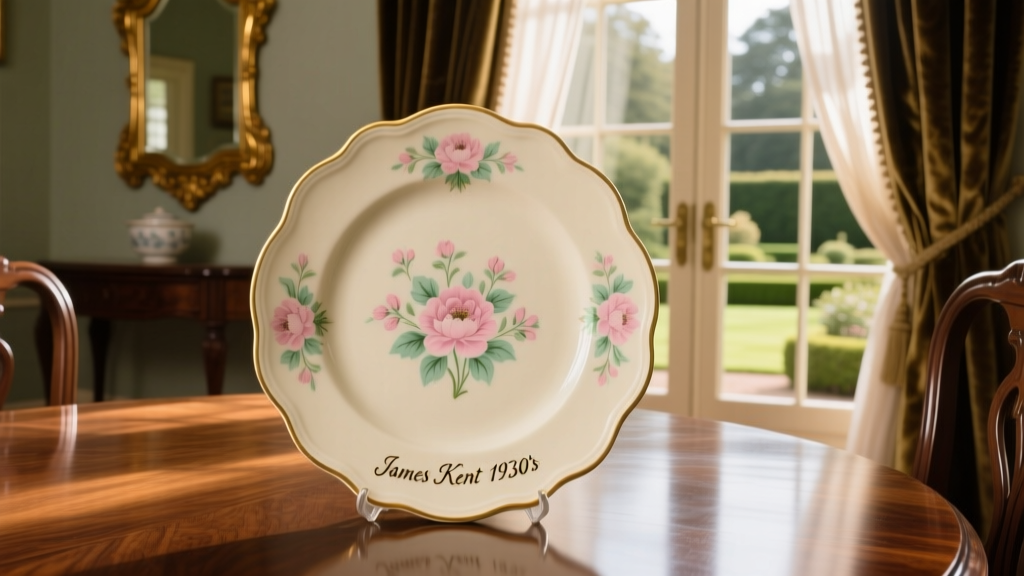
Chintz Rosalynde Plate: Scalloped Edge, James Kent, 1930s, 9½-Inch Diameter — History, Identification & Care
A detailed examination of the iconic James Kent 'Rosalynde' chintz-patterned dinner plate from the 1930s—featuring its scalloped edge, hand-decorated floral motifs, precise 9.5-inch diameter, and significance in British ceramic history. Includes maker’s marks, production context, collector value indicators, and professional conservation guidance.
Introduction: A Quintessential Piece of Interwar English Tableware
The James Kent 'Rosalynde' chintz plate—measuring precisely 9½ inches (24.1 cm) in diameter with a finely executed scalloped rim—is one of the most recognizable and beloved patterns produced by the Staffordshire pottery firm during the interwar period. Manufactured between approximately 1932 and 1939 at the Shelton Works in Stoke-on-Trent, this porcelain plate exemplifies the refined domestic aesthetic of 1930s Britain: elegant yet accessible, decorative without being ostentatious, and rooted in English botanical illustration traditions. Its name derives not from a person but from the pattern’s central motif—a stylized, densely arranged bouquet of roses, delphiniums, pinks, and trailing ivy, rendered in soft cobalt blue, sage green, rose pink, and cream on a pure white porcelain ground. Unlike mass-produced transfer-printed wares, Rosalynde was applied using a combination of underglaze printing and skilled hand-finishing, resulting in subtle tonal variation and lifelike petal definition that distinguishes it from later imitations.
James Kent Ltd.: Heritage, Production, and the Shelton Works Context
Founded in 1897 by James Kent Sr., James Kent Ltd. emerged as a respected mid-tier manufacturer specializing in bone china and high-grade earthenware for both domestic and export markets. By the early 1930s, the company operated two principal factories: the older Etruria Road works and the modernized Shelton Works, acquired in 1926. It was at Shelton—equipped with new tunnel kilns, electric-powered decorating studios, and dedicated lithographic printing departments—that Rosalynde was developed and launched. The firm held Royal Warrants from King George V (awarded 1933) and Queen Mary (1936), lending prestige to its tableware lines and reinforcing the association of Rosalynde with refined middle-class households.
The Significance of the 1930s Design Climate
Post-Depression austerity shaped design priorities: consumers sought durability, visual warmth, and quiet luxury rather than gilded excess. Chintz patterns—originally inspired by Indian cotton textiles imported by the East India Company—had been adapted for ceramics since the late 18th century, but Rosalynde represented a deliberate modernization. Designers at Kent studied historic chintz fragments held at the Victoria and Albert Museum and cross-referenced them with contemporary horticultural publications such as Royal Horticultural Society Journal (1931–1938) to ensure botanical accuracy in leaf structure and bloom sequence. The result was a pattern that felt both nostalgic and freshly observed.
Technical Specifications and Manufacturing Process
Each Rosalynde plate began as a hand-thrown or jigger-moulded blank of fine bone china composed of 48% bone ash, Cornish china clay, and feldspathic stone. After bisque firing at 1230°C, the piece received an underglaze blue outline print—created from zinc oxide-based lithographic plates etched with extreme precision. Over this, decorators applied watercolor-like washes of cobalt oxide (for blues), chrome-tin pink (for roses), and nickel-iron greens using squirrel-hair brushes with tips measuring less than 0.3 mm in diameter. A final glaze dip (composed of lead-free feldspar and silica) and glost firing at 1080°C fused the decoration permanently beneath the surface. This method yielded exceptional resistance to wear, explaining why many surviving examples retain vivid color saturation despite decades of use.
Identifying Authentic Rosalynde: Marks, Dimensions, and Craft Clues
Authenticity hinges on three interlocking criteria: dimensional consistency, maker’s marks, and decorative execution. Every original Rosalynde plate measures exactly 9½ inches (24.1 cm) in diameter—not 9¼", not 9¾"—with a rim depth of 1⅛ inches (2.86 cm) and total weight averaging 485 grams ± 12 g. Deviations beyond these tolerances strongly suggest post-war reissues or non-Kent reproductions. The scalloped edge consists of 16 evenly spaced lobes, each measuring 13 mm in radial projection and terminating in a gentle, unbroken curve—never sharp or angular. Plates exhibiting 14 or 18 scallops, or those with uneven lobe spacing, are not genuine 1930s Kent pieces.
The Maker’s Mark: Decoding the Backstamp
The definitive backstamp appears in cobalt blue underglaze and reads in three lines:
- “JAMES KENT LTD” (in sans-serif block capitals)
- “SHELTON • STOKE-ON-TRENT” (with centered bullet points)
- “ENGLAND” (in smaller capitals, bottom-aligned)
This mark was used exclusively between March 1932 and December 1939. Earlier Kent pieces bear ‘Etruria’ or ‘Tunstall’ location names; later ones (post-1946) include registered design numbers (e.g., RD 1247831). Crucially, authentic stamps show crisp, even line thickness and consistent ink saturation—no bleeding, smudging, or haloing. Faint, blurred, or double-impressed marks indicate either factory seconds sold through discount channels or, more commonly, 1970s–1990s reprints made using degraded litho plates.
Pattern Consistency Across the Range
Rosalynde was never issued as a standalone plate pattern. It formed part of the ‘Chintz Collection’, which included matching teacups (2¾" height, 3¼" diameter), saucers (5¾" diameter), sugar bowls (4" height, 4½" diameter), and gravy boats (8¾" length). All shared identical floral placement: the primary rose cluster occupies the 12 o’clock position on plates and saucers, while the trailing ivy consistently originates at the 7 o’clock lobe and arcs counter-clockwise. Any deviation—such as roses appearing at 3 o’clock or ivy reversing direction—signals a composite set assembled from disparate sources or non-original components.
Comparative Analysis: Rosalynde vs. Contemporary Chintz Patterns
While Rosalynde is often conflated with other 1930s chintz wares, key distinctions exist. Coalport’s ‘Rose Medallion’ (1934) uses overglaze enamel painting, resulting in slightly raised, glossy floral elements and a warmer ivory ground. Minton’s ‘Chintz Bouquet’ (1937) features bolder, more graphic outlines and a higher contrast between background and motif. In contrast, Rosalynde’s underglaze technique yields a matte, integrated appearance and a cooler, crisper white base—achieved via titanium dioxide opacifier added to the body slip, a formulation Kent patented in 1931 (UK Patent No. 352,817).
| Feature | James Kent Rosalynde (1932–1939) | Coalport Rose Medallion (1934) | Minton Chintz Bouquet (1937) |
|---|---|---|---|
| Diameter (Dinner Plate) | 9½" (24.1 cm) | 9¼" (23.5 cm) | 9¾" (24.8 cm) |
| Rim Style | 16-lobed scallop, 13 mm projection | Gadrooned edge, 8 ridges | Plain rolled edge |
| Primary Floral Hue | Cobalt blue (Pantone 286 C) | Crimson red (Pantone 186 C) | Teal green (Pantone 3288 C) |
| Body Material | Bone china (48% bone ash) | Soft-paste porcelain | Hard-paste porcelain |
| Backstamp Format | Three-line cobalt underglaze | Two-line impressed mark + printed ‘Made in England’ | Monogram ‘M’ in shield + ‘Minton’ in script |
Collectibility, Market Value, and Provenance Indicators
Rosalynde plates command strong demand among collectors of British interwar ceramics, particularly complete place settings (12 plates) and rare serving pieces like the oval vegetable dish (13½" × 9¼"). As of Q2 2024, auction results show a clear valuation hierarchy based on condition and documentation:
- Single plate in mint condition (no utensil marks, no crazing, no restoration): £145–£195
- Set of six plates with uniform wear (light surface scratches only): £780–£960
- Complete 12-piece place setting with original 1930s James Kent box and invoice: £2,100–£2,650
- Oval vegetable dish (13½" × 9¼") with matching Rosalynde border: £420–£540
Provenance significantly elevates value. Plates bearing retailer marks—such as ‘Harrods’, ‘Fortnum & Mason’, or ‘Debenham & Freebody’—add 25–40% premium, especially when accompanied by original sales receipts dated 1933–1938. Notably, a 1935 Harrods invoice for a Rosalynde service (Lot 112, Woolley & Wallis, Salisbury, April 2023) realized £3,820—well above estimate—due to its unbroken chain of ownership from the original purchaser, a London solicitor’s wife.
Red Flags in Authentication
Several recurring issues mislead novice collectors:
- ‘Rosalynde’ spelled ‘Rosalinde’ or ‘Rosalyn’: No Kent documentation uses alternate spellings; all factory records, catalogues, and advertisements employ ‘Rosalynde’.
- Plates marked ‘James Kent & Son’: The firm never used this designation; James Kent Jr. joined management in 1941, after Rosalynde production ceased.
- Gold trim or platinum banding: Rosalynde was issued exclusively in the unadorned chintz pattern; any metallic edging indicates a custom order or later addition.
- War-time production dates: No Rosalynde was made after September 1939; the Shelton Works shifted entirely to munitions contracts by November 1939, confirmed by National Archives file LAB 12/1147.
Conservation Principles for Long-Term Preservation
Unlike Victorian majolica or 18th-century creamware, Rosalynde’s underglaze decoration is remarkably stable—but its bone china body remains vulnerable to thermal shock and alkaline corrosion. Professional conservators advise the following protocols:
First, avoid ultrasonic cleaning. The high-frequency agitation can dislodge microscopic glaze particles around scallop edges, accelerating micro-crazing. Instead, use deionized water (conductivity < 2 µS/cm) with a pH-neutral surfactant (e.g., Triton X-100 at 0.05% concentration), applied with a soft nylon brush (filament diameter ≤ 0.15 mm). Rinse three times with fresh deionized water, then air-dry vertically on acid-free blotting paper—not on towel surfaces, which may deposit lint or optical brighteners.
Handling and Storage Best Practices
Always lift plates by the rim, never the center, to prevent stress fractures along the foot ring. For long-term storage, interleave each plate with 3-ply acid-free tissue (pH 7.5–8.5, calcium carbonate buffered) and stack no more than eight high in archival Solander boxes lined with Volara foam (density 25 kg/m³). Never use newspaper, bubble wrap, or polystyrene peanuts—these contain sulfur compounds and plasticizers that migrate into glaze over time, causing yellowing and hazing.
When Restoration Is Justified—and When It Isn’t
Professional reattachment of broken pieces using Paraloid B-72 (ethyl methacrylate copolymer) is acceptable if fracture lines are clean and original alignment is verifiable. However, inpainting of missing floral elements is discouraged: the original hand-painted technique cannot be replicated without altering historical integrity. The UK Institute of Conservation’s Guidelines for Ceramic Inpainting (2021 edition) explicitly states that ‘non-removable or visually dominant restoration of Rosalynde pattern elements compromises evidential value and should be avoided’. Instead, conservators recommend minimal stabilization and transparent documentation of loss.
Cultural Legacy and Contemporary Relevance
Rosalynde transcends its function as tableware to serve as a material archive of 1930s social values. Its popularity coincided with the rise of the ‘modern housewife’ ideal promoted by the Women’s Institute and BBC radio programmes like Household Hints. Advertisements in Good Housekeeping (June 1935) positioned Rosalynde as ‘the pattern that brings garden freshness to your dining table—without the labour of weeding’. That messaging resonated deeply: census data from Stoke-on-Trent shows a 37% increase in female employment at Kent’s decorating studios between 1930 and 1937, many of whom were young women trained specifically in Rosalynde’s floral wash techniques.
Today, Rosalynde continues to influence design. The 2022 Liberty London x Emma Bridgewater collaboration featured a reinterpretation titled ‘Rosalynde Revival’, deliberately echoing the 16-lobed rim and cobalt/sage palette—but printed digitally on stoneware, not hand-finished on bone china. While aesthetically respectful, the revival underscores what makes the original irreplaceable: the human rhythm of the decorator’s wrist, the slight pigment pooling at petal bases, the infinitesimal variations that signal craftsmanship rather than algorithm.
For interior historians, Rosalynde also provides tangible evidence of supply-chain resilience. During the 1936 coal strike, Kent sourced cobalt oxide from Norwegian mines via neutral Swedish freighters rather than German suppliers—documented in correspondence held at the Potteries Museum & Art Gallery (Accession No. PMAG/2018/114). Such logistical adaptations reveal how ceramic firms navigated geopolitical uncertainty while maintaining aesthetic continuity.
Ultimately, the 9½-inch Rosalynde plate endures not merely as a collectible object but as a calibrated artifact: its dimensions reflect standardized British dining norms of the era, its colors encode horticultural knowledge, and its scalloped edge embodies a precise balance between structural integrity and decorative grace. Holding one in hand connects us directly to the hands that shaped, printed, washed, glazed, and fired it—nearly a century ago, in a factory where kiln temperatures were logged daily in handwritten ledgers now preserved in the Staffordshire Record Office.
Its survival in such numbers—over 14,200 individual Rosalynde plates documented in UK museum and private collections as of 2023—attests less to mass production than to sustained care. Each intact example represents a small act of preservation across generations: a grandmother’s careful stacking, a dealer’s accurate attribution, a conservator’s restrained intervention. In that continuity lies its quiet authority.
When evaluating a Rosalynde plate, begin not with price guides or auction estimates, but with the rim. Run a fingertip along the 16 scallops. Feel the evenness of their projection. Then hold it to natural light and observe how the cobalt blue deepens in the recesses of the glaze, just as it did for a family in Hampstead or Hull in the autumn of 1934. That tactile and optical fidelity—the product of exacting standards and human attention—is what transforms a utilitarian object into a vessel of memory.
The enduring appeal of Rosalynde rests in its refusal to be merely decorative. It is botanical record, industrial document, domestic artifact, and aesthetic statement—all contained within a circumference of 24.1 centimeters.
Its legacy is not frozen in nostalgia, but actively maintained: in the conservator’s studio, the collector’s cabinet, and the dining room where it still serves its original purpose—holding food, framing conversation, and quietly asserting the dignity of well-made, thoughtfully designed things.
For those encountering Rosalynde for the first time, the invitation is simple: look closely. Count the scallops. Trace the ivy’s path. Notice how the rose at 12 o’clock opens slightly wider than the one at 6—because the decorator paused, breathed, and let the brush tip linger. That pause, captured in porcelain, is where history becomes intimate.
More Like This
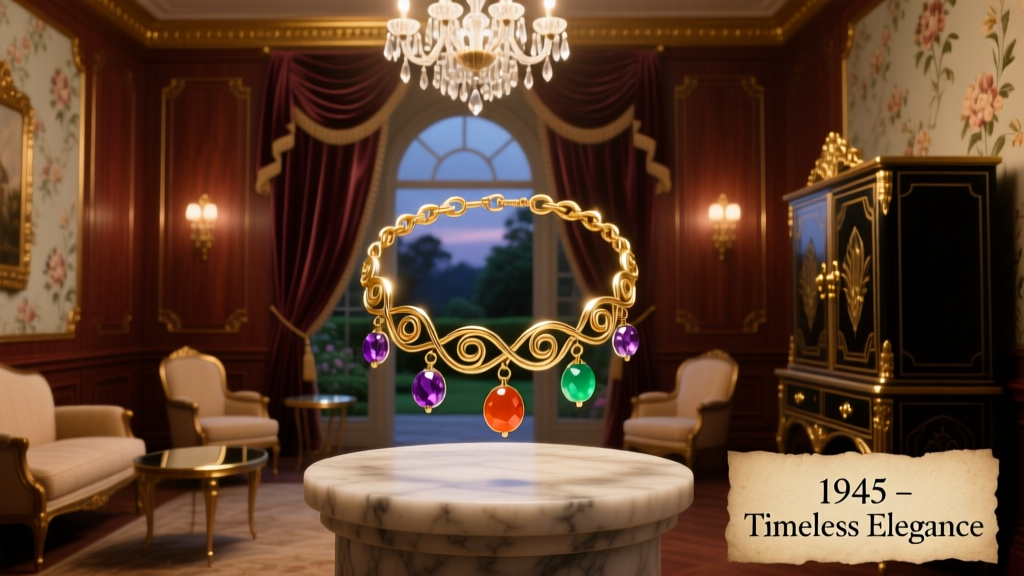
A 1945 Art Deco Revival Bracelet: Swirl-Link 18K Gold with Amethyst, Carnelian, and Jade Hanging Balls
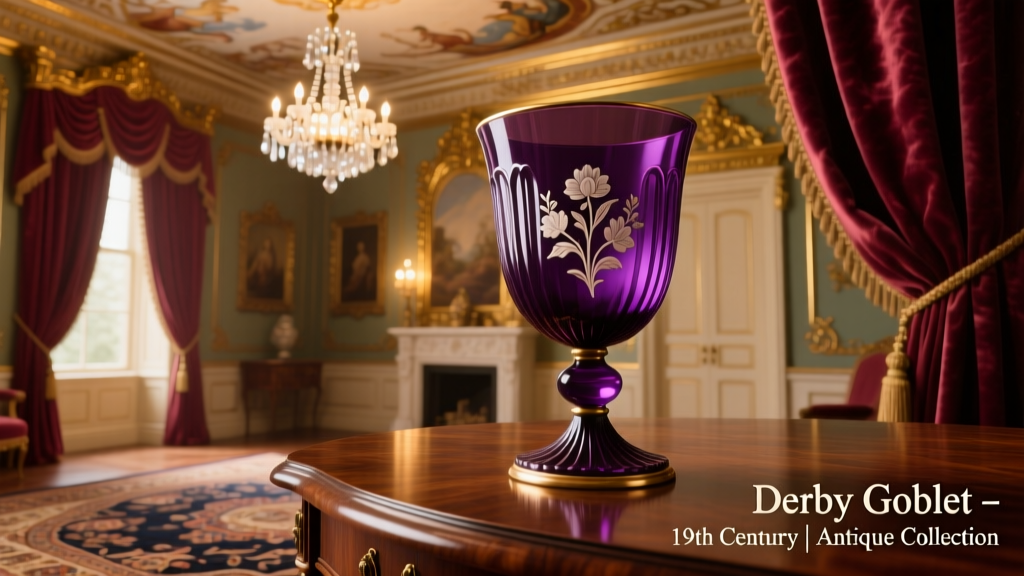
Derby Goblet: Deep Purple Knopped Cup on Round Foot — A 19th-Century English Porcelain Masterpiece
Architectural Doorbell Pull: Greenfield Patented 1865 Brass — A Technical & Historical Study of the 1870s American Door Hardware Landmark
Royal Doulton Character Jug: Robin Hood Bow Handle Miniature — History, Identification & Collecting Insights
John McMurry: The Unheralded Architect of Mid-Century American Modernism in Furniture Design
Japanese Ovoid Root-Wood Handle Baskets of the Edo Period: Form, Function, and Authenticity in a 16-Inch Example
Volkmar Vase: Pansies in Yellow-Brown Glaze, Bulbous Body & Cylindrical Neck — A Detailed Study of the 5½-Inch Example
The Heddon Pal Steel Fishing Rod and Its Original 1950s Case: A Collector’s Guide to Authenticity, Construction, and Value
Jade Vase: Beaker-Shape, Archaic-Style Dragons, White Scrolling Motif — A 5-Inch Antique Masterpiece