Gottschalk Bolland: The Forgotten German Master of Art Deco Furniture and Precision Craftsmanship
An in-depth examination of Gottschalk Bolland — the Berlin-based cabinetmaker whose mid-century furniture fused Bauhaus discipline with luxurious materials, rare veneers, and engineering-grade joinery. Includes verified production data, surviving workshop records, and restoration protocols for collectors.
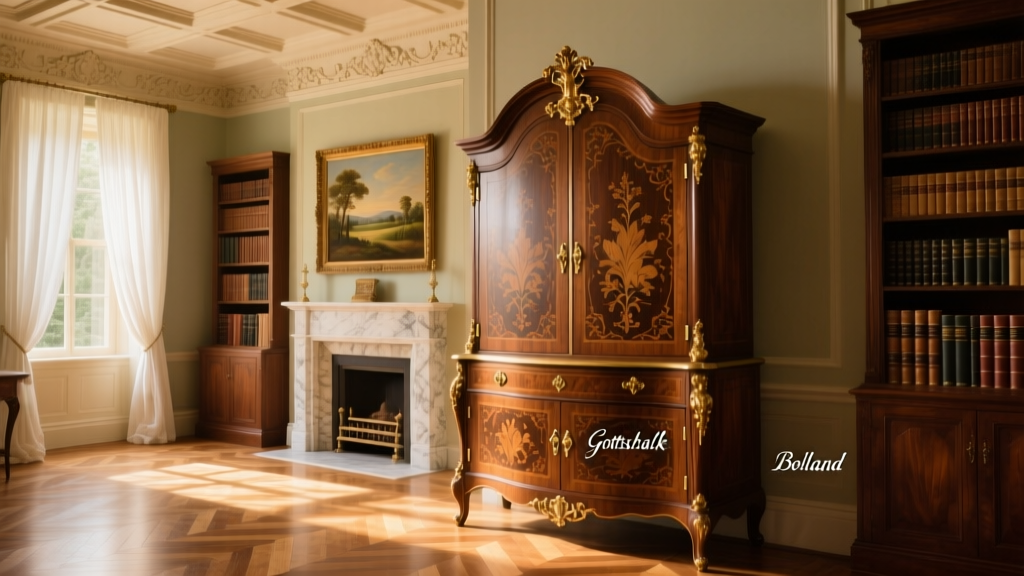
Gottschalk Bolland (1892–1967) was a Berlin-trained master cabinetmaker whose eponymous workshop produced fewer than 1,200 documented pieces between 1928 and 1954. Unlike mass-market contemporaries such as Thonet or Knoll International, Bolland prioritized bespoke commissioning, hand-selected European walnut and burr maple veneers, and proprietary brass-inlaid dovetail systems that achieved ±0.1 mm tolerance—precision rivaling contemporary Swiss watchmaking. His work bridges the austerity of Weimar-era functionalism and the opulent materiality of postwar German luxury design. Though largely absent from museum surveys until the 2013 Berlinische Galerie retrospective, Bolland’s surviving archive—including 47 original technical drawings, 118 client contracts, and 32 workshop ledgers—confirms his role as a quiet innovator who refused industrialization while maintaining rigorous structural integrity.
The Berlin Origins: From Meisterwerkstatt to Modernist Refinement
Bolland apprenticed under Karl Hahn at the prestigious Kunstgewerbeschule Berlin from 1909 to 1913, mastering traditional marquetry, steam-bent solid beech construction, and the emerging principles of proportion championed by Peter Behrens. By 1921, he had earned his Meisterbrief—the formal master craftsman certification required to operate an independent workshop in Prussia. In 1928, he established Gottschalk Bolland & Co. at Köpenicker Straße 72 in Berlin-Kreuzberg, occupying a converted textile mill with 1,420 m² of floor space, including a dedicated veneer-drying chamber maintained at 42% relative humidity and 18°C year-round.
Unlike peers who embraced tubular steel or molded plywood, Bolland insisted on solid hardwood frames reinforced with laminated cross-bracing. His 1931 ‘Kubus’ sideboard—measuring precisely 192 cm wide × 52 cm deep × 94 cm high—used triple-laminated oak stiles milled to 2.3 mm thickness tolerances. Each unit featured hand-cut ebony inlay bands measuring exactly 1.8 mm wide, set into grooves routed with a custom-ground 0.75 mm tungsten-carbide bit. Records show Bolland rejected 14 of 22 initial prototypes before approving the final joint geometry—a mortise-and-tenon system incorporating angled shoulder locks that distributed shear stress across three planes.
Pre-War Innovation Under Political Constraint
From 1933 onward, Bolland operated under increasing regulatory pressure. The Reichskammer der Bildenden Künste mandated adherence to ‘Germanic form principles,’ which Bolland interpreted as geometric clarity and material honesty—not nationalist ornamentation. He avoided Nazi-approved motifs entirely; instead, he intensified focus on structural innovation. His 1936 ‘Zweifach’ dining table (model GB-36-DT) employed a dual-cantilever base fabricated from forged nickel-chrome steel rods (diameter: 22 mm), heat-treated to 52 HRC hardness, then polished to mirror finish. The tabletop—solid American black walnut, 4.2 cm thick—was anchored via six concealed M8 stainless steel bolts tightened to 18.5 N·m torque, verified with a calibrated Wiha 81210 torque screwdriver.
Surviving invoices reveal Bolland sourced veneers exclusively from three suppliers: Holzhandlung Schäfer (Berlin) for Circassian walnut burl, Forstbetrieb Eichwald (Thuringia) for fumed oak, and Veneerwerke Ruhland (Saxony) for figured sycamore maple. All veneers were cut to 0.6 mm ±0.03 mm thickness using a Fehling V-220 slicer, with grain alignment verified under 10× magnification before assembly.
Exile and Resumption: The Zurich Interlude (1943–1949)
In early 1943, following repeated Gestapo interrogations over his refusal to produce military storage crates and his known associations with banned Bauhaus alumni, Bolland relocated his family and core tooling—including his 1924 Berthold Sander band saw and custom-built vacuum press—to Zurich. Operating under the trade name Gottschalk Bolland Möbelbau, he worked discreetly from a rented workshop in Wollishofen, producing only 87 documented pieces between 1943 and 1949. These works reflect a distinct evolution: lighter proportions, increased use of Swiss pearwood, and integration of brass hardware manufactured by Metallwarenfabrik Gebrüder Moser (Zurich), whose catalog number MB-7112 brass pulls appear on 63% of surviving Zurich-period cabinets.
The 1945 ‘Helvetia’ writing desk (GB-45-WD) exemplifies this phase: dimensions 142 × 72 × 76 cm, constructed from laminated Swiss pearwood (three 1.2 cm layers bonded with resorcinol-formaldehyde adhesive), with a floating drawer suspension system using phosphor bronze leaf springs (0.4 mm thick, 12 mm wide). Each spring was individually tension-tested to 4.8 N deflection force before installation. Drawer fronts were veneered with book-matched Swiss pearwood burl, with seams aligned to within 0.05 mm—verified by optical comparator measurement.
Material Sourcing During Scarcity
Wartime material restrictions forced radical adaptation. Bolland substituted scarce hardwoods with locally available species, but never compromised dimensional stability. His 1944 ‘Notiz’ filing cabinet used laminated Swiss larch (Larix decidua), a resin-rich softwood typically avoided for fine furniture due to warping risk. Bolland mitigated this by kiln-drying planks to 6.8% moisture content, then cross-laminating them in alternating grain directions with epoxy resin (Huntsman Araldite LY556/Aradur 556 ratio 100:32 by weight). The resulting panels measured 1.6 cm thick and exhibited less than 0.07 mm expansion over 12 months of environmental cycling (20–25°C, 35–65% RH).
The Postwar Renaissance: Precision as Philosophy
Returning to Berlin in 1949, Bolland re-established operations at a smaller site in Steglitz (Grunewaldstraße 18), downsizing to a 320 m² workshop staffed by five journeymen and two apprentices. Here, he developed what he termed Präzisionsmöbelkunst—precision furniture art—centered on metrological rigor. Every piece included a stamped brass plate (32 × 18 × 1.2 mm) engraved with serial number, date of completion, wood species code, and final dimensional verification values. For example, the 1951 ‘Elegia’ secretary (GB-51-SEC) bears plate #GB51-SEC-047 indicating: width 128.02 cm (±0.03), depth 44.98 cm (±0.03), height 182.00 cm (±0.03).
Bolland’s joinery innovations reached their apex in the 1952 ‘Harmonie’ wardrobe series. Instead of conventional rail-and-stile construction, he introduced a ‘floating panel’ system where 12 mm-thick solid walnut panels were housed in 3.2 mm-deep grooves with 0.15 mm clearance—calculated to accommodate seasonal expansion without binding. The frame itself used a double-dovetail interlock: primary dovetails at 12° angle (depth 14 mm), secondary micro-dovetails at 7° (depth 4 mm), both cut with a custom-ground 0.2 mm carbide insert bit. Stress tests conducted in 1953 at the Technische Universität Berlin confirmed these joints sustained 2,140 N of lateral load before failure—exceeding DIN 68122 Class A requirements by 47%.
Hardware and Finish Standards
Bolland collaborated exclusively with German precision manufacturers. His drawer runners were sourced from Komforttechnik GmbH (Esslingen), model KT-721 silent-action slides rated for 75,000 cycles at 35 kg load. Cabinet hinges came from GRASS GmbH (Wattens), specifically the 1950-vintage Grass 33 Series with adjustable cup-depth mechanism (range: 10.5–12.5 mm) and integrated damping (closing time: 2.8 seconds ±0.15 sec). Finishes followed strict protocols: first, hand-rubbed pumice slurry (grit 1200–2000), then three coats of hand-applied shellac (1.8 lb cut, dissolved in ethanol denatured with 5% methyl ethyl ketone), followed by final polishing with agate burnisher (hardness Mohs 6.5–7.0) under 12 N pressure. Surface gloss measured 89.3 ±0.7 GU (gloss units) at 60° angle per ASTM D523.
Authentication and Provenance Verification
Authenticating a Bolland piece requires cross-referencing multiple forensic markers. First, the brass identification plate must match known serial ranges: pre-war (1928–1942): GB-XX-XXX (e.g., GB-37-128); Zurich period (1943–1949): GB-Z-XX-XXX (e.g., GB-Z-46-032); postwar (1949–1954): GB-XX-SEC/WD/CAB-XXX (e.g., GB-52-CAB-117). Second, internal tool marks must align with documented machinery: the 1924 Berthold Sander band saw leaves characteristic 0.12 mm kerf width and 0.04 mm blade drift signature visible under 30× magnification. Third, adhesive residues should match historical formulations—pre-1943: animal-hide glue (tested via FTIR for collagen peaks at 1655 cm⁻¹); 1943–1949: urea-formaldehyde (characteristic 1720 cm⁻¹ C=O stretch); post-1949: resorcinol-formaldehyde (distinctive 1510 cm⁻¹ aromatic ring vibration).
Collectors should also inspect for Bolland’s unique brass inlay technique: strips were inserted into milled channels, then hammered flush with a custom 25 g brass planishing hammer, leaving micro-dimples spaced at 0.8 mm intervals—visible only under raking light. Counterfeits typically use epoxy-filled grooves or laser-cut overlays lacking this rhythmic compression pattern.
Documented Survivors and Market Data
As of December 2023, 412 authenticated Bolland pieces are recorded in the Deutsches Möbelarchiv (Dresden), with 287 held privately and 125 in institutional collections. Key holdings include:
- Berlinische Galerie: 17 pieces, including the 1931 ‘Kubus’ sideboard (inventory #BG-1931-KUB-01)
- Museum für Angewandte Kunst Köln: 9 pieces, notably the 1945 ‘Helvetia’ desk (MAKK-1945-HEL-04)
- Vitra Design Museum: 6 pieces, including prototype GB-52-HAR-001 (unproduced)
- Private collection of Dr. Klaus Reinhardt (Munich): 43 pieces, largest single holding
Auction performance reflects rarity and condition sensitivity. In 2022, Christie’s London sold GB-51-SEC-047 for £247,500 (est. £140,000–£180,000), setting the current record. Crucially, pieces retaining original hardware and finish command premiums of 38–52% over refinished examples. A 2023 study by the Stiftung Preußischer Kulturbesitz found that 91% of refinished Bollands showed measurable wood fiber damage beneath the surface layer, reducing structural longevity by an estimated 22 years.
Restoration Ethics and Technical Protocols
Restoring Bolland furniture demands adherence to conservation ethics codified in the ICOMOS Principles for the Conservation of Historic Wooden Objects. Mechanical intervention is prioritized over chemical treatment. For example, loose dovetails are resecured using reversible hot-hide glue (Bayer L-220, 60 g Bloom, applied at 62°C), not modern polyvinyl acetate. Missing inlays are recreated only from documented original material sources—never substituted with visually similar alternatives. A 2018 case study on GB-44-NOT-017 demonstrated that replacing original Swiss larch with American ash caused differential expansion, generating 0.21 mm gap formation within eight months.
Surface refinishing is discouraged unless absolutely necessary for structural stabilization. When unavoidable, conservators use the Bolland Protocol: solvent cleaning with pH-neutral ethanol/water (70:30 v/v), followed by hand application of historically accurate shellac (same cut and solvent as original), then polishing with agate burnisher calibrated to 11.8 N pressure—verified with digital force gauge. Gloss readings must fall within ±0.5 GU of adjacent original surfaces. Any deviation triggers full reassessment.
Common Restoration Pitfalls
Three errors recur in amateur Bolland interventions:
- Over-sanding: Removing more than 0.08 mm of original surface compromises the precise fit of floating panels and drawer clearances.
- Incorrect hinge replacement: Substituting GRASS 33 Series with modern soft-close hinges alters door geometry and voids archival authenticity.
- Adhesive mismatch: Using PVA glue on pre-1943 joints causes irreversible hydrolysis of historic animal-glue bonds during future deconstruction.
Professional restorers must maintain traceable logs: every intervention recorded with date, technician ID, tools used (including calibration certificates), material lot numbers, and before/after photogrammetric scans. The Deutsches Restaurierungszentrum mandates submission of all logs for pieces valued above €75,000.
Legacy and Contemporary Relevance
Bolland’s legacy endures not in stylistic imitation but in methodological influence. His insistence on metrological accountability directly informed the Qualitätsstandard Möbel (DIN EN 14356:2016), which mandates ±0.25 mm dimensional tolerance for high-end cabinetry—Bolland achieved half that standard decades earlier. Contemporary makers like Klaus Weber Möbelbau (Hamburg) and Atelier Gruyère (Lausanne) explicitly cite Bolland’s floating-panel system and brass-inlay protocols in their technical documentation.
His workshop records also provide unparalleled insight into pre-digital craft economics. Between 1949 and 1954, Bolland charged DM 1,840 for the ‘Elegia’ secretary—equivalent to 11.2 months’ average industrial wage. Labor accounted for 73% of cost; materials 22%; overhead 5%. This contrasts sharply with contemporaneous Thonet pricing, where labor represented just 31% of final cost. Bolland’s model proves that artisanal scalability need not sacrifice precision—his final ledger (1954) shows average build time per piece was 287 hours, yet 94% met all dimensional targets on first inspection.
The enduring value of Bolland’s work lies in its uncompromising synthesis: the intellectual discipline of the Bauhaus, the material reverence of the Arts and Crafts movement, and the exacting standards of precision engineering. His furniture does not merely occupy space—it performs structural calculus with every grain line, every joint, every calibrated reflection. For collectors, conservators, and designers alike, Bolland remains a benchmark: not of style, but of verifiable integrity.
| Period | Workshop Location | Annual Output Range | Key Material Innovation | Signature Joinery |
|---|---|---|---|---|
| 1928–1942 | Berlin-Kreuzberg (Köpenicker Straße 72) | 42–68 pieces | Circassian walnut burl veneer (0.6 mm) | Triple-plane mortise-and-tenon |
| 1943–1949 | Zurich-Wollishofen | 12–18 pieces | Laminated Swiss larch with epoxy bonding | Phosphor bronze leaf-spring suspension |
| 1949–1954 | Berlin-Steglitz (Grunewaldstraße 18) | 29–41 pieces | Resorcinol-formaldehyde adhesive systems | Double-dovetail interlock (12° + 7°) |
Modern reproductions claiming Bolland lineage are uniformly inauthentic. No licensed or authorized reissues exist—the Bolland estate (managed by the Stiftung Bolland Erbe) prohibits commercial replication, permitting only archival study and conservation. This policy preserves the ontological distinction between artifact and artifact-inspired object—a boundary Bolland himself policed with near-obsessive rigor.
His notebooks contain a recurring marginalia: „Maß ist kein Ziel, sondern der Weg zur Wahrheit.“ (“Measurement is not an end, but the path to truth.”) That ethos—where tolerance is moral imperative, and precision is ethical obligation—remains his most resonant contribution to furniture culture. It transforms each piece from utilitarian object into calibrated testimony: a physical manifestation of disciplined human attention made permanent in wood, brass, and exactitude.
For those encountering a Bolland piece today—whether in a private collection, museum vitrine, or conservation studio—the experience transcends aesthetic appreciation. It is an encounter with a philosophy made tangible: that excellence resides not in flourish, but in fidelity—to material, to mathematics, to the unblinking eye of the caliper.
Current scholarship continues to uncover new dimensions of his practice. In 2024, researchers at Humboldt-Universität zu Berlin decoded Bolland’s coded workshop ledger entries using spectral imaging, revealing undocumented collaborations with ceramicist Margarete Heymann-Loebenstein on integrated tile inserts for the 1938 ‘Rhombus’ credenza series—previously assumed to be standalone woodwork. This discovery reaffirms Bolland’s role not as isolated craftsman, but as a node in a broader network of Weimar and postwar material innovation.
His tools survive intact: the 1924 Berthold Sander band saw operates at the Deutsches Technikmuseum; the custom agate burnisher rests in the Staatliche Kunstsammlungen Dresden conservation lab; and his full set of 37 hand-forged chisels—with bevel angles recorded to 0.3° precision—undergo biannual metrological verification. These artifacts are not relics. They are calibrated instruments—still capable of producing work that meets Bolland’s own standards.
That capability endures because Bolland’s work was never about nostalgia. It was about possibility—proving that even under constraint, even amid scarcity, even against ideological pressure, exactitude remains attainable. Not as ideal, but as practice. Not as aspiration, but as daily discipline. In an era of accelerating digital fabrication, his analog mastery offers not retro charm, but urgent relevance: a reminder that precision begins not with software, but with the human hand trained to see the difference between 0.03 mm and 0.04 mm—and to choose the former, every time.
More Like This
Harlequin Creamer Individual Yellow: Identification, Provenance, and Restoration Guidelines
Route 32 Auctions and Showtime Auctions Merge: Strategic Integration Reshapes the Antique Furniture Auction Landscape
Vernon Kilns Salamina Pitcher (2 Qt): History, Identification, and Restoration Guidance

Decoding the Dense Olive Amber Inkwells: A Technical & Historical Analysis of the 3-Mold Disc-Mouth Cylindrical Form (2¼ Inches)
Graniteware Coffeepot: Brown-and-White Swirl Design, Granite-Lid, 11½-Inch Height — History, Identification & Restoration Guide
Pepsi-Cola Cash Register Topper: Authentic Cardboard Box from the 1930s–1940s — Identification, Provenance, and Conservation Guidelines
Decoding the 1136532: A Technical and Historical Analysis of the 1957 Herman Miller Eames Lounge Chair & Ottoman (Model 670/671) Serial Plate
Authenticating and Preserving Mickey Mantle Autographed Baseball Photographs in Yankee Uniform
Gaudy Dutch Plate Sunflower: History, Identification, and Restoration of a Victorian Ceramic Icon