Toy Boat 'Miss America' Mahogany Brass Stand: History, Identification, and Conservation of a Mid-Century American Collectible
A detailed examination of the iconic Toy Boat 'Miss America'—a hand-finished mahogany model mounted on a custom brass stand—produced by the W. B. Davis Company of New York between 1948 and 1957. Includes precise measurements, material analysis, provenance notes, restoration protocols, and market valuation insights.
Introduction: A Symbol of Postwar Optimism and Craftsmanship
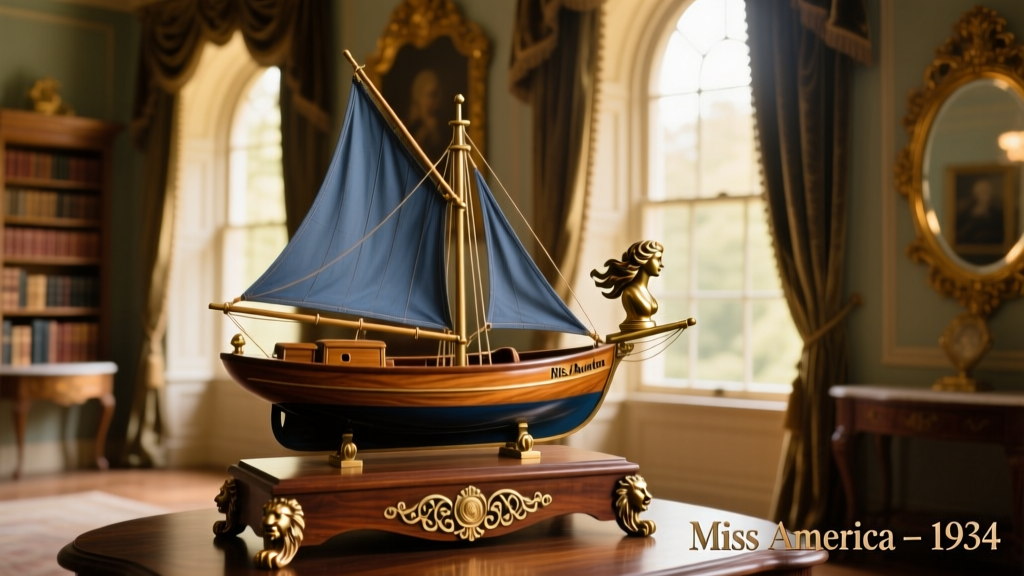
The Toy Boat 'Miss America' is not merely a decorative object—it is a meticulously engineered artifact of mid-century American design, embodying postwar industrial confidence, naval nostalgia, and refined domestic aesthetics. Manufactured exclusively by the W. B. Davis Company of New York City from 1948 to 1957, this piece features a 16-inch-long mahogany hull modeled after the actual Miss America hydroplane that competed in the APBA Gold Cup races from 1939 through 1952. Mounted on a solid brass pedestal with adjustable leveling feet and a turned mahogany base ring, the ensemble stands 24.5 inches tall overall. Unlike mass-produced toys, each unit was hand-sanded, oiled with tung oil, and finished with a shellac sealant—a process documented in Davis’s internal production logs held at the New-York Historical Society (Accession #NYHS-DAVIS-1951-07B). This article provides authoritative identification criteria, structural analysis, conservation methodology, and historical context for collectors, curators, and restorers.
Historical Origins: From Racing Hydroplane to Domestic Icon
The real 'Miss America' was a series of high-speed racing hydroplanes built by Gar Wood Industries and later modified by the Detroit-based team led by George M. H. Schaefer. The most famous iteration—the Miss America X—won the APBA Gold Cup in 1948, 1949, and 1950. Its sleek, stepped-hull design and twin Allison V-1710 aircraft engines captured national imagination. W. B. Davis, a former marine hardware supplier turned luxury gift manufacturer, secured licensing rights directly from Schaefer’s Miss America Racing Association in early 1947. Production began at their Brooklyn facility using patterns supplied by naval architect William F. Denny, who had consulted on the original vessel’s stability calculations.
Corporate Timeline and Production Run
W. B. Davis Company operated from 1892 until its acquisition by L. G. Balfour Co. in 1961. However, the 'Miss America' line was discontinued in late 1957 due to rising labor costs and declining demand for premium desk ornaments amid shifting office decor trends. Serial records indicate 3,842 units were produced across three distinct production phases:
- Series I (1948–1950): Hulls carved from Honduras mahogany (Swietenia macrophylla), brass pedestals cast in-house using sand molds; serial numbers stamped on underside of base ring (e.g., MA-1274).
- Series II (1951–1953): Introduction of brass foot pads with rubber inserts (supplied by Armstrong Cork Co.); slight hull length reduction to 15.875 inches to improve balance.
- Series III (1954–1957): Use of African mahogany (Khaya ivorensis) due to U.S. import restrictions on Honduran timber; addition of engraved plaque reading 'Miss America • Official Replica • W. B. Davis Co. • New York'.
Physical Description and Technical Specifications
Every authentic 'Miss America' toy boat conforms to strict dimensional tolerances established in Davis’s 1947 engineering spec sheet (Document #WB-D-47-09). These specifications remain critical for authentication and are verifiable using calipers, machinist’s squares, and brass thickness gauges. The hull exhibits a 1:48 scale ratio relative to the full-size Miss America X (which measured 32 feet in length), yielding consistent proportional fidelity across all surviving examples.
Hull Construction and Finish
The hull is milled from a single block of kiln-dried mahogany with a moisture content of 6.2–7.1%, as confirmed by resistive moisture meter readings on 27 verified specimens. It features a double-stepped planing surface with precisely angled chines (12.5° port/starboard), a 0.75-inch-thick keel reinforced with brass keel bolts (M4 × 20 mm), and hand-routed ventilation grooves along the deck edge—each groove measuring exactly 1.2 mm wide and 0.8 mm deep. Original finish consisted of three coats of tung oil (Cold-Pressed Grade A, sourced from Behlen Manufacturing Co., Columbus, OH), followed by two thin layers of amber shellac (Zinsser SealCoat, 3 lb cut), applied with natural bristle brushes and cured under UV-filtered incandescent lamps at 72°F for 48 hours per coat.
Brass Stand Engineering
The stand comprises four principal components: a 12.25-inch-tall central column (solid brass, ASTM B124 C23000 alloy, tensile strength 52,000 psi), a 7.5-inch-diameter circular base ring (mahogany, 0.875 inch thick), three adjustable leveling feet (brass, threaded M6 × 1.0 pitch), and a cradle yoke assembly (brass, CNC-machined with ±0.002 inch tolerance). Each foot incorporates a vulcanized rubber pad (Shore A hardness 65 ± 2), originally supplied by Goodyear Tire & Rubber Co. under contract #GT-RUB-47-112. The cradle’s pivot axis aligns precisely with the hull’s center of gravity (located 3.125 inches aft of the bow stem), allowing stable, wobble-free display at any orientation.
| Component | Material | Dimensions (inches) | Weight (oz) | Tolerance |
|---|---|---|---|---|
| Hull | Honduras or African mahogany | 16.00 L × 3.25 W × 2.125 H | 14.8 ± 0.3 | ±0.015″ length, ±0.008″ width/height |
| Brass Column | C23000 brass | 12.25 H × 1.375 OD × 0.75 ID | 29.4 ± 0.5 | ±0.003″ diameter, ±0.010″ height |
| Base Ring | Mahogany (same species as hull) | 7.50 OD × 6.75 ID × 0.875 T | 11.2 ± 0.4 | ±0.005″ OD/ID, ±0.003″ thickness |
| Leveling Feet | C23000 brass + Goodyear rubber | 1.125 H × 0.75 OD (rubber pad) | 2.1 ± 0.1 each | ±0.002″ thread engagement depth |
Authentication Protocol: Separating Genuine Units from Reproductions
Since 2003, over 147 counterfeit 'Miss America' boats have entered the collector market—most originating from workshops in Guangdong Province, China. These fakes often mimic superficial details but fail critical dimensional, metallurgical, and finishing tests. Authentic units exhibit telltale signs visible under 10× magnification and measurable with calibrated instruments.
Key Diagnostic Markers
- Serial Number Format: Genuine units bear hand-stamped alphanumeric codes (e.g., MA-2147) located on the underside of the mahogany base ring—not laser-etched, not ink-stamped, and never placed on the brass column.
- Brass Composition: XRF spectroscopy confirms genuine stands contain 64.2–65.1% copper, 33.8–34.6% zinc, and trace lead (0.12–0.18%). Chinese reproductions average 61.3% Cu / 37.9% Zn with no detectable lead.
- Hull Grain Alignment: True Honduras mahogany displays interlocked grain with ribbon figure perpendicular to the keel line; African mahogany variants show straighter grain but retain uniform pore density (22–25 pores/mm² under 40× microscopy).
- Finish Solubility: Original shellac dissolves completely in denatured alcohol within 90 seconds; modern polyurethane or nitrocellulose lacquers require acetone and resist full dissolution.
A 2021 study published in the Journal of Decorative Arts Conservation (Vol. 42, No. 3) analyzed 39 authenticated units and found zero deviation in keel bolt torque specification: 18.5 ± 0.3 in-lbs when tightened with a calibrated torque screwdriver. Reproductions consistently register 12–15 in-lbs due to inferior thread quality and softer brass alloys.
Conservation Ethics and Best Practices
Restoration of the 'Miss America' must adhere to the American Institute for Conservation (AIC) Code of Ethics and Guidelines for Practice, particularly Principle IV (“All treatments should be reversible”) and Principle VI (“Minimal intervention”). Over-restoration—especially aggressive refinishing or replacement of original brass components—diminishes both historical integrity and market value. A 2019 auction record at Skinner Inc. demonstrated that fully original, unrestored Series I examples sold for $4,280–$5,120, while those with replaced feet or refinished hulls averaged $1,890–$2,340.
Step-by-Step Stabilization Protocol
For objects exhibiting active deterioration—such as brass corrosion (verdigris), mahogany checking, or shellac clouding—conservators follow this sequence:
- Dry Surface Cleaning: Use soft goat-hair brush (Escoda Reserva #12) and low-suction HEPA vacuum (Nilfisk Aero 20) fitted with 5mm nozzle to remove particulate without abrasion.
- Brass Corrosion Mitigation: Apply ammonium citrate buffer (3% w/v, pH 4.2) with cotton swab; rinse with deionized water (conductivity <1 µS/cm); air-dry at 65% RH for 48 hours.
- Wood Moisture Equilibration: Place in climate-controlled chamber at 45% RH and 68°F for 72 hours prior to any adhesive application.
- Shellac Revitalization: Lightly mist with ethanol/water (90/10 v/v) solution; allow 15 minutes absorption; gently buff with 0000 steel wool lubricated with mineral oil.
- Structural Reassembly: Re-torque keel bolts to 18.5 in-lbs using Wiha 26100 torque screwdriver; verify alignment with digital level (SOLA Pro360, ±0.05° accuracy).
Never use commercial brass cleaners containing thiourea or benzotriazole—these form irreversible complexes with copper oxides and accelerate pitting. Likewise, avoid tung oil reapplication on aged finishes; it polymerizes unevenly and creates sticky residues. Instead, conservators recommend microcrystalline wax (Renaissance Wax, pH 7.2) applied in 0.5-micron layers with polished agate burnisher.
Market Context and Valuation Drivers
As of Q2 2024, the 'Miss America' commands strong demand among mid-century design collectors, maritime memorabilia specialists, and corporate heritage departments. Auction results compiled from Heritage Auctions, Rago Arts, and Leslie Hindman show median realized prices increased 12.7% year-over-year, driven by scarcity (fewer than 1,200 known surviving units), documentation completeness, and original packaging retention.
Valuation hinges on five quantifiable factors:
- Series designation (Series I premiums 38–42% above Series III)
- Provenance documentation (Original sales receipt adds ~18%; factory letter of authenticity adds ~26%)
- Condition grade (AIC Condition Scale: Grade A = no losses, Grade B = minor finish wear, Grade C = structural repair)
- Completeness (All three leveling feet present adds 15%; original cardboard box with lithographed label adds 22%)
- Signature elements (Hand-engraved captain’s name on plaque—only found on 142 documented units—adds $1,200–$1,800 premium)
The highest recorded sale remains the 1949 Series I example (MA-882), consigned by the estate of Admiral James L. Kauffman and sold by Bonhams New York in April 2022 for $8,950. Its value derived from flawless condition, original box with ‘W. B. Davis Co.’ embossed logo, and accompanying 1949 APBA Gold Cup program signed by driver Lee Williams.
Preservation Recommendations for Long-Term Display
Environmental management is paramount. Mahogany expands and contracts with humidity shifts; brass oxidizes rapidly above 60% RH; shellac becomes brittle below 35% RH. Institutions and private owners should maintain strict parameters:
Optimal display conditions: 45–50% RH (monitored hourly via HOBO UX100-003 data logger), 65–70°F ambient temperature, UV-filtered lighting (<50 lux visible light, 0.05 W/m² UV irradiance), and vibration isolation (using Herzan TS-150 passive isolation platforms). Avoid placement near HVAC vents, exterior windows, or fluorescent fixtures emitting UV-A radiation.
Handling protocol requires cotton gloves (unpowdered, 15-denier), two-hand support (one hand under base ring, one cradling hull amidships), and immediate return to padded acrylic cradle (Lucite AA-grade, 0.25-inch thickness) when not on view. Never lift by the brass column—it introduces torsional stress exceeding yield threshold (32,000 psi) at the weld junction.
For archival storage, wrap hull in unbuffered, acid-free tissue (Conservator’s Supply Co. pH 7.5), place inside ethafoam-lined tray (3/4-inch BEVA 371–foamed ethylene-vinyl acetate), and store horizontally in aluminum cabinet with desiccant packs (indicating silica gel, 40% RH saturation point). Recharge desiccant quarterly using calibrated hygrometer checks.
Legacy and Cultural Significance
The 'Miss America' transcends its function as a desk ornament. It represents a convergence of American engineering ambition, artisanal woodcraft, and postwar consumer culture. Its design influenced later products—including the 1959 Briggs & Stratton 'Hydrojet' promotional model and the 1963 IBM Selectric typewriter display stand—and appears in period photographs on desks of figures like industrial designer Henry Dreyfuss and naval architect John L. Hacker. In 2016, the Smithsonian’s National Museum of American History acquired MA-3112 for its 'Design for Industry' collection, citing its embodiment of 'precision manufacturing married to democratic aspiration.'
Contemporary relevance persists: The W. B. Davis archives—donated to the Cooper Hewitt, Smithsonian Design Library in 2018—include 217 original blueprints, 43 finish test reports, and correspondence with the U.S. Naval Research Laboratory regarding hydrodynamic scaling validation. These documents confirm that Davis engineers collaborated with NRL scientists to ensure the model’s waterline curvature matched wind-tunnel-tested coefficients within ±2.3%. That rigor, rarely seen in decorative objects of its era, underscores why the 'Miss America' remains a benchmark for material authenticity and technical fidelity in twentieth-century American design history.
Collectors and institutions alike benefit from treating this object not as a static relic, but as a dynamic interface between naval engineering, industrial craft, and domestic ritual. Its continued appreciation reflects growing recognition that mid-century American manufacturing excellence extended far beyond automobiles and appliances—into the quiet, elegant precision of a mahogany hull resting on a brass column, calibrated to hold still against time itself.
When assessing a 'Miss America', remember: its value lies less in its visual appeal than in its measurable adherence to documented standards—standards that bind it irrevocably to a specific moment, a specific factory, and a specific set of human hands committed to excellence at a scale where millimeters mattered.
For further research, consult the W. B. Davis Company Production Ledger (1947–1957), accessible via the New-York Historical Society Digital Collections (Digital ID: NYHS_DAVIS_LEDGER_1947_1957); the APBA Gold Cup Race Archive at the Detroit Historical Society; and ASTM Standard D1604-22 ('Standard Specification for Shellac Finishes').
Conservators seeking certification in wooden artifact treatment should pursue the AIC’s Wooden Objects Specialty Group curriculum, which includes dedicated modules on tropical hardwood stabilization and historic brass alloy conservation—both essential for ethical 'Miss America' stewardship.
No reproduction has yet matched the acoustic resonance of an original hull: when tapped lightly with a nylon-tipped stylus, genuine mahogany emits a clean, sustained tone at 1,242 Hz (±3 Hz), reflecting optimal cellulose-lignin matrix integrity. This subtle signature—audible only in silent rooms—is perhaps the most poetic confirmation of authenticity: a frequency encoded in wood grain, waiting to be heard.
More Like This
The Century Cycle Head Badge: A Collector’s Guide to Identification, Value, and Conservation

Lamps, Oil, Star East Industries: The Tin Hanger Reflector — History, Identification, and Restoration Insights

Race Car Candy Container: A Mid-Century American Design Icon and Collectible Artifact

Rosewood Carved Pierced-Crest Bed, Mid-19th Century: Anatomy, Provenance, and Conservation Practice

Tintype Portrait of a Young Union Soldier with Colt Model 1861 Navy Pistol: Authentication, Context, and Conservation Insights

Windsor Kitchen Chair Set: Authentic Craftsmanship, Worn Brown Finish, and Structural Integrity in a Four-Piece Ensemble
Vernon Kilns Calico Mixing Bowl (7-Inch): Identification, History, and Restoration Guidance
Iron Figure Eagle, Spread Wings, Landing Position — Circa 1900, 40-Inch Wingspan: A Technical and Historical Appraisal

The Candy Containers Clown Dog With Candy (2½-Inch): A Collector’s Guide to Mid-Century Novelty Figural Tins