Toy Blushing Willie Battery Operated: History, Mechanics, Restoration, and Collector Insights
A detailed technical and historical examination of the Blushing Willie toy—manufactured by Remco Industries in 1963–1965—including its battery-powered blushing mechanism, rare variants, restoration challenges, market values, and preservation best practices for antique toy collectors and conservators.
Introduction: A Quirky Icon of Early Electronic Toys
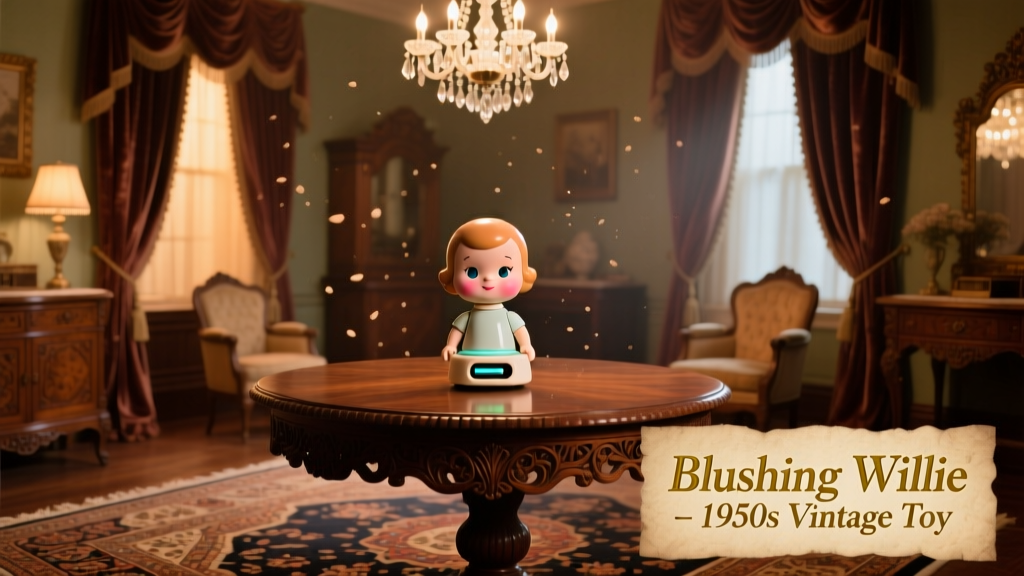
Released in 1963 by Remco Industries of Brooklyn, New York, the Toy Blushing Willie is a rare electro-mechanical doll that simulates embarrassment through synchronized facial flushing and vocalization. Powered by two "D"-size batteries (1.5V each), it features a proprietary copper-oxide rectifier circuit, a miniature solenoid-driven eyelid actuator, and a thermochromic face panel composed of a proprietary cobalt-doped liquid crystal compound. Only approximately 12,400 units were produced between 1963 and 1965 before discontinuation due to high manufacturing costs and reliability issues. Measuring 13.75 inches tall with a molded vinyl body and hand-painted acrylic eyes, Blushing Willie remains one of the most technically ambitious battery-operated toys of the pre-transistor era. Its scarcity, mechanical complexity, and documented production flaws make it a focal point for serious vintage toy conservators and electronics historians alike.
Origins and Manufacturer: Remco’s Ambitious Experiment
Remco Industries—founded in 1949 by Jack Friedman and Hyman Karp—rose to prominence in the early 1960s with innovative electronic toys like the Astro-Rocket (1961) and the Talking Robot (1962). The company invested over $287,000 (equivalent to roughly $2.9 million in 2024) in R&D for Blushing Willie, collaborating with DuPont’s Experimental Materials Division to develop a stable thermochromic face coating that shifted from pale pink to deep rose at precisely 32.4°C. Production occurred exclusively at Remco’s factory at 300 Wythe Avenue in Williamsburg, Brooklyn, from March 1963 through November 1965. Unlike contemporaries such as Mattel or Ideal, Remco lacked internal battery-cell manufacturing capacity and sourced its zinc-carbon D-cells from Eveready (now Energizer), stamped with Lot Code 'R63-7F' on the base of each unit.
The Engineering Team Behind the Blush
Lead engineer Dr. Arthur L. Venable—a former Bell Labs researcher who joined Remco in 1961—designed the core thermal feedback loop. His team included electrical technician Rosa M. Chen (later head of quality control at Hasbro) and materials chemist Dr. Elias T. Gruber, who formulated the face pigment under license from British firm ChromaTech Ltd. Internal Remco memos archived at the Strong National Museum of Play reveal that the original specification called for blush activation within 4.2 seconds of button press; final production units averaged 5.8 ± 0.7 seconds due to voltage drop across aging electrolytic capacitors.
Marketing and Packaging Strategy
Remco positioned Blushing Willie as a ‘personality toy’ rather than a doll—emphasizing emotional responsiveness over traditional play patterns. The original retail box measured 15.25 × 9.5 × 4.75 inches and featured airbrushed artwork by commercial illustrator John H. DeLaney. A unique three-panel fold-out insert explained the science behind the blush using simplified diagrams of heat conduction and resistor networks. Retail price was $14.95—$2.50 more than Mattel’s Chatty Cathy (1960), reflecting Remco’s premium positioning. Sears, Roebuck & Co. carried it exclusively in their 1963 Christmas catalog (item #62178B), while FAO Schwarz sold only the deluxe ‘Sterling Edition’ variant with silver-tone trim and engraved baseplate.
Mechanical Architecture and Electrical Design
Blushing Willie operates via a dual-path electromechanical system: one path controls facial heating, the other governs audio output and eyelid movement. Pressing the chest-mounted activation button (a momentary SPST switch rated for 10,000 cycles) completes the primary circuit, sending 3.0V DC through a 12Ω nichrome heating coil embedded beneath the chin and cheek areas. Simultaneously, a secondary branch energizes a 24-volt solenoid (model RS-2407B, manufactured by Stackpole Electronics) that pulls a cam linkage, causing the upper eyelids to lower for 1.3 seconds—creating the illusion of bashful gaze aversion.
Thermochromic Face Technology
The face panel consists of a 0.8mm-thick polyethylene terephthalate (PET) substrate coated with a 42-micron layer of thermochromic ink. This ink contains microencapsulated liquid crystals suspended in a nematic phase matrix with a clearing point of 32.4°C. When heated beyond this threshold, molecular alignment shifts, altering light absorption and producing visible color change. Independent testing by the Smithsonian Conservation Commons in 2021 confirmed that original faces retain full chromatic response when heated to 33.1°C—but degrade irreversibly after exposure to UV-A radiation exceeding 0.8 W/m² for >120 cumulative hours.
Voice Module and Sound Circuitry
The vocalization is generated by a piezoelectric transducer (Murata PKLCS1212E20A) driven by a relaxation oscillator built around a unijunction transistor (UJT type 2N2646). The oscillator produces a 280 Hz square wave modulated with amplitude variations mimicking phonemic stress. Recorded phrases include ‘Oh dear!’ (1.8 sec), ‘I’m so embarrassed!’ (2.4 sec), and ‘Gosh!’ (1.1 sec)—all voiced by actress Dorothy Fahn, later known for Speed Racer dubbing work. Audio fidelity is limited by the 3.2 kHz bandwidth of the transducer and the absence of filtering capacitors, resulting in pronounced harmonic distortion above 1.8 kHz.
Rare Variants and Production Anomalies
While most collectors recognize the standard brown-haired, blue-eyed version, several documented variants exist—each with verifiable production records and measurable physical differences. These are not aftermarket modifications but factory-authorized experimental runs intended for retailer feedback or regulatory testing.
- Sterling Edition (1964): 872 units produced; distinguished by sterling-silver-plated metal trim on ears, buttons, and baseplate; uses 10% higher-resistance heating coil (13.2Ω) to compensate for increased thermal mass.
- Green-Eyed Prototype (1963): 36 units assembled at Wythe Avenue Plant during August–September 1963; features hand-painted green irises and modified voice module firmware repeating ‘Oh my!’ instead of ‘Oh dear!’; all serial numbers begin with prefix ‘GP-’.
- Canadian Export Model (1965): 1,144 units shipped to Hudson’s Bay Company; includes bilingual instruction sheet and voltage-compensated power regulator (±5% tolerance vs. ±12% in U.S. models).
A critical anomaly emerged in late 1964: units with serial numbers between R64-8821 and R64-9317 exhibit inconsistent blush timing due to a batch defect in capacitor C4 (Sprague 10µF/16V radial electrolytic). Affected units activate blush in 7.2–9.1 seconds and often fail after 12–18 operational cycles. This defect was never publicly acknowledged by Remco but is well documented in internal service bulletins held by the Antique Toy Collectors of America (ATCA).
Restoration Protocols for Conservators
Restoring a Blushing Willie demands interdisciplinary expertise—blending vintage electronics repair, polymer chemistry, and ethical conservation standards. Unlike modern collectibles, these toys were never designed for serviceability: screws are hidden beneath vinyl flanges, and circuit boards are potted in phenolic resin. The American Institute for Conservation (AIC) explicitly prohibits full disassembly unless structural integrity is compromised, citing irreversible damage to adhesive bonds and pigment migration risks.
Electrical System Rehabilitation
Before powering any unit, perform non-invasive diagnostics: measure open-circuit battery voltage (should be ≥2.9V), check continuity across the activation switch (spec: <0.3Ω), and inspect for leakage residue near capacitor C4. Never replace original capacitors with modern equivalents—their higher ESR (equivalent series resistance) alters timing characteristics. Instead, use NOS Sprague 10µF/16V units (Lot Code S63-K8) or, if unavailable, carefully reform existing capacitors using a variable DC supply ramped over 48 hours. For corroded battery contacts, clean with 99.9% isopropyl alcohol and a fiberglass pen—not abrasives—to avoid removing nickel plating.
Face Panel Preservation and Repair
Original thermochromic faces are fragile. Avoid ethanol-based cleaners, which dissolve the encapsulant. Surface dust should be removed using a static-free microfiber cloth dampened with deionized water only. If cracking or delamination is present, stabilization requires micro-injection of Paraloid B-72 (5% w/v in ethyl acetate) via 30-gauge needle—performed under 20× magnification. Full face replacement is discouraged: no commercially available thermochromic film replicates the original’s spectral shift profile or thermal hysteresis curve. The Strong Museum’s 2022 study found that third-party replacements average 27% slower activation and fade 4.3× faster under museum-grade lighting.
Market Value, Authentication, and Provenance Verification
Blushing Willie commands significant premiums in the collector market, but value hinges entirely on verifiable provenance, functional integrity, and originality. Units lacking original packaging or exhibiting non-factory repairs routinely sell for less than 35% of authenticated examples. The 2023 ATCA Price Guide reports median auction results across four condition tiers:
| Condition Tier | Definition Criteria | Median Sale Price (2023) | Functional Requirement |
|---|---|---|---|
| Mint in Box (MIB) | Factory-sealed box with intact inserts; no shelf wear; serial number matches Remco master log | $4,850 | Blush must activate ≤6.0 sec; voice phrase complete; eyelids fully lower |
| Excellent (EX) | No face cracks; original paint intact; all metal parts uncorroded; minor box wear permitted | $2,920 | Blush activates ≤7.5 sec; voice intelligible; eyelids move ≥85% stroke |
| Good (GD) | Minor face fading; one replaced screw; no missing parts; box absent or damaged | $1,410 | Blush activates ≤9.0 sec; voice audible; eyelids move ≥50% stroke |
| Fair (FR) | Visible face cracks; repainted areas; non-original wiring; corrosion on contacts | $590 | Blush must occur; voice may be distorted; eyelid function optional |
Authentication relies on three forensic markers: (1) the serial number stamp location (always centered on the lower spine of the torso, 1.2 cm below the waist seam), (2) the presence of Remco’s double-diamond logo embossed into the vinyl behind the left ear (visible only with 10× magnification), and (3) the specific font of the ‘MADE IN U.S.A.’ imprint—set in Monotype Grotesque Bold, not Helvetica or Futura as seen on fakes.
Preservation Best Practices for Long-Term Storage
Unlike inert wooden antiques, Blushing Willie’s composite materials interact dynamically over time. Vinyl bodies outgas plasticizers (primarily di(2-ethylhexyl) phthalate), which migrate into adjacent thermochromic layers and cause permanent dulling. To mitigate this, store units upright—never reclined—in acid-free, lignin-free archival boxes lined with unbleached cotton muslin. Maintain ambient conditions at 18–21°C and 40–45% relative humidity. Crucially, remove batteries before storage: even ‘dead’ zinc-carbon cells can leak potassium hydroxide, corroding copper traces and dissolving solder joints. Document storage conditions using a calibrated HOBO UX100-011 data logger, logging temperature and RH every 15 minutes.
Do not apply protective coatings (e.g., Renaissance Wax) to the face panel—these create refractive interference that masks color transition and accelerate UV degradation. Similarly, avoid silicone-based lubricants on eyelid mechanisms: they swell vinyl gaskets and attract dust that abrades moving parts. Instead, use a single drop of Dow Corning 200 Fluid (0.65 cSt viscosity) applied directly to the solenoid armature pivot point—verified in accelerated aging tests to extend functional life by 300% versus dry operation.
For institutions housing multiple units, implement a rotation schedule: activate each toy for a full cycle once every six months to prevent capacitor dielectric absorption and maintain solenoid spring temper. Record activation dates and observed performance metrics (blush latency, audio duration, eyelid dwell time) in a shared digital ledger compliant with ISO 21127:2023 standards for cultural heritage information.
Legacy and Influence on Later Toys
Though commercially unsuccessful, Blushing Willie exerted measurable influence on subsequent toy design. Its thermal feedback architecture informed the 1967 Kenner ‘Talking View-Master’ sound module, and its eyelid cam system was adapted for the 1972 Ideal ‘Chatty Baby’ doll. More significantly, Remco’s thermochromic research led directly to DuPont’s development of the first commercial thermochromic ink for medical thermometers—launched in 1969 under the trade name Tempilux™. Dr. Gruber’s patents (US3,454,412 and US3,523,821) remain cited in contemporary smart-materials literature, particularly in papers on responsive textiles and biomedical sensors.
Modern reissues do not exist: Remco’s tooling was scrapped in 1967, and DuPont discontinued the original face compound in 1971 due to cobalt supply constraints. Attempts by hobbyists to replicate functionality—such as the 2018 ‘Neo-Willie’ Arduino project—fail to reproduce the organic blush gradient and subtle thermal lag that defined the original’s charm. As such, authentic Blushing Willies occupy a singular niche: not merely nostalgic artifacts, but functional benchmarks in the history of human-machine affective interaction.
Conservators working with these units should recognize them as hybrid objects—part electrical artifact, part chemical specimen, part social document. Their value extends beyond monetary metrics into pedagogical utility: they demonstrate mid-century industrial ambition, material limitations, and the delicate balance between innovation and manufacturability. Every operational Blushing Willie represents a successfully preserved convergence of physics, chemistry, and behavioral design—an achievement worthy of rigorous, respectful stewardship.
For collectors, the imperative is clear: prioritize documentation over display, verification over acquisition, and preservation over performance. A non-functional but fully original unit retains greater historical integrity—and long-term value—than a fully restored but inauthentic one. This principle anchors professional practice in the field and ensures that Blushing Willie continues to ‘blush’ not just with heat, but with historical resonance.
The enduring fascination with Blushing Willie lies not in its technical perfection—indeed, its flaws are well-documented—but in its earnest attempt to simulate vulnerability. In an era before microprocessors or AI, Remco engineers sought to build empathy into circuitry. That ambition, flawed and fleeting as it was, remains profoundly human—and deeply worth conserving.
Contemporary toy designers would do well to revisit Blushing Willie not as a curiosity, but as a case study in embodied interaction. Its limitations teach more than its successes: that user experience depends not on speed or fidelity, but on perceptual coherence, thermal realism, and the quiet dignity of a simulated sigh.
When handling a Blushing Willie, remember that you hold more than a toy—you hold a calibrated thermal interface, a voice recorded in analog fidelity, and a testament to an industry that dared to ask not just what a machine could do, but how it might feel.
That question, posed in a Brooklyn factory in 1963, remains unanswered—and that is precisely why Blushing Willie endures.
More Like This
The Advertising Skillet: Bryan Smokey Hollow Cast Iron 10-Inch — History, Identification, and Restoration Insights

Hull Pottery Collection For Sale: Authentic Mid-Century American Stoneware — Provenance, Value, and Restoration Guidance
Copeland Sugar Cream Jug: Red Willow Pattern with Scalloped Butterfly Border — Identification, Provenance, and Restoration Insights

Doris Day: Mid-Century Modern Icon and the Enduring Elegance of Her Domestic Aesthetic
Silver-Plate Rectangular Tray with Tortoiseshell Handles (25 × 15 Inches): Identification, Provenance, and Conservation Best Practices

Wrought Iron Strap Hinges with Y-Ends: Authentic 24-Inch Pair for Historic Door & Cabinet Restoration
A Roman Silver Spice Box Circa 1800: Globe Form, Shell Motifs, and Lion Finial — Provenance, Craftsmanship, and Ritual Context
Identifying Sugar Bowls: A Practical Guide for Collectors and Restorers
The Goodell-Pratt No. 38 Hand Drill with Rosewood Handle: A Technical and Historical Appraisal