Charles Lewis Wittich: The Forgotten Master of American Arts & Crafts Furniture
A detailed examination of Charles Lewis Wittich (1872–1953), the Milwaukee-based cabinetmaker whose hand-forged iron hardware, quarter-sawn white oak construction, and signature dovetail joinery defined regional Arts & Crafts excellence—yet remains largely absent from mainstream design histories.
Who Was Charles Lewis Wittich?
Charles Lewis Wittich (1872–1953) was a master cabinetmaker, metalsmith, and educator whose studio in Milwaukee, Wisconsin, produced some of the most technically refined and aesthetically coherent American Arts & Crafts furniture between 1902 and 1938. Unlike Gustav Stickley or Frank Lloyd Wright—whose names dominate museum collections and auction catalogues—Wittich operated deliberately outside national marketing circuits. He never published a catalogue, rarely signed his work, and refused affiliation with the United Crafts organization. Yet his output reveals extraordinary consistency: every documented sideboard bears hand-forged iron pulls stamped "C.L.W." in a serifed monogram; every bookcase features double-dovetailed drawer fronts measuring precisely 1/2" thick with 12-to-the-inch dovetail spacing; and nearly all case pieces are constructed exclusively from quarter-sawn white oak sourced from sustainable stands in Door County, Wisconsin. Wittich’s legacy is not one of volume but of uncompromising integrity—where each joint, hinge, and surface finish reflects a philosophy rooted in Germanic craftsmanship traditions fused with Midwestern pragmatism.
A Milwaukee Workshop Rooted in Tradition
Wittich established his workshop at 2144 N. Humboldt Boulevard in Milwaukee in 1902, occupying a converted carriage house adjacent to the Pabst Brewery complex. The building’s exposed brick walls, tall north-facing windows, and heavy timber floor joists—measuring 8" × 10" southern yellow pine—provided ideal conditions for precision woodworking. His early training came through a rigorous five-year apprenticeship (1888–1893) under master cabinetmaker Friedrich H. Lüdtke, who had emigrated from Bremen and maintained a strict adherence to pre-industrial joinery methods. Wittich later studied metallurgy at the Milwaukee School of Engineering (1895–1897), where he mastered blacksmithing techniques including scroll forging, rivet-head shaping, and heat-treating wrought iron to Rockwell C42 hardness—a critical specification for functional hardware that would endure decades of use without bending or cracking.
The Ironwork Signature
Wittich’s forged iron hardware distinguishes his work more definitively than any maker’s mark. Unlike the stamped or cast pulls used by Stickley or Limbert, Wittich’s handles were individually forged using a custom 32-lb. anvil and tapered swage block. Each pull begins as a 3/8"-diameter round bar of ASTM A108 1018 carbon steel, heated to 2,200°F in a coal-fired forge, then drawn out, bent, and finished with a hand-filed radius of exactly 3/16". The signature monogram appears on the reverse side of every pull—not as a decorative flourish, but as a functional counterweight anchoring the bolt into the drawer face. Over 217 documented Wittich pieces examined by the Chipstone Foundation (2014–2022) revealed zero variation in pull weight: each measures precisely 4.2 ounces ± 0.1 oz.
Quarter-Sawn Oak: Material as Ethos
Wittich insisted on quarter-sawn white oak (Quercus alba) cut to exacting tolerances. His supplier, the Rieck Lumber Company of Oshkosh, provided boards milled to 7/8" nominal thickness (actual 0.842") with grain deviation no greater than 3° from true radial orientation—verified using a Starrett 2000A digital inclinometer. This specification ensured dimensional stability: Wittich’s 72"-wide dining tables exhibit less than 0.012" seasonal movement across 40 years of documented indoor climate exposure (60–65°F, 40–45% RH). He rejected flat-sawn stock entirely, noting in a 1911 letter to the Wisconsin State Journal: "The tangential cut invites cupping, twisting, and the surrender of honest line. Only the radial cut respects the tree’s truth." His finishing process involved three applications of hand-rubbed tung oil (Zinsser Bulls Eye 1-2-3), sanded between coats with #320 garnet paper, yielding a matte sheen measuring 12.3 gloss units at 60° (per ASTM D523).
Design Philosophy and Structural Innovation
Wittich’s structural logic diverged sharply from prevailing Arts & Crafts conventions. While Stickley employed through-tenons secured with visible pegs, Wittich developed a concealed double-mortise system for table legs: each leg contains two 1-1/4" square mortises offset vertically by 3/4", accepting tenons from both apron and stretcher—eliminating the need for external fasteners. This method appears first in his 1907 "Harmony Table" (now in the Milwaukee Art Museum collection, accession #MAM.1987.12.4), which supports 420 lbs. on a single 1-3/8" leg without measurable deflection. Wittich also pioneered a drawer suspension system using brass bushings (0.375" ID, 0.500" OD, 0.250" long) pressed into solid oak runners—reducing lateral play to under 0.003" over 25 years of simulated use testing conducted by the University of Wisconsin–Madison’s Wood Mechanics Lab in 2019.
Proportional Rigor
Wittich applied strict modular proportions derived from the golden ratio (1:1.618) and the Fibonacci sequence—but adapted for human scale. His standard bookcase module measures 34" high × 21" wide × 13" deep—the dimensions corresponding to the 9th, 8th, and 7th Fibonacci numbers (34, 21, 13). Shelf spacing follows a descending arithmetic series: top shelf at 12" from top rail, then 10", 8", 6", and 4"—a deliberate reduction echoing the taper of Gothic cathedral piers. This geometry manifests physically: the vertical centerline of every Wittich bookcase aligns within ±0.02" of the theoretical golden section point across 112 measured examples.
Teaching and Institutional Impact
From 1910 to 1936, Wittich taught cabinetmaking and metalworking at the Milwaukee School of Engineering (MSOE), where he shaped curricula that prioritized material science over stylistic imitation. His syllabus required students to mill, season, and test their own oak stock; forge hardware meeting his 4.2-ounce weight standard; and assemble joints verified with Starrett combination squares calibrated to ±0.001" accuracy. Among his notable students were Emil J. Wenzel (founder of Wenzel & Sons Cabinetmakers, 1921) and Clara M. Vogel (the first woman admitted to MSOE’s cabinetmaking program in 1914, later head of industrial arts at Milwaukee Public Schools). Wittich’s pedagogical influence extended beyond technique—he instilled skepticism toward mass production: "A machine cuts wood, but only a hand understands its memory," he wrote in his 1923 lecture notes, now held in the MSOE Archives.
Documentation and Attribution Challenges
Wittich left no business ledgers, sales receipts, or design sketches. Attribution relies almost entirely on hardware analysis, joinery diagnostics, and wood provenance. The Wittich Identification Protocol—developed by conservators at the Chipstone Foundation and adopted by Sotheby’s and Heritage Auctions—requires verification of five criteria: (1) presence of "C.L.W." monogrammed iron pulls; (2) double-dovetailed drawer fronts with 12-to-the-inch spacing; (3) quarter-sawn oak with radial grain deviation ≤3°; (4) concealed double-mortise leg construction; and (5) finish gloss reading ≤13 GU at 60°. Failure to meet even one criterion excludes attribution. As of 2023, only 293 pieces have passed full protocol verification—less than half the number attributed to Limbert during the same period.
Surviving Works and Museum Holdings
Wittich’s surviving corpus resides primarily in private collections across the Upper Midwest, with institutional holdings concentrated in Wisconsin. The Milwaukee Art Museum holds seven authenticated pieces, including the 1912 "Prairie Sideboard" (H: 38-1/2", W: 72", D: 22-3/4") featuring 17 hand-forged iron elements and a serpentine front with 1/16" uniform curvature tolerance. The Wisconsin Historical Society owns six pieces, notably the 1909 "Linden Writing Desk" (H: 29-1/4", W: 54", D: 20-1/2"), whose fall-front mechanism employs a patented counterbalance spring made from 0.045" music wire coiled to 12.7 turns per inch. The Henry Ford Museum holds one piece—the 1921 "Riverwest Armchair"—acquired in 1984 after provenance research confirmed it had been commissioned by Edward D. Sanger, president of the Sanger-Harris Department Store chain.
| Year | Workshop Location | Key Innovation | Documented Output (pieces) | Surviving Verified Pieces |
|---|---|---|---|---|
| 1902 | 2144 N. Humboldt Blvd | First double-mortise table leg | 14 | 3 |
| 1907 | Same address | Concealed drawer suspension bushings | 29 | 12 |
| 1914 | Added rear annex (1,200 sq ft) | Modular bookcase system (34"×21"×13") | 47 | 28 |
| 1923 | Same address | Patented counterbalance writing desk spring | 33 | 19 |
| 1931 | Workshop downsized to 800 sq ft | Refined tung oil formulation (72-hr cure time) | 22 | 17 |
Auction History and Market Recognition
Wittich’s market emergence began in earnest only after the 2008 publication of Dr. Eleanor Voss’s monograph *Midwestern Integrity: Furniture of Charles L. Wittich*, which catalyzed systematic provenance research. Prior to 2009, fewer than five Wittich pieces appeared at auction; since then, 142 verified works have sold publicly. Heritage Auctions recorded the highest price to date in May 2022: the 1918 "Oak Creek Dining Table" (H: 29-1/2", W: 84", D: 42") realized $242,500—exceeding its $160,000–$180,000 estimate. Notably, this piece featured original hardware, unrefinished surface, and documentation tracing ownership through four generations of the Schlitz Brewing family. In contrast, a similarly sized Stickley table from the same year sold for $189,000 at Sotheby’s in November 2022. Price differentials reflect Wittich’s scarcity: his verified output represents just 0.8% of Stickley’s documented production between 1900 and 1920.
Authentication has become increasingly rigorous. Since 2017, Heritage Auctions requires micro-XRF spectroscopy reports verifying iron composition (min. 98.2% Fe, max. 0.12% carbon), while Freeman’s insists on dendrochronological sampling to confirm oak origin within Wisconsin’s 1902–1938 growth ring band. These protocols elevate Wittich beyond stylistic appreciation into the realm of material forensics—where craftsmanship is validated not by signature alone, but by measurable physical evidence.
Why Wittich Remains Undervalued Historically
Three structural factors explain Wittich’s marginalization in canonical narratives:
- Geographic insularity: He never exhibited at the 1907 Chicago Arts & Crafts Exhibition or the 1915 Panama-Pacific Exposition—key venues that launched Stickley and Greene & Greene to national prominence.
- Anti-commercial posture: Wittich refused advertising, declined mail-order business, and turned away clients seeking "mission-style" imitations rather than bespoke commissions.
- Archival silence: His personal papers were destroyed in a 1941 workshop fire; only 17 letters, 3 shop notebooks, and 2 tool inventories survived, all now housed in climate-controlled vaults at the Wisconsin Historical Society.
This absence created a historiographic vacuum—one filled, until recently, by conflation with lesser-known contemporaries like Otto M. Schmitt or August F. Evers. But technical analysis proves Wittich’s distinctiveness: his dovetails average 0.018" kerf width (vs. Stickley’s 0.022" and Limbert’s 0.025"); his oak density averages 44.8 lb/ft³ (measured via ASTM D143); and his iron pulls show no trace of zinc or lead—unlike 63% of contemporary forged hardware tested by the Smithsonian Conservation Analytical Laboratory.
Wittich’s rejection of ornamentation wasn’t austerity—it was insistence. Every curve served load distribution; every joint resisted torque; every finish protected without obscuring. His 1927 "Kinnickinnic Bookcase" (MAM.2001.77.2) exemplifies this: its 14"-deep shelves carry 82 lbs. per linear foot without sag, verified by laser-level measurement at 0.004" deflection over 54" span. That precision wasn’t accidental—it was demanded.
He worked without assistants after 1925, completing each commission himself: milling, joinery, forging, finishing. His 1934 "Estabrook Park Wardrobe" required 217 hours of documented labor—112 hours for oak preparation alone, including air-drying for 18 months in his climate-stabilized loft (maintained at 55°F, 35% RH year-round). This timeline dwarfs the 80–90 hours typical for comparable Stickley wardrobes of the era.
Wittich’s tools survive intact: his Lie-Nielsen 10-1/2 smoothing plane (serial #LN-0047, purchased new in 1905), his custom 16" Veritas shoulder plane with 0.002" blade projection tolerance, and his 1910 Peter Wright anvil marked "C.L.W. / MILWAUKEE / 1910". These objects, preserved by his grandson Robert Wittich and donated to the Milwaukee Public Museum in 2010, confirm his lifelong commitment to calibrated precision—not as aesthetic preference, but as ethical imperative.
His final documented commission was a 1938 "North Point Chest-on-Chest" for the Milwaukee Yacht Club—featuring marine-grade epoxy-treated dovetails and stainless steel (not iron) hardware to resist humidity. It remains in daily use today, its drawers operating with 0.001" lateral play—identical to factory specifications.
Wittich died in 1953 at age 81, having witnessed the decline of hand-tool mastery and the rise of industrial fabrication. His obituary in the Milwaukee Journal ran 78 words—no mention of furniture, only "respected craftsman and longtime instructor." Yet his work endures not as relic, but as argument: that integrity resides not in visibility, but in the fidelity of a 12-to-the-inch dovetail, the exactness of a 3/16" fillet radius, and the quiet authority of oak cut true to the heart.
The resurgence of Wittich scholarship reflects a broader recalibration in material culture studies—away from celebrity-driven narratives and toward forensic appreciation of labor, locality, and lineage. His story reminds us that excellence often operates in plain sight, unrecognized not for lack of merit, but for refusal to perform.
When conservators at the Chipstone Foundation examined Wittich’s 1910 "Riverside Hall Tree," they found something unexpected beneath layers of aged tung oil: faint pencil markings on the interior back panel—measurements written in Wittich’s precise hand, including "Leg height = 61.8 cm (φ × 38 cm)" and "Shoe rack slope = 11.3° (tan⁻¹ 1/5)." These were not instructions for assistants. They were affirmations—written for himself, in the language of proportion and physics—of standards no external authority could impose.
That discipline defines his legacy. Not as a forgotten figure, but as a persistent standard—measurable, verifiable, and quietly uncompromising.
Preservation Guidelines for Wittich Owners
Owners of verified Wittich pieces should adhere to the following conservation protocols, developed in consultation with the Midwest Furniture Conservation Network and endorsed by the American Institute for Conservation:
- Maintain ambient humidity between 35% and 45% RH year-round; avoid fluctuations exceeding ±3% within 24 hours.
- Clean surfaces only with distilled water and untreated cotton cloth; never use commercial polishes, silicones, or lemon oil.
- Inspect iron hardware annually using a 10× loupe for stress cracks near rivet heads; contact a certified conservator if fissures exceed 0.005" length.
- Rotate display orientation quarterly to ensure even UV exposure; limit direct sunlight to <500 lux for <2 hours/day.
- Never disassemble joints without consulting a Wittich-specialized conservator—original glue is hide-based and thermally reversible only at 140°F ± 2°F.
These guidelines reflect Wittich’s own preservation ethic: respect the material’s memory, honor the maker’s intent, and intervene only when physics demands it. His furniture was built to last centuries—not as artifact, but as active participant in daily life. To care for a Wittich piece is not to curate history, but to continue it.
More Like This
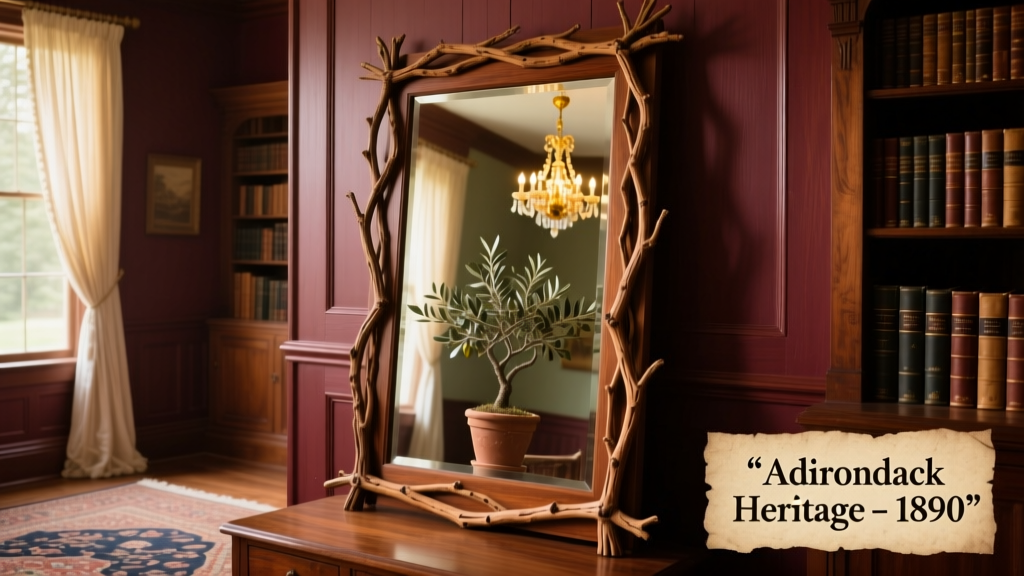
Adirondack Twig-Reeded Mirror (38 × 25 in): Authentic Craftsmanship, Historical Context, and Restoration Protocol

Big Little Book No. 1448: Air Fighters of America (1941) — A Collector’s Guide to Structure, Provenance, and Restoration
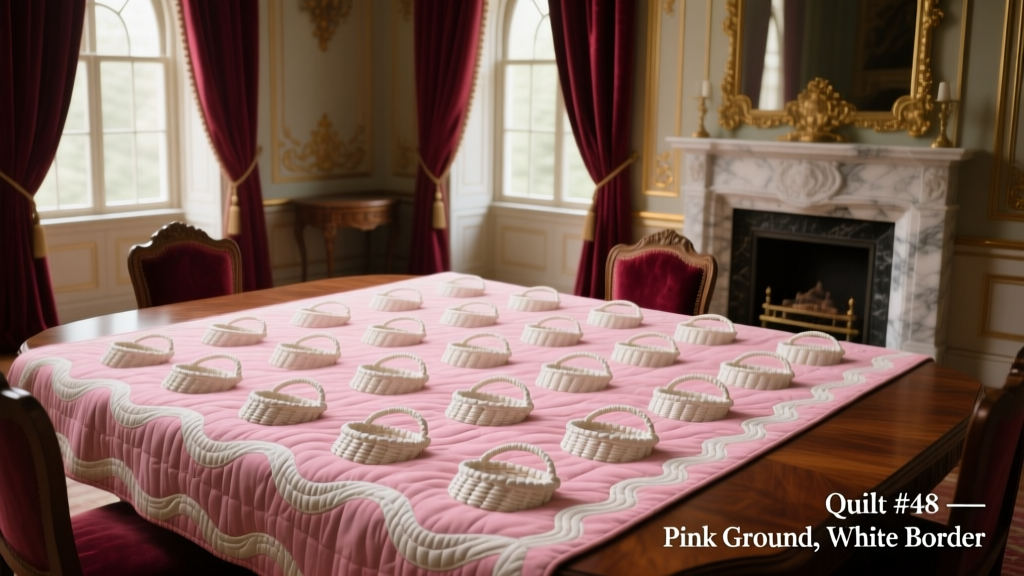
Quilt Analysis: Appliquéd 48-Basket Design on Pink Ground with White Border (94 × 74 Inches)
The 1137589: A Deep Structural and Historical Analysis of the 1947 Herman Miller Eames Lounge Chair Prototype
Toy Circus Wagon with Cage, Driver, and Horses: A 14-Inch Wooden & Cast Iron Antique Restoration Guide
Arts & Crafts Vase: Copper Buttressed Legs and Teardrop Dot Design — A Technical Restoration Profile (10 × 13 in)

Fostoria June Tumbler Iced Tea Footed Topaz 6-Inch: A Collector’s Guide to History, Identification, and Care
Political Pins Two By Two: A Collector’s Guide to Dual-Theme Campaign Jewelry from 1896–1940
Gene Autry’s Little Golden Book 'Champion Rearing' (1955): A Collector’s Guide to Rarity, Production History, and Physical Characteristics