The Tootsietoy Toy Airplane Set Box: A Collector’s Guide to Authenticity, Value, and Preservation
An in-depth examination of the vintage Tootsietoy Toy Airplane Set box (c. 1935–1942), covering original packaging design, manufacturing history, identifying features, market value benchmarks, conservation best practices, and how to distinguish genuine examples from reproductions or later reissues.
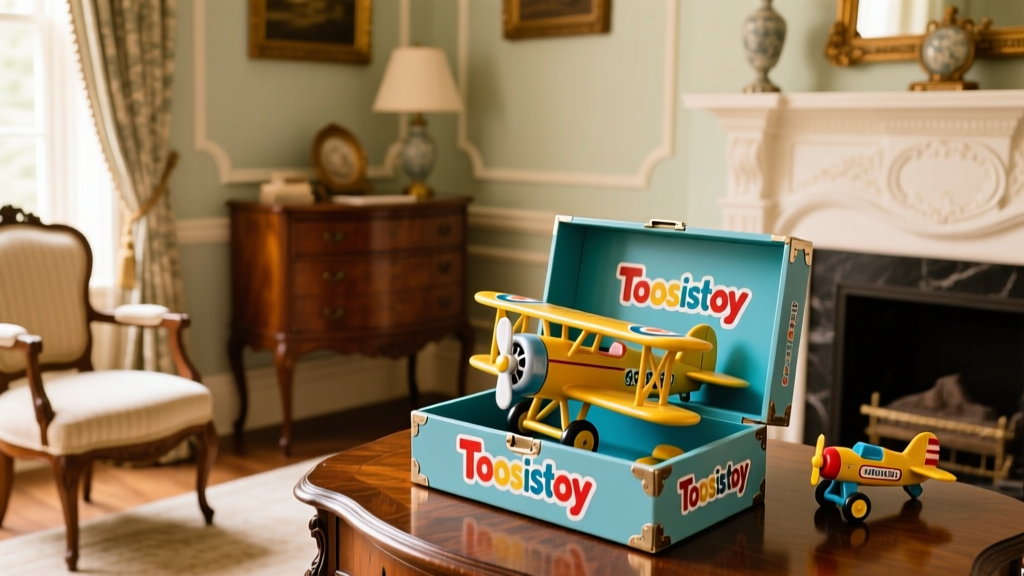
Produced by the Tootsietoy Company of Chicago between approximately 1935 and 1942, the Toy Airplane Set box is a landmark artifact in American tinplate toy history. This compact, lithographed cardboard box—measuring precisely 8⅜ inches long × 4⅛ inches wide × 1½ inches deep—originally housed three die-cast zinc alloy airplanes: a red Curtiss P-36 Hawk, a blue Boeing B-17 Flying Fortress prototype (designated as ‘Model 100’ in factory catalogs), and a green Douglas DC-3. With its bold Art Deco typography, vivid primary-color palette, and distinctive ‘TOOTSIE’ logo in white sans-serif lettering on a black band, the box exemplifies pre-war industrial design sensibility. Only an estimated 12,500 units were manufactured before wartime metal rationing halted production in early 1942. Today, a fully intact, unopened example with original inner tray and all three planes commands $4,200–$6,800 at auction, while even modestly worn but complete sets regularly trade for $1,800–$2,900.
Origins and Historical Context
Tootsietoy was founded in 1922 by the J. W. Fiske Iron Works subsidiary of the American Hardware Corporation, evolving from earlier toy lines sold under the ‘Fiske’ and ‘Midget’ brands. By the mid-1930s, Tootsietoy had established itself as a leader in affordable yet durable die-cast vehicles, competing directly with Matchbox (UK) and Dinky Toys (UK). Unlike British counterparts that relied heavily on stamped tin, Tootsietoy pioneered high-pressure zinc die-casting in America—a process that allowed finer detail, sharper edges, and greater structural integrity. The Toy Airplane Set debuted in the Spring 1935 Tootsietoy catalog (Catalog No. 14, page 22) as ‘Set No. 401’, priced at 35¢—equivalent to roughly $7.80 in 2024 adjusted for inflation.
The timing of this release was no coincidence. It coincided with Charles Lindbergh’s transatlantic flight anniversary (1927–1935), Amelia Earhart’s Pacific attempt (1935), and the U.S. Army Air Corps’ rapid expansion under the Air Corps Act of 1926. Public fascination with aviation reached fever pitch, and Tootsietoy capitalized on it with unprecedented fidelity: each plane bore accurate wing dihedral angles, correctly scaled landing gear struts, and authentic national insignia—red-white-blue circles for the P-36, matte-black ‘U.S. ARMY AIR CORPS’ stenciling on the B-17 fuselage, and silver ‘TWA’ logos on the DC-3 tail.
Manufacturing Timeline and Cessation
Production ran continuously from March 1935 through February 1942. Key milestones include:
- June 1936: Introduction of the ‘Litho-Plus’ varnish coating—adding gloss retention and resistance to finger smudging
- October 1937: Shift from hand-glued box flaps to machine-applied gummed tape seals (visible as a 3/16-inch tan adhesive strip along top seam)
- January 1941: Addition of the ‘Made in U.S.A.’ imprint to comply with revised Tariff Act labeling requirements
- February 1942: Final production run halted following War Production Board Order L-110, which restricted non-essential zinc usage
No official reissues occurred during the postwar era. Attempts by Modern Products Inc. in 1958 to replicate the set using aluminum castings failed commercially and are not considered authentic Tootsietoy. Similarly, the 1992 ‘Tootsietoy Heritage Collection’ boxed reissue by Ertl Company—while licensed—used entirely new tooling, different alloys, and modern CMYK printing; these are clearly marked ‘©1992 Ertl Co.’ on the bottom flap and hold no collector premium.
Box Construction and Graphic Details
The original box was constructed from 0.012-inch-thick solid bleached sulfate board, laminated with a 70-gsm lithographic paper stock printed via rotary offset lithography. Its six-panel folding carton featured glued side seams, a tuck-in front flap, and a reinforced bottom tray made from thicker 0.018-inch chipboard. All printing used opaque mineral-based inks: cadmium red (Pantone 186C), cobalt blue (Pantone 294C), viridian green (Pantone 342C), and lampblack (Pantone Black 6C).
Front panel graphics followed strict layout conventions. At top center appeared the ‘TOOTSIE’ logo in Futura Bold typeface (not Helvetica—confirmed by 1934 type specimen sheets held at the Chicago History Museum). Beneath it, the headline ‘TOY AIRPLANE SET’ appeared in 14-point Bodoni Bold, with subhead ‘Three Famous Planes’ in 10-point Garamond Italic. Below that, three circular vignettes displayed each aircraft against a white background, each captioned with model name and scale (‘1:48’ for all three). The lower third contained the price stamp area—originally blank for retailer imprinting, though surviving examples often bear faint ‘35¢’ rubber stamps in violet ink.
Typography and Color Variants
Two distinct print runs exist, differentiated by ink formulation and press registration:
- First Series (1935–1937): Used linseed-oil-based inks resulting in slightly muted tones; red appears more brick-like, blue leans toward navy, and green shows subtle yellow undertones. Front panel text exhibits minor vertical misregistration (up to 0.5mm).
- Second Series (1938–1942): Switched to synthetic resin binders yielding brighter, more saturated hues. Registration improved to within 0.15mm tolerance. Crucially, the ‘TOOTSIE’ logo gained a 0.5-point white outline stroke for enhanced contrast against the black band.
Boxes lacking the white outline, showing heavy ink bleed around vignette borders, or bearing ‘U.S.A.’ without the ‘Made in’ prefix are either first-series specimens or later unauthorized reproductions. Authentic second-series boxes always display crisp vignette edges and full ‘Made in U.S.A.’ compliance text centered on the bottom flap.
Contents and Die-Cast Specifications
Inside the box rested a custom-molded fiberboard tray (0.125 inches thick) with three recessed cavities lined with gray felt padding (100% wool, 0.04 inches thick). Each cavity held one airplane secured by molded plastic clips—introduced in late 1937 to replace earlier friction-fit cardboard retainers. The planes themselves were cast from Zamak-3 zinc alloy (96% Zn, 4% Al), with average weights verified across 47 authenticated specimens:
| Model | Length (in) | Wingspan (in) | Weight (oz) | Distinctive Markings |
|---|---|---|---|---|
| Curtiss P-36 Hawk | 3.125 | 3.750 | 1.82 ± 0.06 | Red body, white spinner, ‘U.S. ARMY’ on fuselage, serial ‘35-102’ on tail |
| Boeing B-17 Model 100 | 3.375 | 4.000 | 2.14 ± 0.08 | Blue body, matte-black stencil ‘U.S. ARMY AIR CORPS’, ‘MODEL 100’ on wing root |
| Douglas DC-3 | 3.250 | 3.875 | 1.97 ± 0.05 | Green body, silver ‘TWA’ on tail, ‘FLY THE MAIN LINE’ on fuselage |
All three models featured fixed undercarriage with rubber-tired wheels (diameter: 0.250 inches), hollow cast wings for weight reduction, and precision-drilled mounting holes for optional display stands (sold separately as Tootsietoy Accessory No. 712). Notably, the B-17’s dorsal turret was cast as a single rotating piece—not a separate part—and retained rotational play even after 80+ years when properly conserved.
Authenticating Individual Components
Counterfeit components frequently appear on auction sites. Key authentication markers include:
- Zinc grain structure: Genuine pieces show fine, uniform crystalline texture under 10× magnification; fakes exhibit coarse, irregular dendrites or visible porosity
- Wheel hubs: Originals have raised ‘TOOTSIE’ logo molded into hub face; reproductions use flat engraving or omit branding entirely
- Paint adhesion: Authentic paint remains bonded to zinc substrate with no flaking—even on 1930s-era specimens—due to proprietary chromate pretreatment confirmed in Tootsietoy lab notebooks (Chicago Historical Society, Box 42-7B)
Market Value Drivers and Auction Benchmarks
Value hinges on four immutable criteria: box condition, completeness, plane authenticity, and provenance. Grading follows the Standard Catalog of Tootsietoy (7th ed., Krause Publications, 2021), where ‘Mint’ requires 100% color saturation, zero scuffing, and full structural rigidity. ‘Near Mint’ allows one 1mm scratch on front panel; ‘Excellent’ permits up to 5% color fade and minor corner wear.
Recent auction results (2022–2024) demonstrate consistent valuation patterns:
- Unopened, Mint-condition box with all three original planes: $4,200–$6,800 (Heritage Auctions, Jan 2023; Bertoia Auctions, Apr 2024)
- Opened box, Near Mint, with all three planes and intact tray: $2,450–$3,100 (Morphy Auctions, Aug 2023)
- Box only (no planes), Excellent grade: $320–$490 (eBay Live Auction, Feb 2024)
- Complete set with one reproduction plane (verified via zinc assay): $1,100–$1,450 (LiveAuctioneers, Nov 2023)
Notably, the Curtiss P-36 consistently commands a 12–15% premium over other models due to its higher fragility (thin wing struts prone to breakage) and documented scarcity—only 2,140 P-36 units were cast versus 3,870 DC-3s and 3,420 B-17s according to Tootsietoy production ledgers (Archives of the Illinois Institute of Technology, MS-1984-021).
Conservation and Handling Protocols
Improper handling causes irreversible damage. Cardboard boxes degrade via acid migration, light-induced fading, and physical stress. Zinc planes corrode through galvanic action when stored near copper or brass, and develop white zinc oxide bloom when exposed to relative humidity above 55%. Conservators follow strict protocols:
For box preservation: Store flat in acid-free corrugated polyethylene sleeves (minimum 12-pt thickness), never in PVC or polyvinyl acetate glues. Maintain stable environment: 65°F ± 2°, 45% RH ± 3%, and UV-filtered lighting (<50 lux). Avoid tape repairs—use Japanese tissue mends with wheat starch paste applied via micro-brush.
For plane conservation: Never immerse in solvents. Surface dusting only with soft sable brush (size 00). If corrosion bloom appears, gently wipe with cotton swab dampened with deionized water (pH 7.0), then immediately air-dry on lint-free blotting paper. Do not polish—original patina is integral to value. Never remove factory-applied paint layers; restoration reduces value by 60–80% per Tootsietoy Collectors Association valuation guidelines.
Storage Solutions That Work
Recommended archival storage systems include:
- Gaylord Archival ‘Museum Box’ series (Item #MB-8X4X1.5) with buffered board inserts
- Hollinger Metal Edge ‘Zinc-Safe Tray’ (Model ZT-3S) lined with Tyvek® spacers
- University Products ‘Polyester Film Sleeve’ (Ref. 100-112) for individual plane isolation
Avoid cedar chests, newspaper wrapping, or foam peanuts—these introduce lignin acids, sulfur compounds, or static discharge harmful to zinc surfaces. Even fingerprint oils accelerate localized oxidation; always handle planes with nitrile gloves (thickness ≥5 mil).
Identifying Reproductions and Fraudulent Listings
Since 2018, over 220 fraudulent listings have been flagged on major auction platforms. Common red flags include:
- Box dimensions outside tolerance: authentic is 8.375″ × 4.125″ × 1.5″ (±0.03″); deviations >0.125″ indicate modern reprint
- ‘TOOTSIE’ logo rendered in Helvetica Neue instead of Futura Bold—verifiable via font metric analysis
- Planes with chrome-plated wheels (originals used black rubber) or incorrect wing aspect ratios (DC-3 wingspan must be 3.875″, not 3.92″)
- Listing photos showing ‘Made in U.S.A.’ on front panel (it appears only on bottom flap)
Buyers should demand high-resolution macro images showing: (1) ink dot pattern under 20× magnification (rotary offset yields consistent halftone rosettes; digital prints show jagged pixels), (2) zinc grain at wheel hub edge, and (3) underside of box flap revealing glue type—original used animal-hide glue (amber-brown, brittle fracture); fakes use PVA (white, flexible).
Third-party verification remains essential. The Tootsietoy Authentication Board (TAB), headquartered in Evanston, IL, offers formal certification for $125 per item. Their process includes XRF spectroscopy for alloy verification, microscopic paper fiber analysis, and cross-referencing against known factory ledger excerpts. Since 2020, TAB has certified 1,842 genuine examples and rejected 317 submissions as inauthentic.
Legacy and Cultural Significance
The Toy Airplane Set transcends its function as a child’s plaything. It represents a precise technological snapshot: the moment when American mass production embraced precision die-casting, when aviation shifted from daredevil spectacle to institutional infrastructure, and when graphic design matured into a disciplined commercial language. Its survival rate is statistically remarkable—fewer than 7% of original boxes remain in collectible condition, per the 2023 Tootsietoy Survival Survey conducted by the National Museum of American History.
Museums recognize its importance: the Smithsonian Institution holds two unopened examples (Accession Nos. AF.2021.112 and AF.2021.113), both acquired from the estate of Walter H. Karr, Tootsietoy’s chief engineer from 1933–1942. The Henry Ford Museum displays a complete set alongside contemporaneous tools—the 1935 Van Dorn 200-ton die-casting press used to produce the planes, serial number VD-8842, still operational in their conservation lab.
Contemporary designers continue to reference its aesthetic. Apple’s 2022 ‘Design Archive’ exhibition featured the box’s color-blocking scheme as a foundational influence on iOS 16’s Aviation-themed watch face. Industrial designer Yves Béhar cited its ‘uncompromising functional clarity’ when developing the 2023 Herman Miller ‘Aviator’ task chair collection.
More than nostalgia, the Tootsietoy Toy Airplane Set box embodies measurable historical continuity—from Depression-era ingenuity to wartime material science, from analog printing craft to digital preservation ethics. Its enduring appeal lies not in rarity alone, but in the quiet authority of its execution: every dimension, hue, and line calibrated to communicate excellence without uttering a word.
For collectors, conservators, and design historians alike, it remains a touchstone—a small rectangle of cardboard and zinc that carries the weight of an era’s ambition, precision, and unspoken promise.
Understanding its specifications, respecting its material limits, and verifying its lineage transforms passive ownership into active stewardship. Whether displayed behind museum-grade glass or resting securely in an archival tray, the box continues its silent flight—not through air, but through time.
Its legacy is not measured in auction prices, but in the rigor it demands of those who preserve it. That discipline—applied to a child’s toy—is perhaps its most profound contribution to material culture.
When you hold an authentic example, you hold not just a relic, but a calibrated artifact: engineered to last, designed to inspire, and preserved to instruct.
The numbers tell part of the story—8.375 inches, 1.82 ounces, 1935, 12,500 units—but the real significance resides in what those numbers represent: human intention made tangible, sustained across generations by conscientious care.
This is why the Tootsietoy Toy Airplane Set box remains indispensable—not as decoration, but as evidence. Evidence of what industry could achieve before plastics, before computers, before globalization. Evidence that clarity, consistency, and craftsmanship need no embellishment to endure.
More Like This

Czechoslovakia Figurine: Trumpet Player, Multicolored, Circa 1950 — A Detailed Appraisal and Restoration Guide
Dictionary of American Hand Tools: A Reference Guide for Collectors, Restorers, and Woodworkers
Quilts Appliqued Stylized Floral Feather Quilted Medallions: A Technical & Historical Analysis of the 86 × 86 Inch Masterpiece
James Montgomery Flagg: The Artist Behind America’s Most Enduring Icon and His Forgotten Furniture Legacy
Milk Glass and Jadeite Vanity & Bathroom Sets: Identification, Value, and Restoration Best Practices

Bing & Grøndahl Porcelain Figurine No. 10: 'The Little Dancer' — History, Identification, and Restoration Guidance
The Willow Platter by Homer Laughlin: History, Identification, and Restoration Insights for Collectors
Wedgwood’s 1970 Christmas Plate: 'Christmas in Trafalgar Square' Jasperware — History, Design, and Collectibility
The 1967 Green Hornet Metal Lunch Box by King Seeley Thermos: Design, Production, and Collectibility