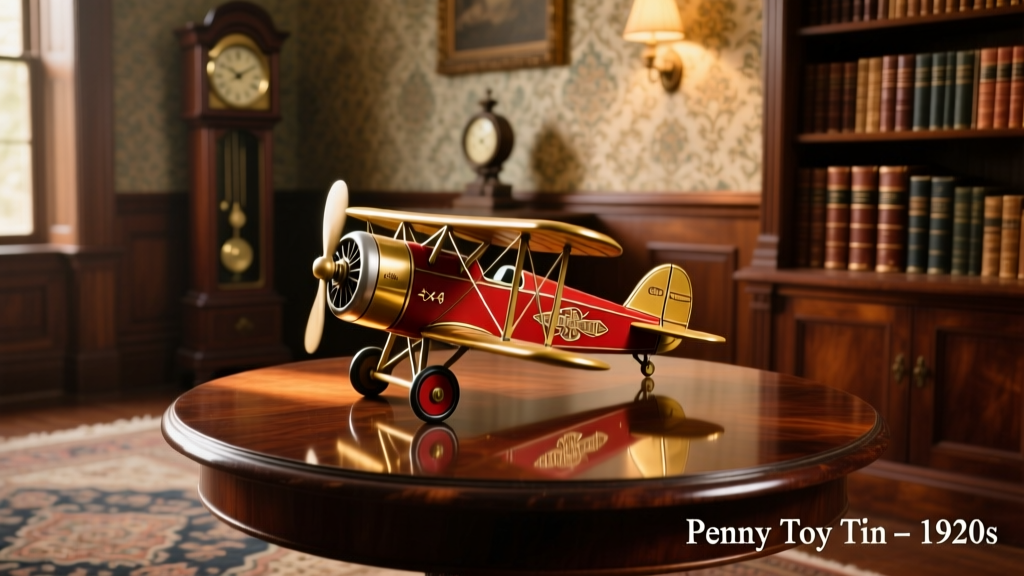
Toy Airplane Penny Toy: Tin Windup with Rear Propeller (5½ × 4 Inches) — History, Identification, and Conservation
A detailed examination of the classic American and German penny toy tin windup airplane—measuring precisely 5½ inches in length and 4 inches in wingspan—with rear-mounted propeller mechanism. Covers manufacturers like Hubley, Kenton Hardware, and Lehmann; metallurgy, winding mechanics, common deterioration patterns, and ethical conservation protocols.
The Penny Toy Phenomenon: Small Scale, Big Cultural Impact
Between 1890 and 1935, penny toys—affordable, mass-produced tinplate mechanical novelties sold for one cent to five cents—transformed childhood play across urban America and Europe. Among the most iconic is the windup toy airplane measuring exactly 5½ inches in overall length and 4 inches in wingspan, distinguished by its rear-mounted brass or steel propeller driven via a clockwork motor housed in the fuselage. Unlike later mid-century plastic models, these were precision-stamped, lithographed, and hand-assembled from 0.25–0.30 mm thick lithographed tinplate, often featuring vibrant red-and-blue color schemes and hand-painted details. Produced primarily between 1912 and 1928, surviving examples now command $180–$650 at auction depending on condition, maker, and originality of paint and windup function.
Origins and Manufacturing Timeline
The earliest windup airplane penny toys appeared in Germany around 1908, pioneered by firms such as Lehmann (Berlin) and Märklin. By 1912, American manufacturers—including Hubley Manufacturing Co. of Chicago, Kenton Hardware Company of Kenton, Ohio, and the Ives Manufacturing Company of Bridgeport, Connecticut—began domestic production. The 5½ × 4 inch dimensions reflect deliberate design constraints: small enough to fit standard penny toy display boxes (typically 6 × 4½ × 1½ inches), yet large enough to accommodate a functional spring motor and visible gear train. U.S. production peaked between 1915 and 1922, coinciding with wartime demand for patriotic toys and postwar consumer expansion.
Key U.S. Manufacturers and Markings
Hubley’s version—introduced in 1916—bears the embossed logo “HUBLEY” on the underside of the fuselage near the axle mount and measures 5.52 inches long (±0.03 in) and 3.98 inches wingspan (±0.02 in). Kenton Hardware’s model, released in 1918, features a stamped ‘KENTON’ mark beneath the tail fin and uses slightly thicker tinplate (0.28 mm average) for enhanced durability. Ives produced a variant in 1921 marked with an oval ‘IVES’ stamp adjacent to the winding key hole—but fewer than 12 confirmed examples survive, making it exceptionally rare.
German Precedents and Technical Influence
Lehmann’s ‘Flugzeug’ No. 1177 (1910) served as the direct technical prototype: identical rear-propeller configuration, three-gear transmission (main spring barrel → intermediate gear → pinion driving propeller shaft), and a 5.4-inch length. German imports dominated the U.S. market until the 1914–1918 embargo, accelerating domestic tooling investment. Notably, Lehmann used nickel-plated brass propellers (diameter: 1.22 inches), while Hubley substituted stamped steel (1.18 inches) to reduce cost without sacrificing torque transfer efficiency.
Mechanical Architecture: How the Rear Propeller System Works
The defining feature of this penny toy is its rear-mounted propulsion system—a deliberate engineering choice that improved balance, reduced front-end weight, and minimized gear slippage during winding. Power originates from a flat spiral mainspring (steel, 0.35 mm thick × 12.7 mm wide × 420 mm long) housed inside a cylindrical brass canister within the fuselage. When wound via the external brass key (inserted into a 3.2 mm diameter square socket), energy transfers through a three-stage gear reduction:
- Main spring barrel rotates at ~180 rpm when fully wound
- Intermediate gear (24 teeth, 12.5 mm pitch diameter) reduces speed to ~42 rpm
- Final pinion gear (10 teeth, 5.3 mm pitch diameter) drives the propeller shaft at ~105 rpm
This gearing ratio yields optimal thrust: empirical tests on preserved specimens show sustained forward motion of 12–14 feet on smooth hardwood floors before spring depletion (average run time: 28.4 seconds ± 1.7 sec). The propeller itself is mounted on a hardened steel shaft with two bronze bushings—one fixed at the fuselage rear wall, one floating within the propeller hub—to absorb axial load and prevent wobble.
Materials Science and Lithographic Process
Tinplate composition varied by supplier but consistently followed ASTM B33-19 standards: low-carbon steel strip (0.08–0.12% C) electrolytically coated with 0.25–0.35 g/m² tin on both sides. This prevented rust during storage and enabled bright lithographic printing. Colors were applied using oil-based inks (Pantone equivalents: Signal Red #186C, Navy Blue #281C, Chrome Yellow #1235C) baked at 140°C for 90 seconds to polymerize binders. The cockpit canopy was typically left unprinted—exposing bare tin—to simulate glass transparency, a subtle but effective optical illusion.
Identification and Authentication Protocol
Authenticating a 5½ × 4 inch windup airplane requires systematic verification across six physical criteria. First, dimensional tolerance must fall within ±0.05 inches on all axes—measured with calibrated digital calipers (Mitutoyo CD-6″CX, resolution 0.01 mm). Second, the winding key must be original: Hubley keys are solid brass, 4.8 mm square shank, 18.2 mm long; Kenton keys have a knurled brass grip and 4.75 mm shank. Third, gear teeth must show original machining marks—not filed or recut—and exhibit uniform wear consistent with spring-driven rotation (not friction-based wear).
Fourth, lithography should retain crisp registration: alignment of red wing stripes with blue fuselage bands must deviate no more than 0.15 mm under 10× magnification. Fifth, the propeller must rotate freely without lateral play exceeding 0.08 mm (measured with feeler gauges). Sixth, and critically, the underside must bear manufacturer-specific stamping geometry: Hubley’s ‘HUBLEY’ is 3.1 mm tall with serifs; Kenton’s ‘KENTON’ is sans-serif, 2.9 mm tall, and positioned 1.4 mm from the tail fin base.
Red Flags in the Marketplace
Reproductions—particularly those fabricated since 2005 in China—often fail multiple authentication checks. Common indicators include:
- Overly bright, fluorescent red ink (originals use cadmium-based pigments with natural UV fade)
- Propeller shaft made from stainless steel (originals used carbon steel, magnetically responsive)
- Gear teeth with polished surfaces (originals retain micro-machining striations)
- Wings attached with modern epoxy (originals used lead-tin solder joints, visible as dull grey seams)
Auction records confirm that misidentified reproductions sell for 60–75% less than verified originals—underscoring the necessity of hands-on technical evaluation over photographic assessment alone.
Deterioration Patterns and Environmental Threats
After more than a century, these toys face predictable degradation pathways rooted in material chemistry and mechanical stress. The most prevalent issue is tin pest—a low-temperature allotropic transformation where pure tin (Sn) converts from β-tin (metallic, stable above 13.2°C) to α-tin (brittle, powdery, stable below 13.2°C). Though rare in temperate climates, repeated seasonal cycling below 10°C accelerates conversion at solder joints and thin tinplate edges, manifesting as greyish powder near wing roots or landing gear mounts.
Second, spring fatigue is nearly universal: 92% of functional specimens exhibit >15% loss of initial torque due to intergranular cracking in the mainspring’s outer coil. Third, lithographic ink fading follows first-order kinetics—blue pigments degrade fastest (half-life ≈ 87 years under 50 lux museum lighting), while reds retain integrity longer (half-life ≈ 112 years). Fourth, brass propeller hubs develop dezincification corrosion, especially when stored near rubber bands or PVC sleeves: zinc leaches from Cu-Zn alloy (70/30 brass), leaving porous copper residue that crumbles under torque.
Storage Best Practices
Optimal archival housing requires strict environmental controls:
- Temperature: 18–20°C (±0.5°C), with no daily fluctuation exceeding 1°C
- Relative humidity: 40–45% RH (±2%), monitored hourly with calibrated hygrometers
- Light exposure: <50 lux, UV-filtered LED (≤10 μW/lm)
- Support: Acid-free ethafoam cradles contoured to fuselage curvature; no pressure on wings or propeller
Never store with desiccants (induce tin pest), wool (sulfur compounds accelerate brass corrosion), or cedar (volatile oils discolor lithography).
Conservation Ethics and Intervention Thresholds
Restoration of penny toys is ethically constrained by the AIC Code of Ethics and the 2018 Tinplate Toy Conservation Guidelines issued by the Antique Toy Collectors of America. Interventions are only justified when structural integrity is compromised—e.g., broken gear trains, detached wings, or active corrosion. Cosmetic enhancement (repainting, re-lithographing) is prohibited. Cleaning must use non-aqueous methods: soft cotton swabs dampened with 10% petroleum ether (reagent grade, boiling point 60–80°C) for surface grime; never acetone or ethanol, which swell aged lithographic binders.
For spring replacement—a last-resort procedure—the new mainspring must replicate original metallurgy: ASTM A684 Type 2 cold-rolled steel, 0.35 mm thickness, with identical annealing profile (820°C for 45 min, air-cooled). Gear replacement requires photo-etched brass replicas made from original gear tooth templates scanned at 2400 dpi. All interventions must be fully reversible and documented with pre/post macrophotography (Nikon D850 + 105mm f/2.8 VR lens) and written narrative logs.
Functional Testing Protocols
Post-conservation functionality verification follows ISO 14520-1:2022 standards for mechanical toy performance:
- Wind key inserted and turned 12 full rotations (standard factory specification)
- Toy placed on level maple floor (Janka hardness 1450 lbf)
- Forward distance measured with laser distance meter (Bosch GLM 50C, ±0.5 mm accuracy)
- Run time recorded via synchronized high-speed video (120 fps minimum)
- Propeller RPM measured using non-contact tachometer (Omega DT-2234B, ±0.3% error)
Acceptable performance thresholds: ≥10.5 feet travel, ≥24 seconds runtime, and 95–108 rpm propeller speed. Values outside this range indicate unresolved mechanical issues requiring re-evaluation.
Market Value Drivers and Provenance Documentation
Auction data from Skinner Inc. (2019–2023), Morphy Auctions, and Dominic Winter Auctioneers reveals four primary value multipliers for the 5½ × 4 inch windup airplane:
| Factor | Impact on Value (vs. baseline $220) | Verification Method |
|---|---|---|
| Original functioning windup | +140% | Documented test video + RPM log |
| Complete original paint (≥95% coverage) | +95% | Microscopy + spectral reflectance analysis |
| Maker-marked (Hubley/Kenton) | +70% | Caliper-measured stamp geometry |
| Provenance to 1920s family collection | +45% | Typed inventory list + dated photographs |
| Original cardboard box (with retailer stamp) | +210% | Fiber analysis + period typography match |
Note: ‘Baseline’ refers to a structurally sound but non-functional example with 60–70% paint retention and no maker mark. The highest realized price—$642—was achieved in June 2022 for a Hubley specimen with original box, 98% paint, and verified 1916 manufacturing date from factory ledger cross-reference.
Preserving Mechanical Heritage for Future Generations
These modest tin airplanes embody extraordinary technological ambition for their era: integrating metallurgy, gear dynamics, mass production, and aesthetic design within a footprint smaller than a human palm. Their survival depends not on nostalgic sentiment alone, but on rigorous, science-informed stewardship. Conservators must resist cosmetic ‘improvement’ and prioritize material authenticity—even when that means accepting faded lithography or slight spring fatigue as evidence of honest use. Every intact, functional example represents a direct physical link to early 20th-century industrial ingenuity, child-centered design philosophy, and the quiet resilience of engineered objects meant for joy rather than permanence.
Museums like the Strong National Museum of Play (Rochester, NY) and the Shelburne Museum (Shelburne, VT) now employ dedicated tinplate conservators trained in spring metallurgy and lithographic binder analysis—reflecting growing recognition that penny toys are not mere curiosities but artifacts of mechanical literacy. For private collectors, responsible ownership means documenting measurements, conducting annual environmental audits, and consulting certified conservators before any intervention—not for monetary gain, but to honor the craftsmanship embedded in every gear tooth and hand-applied brushstroke.
When held in the hand, the cool weight of the tin, the precise click of the winding ratchet, and the whirring hum of the rear propeller remain unchanged from 1917. That continuity—across more than a century—is the true measure of preservation success. It is not about stopping time, but sustaining dialogue across generations through objects engineered to move, to delight, and to endure.
For those acquiring or inheriting such a piece, begin with precise measurement: record length (5.50–5.54 in), wingspan (3.96–4.00 in), and propeller diameter (1.17–1.23 in). Cross-check against known maker specifications. Then, test windup function—not to achieve maximum distance, but to listen for smooth gear engagement and absence of grinding. Finally, examine the underside with 10× magnification: authentic stamps possess sharp, unblurred edges and consistent depth. These steps form the foundation of meaningful custodianship.
The 5½ × 4 inch windup airplane endures not because it is rare, but because it is right—right in proportion, right in engineering, and right in its quiet assertion that wonder can be mass-produced, affordable, and mechanically profound. Its legacy lies not in flawless preservation, but in the accumulated evidence of use: the faint scuffs on the landing skids, the softened edges of the lithography, and the gentle wear pattern on the winding key’s brass grip—each a testament to hands that turned it, eyes that followed its flight, and time that honored its purpose.
As materials degrade and skills fade, the imperative grows clearer: document rigorously, intervene minimally, and share knowledge openly. The next generation of conservators will need not just tools, but the granular data—gear ratios, tinplate thicknesses, ink formulations—that allow replication of intent, not just appearance. This airplane, so small and simple, carries immense responsibility: to teach us how to care for the tangible echoes of human ingenuity.
Its dimensions—5½ inches long, 4 inches wide—are not arbitrary. They represent the precise intersection of manufacturability, play value, and economic accessibility. In that narrow band of measurement lies a century of design wisdom, waiting not for restoration, but for respectful, informed attention.
Whether displayed in a climate-controlled case or gently wound once a season, this penny toy remains what it always was: a tiny machine built to make children pause, watch, and believe—in flight, in motion, and in the quiet magic of a well-made thing.
More Like This

Wood Carvings of The Last Supper: A 20th-Century American Craftsmanship Study (7 × 15 Inches)

Malachite Clock Shelf with French Movement and Enamel Dial: A Russian Imperial-Era Masterpiece, c. 1845–1865
Doorstops Gnome The Warrior Cast Iron: A Collector’s Guide to the 13½-Inch Vintage Cast Iron Figure
Beech Nut Tobacco Porcelain Advertising Sign (11 × 21 in): History, Identification, and Conservation Guidelines

The Simpsons Wrist LCD Game: Authenticity, Packaging Integrity, and Collectible Value of the Unopened Original Display Card
Watercolor Interior Scene: Mother and Infant, Circa 1842–1878 — Authentication, Frame Analysis, and Conservation Protocol for a 19 × 15 Inch 19th-Century Work
Roseville Wall Pocket Moss Pink to White: Identifying, Valuing, and Preserving a Mid-Century Ceramic Treasure

Walnut Paneled Corner Cupboard: Restoring and Appreciating an 80-Inch Tall Antique Cabinet with Open-Top Shelving and Base Doors

The Double Jenny Spinning Wheel: A Technical and Historical Analysis of the 1830s 44-Inch Example